Late Medieval Books

Late Medieval Books is in Books.

A Chronicle of London

A Chronicle of London from 1089 to 1483 written in the Fifteenth century, and for the first time printed from MSS. in the British Museum: to which are added numerous contemporary illustrattons, consisting of royal letters, poems, and other articles descriptive of public events, or of the manners and customs of the metropolis. 1828.

Annals of Six Kings of England by Nicholas Trivet

Translation of the Annals of the Six Kings of England by that traces the rise and rule of the Angevin aka Plantagenet dynasty from the mid-12th to early 14th century. Written by the Dominican scholar Nicholas Trivet, the work offers a vivid account of English history from the reign of King Stephen through to the death of King Edward I, blending political narrative with moral reflection. Covering the reigns of six monarchs—from Stephen to Edward I—the chronicle explores royal authority, rebellion, war, and the shifting balance between crown, church, and nobility. Trivet provides detailed insight into defining moments such as baronial conflicts, Anglo-French rivalry, and the consolidation of royal power under Edward I, whose reign he describes with particular immediacy. The Annals combines careful year-by-year reporting with thoughtful interpretation, presenting history not merely as a sequence of events but as a moral and political lesson. Ideal for readers interested in medieval history, kingship, and the origins of the English state, this chronicle remains a valuable and accessible window into the turbulent world of the Plantagenet kings.

Bourgeois de Valenciennes

Récits d’un bourgeois de Valenciennes aka The Chronicle of a Bourgeois of Valenciennes is a vivid 14th-century vernacular chronicle written by an anonymous urban chronicler from Valenciennes in the County of Hainaut. It survives in a manuscript that describes local and regional history from about 1253 to 1366, blending chronology, narrative episodes, and eyewitness-style accounts of political, military, and social events in medieval France, Flanders, and the Low Countries. The work begins with a chronological framework of events affecting Valenciennes and its region under rulers such as King Philip VI of France and the shifting allegiances of local nobility. It includes accounts of conflicts, sieges, diplomatic manoeuvres, and the impact of broader struggles like the Hundred Years’ War on urban life in Hainaut. Written from the perspective of a burgher (bourgeois) rather than a monastery or royal court, the chronicle offers a rare lay viewpoint on high politics and warfare, reflecting how merchants, townspeople, and civic institutions experienced the turbulence of the 13th and 14th centuries. Its narrative style combines straightforward reporting of events with moral and civic observations, making it a valuable source for readers interested in medieval urban society, regional politics, and the lived experience of war and governance in pre-modern Europe.

Chronicle of Adam of Usk

Chronicon Adæ de Usk A.D. 1377-1421. Edited with a Translation and Notes by Sir Edward Maunde Thompson, K.C.B. Second Edition. London Henry Frowde Oxford University Press Warehouse, Amen Corner, E.C. 1904.

Chronicle of Geoffrey le Baker of Swinbroke

Geoffrey le Baker was a secular clerk from Swinbroke, now Swinbrook, an Oxfordshire village two miles east of Burford. His Chronicle describes the events of the period 1303-1356: Gaveston, Bannockburn, Boroughbridge, the murder of King Edward II, the Scottish Wars, Sluys, Crécy, the Black Death, Winchelsea and Poitiers. To quote Herbert Bruce 'it possesses a vigorous and characteristic style, and its value for particular events between 1303 and 1356 has been recognised by its editor and by subsequent writers'. The book provides remarkable detail about the events it describes. Baker's text has been augmented with hundreds of notes, including extracts from other contemporary chronicles, such as the Annales Londonienses, Annales Paulini, Murimuth, Lanercost, Avesbury, Guisborough and Froissart to enrich the reader's understanding. The translation takes as its source the 'Chronicon Galfridi le Baker de Swynebroke' published in in 1889, edited by Edward Maunde Thompson.

Chronicle of the Princes of Wales

Brut y Tywysogion aka Chronicle of the Princes of Wales. Edited by the Reverend John Williams ab Ithel, M.A. Rector of Llanymowddy, Merionethshire. 1860.

Flowers of History by Matthew Paris

The Flowers of History especially as relate to The Affairs of Britain from the Beginning of the World to the Year 1307 collected by Matthew of Westminster.

History of the Arrival of Edward IV

Historie of the Arrivall of Edward IV, in England and the Finall Recouerye of His Kingdomes from Henry VI. A.D. M.CCCC.LXXI Edited by John Bruce, Esq. F.S.A. Published for the Camden Society. M.DCCC.XXX.VIII.

Scalaronica of Thomas Gray

Scalaronica of Thomas Gray. The Reigns of Edward I, Edward II and Edward III as recorded by Sir Thomas Gray. And now translated by the Right Hon. Sir Herbert Maxwell [aged 61] Baronet. Glasgow. James Maclehose & Sons. Publishers to the University. 1907.

The Death of King James

Here folowing begynnythe a full lamentable cronycle, of the dethe and false murdure of James Stewarde, Kyng of Scotys [aged 42], nought long agone prisoner yn englande, the tymes of the kyngs henrye the fifte and henrye the sixte.

Thomas Favent

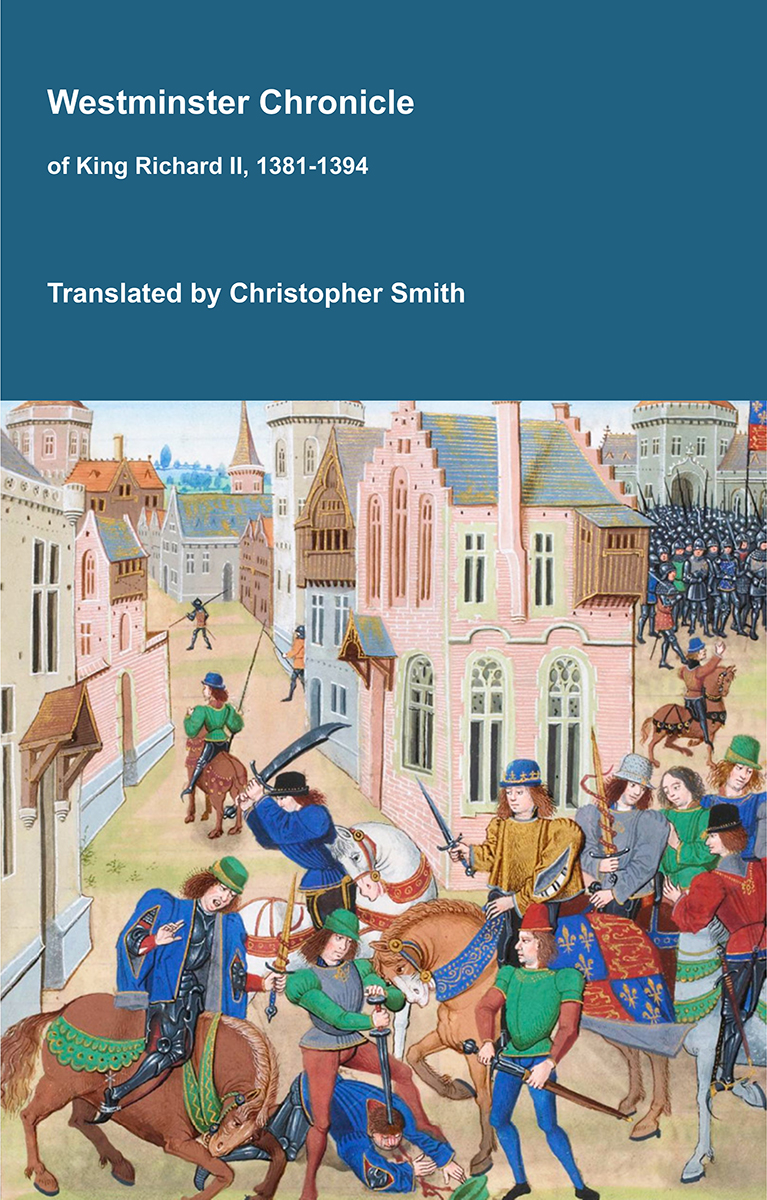
[19th February 1388] When this came to the eares of the Peeres, the five Appellants suddenly arose up, and without expressing any reason, departed out of the Parliament House, which bred great alteration in the House, insomuch that many followed them, and when they come to the Gate of the Hall, they met the Guard leading of Tressilian bound, crying, as they came, We have him, we have him. Tressilian being come into the Hall, was asked what he could say for himselfe, why judgement should not passe upon him for his treason so often committed, hee became as one that had beene struck dumb, and his heart was as it were hardned to the very last, and would not confesse himselfe guilty of any thing: And for this cause the Parliament arose, deferring Brembres triall till the next day. But Tressilian was without delay led to the Tower, that he might suffer the execution of the sentence passed against him, his wife and his children did with maine teares accompany him to the Tower, but his wife was so overcome with dolour and griefe, that she fell down in a swound as if she had beene dead. Immediatly Tressilian is upon a hurdle, and drawne thorow the streets of the Citie, with a wonderfull concourse of people following him, at every furlongs end he was suffered to stand still to rest himselfe, and to see if hee would confesse and report himselfe of any thing, but what he said to the Fryer his Confessor is not knowne, neither am I able to search it out; when hee came to the place of execution hee would not climb the Ladder, untill such time as being soundly beaten with bats and staves he was forced to goe up, and when he was up, hee said, So long as I doe weare any thing upon me I shall not dye, wherefore the executioner stripped him, and found certaine Images painted like to the signes of Heaven, and the head of a devill painted, and the names of many of the devills wrote in Parchment; the exorcising toyes being taken away, hee was hanged up naked, and because the spectators should be certainly assured that he was dead, they cut his throat, and because the night approached, they let him hang untill the next morning, and then his wife having obtained a licence of the King, tooke downe his body, and carried it to the Grey-Fryers, where it was buried.

Three Fifteenth Century Chronicles

Three fifteenth-century chronicles, with historical memoranda by John Stowe, the antiquary, and contemporary notes of occurrences written by him in the reign of Queen Elizabeth by Gairdner, James, 1828-1912.

Warkworth's Chronicle

A Chronicle Of The First Thirteen Years Of The Reign of King Edward The Fourth, By John Warkworth, D.D. Master of St. Peter's College, Cambridge.