

1382 Marriage of Richard II and Anne of Bohemia and her Coronation
In 1354 [his father] Guy of Luxembourg I Count Saint Pol and Ligny and [his mother] Mathilde Chatillon Countess Saint Pol were married. She the daughter of [his grandfather] Jean Chatillon Count Saint Pol and [his grandmother] Jeanne Fiennes.
In 1355 Waleran Luxembourg Count of Saint Pol and Ligny was born to Guy of Luxembourg I Count Saint Pol and Ligny and Mathilde Chatillon Countess Saint Pol.
In 1360 [his uncle] Guy Chatillon V Count Saint Pol died. [his mother] Mathilde Chatillon Countess Saint Pol succeeded Countess Saint Pol. [his father] Guy of Luxembourg I Count Saint Pol and Ligny by marriage Count Saint Pol.
On 5th September 1363 Hugh Courtenay and [his future wife] Maud Holland Countess of Saint-Pol were married. She the daughter of Thomas Holland 1st Earl Kent and [his future mother-in-law] Joan "Fair Maid of Kent" Princess Wales.
On 22nd August 1371 [his father] Guy of Luxembourg I Count Saint Pol and Ligny was killed at Baesweiler, Aachen aka Aix-le-Chapelle. Waleran Luxembourg Count of Saint Pol and Ligny succeeded Count Saint Pol and was captured.
On 24th August 1371 Edward Duke Guelders died from wounds..
In 1373 [his mother] Mathilde Chatillon Countess Saint Pol died.
In 1380 Waleran Luxembourg Count of Saint Pol and Ligny and Maud Holland Countess of Saint-Pol were married. She the daughter of Thomas Holland 1st Earl Kent and Joan "Fair Maid of Kent" Princess Wales. He the son of Guy of Luxembourg I Count Saint Pol and Ligny and Mathilde Chatillon Countess Saint Pol.
Life of Charles VI by a Monk of St Denis. At these games there was present Waleran, the illustrious count of Saint-Pol, recently summoned from England to appear in judgment before the king and answer the many accusations brought against him. Indeed, many charged him with having taken in marriage the [his wife] sister1 of King Richard of England without consulting the king; furthermore, that he had recently made an agreement with the enemies and rivals of the kingdom and had promised to place his castles under their authority. For this reason he had been declared by his accusers guilty of the crime of lèse-majesté. Although some men of the highest authority said that the deed of the count was inexcusable, since it had a corrupt origin and a cause at odds with honour, nevertheless in the presence of the king there were not lacking those who defended him2. They said that what was blameworthy in him, rashness of heart, would be taken away by advancing age, while what was desired, prudence of counsel, would increase with time; and they begged that, as the acts of youth passed away and virtue matured, the king would allow so great a man to grow old within the kingdom. Thus mercy in the king availed more toward obtaining almost a pardon than the case itself toward clearing the charge. Accordingly, appearing at last before the king and the nobles with downcast face and supplicating them not to believe that anything need be feared from him, he responded sufficiently to the accusations and even offered single combat against his accusers, if any there were. Whatever his youth had done without observing the rule of moderation was forgiven by the king's kindness. Thereupon the count and those who favoured his cause gave thanks.
Ludis istis interfuit Valerannus, comes egregius Sancti Pauli, ab Anglia noviter evocatus, ut staret in judicio coram rege, super multis que sibi imponebantur responsurus. Equidem criminabatur a multis quod sororem regis Anglie Richardi, inconsulto rege, duxerat in uxorem; ulterius eo quod cum hostibus et regni emulis nuper pactum pepigerat, et dicioni eorum castra sua submittere spoponderat: unde crimine lese majestatis reus a denunciatoribus dictus erat. Et quamvis nonnulli summe auctoritatis viri factum comitis inexcusabile dicerent, ut pote viciosam habens originem et causam primam ab honestate dissencientem, in presencia tamen regis excusatores non deerant, qui, quod offendebat in eo, pectus inconsultum, etatem cotidie auferre dicerent; quod desiderabatur, consilium, id in dies crescere; rogantes ut senescentibus juvenilibus actibus, maturescente virtute, sineret tantum virum senem in regno fieri. Sicque misericordia in rege ad pene veniam impetrandam quam causa ad crimen purgandum plus valuit. Unde tandem in presencia ejus et procerum demisso vultu comparens, et supplicans ne aliquid de se timere crederent, turn respondens sufficienter ad objecta, contra accusatores, si qui essent, pugnam offerens singularem, quidquid juventus egerat norinam temperancie non observans, a benignitate regia indultum est. Inde gracie acte sunt a comite et faventibus causam ejus.
Note 1. Maud, Lady of Courtenay, uterine sister of Richard II. Her parents were Joan, the Fair Maid of Kent and Thomas Holland, 1st Earl of Kent. Following Thomas' death Joan married, Edward the Black Prince, son of King Edward III. Maud married 1. in 1363 Hugh Courtenany, and 2. in 1380 Waleran III, Count of Ligny and Saint Pol.
1. Mathilde de Courtenai, sœur utérine de Richard II.
Note 2. "Then the Count of Saint-Pol was recalled ... and the Duke of Brabant furthered his cause at Reims, as did the Duke of Anjou, in whose favour and affection the Count of Saint-Pol stood very high." Froissart.
2. «Adone fut le comte de Saint-Pol rappelé ... et lui fit à Reims, le duc de Brabant sa besogne, et le duc d’Anjou aussi, en laquelle grâce et amour le comte de Saint-Pol était moult grandement» Froissart.
After 24th June 1380 John Hastings 3rd Earl Pembroke and Elizabeth Lancaster Duchess Exeter marriage annulled since she had become pregnant by [his brother-in-law] John Holland 1st Duke Exeter whom she subsequently married. It isn't clear whether John Holland was punished; he was half-brother to King Richard II of England through their mother Joan "Fair Maid of Kent" Princess Wales.


On 15th July 1381 John Ball was hanged, drawn and quartered in St Albans, Hertfordshire in the presence of [his brother-in-law] King Richard II of England.
On 20th January 1382 [his brother-in-law] King Richard II of England and Anne of Bohemia Queen Consort England were married at Westminster Abbey by Bishop Robert Braybrooke. She by marriage Queen Consort England. She the daughter of Charles IV King Bohemia Holy Roman Emperor Luxembourg and Elizabeth Pomerania Holy Roman Empress Luxembourg. He the son of Edward "Black Prince" and [his mother-in-law] Joan "Fair Maid of Kent" Princess Wales.
It was the first royal wedding that including a Royal Procession from the Tower of London to Westminster Abbey.
Arranged by Michael de la Pole 1st Earl Suffolk the marriage not popular since it brought no dowry and little prospect of increased trade since Bohemia not a primary English trade partner.
In 1384 [his brother] Pierre Luxembourg Bishop Metz was appointed Bishop Metz. He was enthroned there that September entering barefoot on a mule.
In 1384 [his sister-in-law] Joan Holland Duchess Brittany died.
In May 1385 Ralph Stafford was murdered by [his brother-in-law] John Holland 1st Duke Exeter. He was buried at King's Langley Priory, Hertfordshire.
On 6th August 1385 Edmund of Langley 1st Duke of York was created 1st Duke York by [his brother-in-law] King Richard II of England. Isabella of Castile Duchess York by marriage Duchess York.
Thomas of Woodstock 1st Duke of Gloucester was created 1st Duke Albemarle, and 1st Duke Gloucester. Eleanor Bohun Duchess Gloucester by marriage Duchess Albemarle and Duchess Gloucester.
Michael de la Pole 1st Earl Suffolk was created 1st Earl Suffolk. Katherine Wingfield Countess Suffolk by marriage Countess Suffolk.
On 7th August 1385 [his mother-in-law] Joan "Fair Maid of Kent" Princess Wales died at Wallingford Castle. She was buried at Blackfriars Friary, Stamford beside her first husband Thomas Holland 1st Earl Kent. [his brother-in-law] Thomas Holland 2nd Earl Kent succeeded 6th Baron Wake of Liddell.
On 24th June 1386 [his brother-in-law] John Holland 1st Duke Exeter and Elizabeth Lancaster Duchess Exeter were married at Plymouth, Devon. She the daughter of John of Gaunt 1st Duke Lancaster and Blanche Duchess of Lancaster. He the son of Thomas Holland 1st Earl Kent and [his mother-in-law] Joan "Fair Maid of Kent" Princess Wales.
Around 1387 [his brother] John Luxembourg II Count of Brienne and Conversano and [his sister-in-law] Margaret Brienne Countess of Brienne were married. He the son of [his father] Guy of Luxembourg I Count Saint Pol and Ligny and [his mother] Mathilde Chatillon Countess Saint Pol.
On 4th July 1387 [his brother] Pierre Luxembourg Bishop Metz died.
On 3rd February 1388 the Merciless Parliament commenced. It ended on 4th June 1388. Its primary function was to prosecute members of the Court of [his brother-in-law] King Richard II of England. The term "Merciless" is contemporary having been coined by the chronicler Henry Knighton.
Michael de la Pole 1st Earl Suffolk was sentenced to be hanged, drawn and quartered in his absence. He had escaped to France. Earl Suffolk and Baron Pole forfeit.
Archbishop Alexander Neville was found guilty of treason and it was determined to imprison him for life in Rochester Castle, Kent. He fled to Louvain where he became a parish priest for the remainder of his life.
On 19th February 1388 Robert Tresilian was hanged naked and his throat cut. See Chronicle of Adam of Usk.
On 25th March 1388 Nicholas Brembre was hanged. He was buried at Christ Church, Greyfriars.
On 5th May 1388 Simon Burley was executed despite the protestations of his friend Edmund of Langley 1st Duke of York. See Chronicle of Adam of Usk.
On 12th May 1388 John Beauchamp 1st Baron Beauchamp was beheaded at Tower Hill. He was buried at Worcester Cathedral. Baron Beauchamp of Kidderminster forfeit.
Robert de Vere 1st Duke Ireland was attainted.
Walsingham Chronica Majora. The truce confirmed
Around the feast of the Nativity of St John the Baptist [24th June 1389], a three-year truce was confirmed between the realms of England and France; Sir John Clanvowe and Richard Rounhale, clerk, receiving in France the oath on behalf of the King of France. And shortly afterwards, namely around the feast of St Lawrence [10th August 1389], there came into England the Count of Saint-Pol, who had married Maud de Courtenay1, sister of the King of England, together with other honourable men, to receive the oath on behalf of the King of England that the truce would be faithfully observed; and he was received with the greatest honour.
Treugæ furmate.
Circa festum Nativitatis Sancti Johannis Baptistæ, firmatæ sunt treugæ triennales inter regna Angliæ et Franciæ; Johanne Clanbow, milite, et Ricardo Rouhale, clerico, suscipientibus in Francia juramentum ex parte Regis Franciæ; et paulo post, scilicet, circa festum Sancti Laurentii, venit in Angliam Comes Sancti Pauli, qui desponsaverat sororem Regis Angliæ Matildem de Courtenay, cum aliis honorabilibus, ad suscipendum juramentum de treugis servandis fideliter ex parte Regis Angliæ; qui cum honore maximo susceptus
Note 1. [his wife] Maud Holland Countess of Saint-Pol, half-sister of King Richard II, had married Hugh Courtenay in 1363. He died in 1374 after which she married Waleran, Count of Saint Pol and
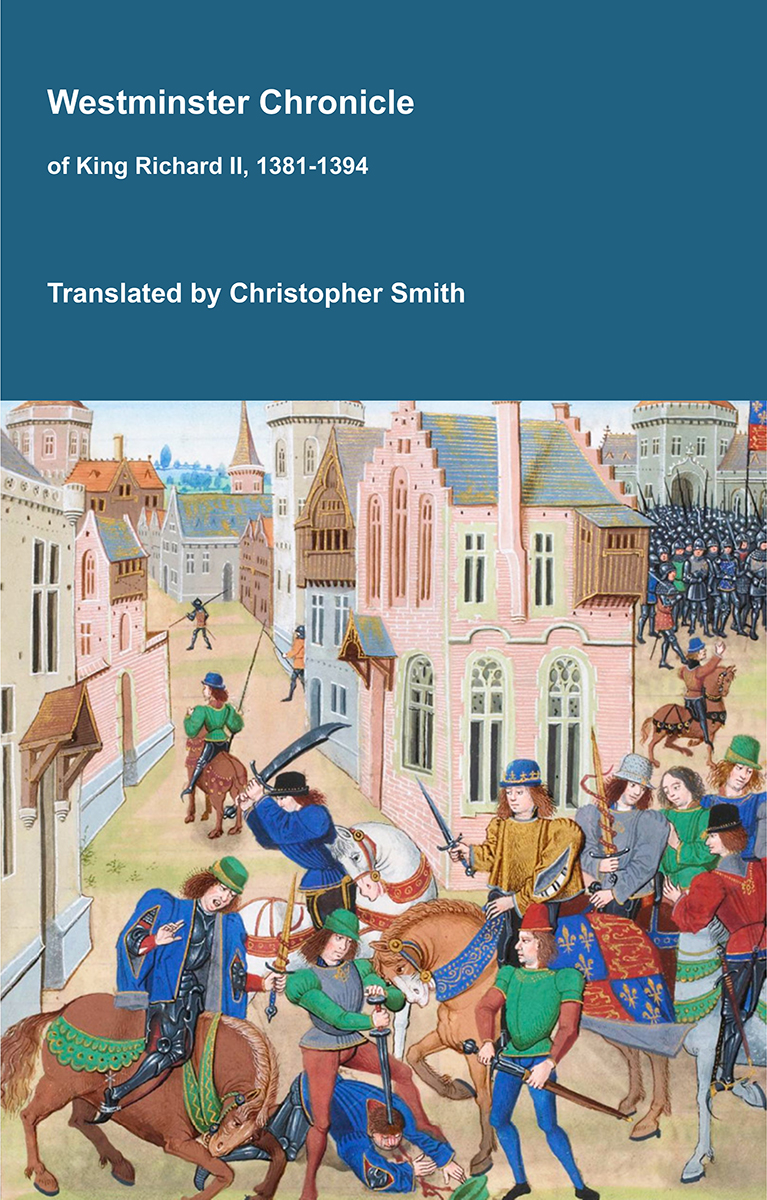 Westminster Chronicle. At the end of the month of July, our negotiators for peace came to London. They immediately went to the king, explaining to him how and under what form the truce had been made. Then, on the 4th day of August, the Count of Saint-Pol1 came to London to obtain security from the king concerning the observance of the aforesaid truce. Therefore the lord king, with his council, came to Westminster on the 9th day of August, and on the 10th day of the same month, security having been given, he confirmed the aforesaid truce2. When these things had been duly completed, the king went to his manor of Eltham, where he splendidly entertained the aforesaid count and the other knights who had come with him for the aforesaid reason. Then, having taken leave, within a few days the aforesaid count and the others who were with him returned to their own king.
In fine mensis Julii venerunt Londonias pacis nostri tractatores, qui confestim adierunt regem exponentes sibi quomodo et sub qua forma capta erat treuga. Deinde quarto die Augusti venit Londonias comes sancti Pauli ad captandam securitatem à rege super observatione treugæ prædictæ, quare dominus rex cum suo consilio ix die Augusti venit Westmonasterium et decimo die ejusdem mensis facta securitate firmavit treugam præfatam. His igitur rite peractis accessit rex ad manerium suum de Eltham ubi splendide convivavit comitem prædictum, et alios milites qui causa prætacta cum illo venerunt, demum licentia captata infra paucos dies præfatus comes et alii qui cum illo aderant suum remearunt ad regem.
Note 1. Waleran of Luxembourg, 1355-1415. Count of Saint Pol and Ligny. In 1374 he was captured by the English at the Battle of Baesweiler at which his father was killed. In 1380 whilst captive in England he married Maud Holland, half-sister of King Richard II. After Maud's death in 1392 he married Bona of Bar, granddaughter of King John II of France.
Note 2. Life of Charles VI by a monk of St Denis: "Around the same time, the Bishop of Bayeux, the king's counsellor and principal president of his Chamber of Accounts, informed him that a three-year truce had been voluntarily granted by the King of England, and that, to establish it more firmly, a certain famous knight would soon come. Receiving him honourably and with a gracious countenance, the king entertained him lavishly on repeated occasions, pledged his faith to him that the agreement would be kept inviolate, and, as was his custom, sent him back to his own king laden with abundant gifts. He then sent the Count of Saint-Pol there, to require a similar oath from him." and Walsingham, Historia Anglicana: "Around the feast of the Nativity of St John the Baptist [24th June], a three-year truce was confirmed between the realms of England and France; Sir John Clanvowe and Richard Rounhale, clerk, receiving in France the oath on behalf of the King of France. And shortly afterwards, namely around the feast of St Lawrence [10th August], there came into England the Count of Saint-Pol, who had married Maud de Courtenay, sister of the King of England, together with other honourable men, to receive the oath on behalf of the King of England that the truce would be faithfully observed; and he was received with the greatest honour."
Westminster Chronicle. Also, on the 10th day of October, solemn jousts were held at Smithfield, and for this reason earls and valiant knights came to the city of London from many parts. Among others came the Count of Saint-Pol, with his wife, the [half] sister of the lord king, together with other vigorous men from France. There also came the count called Ostrevant1, with other Germans, in noble array. For he brought with him by water all the equipment needed for himself and his men. The reason for these jousts was this: when the Duke of Guelders was here in England, he greatly desired to see our king armed, and at his departure he promised to return and be present at the said jousts on the appointed day and at the appointed place; but, being prevented, he could not accomplish what he wished. These jousts lasted for three days. The praise of the first day was granted to the lord king.
Item x die Octobris apud Smethefeld erant solemnia hastiludia, qua de causa de pluribus partibus ad civitatem Londoniæ comites et valentes milites accesserunt. Inter alios venit comes sancti Pauli cum uxore sua, sorore domini regis, cum aliis strenuis de Francia. Venit etiam comes dictus Ostrenantz cum aliis Alemannis in nobili apparatu. Nam omnia utensilia pro se et suis secum adduxit per aquam. Causa horum hastiludiorum fuit hæc. Nam dux Geldriæ dum esset hic in Anglia multum affectavit videre regem nostrum armatum promisitque in suo recessu revenire et dictis hastiludiis interesse die et loco, sed impeditus non potuit perficere quod optabat. Durabant namque ista hastiludia per tres dies Laus quoque primæ diei domino regi fuit concessa.
Note 1. William, 1365-1417, at the time known by the courtesy title of Count of Ostrevant. He succeeded his father in 1404 as Count of Holland, Hainaut and Zeeland. He married in 1385 Margaret, sister of John the Fearless, Duke of Burgundy, at which ceremony John married William's sister Margaret Wittelsbach Duchess Burgundy.
Before 23rd April 1391 [his wife] Maud Holland Countess of Saint-Pol died.
After 1393 Waleran Luxembourg Count of Saint Pol and Ligny and Bona of Bar were married. She the daughter of Robert of Bar 1st Duke of Bar and Marie Valois Duchess Bar. He the son of Guy of Luxembourg I Count Saint Pol and Ligny and Mathilde Chatillon Countess Saint Pol.
In 1394 Louis Count of Enghien died. [his sister-in-law] Margaret Brienne Countess of Brienne succeeded Countess Brienne. [his brother] John Luxembourg II Count of Brienne and Conversano by marriage Count Brienne.
In 1396 [his brother] André Luxembourg Bishop Cambrai died.
In 1397 [his brother] John Luxembourg II Count of Brienne and Conversano died.
On 21st February 1402 [his son-in-law] Anthony Valois Duke Brabant and Jeanne Luxembourg Duchess Brabant were married at Arras. She by marriage Duchess Brabant. She the daughter of Waleran Luxembourg Count of Saint Pol and Ligny and Maud Holland Countess of Saint-Pol. He the son of Philip "Bold" Valois II Duke Burgundy and Margaret Dampierre Duchess Burgundy.
In 1407 [his daughter] Jeanne Luxembourg Duchess Brabant died.
On 12th April 1415 Waleran Luxembourg Count of Saint Pol and Ligny died. [his nephew] Peter Luxembourg I Count Saint Pol succeeded Count Saint Pol.
In 1436 [his former wife] Bona of Bar died.
[his daughter] Jeanne Luxembourg Duchess Brabant was born to Waleran Luxembourg Count of Saint Pol and Ligny and Maud Holland Countess of Saint-Pol. She married 21st February 1402 Anthony Valois Duke Brabant, son of Philip "Bold" Valois II Duke Burgundy and Margaret Dampierre Duchess Burgundy, and had issue.