See Painters.
In 1872, in partnership with Lord Ronald Gower, John O'Connor established a studio at 47 Leicester Square, the former residence of Sir Joshua Reynolds. Concentrating on architectural and landscape painting, he left the Haymarket in 1878 although he still took theatrical commissions and painted scenery for the Cambridge Amateur Dramatic Club, of which he was a member.
Before 12th August 1830 [his father] Francis O’Connor and [his mother] Rose Cunningham of Bath were married.
On 12th August 1830 John O'Connor was born to Francis O’Connor and Rose Cunningham of Bath.
In or before 1842 [his mother] Rose Cunningham of Bath died.
In or before 1842 [his father] Francis O’Connor died. His son John [aged 11] went to live with his uncle, who held the lease of the Liverpool and Belfast theatres; O'Connor initially worked as a call-boy in the Belfast theatre, before becoming an assistant scene-painter.
In 1848 John O'Connor [aged 17] found employment in 1848 at Drury Lane, and from 1863 was principal Scene Painter at the Haymarket Theatre.
On 30th December 1851 John O'Connor [aged 21] and Ann Butler Fairburn were married at St John the Evangelist in Upper Holloway. They had two sons they had two boys: Francis, born 1853, and John Peter, born 1854.
On 17th July 1860 [his wife] Ann Butler Fairburn died at her home 6 Waverly Place, Marylebone.
On 9th January 1862 John O'Connor [aged 31] and Ellen Fairburn were married at Islington Parish Church. She the half-sister of his first wife Ann Butler Fairburn who had died two years before. The had two sons: Henry, born 1862, and Joseph William, born 1864.
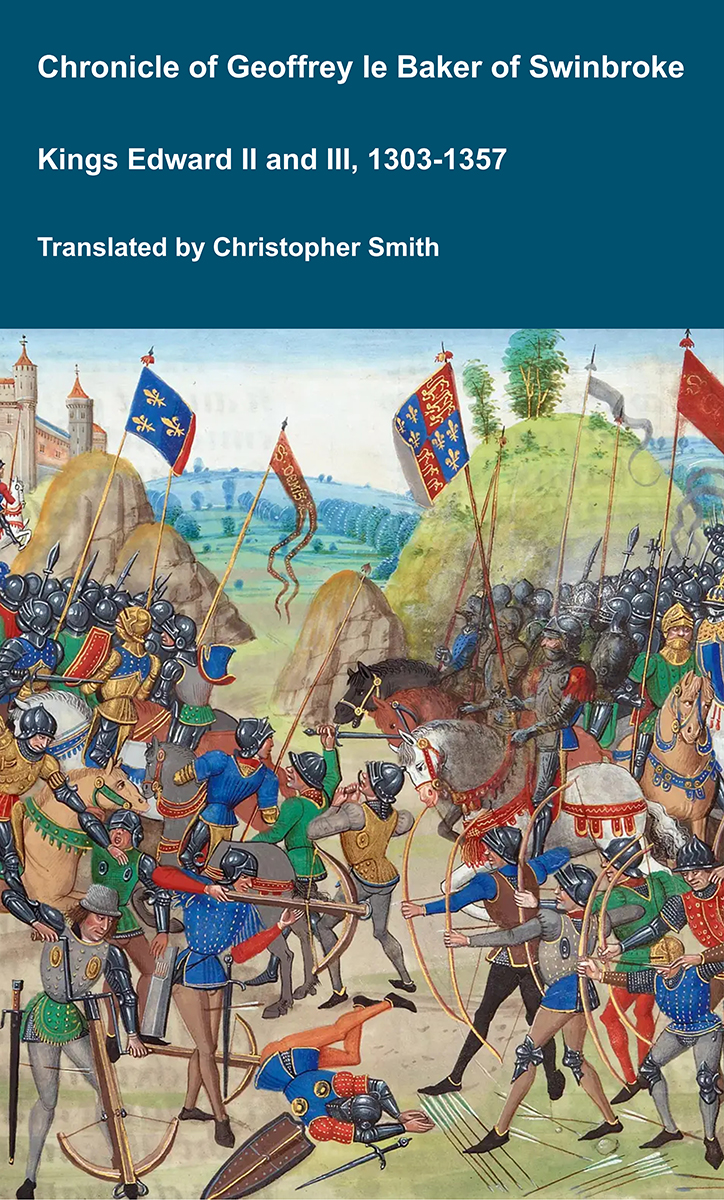
Chronicle of Geoffrey le Baker of Swinbroke
Baker was a secular clerk from Swinbroke, now Swinbrook, an Oxfordshire village two miles east of Burford. His Chronicle describes the events of the period 1303-1356: Gaveston, Bannockburn, Boroughbridge, the murder of King Edward II, the Scottish Wars, Sluys, Crécy, the Black Death, Winchelsea and Poitiers. To quote Herbert Bruce 'it possesses a vigorous and characteristic style, and its value for particular events between 1303 and 1356 has been recognised by its editor and by subsequent writers'. The book provides remarkable detail about the events it describes. Baker's text has been augmented with hundreds of notes, including extracts from other contemporary chronicles, such as the Annales Londonienses, Annales Paulini, Murimuth, Lanercost, Avesbury, Guisborough and Froissart to enrich the reader's understanding. The translation takes as its source the 'Chronicon Galfridi le Baker de Swynebroke' published in 1889, edited by Edward Maunde Thompson.
Available at Amazon in eBook and Paperback format.
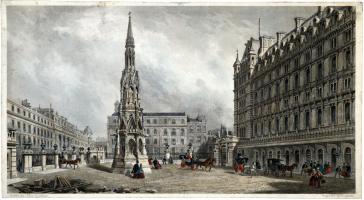
Around 1865. John O'Connor [aged 34]. "Charing Cross, London [Map]".

1872. John O'Connor [aged 41]. "York Water Gate [Map]".

1884. John O'Connor [aged 53]. "From Pentonville Road looking west evening".

1889. John O'Connor [aged 58]. "St Paul's Cathedral [Map] from Ludgate Hill".
On 23rd May 1889 John O'Connor [aged 58] died at Heathcroft, Yately, Hampshire.
An Artist's Reminiscences Chapter 8. I was fortunate enough to have some beautiful ladies in my Florentine and Venetian groups. Miss Lisa Stillmann [aged 29] was Fiammetta. Miss Galloway of Manchester was the Paris Bordone lady. Miss Lisa Lehmann [aged 32] was my Beatrice. (Mr. Stock, R.I., the artist, was an admirable Dante.) Mr. W. A. S. Benson was Niccolo Pisano. My wife [Mary Frances Andrews [aged 48]] took the part of Laura. My little daughter was an early Italian angel. My eldest son personated the young Giotto, and I represented Cimabue myself, in the white costume in which Leighton painted him, taken from the fresco of Simone Memmi at Florence.
Sir James Linton was Veronese in my Venetian group, the late Mr. J. H. Mole, R.I., personating Titian. The late Mr. John O'Connor made an excellent Michael Angelo, and Mr. E. R. Hughes [aged 43] presented a lifelike and artistic portrait of the young Raphael.


In 1931 [his former wife] Ellen Fairburn died at Edmonton, Middlesex.