

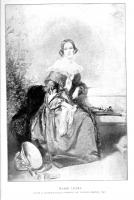
In 1840 [his father] Thomas Crane [aged 31] and [his mother] Marie Kearsley were married.
On 15th August 1845 Walter Crane was born to Thomas Crane [aged 37] and Marie Kearsley in Liverpool, Lancashire [Map] at Maryland Street, Liverpool [Map]. Her father was a "maltster," a prosperous man in a good position in Chester. His mother seems to have died early, and her father married a second time.
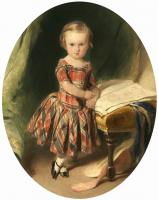
1846. [his father] Thomas Crane [aged 37]. Portrait of his son Walter Crane.
In July 1859 [his father] Thomas Crane [aged 51] died.
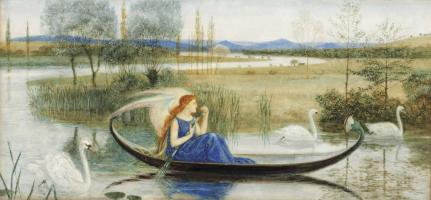
Between 1861 and 1871. Walter Crane [aged 15]. "The Enchanted Boat". This drawing illustrates an episode from Shelley's Prometheus Unbound, Asia's song, Act II, sc. V: "My soul is like an enchanted boat, Which, like a sleeping swan, doth float Upon the silver waves of thy sweet singing; And thine doth like an angel sit Beside a helm conducting it, Whilst all the winds with melody are ringing."

1862. Walter Crane [aged 16]. "The Lady of Shalott". Exhibited at the Royal Academy.

1865. Walter Crane [aged 19]. "La Belle Dame Sans Merci by John Keats".
On 6th September 1871 Walter Crane [aged 26] and Mary Frances Andrews [aged 25] were married at All Souls, Marylebone [Map]. See An Artist's Reminiscences.
In 1873 [his daughter] Beatrice Crane was born to Walter Crane [aged 27] and [his wife] Mary Frances Andrews [aged 27] in Rome.

The True Chronicles of Jean le Bel Volume 1 Chapters 1-60 1307-1342
The True Chronicles of Jean le Bel offer one of the most vivid and immediate accounts of 14th-century Europe, written by a knight who lived through the events he describes, and experienced some of them first hand. Covering the early decades of the Hundred Years’ War, this remarkable chronicle follows the campaigns of Edward III of England, the politics of France and the Low Countries, and the shifting alliances that shaped medieval warfare. Unlike later historians, Jean le Bel writes with a strong sense of eyewitness authenticity, drawing on personal experience and the testimony of fellow soldiers. His narrative captures not only battles and sieges, but also the realities of military life, diplomacy, and the ideals of chivalry that governed noble society. A key source for Jean Froissart, Le Bel’s chronicle stands on its own as a compelling and insightful work, at once historical record and literary achievement. This translation builds on the 1905 edition published in French by Jules Viard, adding extensive translations from other sources Rymer's Fœdera, the Chronicles of Adam Murimuth, William Nangis, Walter of Guisborough, a Bourgeois of Valenciennes, Geoffrey le Baker of Swinbroke and Richard Lescot to enrich the original text and Viard's notes.
Available at Amazon in eBook and Paperback format.
On 6th May 1876 [his son] Lionel Francis Crane was born to Walter Crane [aged 30] and [his wife] Mary Frances Andrews [aged 30]. He married (1) July 1913 Gertrude Sandes, daughter of Frederick Sandys and Mary Emma Jones aka "Miss Clive" (2) 1921 Winifred Gertrude Sandes, daughter of Frederick Sandys and Mary Emma Jones aka "Miss Clive".
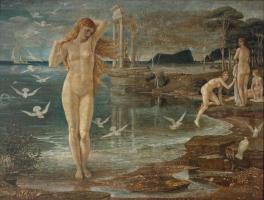
1877. Walter Crane [aged 31]. "The Renaissance of Venus".
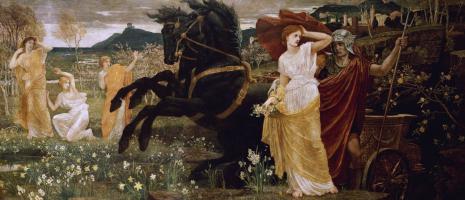
1878. Walter Crane [aged 32]. "The Fate of Persephone".
In 1880 [his son] Lancelot Crane was born to Walter Crane [aged 34] and [his wife] Mary Frances Andrews [aged 34].
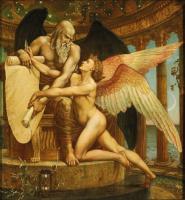
1882. Walter Crane [aged 36]. "The Roll of Fate".
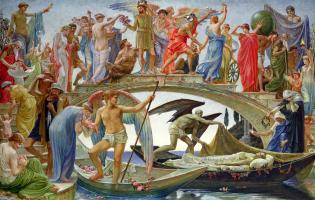
1882. Walter Crane [aged 36]. "The Bridge of Life".
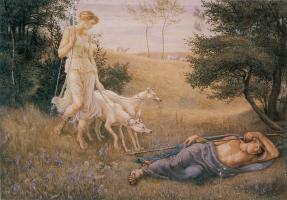
1883. Walter Crane [aged 37]. "Diana and Endymion".

1885-86. Walter Crane [aged 39]. "The Apotheosis of Italian Art". Models for the central Florentine Group: Lisa Romana Stillman [aged 19] as Fiammetta, the artist Walter Crane as Cimabue [in the white costume], the artist's [his wife] wife [aged 39] as Beatrice, and their son the young Giotto. See An Artist's Reminiscences.
Lisa Romana Stillman: On 2nd December 1865 she was born to William James Stillman and Marie Spartali aka Stillman. On 11th February 1946 she died.
Mary Frances Andrews: In 1846 she was born. On 6th September 1871 Walter Crane and she were married at All Souls, Marylebone [Map]. See An Artist's Reminiscences. On 18th December 1914 Mary Frances Andrews committed suicide by jumping in front of a train. Her death was attributed to temporary insanity.
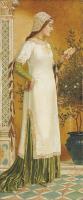
1886. Walter Crane [aged 40]. "Laura Reading". Laura was a young woman for whom the poet Petrarch nursed an unrequited passion. The story has obvious parallels with that of Dante and Beatrice, but it attracted far less attention from artists working in the romantic tradition.

1886. Frederick Hollyer [aged 47]. Photograph of Walter Crane [aged 40].
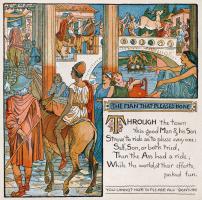
1887. Walter Crane [aged 41]. Illustration for Baby's Own Aesop.

Chronicle of a Bourgeois of Valenciennes
Récits d’un bourgeois de Valenciennes aka The Chronicle of a Bourgeois of Valenciennes is a vivid 14th-century vernacular chronicle written by an anonymous urban chronicler from Valenciennes in the County of Hainaut. It survives in a manuscript that describes local and regional history from about 1253 to 1366, blending chronology, narrative episodes, and eyewitness-style accounts of political, military, and social events in medieval France, Flanders, and the Low Countries. The work begins with a chronological framework of events affecting Valenciennes and its region under rulers such as King Philip VI of France and the shifting allegiances of local nobility. It includes accounts of conflicts, sieges, diplomatic manoeuvres, and the impact of broader struggles like the Hundred Years’ War on urban life in Hainaut. Written from the perspective of a burgher (bourgeois) rather than a monastery or royal court, the chronicle offers a rare lay viewpoint on high politics and warfare, reflecting how merchants, townspeople, and civic institutions experienced the turbulence of the 13th and 14th centuries. Its narrative style combines straightforward reporting of events with moral and civic observations, making it a valuable source for readers interested in medieval urban society, regional politics, and the lived experience of war and governance in pre-modern Europe.
Available at Amazon in eBook and Paperback format.
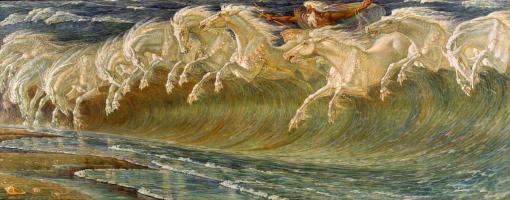
1892. Walter Crane [aged 46]. "The Horses of Neptune".
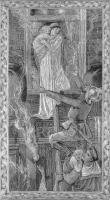
1893. Walter Crane [aged 47]. "The Union Street Fire".
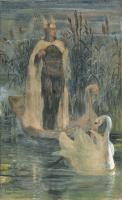
1895. Walter Crane [aged 49]. "Lohengrin".
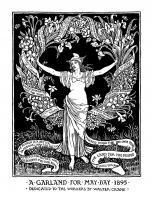
1895. Walter Crane [aged 49]. "A Garland for May Day 1895".
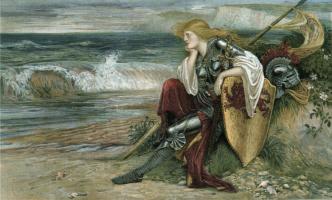
1900. Walter Crane [aged 54]. "Britomast". Spenser's Fairie Queene, Book III. See The Faerie Queene by Spenser.

Before 1904. George Frederick Watts [aged 86]. Portrait of Walter Crane [aged 58].
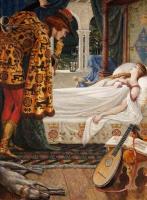
1905. Walter Crane [aged 59]. "The Briar Rose".
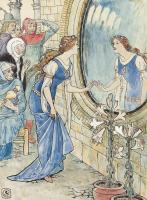
1909. Walter Crane [aged 63]. "The Mirror". Illustration for Arthur Kelly's The Rosebud and Other Tales.

In July 1913 Lionel Francis Crane [aged 37] and Gertrude Sandes [aged 41] were married. an example of Married to Two Siblings - following her death in 1920 he married her sister Winifred Gertrude Sandes [aged 42]. She the illegitmate daughter of Frederick Sandys and Mary Emma Jones aka "Miss Clive" [aged 68]. He the son of Walter Crane [aged 67] and Mary Frances Andrews [aged 67].
On 18th December 1914 [his wife] Mary Frances Andrews [aged 68] committed suicide by jumping in front of a train. Her death was attributed to temporary insanity.
On 14th March 1915 Walter Crane [aged 69] died at Horsham Hospital, West Sussex. His body was cremated at the Golders Green Crematorium, where his ashes remain.