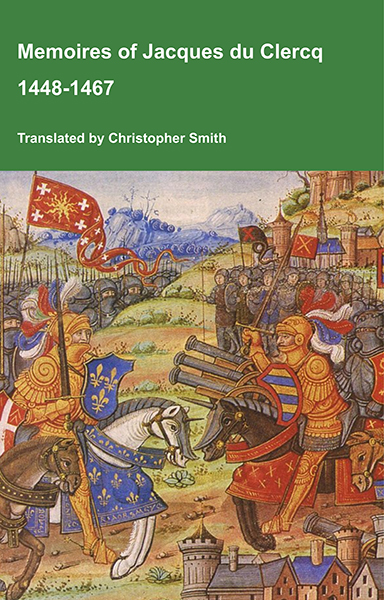
Memoires of Jacques du Clercq

This is a translation of the 'Memoires of Jacques du Clercq', published in 1823 in two volumes, edited by Frederic, Baron de Reissenberg. In his introduction Reissenberg writes: 'Jacques du Clercq tells us that he was born in 1424, and that he was a licentiate in law and a counsellor to Philip the Good, Duke of Burgundy, in the castellany of Douai, Lille, and Orchies. It appears that he established his residence at Arras. In 1446, he married the daughter of Baldwin de la Lacherie, a gentleman who lived in Lille. We read in the fifth book of his Memoirs that his father, also named Jacques du Clercq, had married a lady of the Le Camelin family, from Compiègne. His ancestors, always attached to the counts of Flanders, had constantly served them, whether in their councils or in their armies.' The Memoires cover a period of nineteen years beginning in in 1448, ending in in 1467. It appears that the author had intended to extend the Memoirs beyond that date; no doubt illness or death prevented him from carrying out this plan. As Reissenberg writes the 'merit of this work lies in the simplicity of its narrative, in its tone of good faith, and in a certain air of frankness which naturally wins the reader’s confidence.' Du Clercq ranges from events of national and international importance, including events of the Wars of the Roses in England, to simple, everyday local events such as marriages, robberies, murders, trials and deaths, including that of his own father in Book 5; one of his last entries.

Available at Amazon in eBook and Paperback format.

Trefor Burial Chamber, Beaumaris, Anglesey, North-West Wales aka Gwynedd, British Isles [Map]

Archaeological Journal Volume 3 Page 39-44. A large erect cromlech occurs at Llugwy, and more than one fallen cromlech on the neighbouring elevated lands: under the former human bones have been lately found. A double cromlech, thrown down since 1800, is to be seen at Trefor [Map]; one is near Holyhead, and there are several others.

In all these cases the cromlechs are composed of stones found in their immediate neighbourhood; thus, those at Plas Newydd, Bodowyr, and one at Llanidan, are of limestone rock found there in situ: those at Llanfaelog and Presaddfed are of the peculiar porphyritic breccia which accompanies the schistose formation of those districts. The cromlechs at Llugwy and in its vicinity are of limestone, and at Trefor [Map] of chloritic schist, thus affording the inference that they could not have been brought from any considerable distance. The immense rocks at Hên Bias are of the limestone of that spot, on which indeed they stand.

Archaeological Journal Volume 28 1871 Pages 97-108. 11. Trefor [Map], or Trevawr, Llansadwrn par. (E).

David Thomas, in his list of cromlechau, mentions one at "Trefor." Cambr. Reg. for 1796, vol. ii. p. 288. In Gough's additions to Camden's Britannia, vol. iii. p. 201, it is stated that there is at this place "a great rude cromlech, and ruins of another." The Rev. J. Lloyd noticed them also in his MS. collections, published by his daughter Angharad, in her History of Mona, p. 297. "On a tenement called Trevawr in this parish (Llansadwrn) there are two cromlechau; one is a large stone mounted high upon four pillars, its inclination westward; in length it is 9 ft. and 8 ft. in breadth. Near it, and upon the same carnedd, is another, supported only by two stones, with great inclination northward." (This cromlech fell down in 1825. Note, ibid.) Angharad, in the account of the great cromlech at Plas Newydd, p. 243, observes that "another double cromlech, not less extraordinary, is near a house called Trevor, about 2½ miles from Beaumaris, in the road to Plasgwyn. The only material difference between this cromlech and the former is that the second or inferior altar is placed a little further off from its lower end, and that its top is somewhat gibbous," so that, as in the "Giant's Coit," in Cornwall, it is very difficult to stand upon it. Mr. Longueville Jones states that the Trefor cromlech was thrown down a few years since by the tenant, as being "superstitious." Arch. Cambr. N. S., vol. v. p. 205. See also his Memoir on Cromlechs Extant in Anglesey, Arch. Journ., vol. iii. p. 43.