

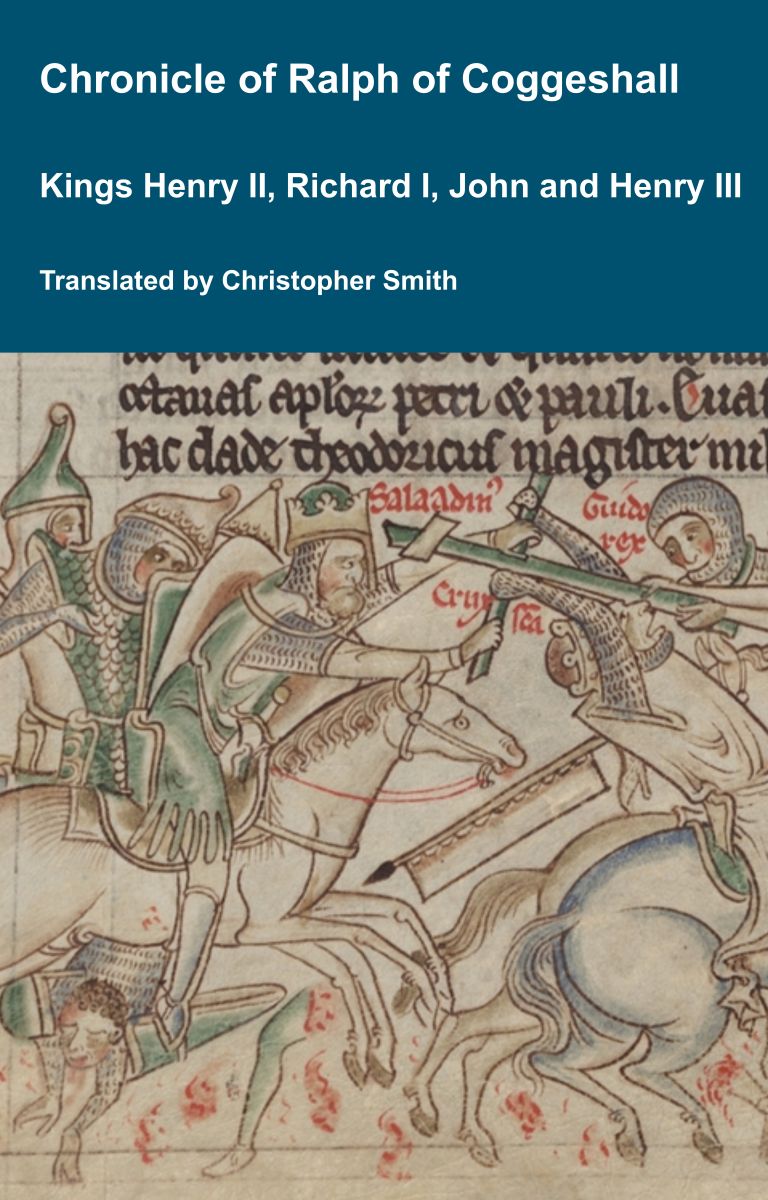
Chronicle of Abbot Ralph of Coggeshall
The Chronicle of Abbot Ralph of Coggeshall (Chronicon Anglicanum) is an indispensable medieval history that brings to life centuries of English and European affairs through the eyes of a learned Cistercian monk. Ralph of Coggeshall, abbot of the Abbey of Coggeshall in Essex in the early 13th century, continued and expanded his community’s chronicle, documenting events from the Norman Conquest of 1066 into the tumultuous reign of King Henry III. Blending eyewitness testimony, careful compilation, and the monastic commitment to record-keeping, this chronicle offers a rare narrative of political intrigue, royal power struggles, and social upheaval in England and beyond. Ralph’s work captures the reigns of pivotal figures such as Richard I and King John, providing invaluable insights into their characters, decisions, and the forces that shaped medieval rule. More than a simple annal, Chronicon Anglicanum conveys the texture of medieval life and governance, making it a rich source for scholars and readers fascinated by English history, monastic authorship, and the shaping of the medieval world.
Available at Amazon in eBook and Paperback format.
 John Evelyn's Diary January 1667
 John Evelyn's Diary March 1667
 John Evelyn's Diary April 1667
 John Evelyn's Diary June 1667
 John Evelyn's Diary July 1667
 John Evelyn's Diary August 1667
 John Evelyn's Diary September 1667
 John Evelyn's Diary December 1667
John Evelyn's Diary 1667 is in John Evelyn's Diary 1660s.
9th January 1667. To the Royal Society, which since the sad conflagration were invited by Mr. Howard to sit at Arundel House [Map] in the Strand, who at my instigation likewise bestowed on the Society that noble library which his grandfather especially, and his ancestors had collected. This gentleman had so little inclination to books, that it was the preservation of them from embezzlement.

24th January 1667. Visited my Lord Clarendon, and presented my son, John [aged 12], to him, now preparing to go to Oxford, of which his Lordship was Chancellor. This evening I heard rare Italian voices, two eunuchs and one woman, in his Majesty's [aged 36] green chamber, next his cabinet.
29th January 1667. To London, in order to my son's [aged 12] Oxford journey, who, being very early entered both in Latin and Greek, and prompt to learn beyond most of his age, I was persuaded to trust him under the tutorage of Mr. Bohun, Fellow of New College, who had been his preceptor in my house some years before; but, at Oxford, under the inspection of Dr. Bathurst [aged 47], President of Trinity College, where I placed him, not as yet thirteen years old. He was newly out of long coats.
15th February 1667. My little book, in answer to Sir George Mackenzie on Solitude, was now published, entitled "Public Employment, and an active Life with its Appanages, preferred to Solitude"..
18th February 1667. I was present at a magnificent ball, or masque, in the theatre at the Court, where their Majesties [Note. King Charles II of England Scotland and Ireland [aged 36] and Catherine of Braganza Queen Consort England [aged 28]] and all the great lords and ladies danced, infinitely gallant, the men in their richly embroidered, most becoming vests.

19th February 1667. I saw a comedy acted at Court. In the afternoon, I witnessed a wrestling match for £1,000 in St. James's Park, before his Majesty [aged 36], a vast assemblage of lords and other spectators, between the western and northern men, Mr. Secretary Morice [aged 64] and Lord Gerard [aged 33] being the judges. The western men won. Many great sums were betted.
6th March 1667. I proposed to my Lord Chancellor [aged 58], Monsieur Kiviet's [aged 40] undertaking to wharf the whole river of Thames, or quay, from the Temple [Map] to the Tower [Map], as far as the fire destroyed, with brick, without piles, both lasting and ornamental.-Great frosts, snow and winds, prodigious at the vernal equinox; indeed it had been a year of prodigies in this nation, plague, war, fire, rain, tempest and comet.


14th March 1667. Saw "The Virgin Queen", a play written by Mr. Dryden [aged 35].


Anne Boleyn. Her Life as told by Lancelot de Carle's 1536 Letter.
In 1536, two weeks after the execution of Anne Boleyn, her brother George and four others, Lancelot du Carle, wrote an extraordinary letter that described Anne's life, and her trial and execution, to which he was a witness. This book presents a new translation of that letter, with additional material from other contemporary sources such as Letters, Hall's and Wriothesley's Chronicles, the pamphlets of Wynkyn the Worde, the Memorial of George Constantyne, the Portuguese Letter and the Baga de Secrets, all of which are provided in Appendices.
Available at Amazon in eBook and Paperback format.
26th March 1667. Sir John Kiviet [aged 40] dined with me. We went to search for brick-earth, in order to a great undertaking.
4th April 1667. The cold so intense, that there was hardly a leaf on a tree.
22nd April 1667. Saw the sumptuous supper in the banqueting-house [Map] at Whitehall, on the eve of St. George's day, where were all the companions of the Order of the Garter.
23rd April 1667. In the morning, his Majesty [aged 36] went to chapel with the Knights of the Garter, all in their habits and robes, ushered by the heralds; after the first service, they went in procession, the youngest first, the Sovereign last, with the Prelate of the Order and Dean, who had about his neck the book of the Statutes of the Order; and then the Chancellor of the Order (old Sir Henry de Vic [aged 68]), who wore the purse about his neck; then the Heralds and Garter King-at-Arms, Clarencieux, Black Rod. But before the Prelate and Dean of Windsor went the gentlemen of the chapel and choristers, singing as they marched; behind them two doctors of music in damask robes; this procession was about the courts at Whitehall [Map]. Then, returning to their stalls and seats in the chapel, placed under each knight's coat-armor and titles, the second service began. Then, the King offered at the altar, an anthem was sung; then, the rest of the Knights offered, and lastly proceeded to the banqueting-house [Map] to a great feast. The King sat on an elevated throne at the upper end at a table alone; the Knights at a table on the right hand, reaching all the length of the room; over against them a cupboard of rich gilded plate; at the lower end, the music; on the balusters above, wind music, trumpets, and kettle-drums. the King was served by the lords and pensioners who brought up the dishes. About the middle of the dinner, the Knights drank the King's health, then the King, theirs, when the trumpets and music played and sounded, the guns going off at the Tower [Map]. At the Banquet, came in the Queen [aged 28], and stood by the King's left hand, but did not sit. Then was the banqueting-stuff flung about the room profusely. In truth, the crowd was so great, that though I stayed all the supper the day before, I now stayed no longer than this sport began, for fear of disorder. The cheer was extraordinary, each Knight having forty dishes to his mess, piled up five or six high; the room hung with the richest tapestry.
25th April 1667. Visited again the Duke of Newcastle [aged 74], with whom I had been acquainted long before in France, where the Duchess [aged 44] had obligation to my wife's [aged 32] mother for her marriage there; she was sister to Lord Lucas [aged 60], and maid of honor then to the Queen-Mother [aged 57]; married in our chapel at Paris. My wife being with me, the Duke and Duchess both would needs bring her to the very Court.


26th April 1667. My Lord Chancellor [aged 58] showed me all his newly finished and furnished palace and library; then, we went to take the air in Hyde-Park [Map].
27th April 1667. I had a great deal of discourse with his Majesty [aged 36] at dinner. In the afternoon, I went again with my wife [aged 32] to the Duchess of Newcastle [aged 44], who received her in a kind of transport, suitable to her extravagant humor and dress, which was very singular.

8th May 1667. Made up accounts with our Receiver, which amounted to £33,936 1s. 4d. Dined at Lord Cornbury's [aged 5], with Don Francisco de Melos, Portugal Ambassador, and kindred to the Queen [aged 28]: Of the party were Mr. Henry Jermyn [aged 62] and Sir Henry Capel [aged 29]. Afterward I went to Arundel House [Map], to salute Mr. Howard's sons, newly returned out of France.
11th May 1667. To London; dined with the Duke of Newcastle [aged 74], and sat discoursing with her Grace [aged 44] in her bedchamber after dinner, till my Lord Marquis of Dorchester [aged 61], with other company came in, when I went away.
30th May 1667. To London, to wait on the Duchess of Newcastle [aged 44] (who was a mighty pretender to learning, poetry, and philosophy, and had in both published divers books) to the Royal Society, whither she came in great pomp, and being received by our Lord President at the door of our meeting-room, the mace, etc., carried before him, had several experiments shown to her. I conducted her Grace to her coach, and returned home.
1st June 1667. I went to Greenwich, Kent [Map], where his Majesty [aged 37] was trying divers grenadoes shot out of cannon at the Castlehill, from the house in the park; they broke not till they hit the mark, the forged ones broke not at all, but the cast ones very well. The inventor was a German there present. At the same time, a ring was shown to the King, pretended to be a projection of mercury, and malleable, and said by the gentlemen to be fixed by the juice of a plant.
8th June 1667. To London, alarmed by the Dutch, who were fallen on our fleet at Chatham, Kent [Map], by a most audacious enterprise, entering the very river with part of their fleet, doing us not only disgrace, but incredible mischief in burning several of our best men-of-war lying at anchor and moored there, and all this through our unaccountable negligence in not setting out our fleet in due time. This alarm caused me, fearing the enemy might venture up the Thames even to London (which they might have done with ease, and fired all the vessels in the river, too), to send away my best goods, plate, etc., from my house to another place. The alarm was so great that it put both country and city into fear, panic, and consternation, such as I hope I shall never see more; everybody was flying, none knew why or whither. Now, there were land forces dispatched with the Duke of Albemarle [aged 58], Lord Middleton [aged 59], Prince Rupert [aged 47], and the Duke [aged 33], to hinder the Dutch coming to Chatham, Kent [Map], fortifying Upnor Castle, Kent [Map], and laying chains and bombs; but the resolute enemy broke through all, and set fire on our ships, and retreated in spite, stopping up the Thames, the rest of the fleet lying before the mouth of it.

The True Chronicles of Jean le Bel Volume 1 Chapters 1-60 1307-1342
The True Chronicles of Jean le Bel offer one of the most vivid and immediate accounts of 14th-century Europe, written by a knight who lived through the events he describes, and experienced some of them first hand. Covering the early decades of the Hundred Years’ War, this remarkable chronicle follows the campaigns of Edward III of England, the politics of France and the Low Countries, and the shifting alliances that shaped medieval warfare. Unlike later historians, Jean le Bel writes with a strong sense of eyewitness authenticity, drawing on personal experience and the testimony of fellow soldiers. His narrative captures not only battles and sieges, but also the realities of military life, diplomacy, and the ideals of chivalry that governed noble society. A key source for Jean Froissart, Le Bel’s chronicle stands on its own as a compelling and insightful work, at once historical record and literary achievement. This translation builds on the 1905 edition published in French by Jules Viard, adding extensive translations from other sources Rymer's Fœdera, the Chronicles of Adam Murimuth, William Nangis, Walter of Guisborough, a Bourgeois of Valenciennes, Geoffrey le Baker of Swinbroke and Richard Lescot to enrich the original text and Viard's notes.
Available at Amazon in eBook and Paperback format.
14th June 1667. I went to see the work at Woolwich, Kent [Map], a battery to prevent them coming up to London, which Prince Rupert [aged 47] commanded, and sunk some ships in the river.


17th June 1667. This night, about two o'clock, some chips and combustible matter prepared for some fire-ships, taking flame in Deptford-yard [Map], made such a blaze, and caused such an uproar in the Tower [Map] (it being given out that the Dutch fleet was come up, and had landed their men and fired the Tower), as had liked to have done more mischief before people would be persuaded to the contrary and believe the accident. Everybody went to their arms. These were sad and troublesome times.
24th June 1667. The Dutch fleet still continuing to stop up the river, so as nothing could stir out or come in, I was before the Council, and commanded by his Majesty [aged 37] to go with some others and search about the environs of the city, now exceedingly distressed for want of fuel, whether there could be any peat, or turf, found fit for use. The next day, I went and discovered enough, and made my report that there might be found a great deal; but nothing further was done in it.
28th June 1667. I went to Chatham, Kent [Map], and thence to view not only what mischief the Dutch had done; but how triumphantly their whole fleet lay within the very mouth of the Thames, all from the North Foreland, Margate, Kent [Map], even to the buoy of the Nore - a dreadful spectacle as ever Englishmen saw, and a dishonor never to be wiped off! Those who advised his Majesty [aged 37] to prepare no fleet this spring deserved-I know what-but-.

28th June 1667. Here in the river off Chatham, Kent [Map], just before the town, lay the carcase of the "London" (now the third time burnt), the "Royal Oak", "James", etc., yet smoking; and now, when the mischief was done, we were making trifling forts on the brink of the river. Here were yet forces, both of horse and foot, with General Middleton [aged 59] continually expecting the motions of the enemy's fleet. I had much discourse with him, who was an experienced commander, I told him I wondered the King [aged 37] did not fortify Sheerness [Map] and the Ferry; both abandoned.
2nd July 1667. Called upon my Lord Arlington [aged 49], as from his Majesty [aged 37], about the new fuel. The occasion why I was mentioned, was from what I said in my Sylva three years before, about a sort of fuel for a need, which obstructed a patent of Lord Carlingford [aged 64], who had been seeking for it himself; he was endeavoring to bring me into the project, and proffered me a share. I met my Lord; and, on the 9th, by an order of Council, went to my Lord Mayor, to be assisting. In the meantime they had made an experiment of my receipt of houllies, which I mention in my book to be made at Maestricht, with a mixture of charcoal dust and loam, and which was tried with success at Gresham College (then being the exchange for the meeting of the merchants since the fire) for everybody to see. This done, I went to the Treasury for £12,000 for the sick and wounded yet on my hands.
Next day, we met again about the fuel at Sir J. Armourer's in the Mews.


8th July 1667. My Lord Brereton [aged 36] and others dined at my house, where I showed them proof of my new fuel, which was very glowing, and without smoke or ill smell.

10th July 1667. I went to see Sir Samuel Morland's [aged 42] inventions and machines, arithmetical wheels, quench-fires, and new harp.
17th July 1667. The Master of the Mint and his lady, Mr. Williamson, Sir Nicholas Armourer [aged 47], Sir Edward Bowyer, Sir Anthony Auger, and other friends dined with me.

19th July 1667. I went to Gravesend, Kent [Map]; the Dutch fleet still at anchor before the river, where I saw five of his Majesty's [aged 37] men-at-war encounter above twenty of the Dutch, in the bottom of the Hope, chasing them with many broadsides given and returned toward the Buoy of the Nore, where the body of their fleet lay, which lasted till about midnight. One of their ships was fired, supposed by themselves, she being run on ground. Having seen this bold action, and their braving us so far up the river, I went home the next day, not without indignation at our negligence, and the nation's reproach. It is well known who of the Commissioners of the Treasury gave advice that the charge of setting forth a fleet this year might be spared, Sir W. C. (William Coventry [aged 39]) by name.

1st August 1667. I received the sad news of Abraham Cowley's [deceased] death, that incomparable poet and virtuous man, my very dear friend, and was greatly deplored.
3rd August 1667. Went to Mr. Cowley's [deceased] funeral, whose corpse lay at Wallingford House, and was thence conveyed to Westminster Abbey [Map] in a hearse with six horses and all funeral decency, near a hundred coaches of noblemen and persons of quality following; among these, all the wits of the town, divers bishops and clergymen. He was interred next Geoffry Chaucer, and near Spenser. A goodly. Monument is since erected to his memory.
3rd August 1667. Now did his Majesty [aged 37] again dine in the presence, in ancient state, with music and all the court ceremonies, which had been interrupted since the late war.
8th August 1667. Visited Mr. Oldenburg [aged 48], a close prisoner in the Tower [Map], being suspected of writing intelligence. I had an order from Lord Arlington [aged 49], Secretary of State, which caused me to be admitted. This gentleman was secretary to our Society, and I am confident will prove an innocent person.
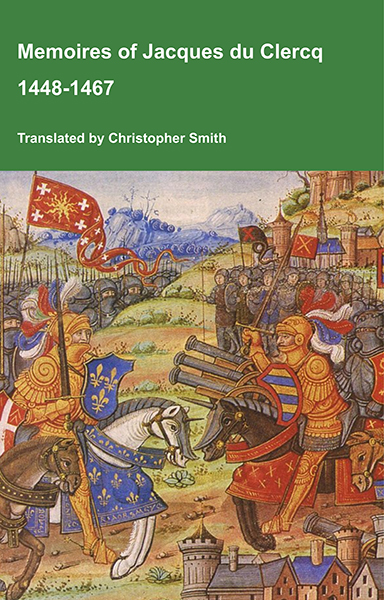
This is a translation of the 'Memoires of Jacques du Clercq', published in 1823 in two volumes, edited by Frederic, Baron de Reissenberg. In his introduction Reissenberg writes: 'Jacques du Clercq tells us that he was born in 1424, and that he was a licentiate in law and a counsellor to Philip the Good, Duke of Burgundy, in the castellany of Douai, Lille, and Orchies. It appears that he established his residence at Arras. In 1446, he married the daughter of Baldwin de la Lacherie, a gentleman who lived in Lille. We read in the fifth book of his Memoirs that his father, also named Jacques du Clercq, had married a lady of the Le Camelin family, from Compiègne. His ancestors, always attached to the counts of Flanders, had constantly served them, whether in their councils or in their armies.' The Memoires cover a period of nineteen years beginning in in 1448, ending in in 1467. It appears that the author had intended to extend the Memoirs beyond that date; no doubt illness or death prevented him from carrying out this plan. As Reissenberg writes the 'merit of this work lies in the simplicity of its narrative, in its tone of good faith, and in a certain air of frankness which naturally wins the reader’s confidence.' Du Clercq ranges from events of national and international importance, including events of the Wars of the Roses in England, to simple, everyday local events such as marriages, robberies, murders, trials and deaths, including that of his own father in Book 5; one of his last entries.
Available at Amazon in eBook and Paperback format.
15th August 1667. Finished my account, amounting to £25,000.
17th August 1667. To the funeral of Mr. Farringdon, a relation of my wife's [aged 32].
17th August 1667. There was now a very gallant horse to be baited to death with dogs; but he fought them all, so as the fiercest of them could not fasten on him, till the men run him through with their swords. This wicked and barbarous sport deserved to have been punished in the cruel contrivers to get money, under pretense that the horse had killed a man, which was false. I would not be persuaded to be a spectator.
21st August 1667. Saw the famous Italian puppet-play, for it was no other.
24th August 1667. I was appointed, with the rest of my brother commissioners, to put in execution an order of Council for freeing the prisoners at war in my custody at Leeds Castle, Kent [Map], and taking off his Majesty's [aged 37] extraordinary charge, having called before us the French and Dutch agents. The peace was now proclaimed, in the usual form, by the heralds-at-arms.
25th August 1667. After evening service, I went to visit Mr. Vaughan, who lay at Greenwich, Kent [Map], a very wise and learned person, one of Mr. Selden's executors and intimate friends.
27th August 1667. Visited the Lord Chancellor [aged 58], to whom his Majesty [aged 37] had sent for the seals a few days before; I found him in his bedchamber, very sad. The Parliament had accused him, and he had enemies at Court, especially the buffoons and ladies of pleasure, because he thwarted some of them, and stood in their way; I could name some of the chief. The truth is, he made few friends during his grandeur among the royal sufferers, but advanced the old rebels. He was, however, though no considerable lawyer, one who kept up the form and substance of things in the Nation with more solemnity than some would have had. He was my particular kind friend, on all occasions. The cabal, however, prevailed, and that party in Parliament. Great division at Court concerning him, and divers great persons interceding for him.
28th August 1667. I dined with my late Lord Chancellor, where also dined Mr. Ashburnham [aged 64], and Mr. W. Legge, of the bedchamber; his Lordship pretty well in heart, though now many of his friends and sycophants abandoned him.
28th August 1667. In the afternoon, to the Lords Commissioners for money, and thence to the audience of a Russian Envoy in the Queen's presence-chamber, introduced with much state, the soldiers, pensioners, and guards in their order. His letters of credence brought by his secretary in a scarf of sarsenet, their vests sumptuous, much embroidered with pearls. He delivered his speech in the Russ language, but without the least action, or motion, of his body, which was immediately interpreted aloud by a German that spoke good English: half of it consisted in repetition of the Czar's titles, which were very haughty and oriental: the substance of the rest was, that he was only sent to see the King [aged 37] and Queen [aged 28], and know how they did, with much compliment and frothy language. Then, they kissed their Majesties' hands, and went as they came; but their real errand was to get money.
29th August 1667. We met at the Star Chamber about exchange and release of prisoners.
Chronicle of Walter of Guisborough
A canon regular of the Augustinian Guisborough Priory, Yorkshire, formerly known as The Chronicle of Walter of Hemingburgh, describes the period from 1066 to 1346. Before 1274 the Chronicle is based on other works. Thereafter, the Chronicle is original, and a remarkable source for the events of the time. This book provides a translation of the Chronicle from that date. The Latin source for our translation is the 1849 work edited by Hans Claude Hamilton. Hamilton, in his preface, says: 'In the present work we behold perhaps one of the finest samples of our early chronicles, both as regards the value of the events recorded, and the correctness with which they are detailed; Nor will the pleasing style of composition be lightly passed over by those capable of seeing reflected from it the tokens of a vigorous and cultivated mind, and a favourable specimen of the learning and taste of the age in which it was framed.'
Available at Amazon in eBook and Paperback format.
7th September 1667. Came Sir John Kiviet [aged 40], to article with me about his brickwork.
13th September 1667. Between the hours of twelve and one, was born my second daughter, who was afterward christened Elizabeth.
19th September 1667. To London, with Mr. Henry Howard [aged 39], of Norfolk, of whom I obtained the gift of his Arundelian marbles, those celebrated and famous inscriptions, Greek and Latin, gathered with so much cost and industry from Greece, by his illustrious grandfather, the magnificent Earl of Arundel, my noble friend while he lived. When I saw these precious. Monuments miserably neglected, and scattered up and down about the garden, and other parts of Arundel House [Map], and how exceedingly the corrosive air of London impaired them, I procured him to bestow them on the University of Oxford. This he was pleased to grant me; and now gave me the key of the gallery, with leave to mark all those stones, urns, altars, etc., and whatever I found had inscriptions on them, that were not statues. This I did; and getting them removed and piled together, with those which were incrusted in the garden walls, I sent immediately letters to the Vice-Chancellor of what I had procured, and that if they esteemed it a service to the University (of which I had been a member), they should take order for their transportation.


19th September 1667. This done 21st, I accompanied Mr. Howard [aged 39] to his villa at Albury, where I designed for him the plot of his canal and garden, with a crypt through the hill.
24th September 1667. Returned to London, where I had orders to deliver the possession of Chelsea College (used as my prison during the war with Holland for such as were sent from the fleet to London) to our Society, as a gift of his Majesty [aged 37], our founder.
8th October 1667. Came to dine with me Dr. Bathurst [aged 47], Dean of Wells, President of Trinity College, sent by the Vice-Chancellor of Oxford, in the name both of him and the whole University, to thank me for procuring the inscriptions, and to receive my directions what was to be done to show their gratitude to Mr. Howard [aged 39].
11th October 1667. I went to see Lord Clarendon, late Lord Chancellor and greatest officer in England, in continual apprehension what the Parliament would determine concerning him.
17th October 1667. Came Dr. Barlow [aged 59], Provost of Queen's College and Protobibliothecus of the Bodleian library, to take order about the transportation of the marbles.
25th October 1667. There were delivered to me two letters from the Vice-Chancellor of Oxford, with the Decree of the Convocation, attested by the Public Notary, ordering four Doctors of Divinity and Law to acknowledge the obligation the University had to me for procuring the Marmora Arundeliana, which was solemnly done by Dr. Barlow [aged 59], Dr. Jenkins, Judge of the Admiralty, Dr. Lloyd [aged 40], and Obadiah Walker [aged 51], of University College, who having made a large compliment from the University, delivered me the decree fairly written;.
25th October 1667. .
Jean de Waurin's Chronicle of England Volume 6 Books 3-6: The Wars of the Roses
Jean de Waurin was a French Chronicler, from the Artois region, who was born around 1400, and died around 1474. Waurin’s Chronicle of England, Volume 6, covering the period 1450 to 1471, from which we have selected and translated Chapters relating to the Wars of the Roses, provides a vivid, original, contemporary description of key events some of which he witnessed first-hand, some of which he was told by the key people involved with whom Waurin had a personal relationship.
Available at Amazon in eBook and Paperback format.
25th October 1667. Sir:
25th October 1667. We intend also a noble inscription, in which also honorable mention shall be made of yourself; but Mr. Vice-Chancellor commands me to tell you that that was not sufficient for your merits; but, that if your occasions would permit you to come down at the Act (when we intend a dedication of our new Theater), some other testimony should be given both of your own worth and affection to this your old mother; for we are all very sensible that this great addition of learning and reputation to the University is due as well to your industrious care for the University, and interest with my Lord Howard, as to his great nobleness and generosity of spirit.
25th October 1667. I am, Sir, your most humble servant,.
25th October 1667. Obadiah Walker, Univ. Coll.
25th October 1667. .
25th October 1667. The Vice-Chancellor's letter to the same effect was too vainglorious to insert, with divers copies of verses that were also sent me. Their mentioning me in the inscription I totally declined, when I directed the titles of Mr. Howard [aged 39], now made Lord, upon his Ambassage to Morocco.
25th October 1667. These four doctors, having made me this compliment, desired me to carry and introduce them to Mr. Howard [aged 39], at Arundel House [Map]; which I did, Dr. Barlow [aged 59] (Provost of Queen's) after a short speech, delivering a larger letter of the University's thanks, which was written in Latin, expressing the great sense they had of the honor done them. After this compliment handsomely performed and as nobly received, Mr. Howard accompanied the doctors to their coach. That evening I supped with them.
26th October 1667. My late Lord Chancellor was accused by Mr. Seymour in the House of Commons; and, in the evening, I returned home.
31st October 1667. My birthday-blessed be God for all his mercies! I made the Royal Society a present of the Table of Veins, Arteries, and Nerves, which great curiosity I had caused to be made in Italy, out of the natural human bodies, by a learned physician, and the help of Veslingius (Professor at Padua), from whence I brought them in 1646. For this I received the public thanks of the Society; and they are hanging up in their repository with an inscription.
9th December 1667. To visit the late Lord Chancellor. I found him in his garden at his new-built palace, sitting in his gout wheel-chair, and seeing the gates setting up toward the north and the fields. He looked and spake very disconsolately. After some while deploring his condition to me, I took my leave. Next morning, I heard he was gone; though I am persuaded that, had he gone sooner, though but to Cornbury, and there lain quiet, it would have satisfied the Parliament. That which exasperated them was his presuming to stay and contest the accusation as long as it was possible: and they were on the point of sending him to the Tower [Map].
9th December 1667. Note. There is some confusion over the dating of this entry since Lord Clarendon is supposed to have left London on 28 Nov 1667. Possible case of Evelyn writing his diary retrospectively.
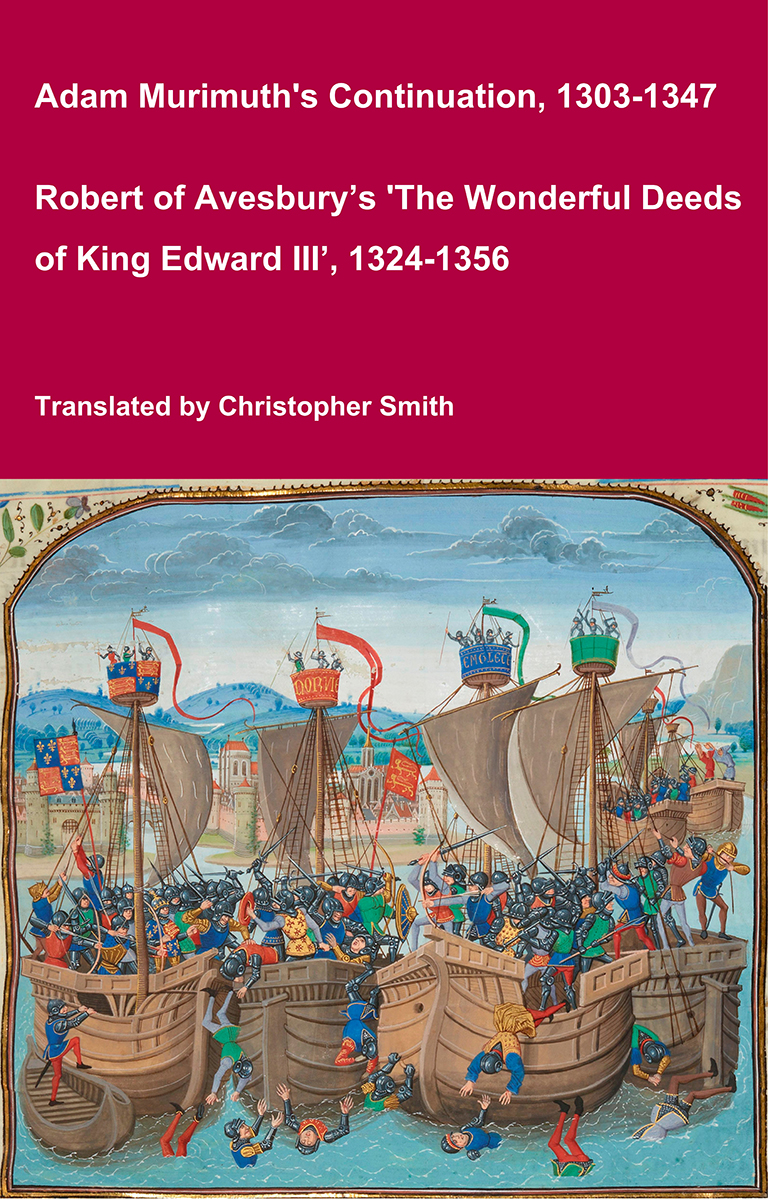
Adam Murimuth's Continuation and Robert of Avesbury’s 'The Wonderful Deeds of King Edward III'
This volume brings together two of the most important contemporary chronicles for the reign of Edward III and the opening phases of the Hundred Years’ War. Written in Latin by English clerical observers, these texts provide a vivid and authoritative window into the political, diplomatic, and military history of fourteenth-century England and its continental ambitions. Adam Murimuth Continuatio's Chronicarum continues an earlier chronicle into the mid-fourteenth century, offering concise but valuable notices on royal policy, foreign relations, and ecclesiastical affairs. Its annalistic structure makes it especially useful for establishing chronology and tracing the development of events year by year. Complementing it, Robert of Avesbury’s De gestis mirabilibus regis Edwardi tertii is a rich documentary chronicle preserving letters, treaties, and official records alongside narrative passages. It is an indispensable source for understanding Edward III’s claim to the French crown, the conduct of war, and the mechanisms of medieval diplomacy. Together, these works offer scholars, students, and enthusiasts a reliable and unembellished account of a transformative period in English and European history. Essential for anyone interested in medieval chronicles, the Hundred Years’ War, or the reign of Edward III.
Available at Amazon in eBook and Paperback format.
10th December 1667. I went to the funeral of Mrs. Heath, wife of my worthy friend and schoolfellow.
21st December 1667. I saw one Carr pilloried at Charing-cross for a libel, which was burnt before him by the hangman.