

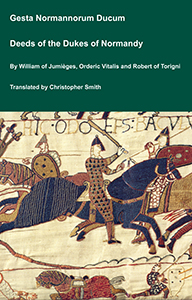
The Deeds of the Dukes of Normandy
The Gesta Normannorum Ducum [The Deeds of the Dukes of Normandy] is a landmark medieval chronicle tracing the rise and fall of the Norman dynasty from its early roots through the pivotal events surrounding the Norman Conquest of England. Originally penned in Latin by the monk William of Jumièges shortly before 1060 and later expanded at the behest of William the Conqueror, the work chronicles the deeds, politics, battles, and leadership of the Norman dukes, especially William’s own claim to the English throne. The narrative combines earlier historical sources with firsthand information and oral testimony to present an authoritative account of Normandy’s transformation from a Viking settlement into one of medieval Europe’s most powerful realms. William’s history emphasizes the legitimacy, military prowess, and governance of the Norman line, framing their expansion, including the conquest of England, as both divinely sanctioned and noble in purpose. Later chroniclers such as Orderic Vitalis and Robert of Torigni continued the history, extending the coverage into the 12th century, providing broader context on ducal rule and its impact. Today this classic work remains a foundational source for understanding Norman identity, medieval statesmanship, and the historical forces that reshaped England and Western Europe between 800AD and 1100AD.
Available at Amazon in eBook and Paperback format.
In 1693 Archbishop Thomas Herring was born to [his father] John Herring.
In 1727 Archbishop Thomas Herring [aged 34] was appointed Chaplain to King George II of Great Britain and Ireland [aged 43].


In 1732 Archbishop Thomas Herring [aged 39] was appointed Dean of Rochester.
In 1737 Archbishop Thomas Herring [aged 44] was appointed Bishop of Bangor.
On 15th January 1738 Archbishop Thomas Herring [aged 45] was consecrated Bishop of Bangor.
On 21st April 1743 Archbishop Thomas Herring [aged 50] was translated to Archbishop of York.

Around 1745 William Hogarth [aged 47]. Portrait of Archbishop Thomas Herring [aged 52].
On 24th October 1745 Archbishop Thomas Herring [aged 52] in a speech at York Castle [Map] during the Jacobite Rebellion said:
"these Commotions in the North are but Part of a Great Plan concerted for our Ruin-They have begun under the Countenance, and will be supported by the Forces of France and Spain, our old and inveterate, (and late Experience calls upon me to add, our savage and blood-thirsty) Enemies-A Circumstance that should fire the Indignation of every honest Englishman. If these Designs should succeed, and Popery and Arbitrary Power come in upon us, under the Influence and Direction of these two Tyrannical and Corrupted Courts, I leave you to reflect, what would become of every Thing that is valuable to us! We are now bless'd with the mild Administration of a Just and Protestant King, who is of so strict an Adherence to the Laws of our Country, that not an Instance can be pointed out, during his whole reign, wherein he made the least Attempt upon the Liberty, or Property, or Religion, of a single Person. But if the Ambition and Pride of France and Spain, is to dictate to us, we must submit to a Man to govern us under their hated and accursed Influence, who brings his Religion from Rome, and Rules and Maxims of his Government from Paris and Madrid.".
Horace Walpole 4th Earl Orford [aged 28] said this speech "had as much true spirit, honesty and bravery in it as ever was penned by an historian for an ancient hero".


On 21st October 1747 Archbishop Thomas Herring [aged 54] was elected Archbishop of Canterbury.
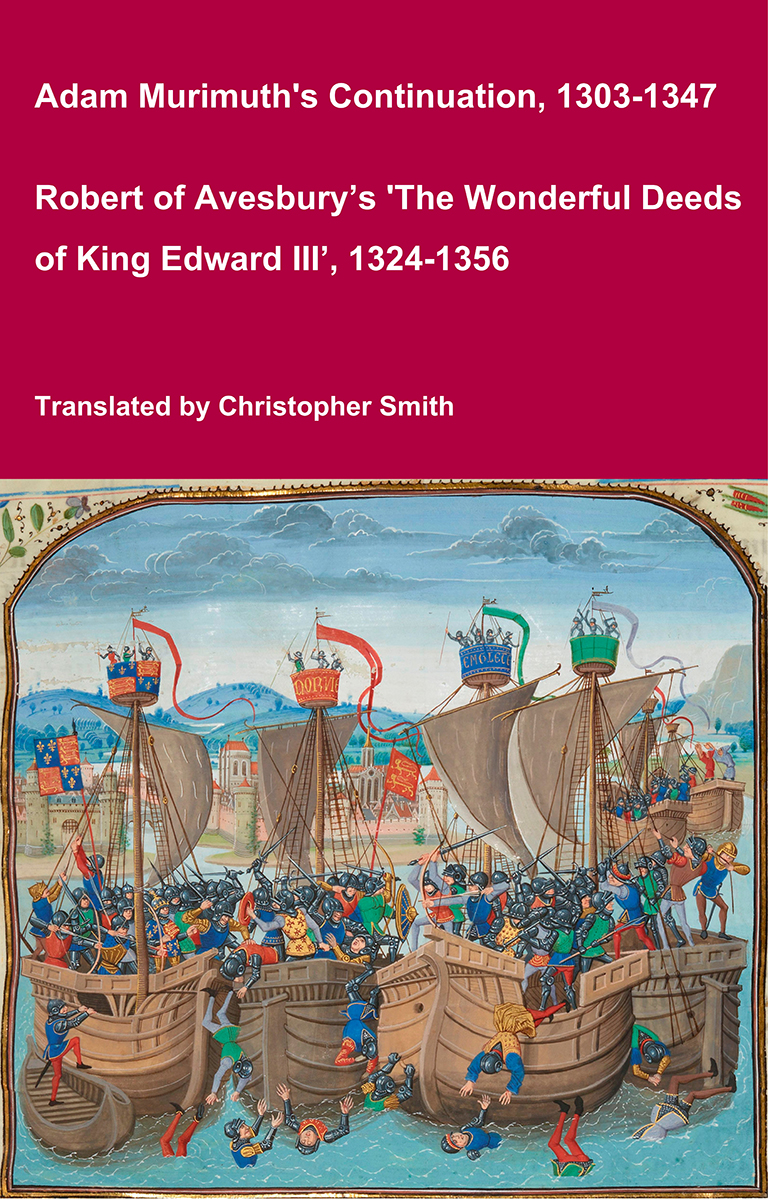
Adam Murimuth's Continuation and Robert of Avesbury’s 'The Wonderful Deeds of King Edward III'
This volume brings together two of the most important contemporary chronicles for the reign of Edward III and the opening phases of the Hundred Years’ War. Written in Latin by English clerical observers, these texts provide a vivid and authoritative window into the political, diplomatic, and military history of fourteenth-century England and its continental ambitions. Adam Murimuth Continuatio's Chronicarum continues an earlier chronicle into the mid-fourteenth century, offering concise but valuable notices on royal policy, foreign relations, and ecclesiastical affairs. Its annalistic structure makes it especially useful for establishing chronology and tracing the development of events year by year. Complementing it, Robert of Avesbury’s De gestis mirabilibus regis Edwardi tertii is a rich documentary chronicle preserving letters, treaties, and official records alongside narrative passages. It is an indispensable source for understanding Edward III’s claim to the French crown, the conduct of war, and the mechanisms of medieval diplomacy. Together, these works offer scholars, students, and enthusiasts a reliable and unembellished account of a transformative period in English and European history. Essential for anyone interested in medieval chronicles, the Hundred Years’ War, or the reign of Edward III.
Available at Amazon in eBook and Paperback format.
On 23rd March 1757 Archbishop Thomas Herring [aged 64] died. He was buried in Croydon Minster [Map].