

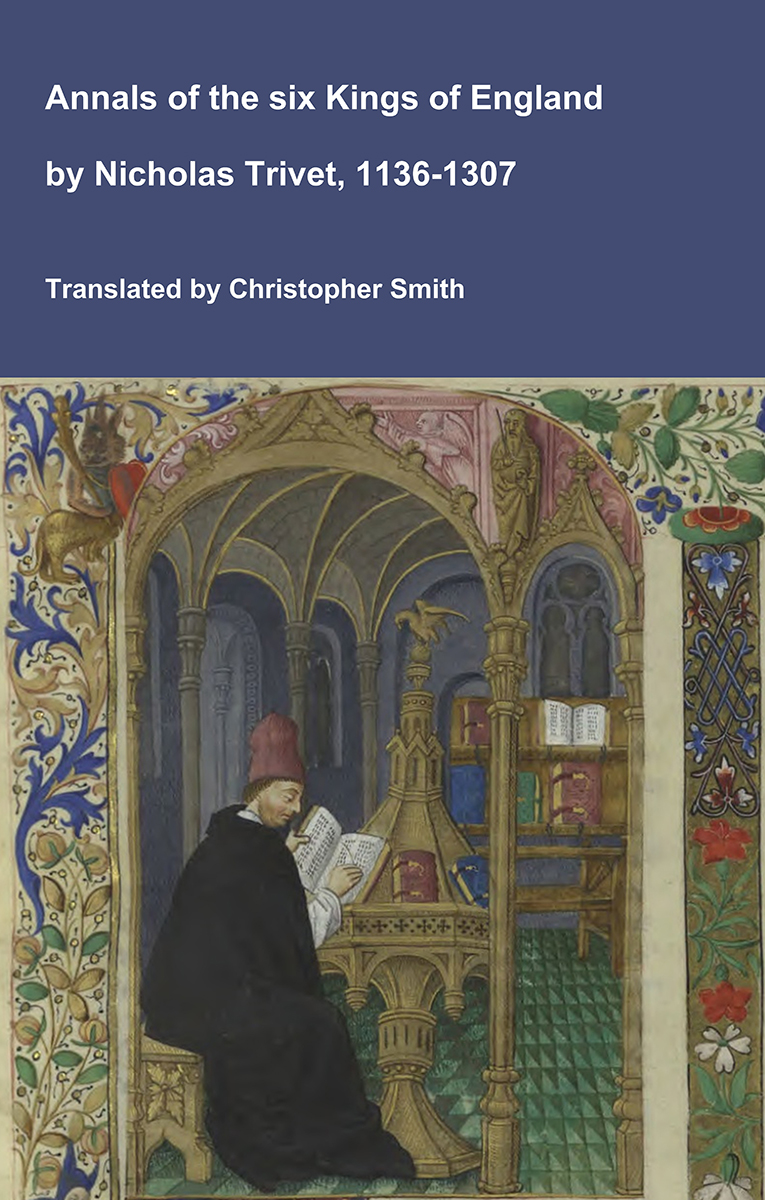
Annals of the six Kings of England by Nicholas Trivet
Translation of the Annals of the Six Kings of England by that traces the rise and rule of the Angevin aka Plantagenet dynasty from the mid-12th to early 14th century. Written by the Dominican scholar Nicholas Trivet, the work offers a vivid account of English history from the reign of King Stephen through to the death of King Edward I, blending political narrative with moral reflection. Covering the reigns of six monarchs—from Stephen to Edward I—the chronicle explores royal authority, rebellion, war, and the shifting balance between crown, church, and nobility. Trivet provides detailed insight into defining moments such as baronial conflicts, Anglo-French rivalry, and the consolidation of royal power under Edward I, whose reign he describes with particular immediacy. The Annals combines careful year-by-year reporting with thoughtful interpretation, presenting history not merely as a sequence of events but as a moral and political lesson. Ideal for readers interested in medieval history, kingship, and the origins of the English state, this chronicle remains a valuable and accessible window into the turbulent world of the Plantagenet kings.
Available at Amazon in eBook and Paperback format.
Lindsey is in Lincolnshire.
See: Blyton, Bolingbroke, East Lindsey, West Lindsey.
In 617 Raedwald King East Anglia [aged 47] and his son Raegenhere Wuffingas fought the Battle of the River Idle which took place at the River Idle, Markham Moor which forms the western border of the Isle of Lindsey [Map].
Raegenhere Wuffingas was killed.
Æthelfrith King Northumbrians [aged 45] was killed. King Edwin of Northumbria [aged 31] succeeded King Northumbria.
Anglo-Saxon Chronicle. 627. This year was King Edwin [aged 41] baptized at Easter, with all his people, by Paulinus, who also preached baptism in Lindsey [Map], where the first person who believed was a certain rich man, of the name of Bleek, with all his people. At this time Honorius succeeded Boniface in the papacy, and sent hither to Paulinus the pall; and Archbishop Justus having departed this life on the tenth of November, Honorius was consecrated at Lincoln, Lincolnshire [Map] Archbishop of Canterbury by Paulinus; and Pope Honorius sent him the pall. And he sent an injunction to the Scots, that they should return to the right celebration of Easter.
In 674 King Ecgfrith of Northumbria [aged 29] seized the Kingdom of Lindsey [Map] after he had repelled King Wulfhere of Mercia [aged 34].
Around 679 King Æthelred of Mercia defeated the Northumbrian army led by King Ecgfrith of Northumbria [aged 34] at the Battle of the Trent somehere in Lindsey [Map]. King Aelfwine of Deira was killed.
Assers Life of Alfred 873. 873. 45. The Heathen winter in Lindsey.98 In the year of our Lord's incarnation 873, being the twenty-fifth of King Alfred's life, the oft-named army, leaving London, went into Northumbria, and there wintered in the shire of Lindsey [Map]; and the Mercians again made peace with them.
Note 98. From the Chronicle.
Anglo-Saxon Chronicle. This year came King Harold [aged 44] from York to Westminster, on the Easter succeeding the midwinter when the king (Edward) died. Easter was then on the sixteenth day before the calends of May. Then was over all England such a token seen as no man ever saw before. Some men said that it was the comet-star, which others denominate the long-hair'd star. It appeared first on the eve called "Litania major", that is, on the eighth before the calends off May; and so shone all the week. Soon after this came in Earl Tosty [aged 40] from beyond sea into the Isle of Wight [Map], with as large a fleet as he could get; and he was there supplied with money and provisions. Thence he proceeded, and committed outrages everywhere by the sea-coast where he could land, until he came to Sandwich, Kent [Map]. When it was told King Harold, who was in London, that his brother Tosty was come to Sandwich, Kent [Map], he gathered so large a force, naval and military, as no king before collected in this land; for it was credibly reported that Earl William from Normandy [aged 38], King Edward's cousin, would come hither and gain this land; just as it afterwards happened. When Tosty understood that King Harold was on the way to Sandwich, Kent [Map], he departed thence, and took some of the boatmen with him, willing and unwilling, and went north into the Humber with sixty skips; whence he plundered in Lindsey [Map], and there slew many good men. When the Earls Edwin and Morkar understood that, they came hither, and drove him from the land. And the boatmen forsook him. Then he went to Scotland with twelve smacks; and the king of the Scots entertained him, and aided him with provisions; and he abode there all the summer. There met him Harold, King of Norway [aged 51], with three hundred ships. And Tosty submitted to him, and became his man.87 Then came King Harold88 to Sandwich, Kent [Map], where he awaited his fleet; for it was long ere it could be collected: but when it was assembled, he went into the Isle of Wight [Map], and there lay all the summer and the autumn. There was also a land-force every where by the sea, though it availed nought in the end. It was now the nativity of St. Mary, when the provisioning of the men began; and no man could keep them there any longer. They therefore had leave to go home: and the king rode up, and the ships were driven to London; but many perished ere they came thither.
Note 87. These facts, though stated in one MS. only, prove the early cooperation of Tosty with the King of Norway. It is remarkable that this statement is confirmed by Snorre, who says that Tosty was with Harald, the King of Norway, in all these expeditions. Vid "Antiq. Celto-Scand." p. 204.
Note 88. i.e. Harold, King of England; "our" king, as we find him. Afterwards called in B iv., to distinguish him from Harald, King of Norway.
Chronicon ex Chronicis by Florence and John of Worcester. 24th April 1066. The same year a comet was seen on the eighth of the calends of May [24th April], not only in England, but, as it is reported, all over the world: it shone with excessive brilliance for seven days. Soon afterwards earl Tosti [aged 40] returned from Flanders, and landed in the Isle of Wight [Map]; and, having compelled the islanders to give him pay and tribute, he departed, and plundered along the sea-coast, until he arrived at Sandwich, Kent [Map]. King Harold [aged 44], who was then at London, having been informed of this, ordered a considerable fleet and a body of horse to be got ready, and prepared to go in person to the port of Sandwich, Kent [Map]. On receiving this intelligence, Tosti took some of the boatmen of the place, willing or unwilling, into his service, and, departing thence, shaped his course for Lindsey [Map], where he burnt several vills and slew a number of men. Thereupon Edwin, earl of Mercia, and Morcar, earl of Northumbria, flew to the spot with some troops, and drove him out of that neighbourhood; and, on his departure, he repaired to Malcolm [aged 35], king of the Scots, and remained with him during the whole summer. Meanwhile king Harold arrived at the port of Sandwich, Kent [Map], and waited there for his fleet. When it was assembled, he sailed to the Isle of Wight [Map]; and as William [aged 38], earl of Normandy, king Edward's cousin, was preparing an army for the invasion of England, he kept watch all the summer and autumn, to prevent his landing; besides which, he stationed a land army at suitable points along the sea-coast; but provisions failing towards the time of the feast of the Nativity of St. Mary [8th September], both the fleet and army were disbanded.
On 20th April 1608 Bishop Edward Rainbowe was born to Thomas Rainbowe Vicar at Blyton.
Around 1422 Agnes Hutton was born at Bolingbroke.
Around 1220 Ranulf de Blondeville Gernon 6th Earl Chester 1st Earl Lincoln [aged 50] commissioned Bolingbroke Castle, Lincolnshire [Map].
Around 1238 William St John was born to Robert St John [aged 38] and Agnes Cantilupe [aged 36] at Bolingbroke Castle, Lincolnshire [Map]. He married Isabel Commartin and had issue.
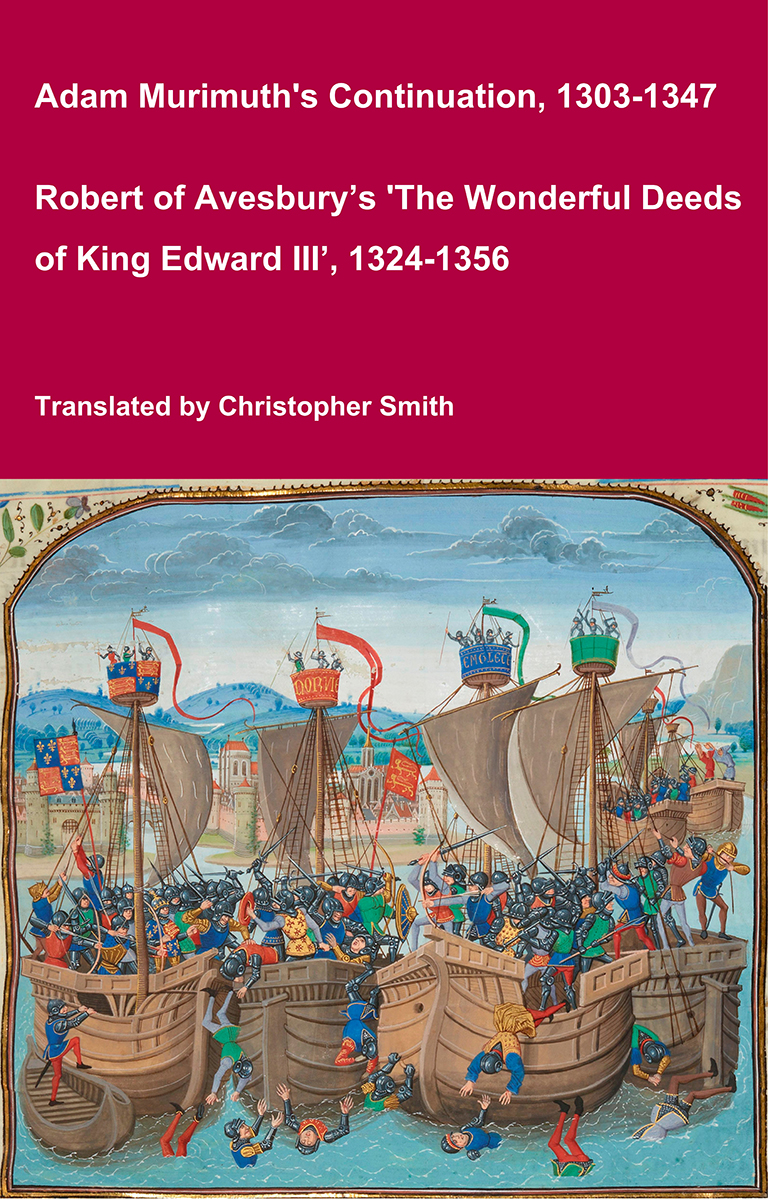
Adam Murimuth's Continuation and Robert of Avesbury’s 'The Wonderful Deeds of King Edward III'
This volume brings together two of the most important contemporary chronicles for the reign of Edward III and the opening phases of the Hundred Years’ War. Written in Latin by English clerical observers, these texts provide a vivid and authoritative window into the political, diplomatic, and military history of fourteenth-century England and its continental ambitions. Adam Murimuth Continuatio's Chronicarum continues an earlier chronicle into the mid-fourteenth century, offering concise but valuable notices on royal policy, foreign relations, and ecclesiastical affairs. Its annalistic structure makes it especially useful for establishing chronology and tracing the development of events year by year. Complementing it, Robert of Avesbury’s De gestis mirabilibus regis Edwardi tertii is a rich documentary chronicle preserving letters, treaties, and official records alongside narrative passages. It is an indispensable source for understanding Edward III’s claim to the French crown, the conduct of war, and the mechanisms of medieval diplomacy. Together, these works offer scholars, students, and enthusiasts a reliable and unembellished account of a transformative period in English and European history. Essential for anyone interested in medieval chronicles, the Hundred Years’ War, or the reign of Edward III.
Available at Amazon in eBook and Paperback format.
On or before 4th April 1340 Maud Plantagenet Duchess Lower Bavaria was born to Henry of Grosmont 1st Duke Lancaster [aged 30] and Isabel Beaumont Duchess Lancaster [aged 20] at Bolingbroke Castle, Lincolnshire [Map]. The exact date of her birth uncertain. The Inquisition of her father in May 1361 refers to Blanche being "Maud lady of Henaud [Hainault], aged 21 years on the feast of St. Ambrose last". The Feast of the Ambrose being the 4th of April so Maud was born on or before the 4th of April 1340. She a great x 2 granddaughter of King Henry III of England. She married (1) 1344 her third cousin once removed Ralph Stafford, son of Ralph Stafford 1st Earl Stafford and Margaret Audley Countess Stafford (2) 1352 her fourth cousin once removed William Wittelsbach I Duke Lower Bavaria, son of Louis Wittelsbach IV Holy Roman Emperor and Margaret Hainaut Holy Roman Empress, and had issue.
On or before 25th March 1342 Blanche Duchess of Lancaster was born to Henry of Grosmont 1st Duke Lancaster [aged 32] and Isabel Beaumont Duchess Lancaster [aged 22] at Bolingbroke Castle, Lincolnshire [Map]. The exact date of her birth uncertain. The Inquisition of her father in May 1361 refers to Blanche being "aged 19 years at the feast of the Annunciation last". The Feast of the Annunciation being the 25th of March so Blanche was born on or before the 25th of March 1342. She a great x 2 granddaughter of King Henry III of England. She married her half second cousin once removed John of Gaunt 1st Duke Lancaster, son of King Edward III of England and Philippa of Hainaut Queen Consort England, and had issue.

On 15th April 1367 King Henry IV of England was born to John of Gaunt 1st Duke Lancaster [aged 27] and Blanche Duchess of Lancaster [aged 25] at Bolingbroke Castle, Lincolnshire [Map]. He a grandson of King Edward III of England. He married (1) 5th February 1381 his second cousin Mary Bohun, daughter of Humphrey Bohun 7th Earl Hereford 6th Earl Essex 2nd Earl of Northampton and Joan Fitzalan Countess Essex, Hereford and Northampton, and had issue (2) 7th February 1403 his third cousin Joanna of Navarre Queen Consort England, daughter of Charles "Bad" II King Navarre and Joan Valois Queen Consort Navarre.