

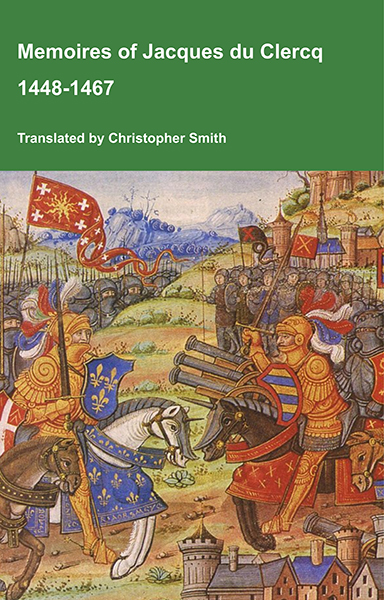
This is a translation of the 'Memoires of Jacques du Clercq', published in 1823 in two volumes, edited by Frederic, Baron de Reissenberg. In his introduction Reissenberg writes: 'Jacques du Clercq tells us that he was born in 1424, and that he was a licentiate in law and a counsellor to Philip the Good, Duke of Burgundy, in the castellany of Douai, Lille, and Orchies. It appears that he established his residence at Arras. In 1446, he married the daughter of Baldwin de la Lacherie, a gentleman who lived in Lille. We read in the fifth book of his Memoirs that his father, also named Jacques du Clercq, had married a lady of the Le Camelin family, from Compiègne. His ancestors, always attached to the counts of Flanders, had constantly served them, whether in their councils or in their armies.' The Memoires cover a period of nineteen years beginning in in 1448, ending in in 1467. It appears that the author had intended to extend the Memoirs beyond that date; no doubt illness or death prevented him from carrying out this plan. As Reissenberg writes the 'merit of this work lies in the simplicity of its narrative, in its tone of good faith, and in a certain air of frankness which naturally wins the reader’s confidence.' Du Clercq ranges from events of national and international importance, including events of the Wars of the Roses in England, to simple, everyday local events such as marriages, robberies, murders, trials and deaths, including that of his own father in Book 5; one of his last entries.
Available at Amazon in eBook and Paperback format.
Ludgate is in Middlesex.
Samuel Pepys' Diary. 31st August 1661. From hence he and I walked towards Ludgate and parted. I back again to the fair all alone, and there met with my Ladies Jemimah and Paulina, with Mr. Pickering and Madamoiselle, at seeing the Monkeys dance, which was much to see, when they could be brought to do so, but it troubled me to sit among such nasty company.
John Evelyn's Diary. 7th September 1666. The people, who now walked about the ruins, appeared like men in some dismal desert, or rather, in some great city laid waste by a cruel enemy; to which was added the stench that came from some poor creatures' bodies, beds, and other combustible goods. Sir Thomas Gresham's statue, though fallen from its niche in the Royal Exchange [Map], remained entire, when all those of the Kings since the Conquest were broken to pieces. Also the standard in Cornhill [Map], and Queen Elizabeth's effigies, with some arms on Ludgate, continued with but little detriment, while the vast iron chains of the city streets, hinges, bars, and gates of prisons, were many of them melted and reduced to cinders by the vehement heat. Nor was I yet able to pass through any of the narrow streets, but kept the widest; the ground and air, smoke and fiery vapor, continued so intense, that my hair was almost singed, and my feet insufferably surbated. The by-lanes and narrow streets were quite filled up with rubbish; nor could one have possibly known where he was, but by the ruins of some Church, or Hall, that had some remarkable tower, or pinnacle remaining.
Blackfriars Priory, Ludgate is also in Priories in England.
On 11th December 1443 John Cornwall 1st Baron Fanhope 1st Baron Milbroke [aged 79] died at Ampthill Castle, Bedfordshire [Map]. He was buried at Blackfriars Priory, Ludgate. Baron Fanhope, Baron Milbroke extinct.
Chronicles of London Vitellius A XVI. And vpon Saterday [1st July 1497] next folowyng was their three hedes set vpon London Brigge. And the IIIJ quarters of the forenamed flammok wer set vpon IIIJ Gates of the Citie of London, that is to wete Ludgate, Newgate, Crepylgate, and Aldrichgate. And the IIIJ quarters of the Smyth wer sent into Devenshire and Cornewaill, as it was Reported. And the Trunke of the lord Awdley was buryed wt in the chirch of the blak ffreres wtin Ludgate, fast by the Chapell of the Erle of Worcetir.
Henry Machyn's Diary. 18th November 1557. [The xviij day of November died the lord Bray, within the Black-friars, near Ludgate]; the wyche he gatt ys deth [at St. Quintin's.]
Henry Machyn's Diary. 7th February 1554. [The vij day of February, in the forenoon, Wyatt [aged 33], with his army and ordnance, were at Hyde Park Corner. There the Queen's host met with, with a great number of men at arms on horseback, beside foot. By one of the clock the Quen['s men and Wyatt's had a skirmish;] ther wher mony slayn; butt master Wyatt toke the way don by Sant James with a grett company and so to Charyngcrosse [Map], and so forth, crying 'God save quen Mare!' tyll he cam to Ludgatt and [knocked there; thinking to have entered; but the gate being kept fast against him, he retired,] and bake agayne unto Tempull Bare, and folouyd hym mony man, and ther he yelded unto master Norray the harold of armes in ys cote of armes, and ther he lycted be-hynd a gentleman unto the cowrte; but by the way mony of them wher slayne by the way or thay cam to Charyng-crosse [Map], what with mores pykes and bylls; and mony of Wyatt('s) men, as they whent, wher the quens fryndes and Englys-men under a fallss pretens that he whent a-bowtt to .... way as thay whent, and cam for to make men beleyff that the quen('s) grace had gyffvyn them pardon; and dyvers of ys men toke the quen('s) men by the hand as thay whent toward Ludgatt. Thys was done on As-Wedynsday the furst yere of quen Mare of England; and the sam nyght to the Towre [Map] ser Thomas Wyatt, master Cobham [aged 57], and master Vane, and ij Knewetes and odur captaynes.


Henry Machyn's Diary. 14th February 1554. The xiiij day of Feybruary wher hangyd at evere gatt and plasse: in Chepe-syd vj; Algatt [Map] j, quartered; at Leydynhall [Map] iij; at Bysshope-gatt [Map] on, and quartered; Morgatt one; Crepullgatt [Map] one; Aldersgatt on, quartered; Nuwgat [Map] on, quartered; Ludgatt on; Belyngat iij hangyd; Sant Magnus iij hangyd; Towre hyll [Map] ij. hangyd; Holborne iij hangyd; Flettstret [Map] iij hangyd; at Peper alley gat iij; Barunsaystret iij; Sant Gorgus iij; Charyng crosse [Map] iiij, on Boyth the fottman, and Vekars of the gard, and ij moo; at Hydparke corner iij, on Polard a waterbeyrar; theys iij hanges in chynes; and but vij quartered, and ther bodys and heds set a-pon the gattes of London.
Wriothesley's Chronicle [1508-1562]. 14th February 1554. The 14 of February divers of the rebells were putt to death, that is to saye, Bothe, one of the Queenes footemen, one Vicars, a Yeoman of the Garde, great John Norton, and one Kinge, were hanged at Charinge Crosse [Map]. And three of the rebells, one called Pollarde, were hanged at the parke pale by Hide Parke; three allso in Fleet street, one at Ludgate, one at Bishopsgate [Map], one at Newgate [Map], one at Aldgate [Map], three at the Crosse [Map] in Cheape, three at Soper Lane ende in Chepe, and three in Smithfield [Map], which persons hanged still all that daye and night tyll the next morninge, and then cutt downe.a And the bodies of them that were hanged at the gates were quartered at Newgate [Map], and the heades and bodies hanged over the gates where they suffred.
Note a. The Grey Friares Chronicle (p. 88) adds "the whych ware of London that fled from the Dnke of Norfoke."
Henry Machyn's Diary. 6th June 1556. The ix day of June was drane from the Towre unto Tyborne [Map] iij gentyllmen for a consperace, master Rosey, master Bedylle, and master Dethyke, and ther hangyd and quartered, and ther quarters bered, master Rosey('s) hed on London bryge, and Bedylle('s) hed over Ludgatt, and master Dethyke('s) over Althergatt.
Henry Machyn's Diary. 27th January 1560. The sam day cam rydyng to London, and so [entered] at Ludgatt, the good yerle of Shreusbery [aged 32], with a C [100] [men] rydyng, and so to Cold Harber to ys owne plasse.


Samuel Pepys' Diary. 7th September 1666. Up by five o'clock; and, blessed be God! find all well, and by water to Paul's Wharfe. Walked thence, and saw, all the towne burned, and a miserable sight of Paul's church [Map]; with all the roofs fallen, and the body of the quire fallen into St. Fayth's [Map]; Paul's school also, Ludgate, and Fleet-street [Map], my father's house, and the church, and a good part of the Temple [Map] the like.
Henry Machyn's Diary. 29th September 1561. The xxix day of September, was Myghellmas evyn, the old shreyffes master Cristofer Draper and master Thomas Rowe unto the nuw shreyffes master (Alexander) Avenon, and master (Humphrey) Baskerfeld [aged 44], was delevered Nugatt [Map] and Ludgatt, and the ij conters, and the presonars.
In 1617 Nicholas Hilliard [aged 70] was briefly imprisoned in Ludgate Prison after standing surety for the debt of another, and being unable to produce the amount.
John Evelyn's Diary. 24th December 1673. Visited the prisoners at Ludgate, taking orders about the releasing of some.
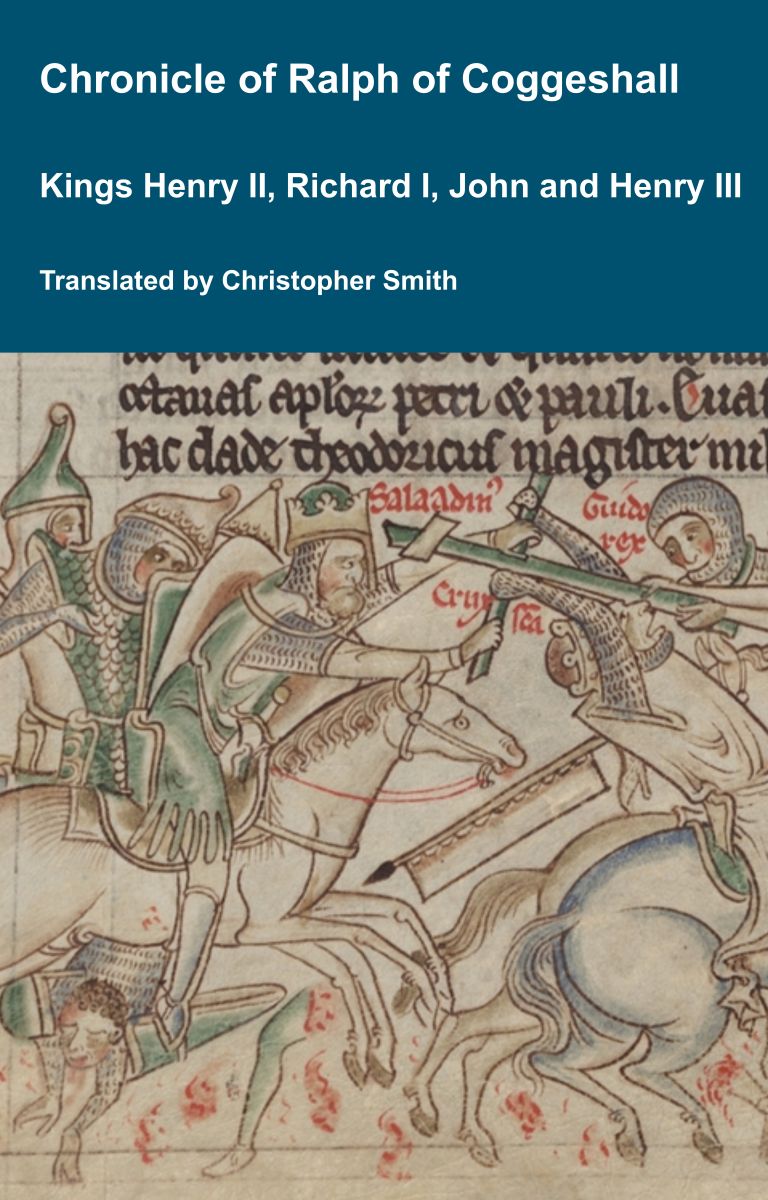
Chronicle of Abbot Ralph of Coggeshall
The Chronicle of Abbot Ralph of Coggeshall (Chronicon Anglicanum) is an indispensable medieval history that brings to life centuries of English and European affairs through the eyes of a learned Cistercian monk. Ralph of Coggeshall, abbot of the Abbey of Coggeshall in Essex in the early 13th century, continued and expanded his community’s chronicle, documenting events from the Norman Conquest of 1066 into the tumultuous reign of King Henry III. Blending eyewitness testimony, careful compilation, and the monastic commitment to record-keeping, this chronicle offers a rare narrative of political intrigue, royal power struggles, and social upheaval in England and beyond. Ralph’s work captures the reigns of pivotal figures such as Richard I and King John, providing invaluable insights into their characters, decisions, and the forces that shaped medieval rule. More than a simple annal, Chronicon Anglicanum conveys the texture of medieval life and governance, making it a rich source for scholars and readers fascinated by English history, monastic authorship, and the shaping of the medieval world.
Available at Amazon in eBook and Paperback format.
In 1713 James "Athenian" Stuart was born in Creed Lane Ludgate Street Ludgate.