

William of Worcester's Chronicle of England
William of Worcester, born around 1415, and died around 1482 was secretary to John Fastolf, the renowned soldier of the Hundred Years War, during which time he collected documents, letters, and wrote a record of events. Following their return to England in 1440 William was witness to major events. Twice in his chronicle he uses the first person: 1. when writing about the murder of Thomas, 7th Baron Scales, in 1460, he writes '… and I saw him lying naked in the cemetery near the porch of the church of St. Mary Overie in Southwark …' and 2. describing King Edward IV's entry into London in 1461 he writes '… proclaimed that all the people themselves were to recognize and acknowledge Edward as king. I was present and heard this, and immediately went down with them into the city'. William’s Chronicle is rich in detail. It is the source of much information about the Wars of the Roses, including the term 'Diabolical Marriage' to describe the marriage of Queen Elizabeth Woodville’s brother John’s marriage to Katherine, Dowager Duchess of Norfolk, he aged twenty, she sixty-five or more, and the story about a paper crown being placed in mockery on the severed head of Richard, 3rd Duke of York.
Available at Amazon in eBook and Paperback format.
Pontefract is in South Yorkshire.
See: All Saints Church, Pontefract [Map], Kirkebi Saxon Church, Pontefract [Map], Pontefract Castle [Map], Pontefract Priory [Map], The Booths, Pontefract [Map].
In 1093 Ilbert Lacy 1st Baron Pontefract [aged 48] died at Pontefract [Map]. His son Robert [aged 18] succeeded 2nd Baron Pontefract.
On 1st October 1211 Roger Lacy 6th Baron Pontefract 7th Baron Halton [aged 40] died in Pontefract [Map].
John Lacy Earl Lincoln [aged 19] succeeded 8th Baron Halton, 7th Baron Pontefract. Alice Aquila Baroness Bowland, Halton and Lacy by marriage Baroness Halton, Baroness Pontefract.
In 1214 John Lacy Earl Lincoln [aged 22] and Alice Aquila Baroness Bowland, Halton and Lacy were married at Pontefract [Map].
On 1st March 1322 Bartholomew Badlesmere 1st Baron Badlesmere [aged 46] reached at Pontefract [Map].
On 16th March 1322 the rebel army led by Thomas Plantagenet 2nd Earl of Leicester, 2nd Earl Lancaster, Earl of Salisbury and Lincoln [aged 44] attempted to cross the bridge over the River Ure (between Ripon and York) at Boroughbridge Bridge [Map]. Their path was blocked by forces loyal to the King led by Andrew Harclay 1st Earl Carlisle [aged 52]. Bartholomew Badlesmere 1st Baron Badlesmere [aged 46], Roger Mortimer 1st Earl March [aged 34], John Botetort 1st Baron Botetort [aged 57] and John Maltravers 1st Baron Maltravers [aged 32] fought for the rebels. Roger Clifford 2nd Baron Clifford [aged 22], Nicholas Longford [aged 37], Thomas Plantagenet 2nd Earl of Leicester, 2nd Earl Lancaster, Earl of Salisbury and Lincoln, John Mowbray 2nd Baron Mowbray [aged 35] were captured.
Warin Lisle [aged 51] was hanged after the battle at Pontefract [Map].
Following the battle Hugh Audley 1st Earl Gloucester [aged 31] and his wife Margaret Clare Countess Gloucester were both imprisoned. He in Nottingham Castle [Map] and she in Sempringham Priory [Map].
John Clinton 2nd Baron Clinton [aged 22], Ralph Greystoke 1st Baron Greystoke [aged 22], William Latimer 2nd Baron Latimer of Corby [aged 46], Robert Lisle 1st Baron Lisle [aged 34], Domhnall Mar II Earl of Mar [aged 29] and Peter Saltmarsh [aged 42] fought for the King.
Adam Everingham 1st Baron Everingham of Laxton [aged 43] was captured.
Humphrey Bohun 4th Earl Hereford 3rd Earl Essex [aged 46] was killed. His son John [aged 15] succeeded 5th Earl Hereford, 4th Earl Essex.
Piers Grandison 2nd Baron Grandison [aged 31] fough for the rebels, and was captured.
Hugh Audley 1st Baron Audley of Stratton Audley [aged 55] surrendered before the battle and was imprisoned in Wallingford Castle [Map] for the rest of his life
John Giffard 2nd Baron Giffard Brimpsfield [aged 34] was captured.
Roger Mortimer 1st Earl March was imprisoned at Tower of London [Map].


The History of King Richard the Third by Thomas More. 1st May 1483. And as soon as they came in his presence, they alighted down with all their company about them. To whom the Duke of Buckingham [aged 28] said, "Go before, gentlemen and yeomen, keep your rooms." And thus in a goodly array, they came to the King [aged 12] and, on their knees in very humble fashion, assuaged his Grace, who received them in very joyous and amiable manner, nothing earthly knowing nor mistrusting as yet. But even by and by, in his presence, they picked a quarrel with the Lord Richard Grey [aged 26], the King's other brother by his mother, saying that he, with the Lord Marquis [aged 28] his brother and the Lord Rivers [aged 43] his uncle, had planned to rule the King and the realm, and to set variance among the lords, and to subdue and destroy the noble blood of the realm. Toward the accomplishing whereof, they said that the Lord Marquis had entered into the Tower of London [Map], and thence taken out the King's treasure, and sent men to the sea. All of which things, these dukes knew well, were done for good purposes and necessary ones by the whole council at London, except that they must say something.
Unto which words, the King answered, "What my brother marquis has done I cannot say. But in good faith I dare well answer for mine uncle Rivers and my brother here, that they be innocent of any such matters.".
"Yea, my Liege," said the Duke of Buckingham, "they have kept their dealing in these matters far from the knowledge of your good Grace.".
And forthwith they arrested the Lord Richard and Sir Thomas Vaughan [aged 73], knight, in the King's presence, and brought the King and all back unto Northampton [Map], where they took again further counsel. And there they sent away from the King whomever it pleased them, and set new servants about him, such as liked them better than him. At which dealing he wept and was nothing content, but it remedied not. And at dinner the Duke of Gloucester [aged 30] sent a dish from his own table to the Lord Rivers, praying him to be of good cheer, all should be well enough. And he thanked the Duke, and prayed the messenger to bear it to his nephew, the Lord Richard, with the same message for his comfort, who he thought had more need of comfort, as one to whom such adversity was foreign. But for himself, he had been all his days used to a life therewith, and therefore could bear it the better. But for all this comfortable courtesy of the Duke of Gloucester, he sent the Lord Rivers and the Lord Richard with Sir Thomas Vaughan into the north country to different places to prison and, afterwards, all to Pomfrait [Map], where they were, in conclusion, beheaded.
On 18th January 1537 Francis Bigod [aged 29]... "Though the commons at first had me in suspicion for my learning and conversation with such a lewd one as they judged were enemies both to Christ's Church and the commonwealth, and I was even in danger of my life at Pountefrett [Map], they have now the greatest confidence in me. Now messengers come from Bishopric, Richmondshire, and the West, for me to go forward with the commons, especially to bring John Halom, whom the mayor of Hull has imprisoned, to their great offence. I have sworn to go with the commons having good reason to doubt the Duke of Norfolk is coming rather to bring them to captivity like those of Lincolnshire than to fulfil our petitions. There is no man they trust so much as Constable whom Bygott would gladly join and follow his advice, if he will be true to them." He begs an answer and sends a copy of their oath.
In 1594 Bishop John Bramhall was born in Pontefract [Map].
In 1626 Francis Foljambe 1st Baronet [aged 36] was elected MP Pontefract.
John Evelyn's Diary. 17th August 1654. Passed through Pontefract [Map]; the richard castle famous for many sieges both of late and ancient times, and the death of that unhappy King murdered in it, was now demolishing by the Rebels; it stands on a mount, and makes a goodly show at a distance. The Queen [aged 44] has a house here, and there are many fair seats near it, especially Mr. Pierrepont's [aged 48], built at the foot of a hill out of the castle ruins. We all alighted in the highway to drink at a crystal spring, which they call Robin Hood's Well; near it, is a stone chair, and an iron ladle to drink out of, chained to the seat. We rode to Tadcaster [Map], at the side of which we have prospect of the Archbishop's Palace (which is a noble seat), and in sight of divers other gentlemen's fair houses. This tract is a goodly, fertile, well-watered, and wooded country, abounding with pasture and plenty of provisions.

In 1747 William Monckton aka Monckton-Arundell 2nd Viscount Galway [aged 22] was elected MP Pontefract which seat he held until 1748.
In 1754 William Monckton aka Monckton-Arundell 2nd Viscount Galway [aged 29] was elected MP Pontefract which seat he held until 1772.
In 1780 Robert Monckton-Arundell 4th Viscount Galway [aged 27] was elected MP Pontefract which seat he held until 1783.
In 1796 Robert Monckton-Arundell 4th Viscount Galway [aged 43] was elected MP Pontefract which seat he held until 1802.
In 1806 Robert Pemberton Milnes [aged 21] was elected MP Pontefract which seat he held until 1818.
In 1885 Rowland Winn 2nd Baron St Oswald [aged 27] was elected MP Pontefract.
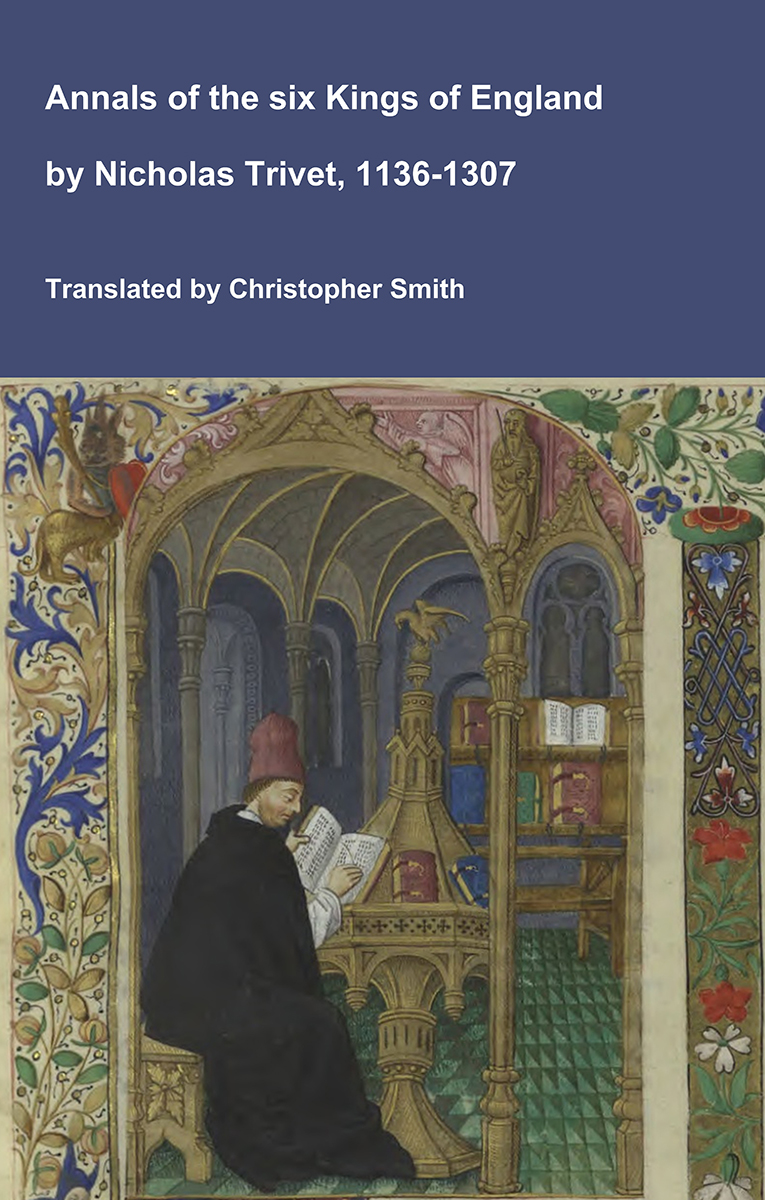
Annals of the six Kings of England by Nicholas Trivet
Translation of the Annals of the Six Kings of England by that traces the rise and rule of the Angevin aka Plantagenet dynasty from the mid-12th to early 14th century. Written by the Dominican scholar Nicholas Trivet, the work offers a vivid account of English history from the reign of King Stephen through to the death of King Edward I, blending political narrative with moral reflection. Covering the reigns of six monarchs—from Stephen to Edward I—the chronicle explores royal authority, rebellion, war, and the shifting balance between crown, church, and nobility. Trivet provides detailed insight into defining moments such as baronial conflicts, Anglo-French rivalry, and the consolidation of royal power under Edward I, whose reign he describes with particular immediacy. The Annals combines careful year-by-year reporting with thoughtful interpretation, presenting history not merely as a sequence of events but as a moral and political lesson. Ideal for readers interested in medieval history, kingship, and the origins of the English state, this chronicle remains a valuable and accessible window into the turbulent world of the Plantagenet kings.
Available at Amazon in eBook and Paperback format.
Between 1200 and 1500 the original All Saints Church, Pontefract [Map] was constructed. It is noted for its double-helix staircase.
In 1645 All Saints Church, Pontefract [Map] was ruined during the Civil War.
In 1831 the Tower and Transept of All Saints Church, Pontefract [Map] were restored.
In 1967 a new Nave was constructed at All Saints Church, Pontefract [Map].
See Priories in England.
In 1090 Robert Lacy 2nd Baron Pontefract [aged 15] founded at Pontefract Priory [Map].
Pontefract Priory [Map] was a Cluniac monastery founded about 1090 by Robert Lacy 2nd Baron Pontefract [aged 15]. It was dedicated to St. John the Evangelist. The Priory was a dependency of the Abbey of la Charité-sur-Loire, which supplied the first monks.
On 22nd March 1322 Thomas Plantagenet 2nd Earl of Leicester, 2nd Earl Lancaster, Earl of Salisbury and Lincoln [aged 44] was beheaded at Pontefract Castle [Map] following his capture six days before at the Battle of Boroughbridge. He was buried at Pontefract Priory [Map]. Earl of Leicester, Earl Lancaster forfeit.
After 30th December 1460 Edmund York 1st Earl of Rutland [deceased] was buried at Pontefract Priory [Map].

Collectanea by John Leland [1502-1552]. The XIIIIth Day of the Monneth [14th July 1503] the Quene [aged 13] departed from the sayd Place, right noble accompaned, and the sayd Mayor, Aldermen, and Bourgesses were att the End of the Towne, without gowyng any fourther.
After that she drew to her Lodgyng at Pontfret, and seyve Mylle from thence cam to hyr Sir John Melton, well arayd, and with him eight Men well horsyd makyng Gambads. Also XIII Horse well appoynted of his Liveray.
Fore Mylle nyer to the sayd Place cam Sir William Gaskyn, having in hys Company many Gentylmen of his Hous, and others, to the Nomber of 100 Horsys well apoynted of his Liveray.
Att two Mylle nyer to the sayd Place Sir John Savyll mett hyr, to the Nomber of XIII Horsys well appoynted.
Item, many other noble Sqyers, and Gentilmen of Yorkshire, well mounted and appoynted, and their Servants also cam to hyr.
Att the Intryng of the sayd Pontfret was the Mayor alone on Horsback, with the Baylys, Bourges, and Habitants all a Foot, who resayved the sayd Queene as the other Precedents.
And ther was the College of the said Place, togeder with the Freres Jacobyns in Processyon, honnestly revested. This don, after the Custome before, she entred within the sayd Towne in fayre Ordre. The wich Thing was very fayre for to se with muche People of the sayd Towne, and of the Contre thereabout.
In the Midds of the fayd Towne wer the Religyous of the Trinite revested, and the Offring hyr the Crosse for to kiss was done by the sayd Bischop in such Manner as before.
And so shee past thorough the sayd Town, and thorough the Castell, to the Abbay [Map]. Wher th' Abbot in Pontificalis, and all the Convent att the Porte of the Church, revested, resayved her. The wiche kissed the Crolfe, and entred within the sayd Church, where she maid her Prayers, and after went to her Lodginge within the sam Place for that Night.