


Anne Boleyn. Her Life as told by Lancelot de Carle's 1536 Letter.
In 1536, two weeks after the execution of Anne Boleyn, her brother George and four others, Lancelot du Carle, wrote an extraordinary letter that described Anne's life, and her trial and execution, to which he was a witness. This book presents a new translation of that letter, with additional material from other contemporary sources such as Letters, Hall's and Wriothesley's Chronicles, the pamphlets of Wynkyn the Worde, the Memorial of George Constantyne, the Portuguese Letter and the Baga de Secrets, all of which are provided in Appendices.
Available at Amazon in eBook and Paperback format.
Upper Thames Street is in Thames Street.
Henry Machyn's Diary. 3rd April 1557. The iij day of Aprell dyd pryche doctur Wattsun [aged 42] bysshope of Lynckolne at Allallows the Mor in ... at after-non, wher was grett audyens of pepull.
Henry Machyn's Diary. 20th September 1558. The xx day of September was bered at Gret All[hallows] in Temstrett the altherman of the Steleard, with ij whyt branchys and xij torchys, and iiij gret tapurs with ....
On or before 24th April 1696 Robert Wooley [aged 58] died. He was buried at All Hallows the Great Church on 24th April 1696.
In March 1423 Richard "Dick" Whittington [aged 69] died without issue. He was buried at St Michael Paternoster Royal Church; the monument is now lost.
Henry Machyn's Diary. 16th October 1555. [The same day were burnt at Oxford for heresy doctor Latimer [aged 68], late bishop of Worcester, and doctor Ridley [aged 55],] late bysshope of London; [they were some] tyme grett prychers as ever was; and at ther bornyng dyd pryche doctur Smyth, sum-tyme the master of Vetyngtun colege (blank).
Henry Machyn's Diary. October 1561. The sam day of October was bered in Whytyngtun colege master Alesandur Karlelle [aged 33] the master of the Vyntoners, the wyche he mared the dowther [aged 28] of ser George Barnes knyght, [late] mare of the nobull cete of London and haburdassher; and he gayff a xx blake gownes, and he gayff (blank) mantyll [frieze] gowne(s) unto (blank) pore men; and ther wher the Clarkes of London syngyng, and [master] Crolley dyd pryche, and then to the plase to denner, and a dolle, and a ij dozen of kochyons of armes, and the leverey of the Vyntonars.
On 14th April 1587 Edward Manners 3rd Earl of Rutland [aged 37] died at his home Ivy Bridge on the Strand [Map] or at Puddle Wharf aka Dock [Map]. He was buried at St Mary the Virgin Church, Bottesford, Leicestershire [Map]. His daughter Elizabeth [aged 12] succeeded 15th Baroness Ros Helmsley. His brother John [aged 36] succeeded 4th Earl of Rutland. Elizabeth Charlton Countess Rutland [aged 34] by marriage Countess of Rutland. He would be Earl for ten months only dying on 24 Feb 1588.
Robert Constable [aged 65] was one of the principal mourners at his funeral.
Samuel Pepys' Diary. 26th June 1660. My Lord dined at his lodgings all alone to-day. I went to Secretary Nicholas [aged 67]1 to carry him my Lord's resolutions about his title, which he had chosen, and that is Portsmouth2. I met with Mr. Throgmorton, a merchant, who went with me to the old Three Tuns, at Charing Cross, who did give me five pieces of gold for to do him a small piece of service about a convoy to Bilbo, which I did. In the afternoon, one Mr. Watts came to me, a merchant, to offer me £500 if I would desist from the Clerk of the Acts place. I pray God direct me in what I do herein. Went to my house, where I found my father, and carried him and my wife to Whitefriars, and myself to Puddlewharf [Map], to the Wardrobe, to Mr. Townsend, who went with me to Backwell, the goldsmith's, and there we chose £100 worth of plate for my Lord to give Secretary Nicholas. Back and staid at my father's [aged 59], and so home to bed.
Note 1. Sir Edward Nicholas, Secretary of State to Charles I and II. He was dismissed from his office through the intrigues of Lady Castlemaine [aged 19] in 1663. He died 1669, aged seventy-seven.
Note 2. Montagu changed his mind, and ultimately took his title from the town of Sandwich, Kent [Map], leaving that of Portsmouth for the use of a King's [aged 30] mistress [aged 10].
Samuel Pepys' Diary. 3rd September 1662. I took him in the tavern at Puddle dock [Map], but neither he nor I drank any of the wine we called for, but left it, and so after discourse parted, and Mr. Townsend not being at home I went to my brother's, and there heard how his love matter proceeded, which do not displease me, and so by water to White Hall to my Lord's lodgings, where he being to go to Hinchingbroke to-morrow morning, I staid and fiddled with Will Howe some new tunes very pleasant, and then my Lord came in and had much kind talk with him, and then to bed with Mr. Moore there alone. So having taken my leave of my Lord before I went to bed, I resolved to rise early and be gone without more speaking to him [Continued tomorow]
Henry Machyn's Diary. 26th August 1557. The xxvj day of August was bered master (blank) Barenteyn sqwyre, with cott armur, and penon of armes, and ij dosen of skochyons, ij whyt branchys, and xij stayffes torchys, iiij grett tapurs; bered in sant Mare Somersett at Broken-warff; and he had a godly masse of owre Lade in pryke songe; and after a masse of requiem songe, and so ys cote offered; and after a grett dener.
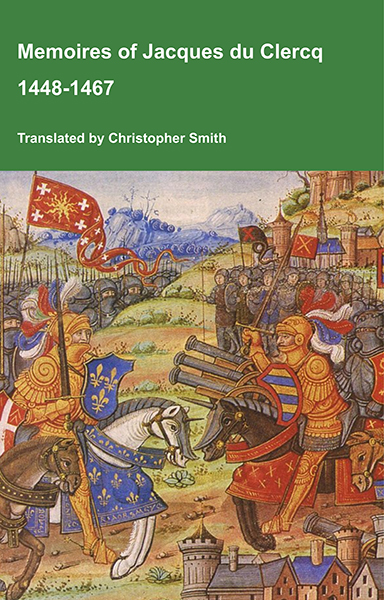
This is a translation of the 'Memoires of Jacques du Clercq', published in 1823 in two volumes, edited by Frederic, Baron de Reissenberg. In his introduction Reissenberg writes: 'Jacques du Clercq tells us that he was born in 1424, and that he was a licentiate in law and a counsellor to Philip the Good, Duke of Burgundy, in the castellany of Douai, Lille, and Orchies. It appears that he established his residence at Arras. In 1446, he married the daughter of Baldwin de la Lacherie, a gentleman who lived in Lille. We read in the fifth book of his Memoirs that his father, also named Jacques du Clercq, had married a lady of the Le Camelin family, from Compiègne. His ancestors, always attached to the counts of Flanders, had constantly served them, whether in their councils or in their armies.' The Memoires cover a period of nineteen years beginning in in 1448, ending in in 1467. It appears that the author had intended to extend the Memoirs beyond that date; no doubt illness or death prevented him from carrying out this plan. As Reissenberg writes the 'merit of this work lies in the simplicity of its narrative, in its tone of good faith, and in a certain air of frankness which naturally wins the reader’s confidence.' Du Clercq ranges from events of national and international importance, including events of the Wars of the Roses in England, to simple, everyday local events such as marriages, robberies, murders, trials and deaths, including that of his own father in Book 5; one of his last entries.
Available at Amazon in eBook and Paperback format.
Henry Machyn's Diary. 16th April 1560. The xvj day of Aprell was bered in the parryche of sant Myghell in Quen-heyff master John Bedy .. sqwyre latt clarke of the gren cloth unto quen [Mary?] with the compene of the Clarkes of London, and then cam the morners, and then the corse, with vj skochyons with ys armes a-pone hym, and master Beycun [aged 48] mad the sermon, and after to ys plasse to dener, for ther was a grett [dinner].
Henry Machyn's Diary. 30th August 1559. The xxx day of August was bered, in sant Thomas apostylle, captayn Matsun, with xx [20] clarkes syngyng, and armes a-bowtt hym, and bered in the qwyre.