

Chronicle of Walter of Guisborough
A canon regular of the Augustinian Guisborough Priory, Yorkshire, formerly known as The Chronicle of Walter of Hemingburgh, describes the period from 1066 to 1346. Before 1274 the Chronicle is based on other works. Thereafter, the Chronicle is original, and a remarkable source for the events of the time. This book provides a translation of the Chronicle from that date. The Latin source for our translation is the 1849 work edited by Hans Claude Hamilton. Hamilton, in his preface, says: 'In the present work we behold perhaps one of the finest samples of our early chronicles, both as regards the value of the events recorded, and the correctness with which they are detailed; Nor will the pleasing style of composition be lightly passed over by those capable of seeing reflected from it the tokens of a vigorous and cultivated mind, and a favourable specimen of the learning and taste of the age in which it was framed.'
Available at Amazon in eBook and Paperback format.
Bishop of Lichfield is in Bishop. See Lichfield Cathedral [Map].
See: Bishop of Coventry.
In 664 Bishop Chad of Mercia was elected Bishop of Lichfield.
After 672 Bishop Winfrith was elected Bishop of Lichfield.
Bede. 2nd March 672. Ceadda died on the 2nd of March, and was first buried by St. Mary's Church [Map], but afterwards, when the church [Map] of the most holy prince of the apostles, Peter, was built, his bones were translated into it. In both which places, as a testimony of his virtue, frequent miraculous cures are wont to be wrought. And of late, a certain distracted person, who had been wandering about everywhere, arrived there in the evening, unknown or unregarded by the keepers of the place, and having rested there all the night, went out in his perfect senses the next morning, to the surprise and delight of all; thus showing that a cure had been performed on him through the goodness of God. The place of the sepulchre is a wooden monument, made like a little house, covered, having a hole in the wall, through which those that go thither for devotion usually put in their hand and take out some of the dust, which they put into water and give to sick cattle or men to drink, upon which they are presently eased of their infirmity, and restored to health. In his place, Theodore [aged 70] ordained Winfrid, a good and modest man, to preside, as his predecessors had done, over the bishoprics of the Mercians, the Midland Angles, and the Lindisfarnes, of all which, Wulfhere [aged 32], who was still living, was king. Winfrid was one of the clergy of the prelate he had succeeded, and had for a considerable time filled the office of deacon under him.
Bede. 673. "In the name of our Lord God and Saviour Jesus Christ, who reigns for ever and for ever, and governs his church, it was thought meet that we should assemble, according to the custom of the venerable canons, to treat about the necessary affairs of the church. We met on the 24th day of September, the first indiction, at a place called Hertford, Hertfordshire [Map], myself, Theodore [aged 71], the unworthy bishop of the see of Canterbury, appointed by the Apostolic See, our fellow-priest and most reverend brother, Bisi, bishop of the East Angles; also by his proxies, our brother and fellow-priest, Wilfrid, bishop of the nation of the Northumbrians, as also our brothers and fellow priests, Putta, bishop of the Kentish castle, called Rochester; Eleutherius, bishop of the West Saxons, and Winfrid, bishop of the province of the Mercians. When we were all met together, and were sat down in order, I said, ' I beseech you, most dear brothers, for the love and fear of our Redeemer, that we may all treat in common for our faith; to the end that whatsoever has been decreed and defined by the holy and revered fathers, may be inviolably observed by all.' This and much more I spoke tending to the preservation of the charity and unity of the church; and when I had ended my discourse, I asked every one of them in order, whether they consented to observe the things that had been formerly canonically decreed by the fathers? To which all our fellow-priests answered, ' It so pleases us, and we will all most willingly observe with a cheerful mind whatever is laid down in the canons of the holy fathers.' I then produced the said book of canons, and publicly showed them ten chapters in the same, which I had marked in several places, because I knew them to be of the most importance to us, and entreated that they might be most particularly received by them all.
Bede. 674. Not long after, Theodore [aged 72], the archbishop, taking offence at some disobedience of Winfrid, bishop of the Mercians, deposed him from his bishopric when he had his place. been possessed of it but a few years, and in his place made Sexwulf bishop, who was founder and abbot of the monastery of Medeshamstead, in the country of the Girvii. Winfrid, thus deposed, returned to his monastery of Barve [Note. Unknown location], and there ended his life in holy conversation.
Before 729 Bishop Aldwine was appointed Bishop of Lichfield and Bishop of Leicester.
In 779 Bishop Hygeberht was appointed Bishop of Lichfield.
Anglo-Saxon Chronicle. 785. This year died Bothwin, Abbot of Ripon, and a litigious synod was holden at Chalk-hythe; Archbishop Eanbert resigned some part of his bishopric, Hibbert was appointed bishop by King Offa, and Everth was consecrated king. In the meantime legates were sent from Rome to England by Pope Adrian, to renew the blessings of faith and peace which St. Gregory sent us by the mission of Bishop Augustine, and they were received with every mark of honour and respect.
In 958 a charter of King Edgar I of England [aged 15] describes Penkridge, Staffordshire [Map] as a "famous place". St Michael's Church, Penkridge [Map] was established as a Royal Free Chapel making it a Royal Peculiar. The church was independent of the Bishop of Lichfield and, correspondingly, the Archbishop of Canterbury.
In or before 1026 Bishop Brihtmær was consecrated Bishop of Lichfield.
In 1039 Bishop Wulfsige was consecrated Bishop of Lichfield.
Chronicon ex Chronicis by Florence and John of Worcester. 1053. In the month of October died Wulfsige, bishop of Litchfield, Godwin [aged 52], abbot of Winchcombe, and Ethelward, abbot of Glastonbury. Leofwine, abbot of Coventry, succeeded Wulfsige; and Ethelnoth, a monk of the same monastery, succeeded Ethelward. But Aldred, bishop of Worcester, kept the abbey of Winchcombe in his own hands until such tune as he appointed Godric, the son of Goodman, the king's chaplain, to be abbot. Ælfric, brother of earl Odda [aged 60], died at Deerhurst on the eleventh of the calends of January [22nd December], but he was buried in the monastery at Pershore [Map].
Abbot John Whethamstede’s Chronicle of the Abbey of St Albans
Abbot John Whethamstede's Register aka Chronicle of his second term at the Abbey of St Albans, 1451-1461, is a remarkable text that describes his first-hand experience of the beginning of the Wars of the Roses including the First and Second Battles of St Albans, 1455 and 1461, respectively, their cause, and their consequences, not least on the Abbey itself. His text also includes Loveday, Blore Heath, Northampton, the Act of Accord, Wakefield, and Towton, and ends with the Coronation of King Edward IV. In addition to the events of the Wars of the Roses, Abbot John, or his scribes who wrote the Chronicle, include details in the life of the Abbey such as charters, letters, land exchanges, visits by legates, and disputes, which provide a rich insight into the day-to-day life of the Abbey, and the challenges faced by its Abbot.
Available at Amazon in eBook and Paperback format.
Anglo-Saxon Chronicle. 1053. About this time was the great wind, on the mass-night of St. Thomas; which did much harm everywhere. And all the midwinter also was much wind. It was this year resolved to slay Rees, the Welsh king's brother, because he did harm; and they brought his head to Gloucester on the eve of Twelfth-day. In this same year, before Allhallowmas, died Wulfsy, Bishop of Lichfield; and Godwin, Abbot of Winchcomb; and Aylward, Abbot of Glastonbury; all within one month. And Leofwine, Abbot of Coventry, took to the bishopric at Lichfield; Bishop Aldred to the abbacy at Winchcomb; and Aylnoth took to the abbacy at Glastonbury. The same year died Elfric, brother of Odda [aged 60], at Deerhurst, Gloucestershire; and his body resteth at Pershore [Map].
Chronicon ex Chronicis by Florence and John of Worcester. 1127. A synod held at Westminster. William [aged 57], archbishop of Canterbury, convened a general synod of all the bishops and abbots, and some men of religion from all parts of England, at the monastery of St. Peter, situated in the western part of London. At this synod he himself presided as archbishop of Canterbury and legate of the apostolic see; assisted by William, bishop of Winchester, Roger of Salisbury, William of Exeter, Hervey of Ely, Alexander of Lincoln, Everard of Norwich, Sigefrid of Chichester, Richard of Hereford, Geoffrey of Bath, John of Rochester, Bernard of St. David's in Wales, Urban of Glamorgan of Llandaff [aged 51], and David of Bangor. Richard, bishop of London, and Robert, bishop of Chester1, were then dead, and no successors had yet been appointed to their sees. But Thurstan [aged 57], archbishop of York, sent messengers with letters assigning reasonable cause for his non-appearance at the convocation. Ralph [aged 67], bishop of Durham, fell sick on the road, and was not able to complete the journey, as the prior of his church and the clerks whom he sent forward solemnly attested. Simon, bishop of Worcester, had gone to visit his relations beyond seas, and was not yet returned. Great multitudes, also, of the clergy and laity, both rich and poor, flocked together, and there was a numerous and important meeting. The council sat for three days, namely, the third of the ides [the 13th] of May, the following day, and the third day afterwards, being the seventeenth of the calends of June [16th May]. There were some proceedings with respect to secular affairs; some were determined, some adjourned, and some withdrawn from the hearing of the judges, on account of the disorderly conduct of the immense crowd. But the decrees and statutes made in this synod by common consent of the bishops we have thought it desirable to record in this work, as they were there publicly declared and accepted. They are these:-
I. We wholly prohibit, by the authority of St. Peter, prince of the apostles, and our own, the buying and selling of any ecclesiastical benefices, or any ecclesiastical dignities whatever. Whoever shall be convicted of having violated this decree, if he be a clerk, or even a regular canon, or a monk, let him be degraded from his order; if a layman, let him be held outlawed and excommunicated, and be deprived of his patronage of the church or benefice.
II. We totally interdict, by the authority of the apostolic see, the ordination or promotion of any person in the church of God, for the sake of lucre.
III. We condemn certain payments of money exacted for the admission of canons, monks, and nuns.
IV. No one shall be appointed a dean but a priest, and no one but a deacon, archdeacon. If any one in minor orders be named to these dignities he shall be enjoined by the bishop to take the orders required. But if he disobey the bishop's monition to take such orders, he shall lose his appointment to the dignity.
V. We utterly interdict all illicit intercourse with women, as well by priests, deacons, and sub-deacons, as by all canons. If, however, they will retain their concubines (which God forbid), or their wives, they are to be deprived of their ecclesiastical orders, their dignity, and benefice. If there be any such among parish priests, we expel them from the chancel, and declare them infamous. Moreover, we command, by the authority of God and our own, all archdeacons and officials, whose duty it is, to use the utmost care and diligence in eradicating this deadly evil from the church of God. If they be found negligent in this, or (which God forbid) consenting thereto, they are for the first and second offence to be duly corrected by the bishops, and for the third to be punished more severely, according to the canons.
VI. The concubines of priests and canons shall be expelled from the parish, unless they shall have contracted a lawful marriage there. If they are found afterwards offending, they shall be arrested by the officers of the church, in whatever lordship they may be; and we command, under pain of excommunication, that they be not sheltered by any jurisdiction, either inferior or superior, but truly delivered up to the officer of the church, to be subjected to ecclesiastical discipline, or reduced to bondage, according to the sentence of the bishop.
VII. We prohibit, under pain of excommunication, any archdeacon from holding several archdeaconriesin different dioceses; let him retain that only to which he was first appointed.
VIII. Bishops are to prohibit all priests, abbots, monks, and priors, subject to their jurisdiction, from holding farms.
IX. We command that tithes be honestly paid, for they are the sovereign right of the most high God.
X. We forbid, by canonical authority, any person from giving or receiving churches or tithes, or other ecclesiastical benefices, without the consent and authority of the bishop. R2
XI. No abbess or nun is to use garments of richer material than lamb's-wool or cat-skin.
Note 1. The bishopric of Lichfield was removed to Chester in 1075, but again restored to its former seat. The present bishopric of Chester is one of the new sees founded after the Reformation.
Before 1200 until the 1860s Eccleshall Castle, Staffordshire [Map] was the residence of the Bishop of Lichfield and, consequently, a number of Bishops of Lichfield are buried its church [Map].
On 20th February 1296 Bishop Walter Langton was elected Bishop of Lichfield.
On 27th June 1322 Roger Northburgh was consecrated Bishop of Coventry and LIchfield.
On 18th August 1386 Archbishop Richard Scrope [aged 36] was appointed Bishop of Lichfield.
On 2nd July 1398 Bishop John Burghill was translated to Bishop of Lichfield.
On 20th September 1459 Bishop John Hales [aged 59] was elected Bishop of Lichfield.
On 25th November 1459 Bishop John Hales [aged 59] was consecrated Bishop of Coventry and Lichfield.
On 3rd February 1492 Bishop William Smyth [aged 32] was consecrated Bishop of Lichfield and Coventry by Cardinal John Morton [aged 72].
The History of William Marshal was commissioned by his son shortly after William’s death in 1219 to celebrate the Marshal’s remarkable life; it is an authentic, contemporary voice. The manuscript was discovered in 1861 by French historian Paul Meyer. Meyer published the manuscript in its original Anglo-French in 1891 in two books. This book is a line by line translation of the first of Meyer’s books; lines 1-10152. Book 1 of the History begins in 1139 and ends in 1194. It describes the events of the Anarchy, the role of William’s father John, John’s marriages, William’s childhood, his role as a hostage at the siege of Newbury, his injury and imprisonment in Poitou where he met Eleanor of Aquitaine and his life as a knight errant. It continues with the accusation against him of an improper relationship with Margaret, wife of Henry the Young King, his exile, and return, the death of Henry the Young King, the rebellion of Richard, the future King Richard I, war with France, the death of King Henry II, and the capture of King Richard, and the rebellion of John, the future King John. It ends with the release of King Richard and the death of John Marshal.
Available at Amazon in eBook and Paperback format.
On 1st October 1492 Bishop Oliver King [aged 60] was appointed Bishop of Exeter.
On 1st October 1492 Bishop William Smyth [aged 32] was appointed Bishop of Lichfield and Coventry.
On 27th May 1502 Bishop Geoffrey Blythe was special ambassador to Vladislas II, King of Hungary and Bohemia, and on his return was appointed Bishop of Lichfield.
In January 1534 Bishop Rowland Lee aka Leigh [aged 47] was appointed Bishop Coventry and Lichfield which at the time was known as Bishop of Chester.
On 19th February 1544 Bishop Richard Sampson was translated to Bishop of Lichfield.
In 1553 Bishop William Overton [aged 28] was elected Bishop Lichfield and Coventry.
On 18th November 1554 Bishop Ralph Baines [aged 50] was consecrated Bishop of Lichfield.
In 1559 Bishop Thomas Bentham [aged 45] was appointed Bishop of Coventry and Lichfield.
In 1610 Archbishop Richard Neale [aged 47] was elected Bishop of Lichfield.
In 1632 Bishop Robert Wright [aged 72] was appointed Bishop of Lichfield.
In 1644 Archbishop Accepted Frewen [aged 55] was appointed Bishop of Lichfield.
In 1661 Bishop John Hacket [aged 68] was appointed Bishop of Lichfield.
In 1671 Bishop Thomas Wood [aged 64] was appointed Bishop of Lichfield.
Abbot John Whethamstede’s Chronicle of the Abbey of St Albans
Abbot John Whethamstede's Register aka Chronicle of his second term at the Abbey of St Albans, 1451-1461, is a remarkable text that describes his first-hand experience of the beginning of the Wars of the Roses including the First and Second Battles of St Albans, 1455 and 1461, respectively, their cause, and their consequences, not least on the Abbey itself. His text also includes Loveday, Blore Heath, Northampton, the Act of Accord, Wakefield, and Towton, and ends with the Coronation of King Edward IV. In addition to the events of the Wars of the Roses, Abbot John, or his scribes who wrote the Chronicle, include details in the life of the Abbey such as charters, letters, land exchanges, visits by legates, and disputes, which provide a rich insight into the day-to-day life of the Abbey, and the challenges faced by its Abbot.
Available at Amazon in eBook and Paperback format.
In 1692 Bishop William Lloyd [aged 64] was appointed Bishop of Lichfield and Coventry.
In 1731 Bishop Richard Smalbroke [aged 59] was translated to Bishop of Lichfield.
In 1768 Bishop John Egerton [aged 46] was appointed Bishop of Lichfield.

In 1771 Bishop Brownlow North [aged 29] was appointed Bishop of Lichfield.
In 1824 Bishop Henry Dudley Ryder [aged 46] was appointed Bishop of Lichfield.

On 23rd January 1840 Bishop James Bowstead [aged 39] was translated to Bishop of Lichfield.
In October 1843 Bishop John Lonsdale [aged 55] was elected Bishop of Lichfield.
On 3rd December 1843 Bishop John Lonsdale [aged 55] was consecrated Bishop of Lichfield.
On 24th June 1878 Archbishop William Dalrymple Maclagan [aged 52] was consecrated Bishop of Lichfield by Archbishop Campbell Tait at St Paul's Cathedral [Map].

On 28th September 1891 Bishop Augustus Legge [aged 51] was confirmed as Bishop of Lichfield at St Mary-le-Bow Church, Cheapside [Map]. He was consecrated Bishop at St Paul's Cathedral [Map] the following day by Archbishop Edward White Benson [aged 62].
Bede. HOW CEADDA, ABOVE-MENTIONED, WAS MADE BISHOP OF THE MERCIANS. OF HIS LIFE, DEATH, AND BURIAL.
At that time, the Mercians were governed by King Wulfhere, who, on the death of Jaruman, desired of Theodore to supply him and his people with a bishop; but Theodore would not obtain a new one for them, but requested of King Oswy that Ceadda might be their bishop. He then lived retired at his monastery, which is at Lestingau, Wilfrid filling the bishopric of York, and of all the Northumbrians, and likewise of the Picts, as far as the dominions of King Oswy extended. And, seeing that it was the custom of that most reverend prelate to go about the work of the Gospel to several places rather on foot than on horseback, Theodore commanded him to ride whenever he had a long journey to undertake, and finding him very unwilling to omit his former pious labour, he himself, with his hands, lifted him on the horse; for he thought him a holy man, and therefore obliged him to ride wherever lie had need to go. Ceadda having received the bishopric of the Mercians and Lindisfarne, took care to administer the same with great rectitude of life, according to the example of the ancients. King Wulfhere also gave him land of fifty families, to build a monastery, at the place called Barvc, or "The Wood," in the province of Lindsey, wherein marks of the regular life instituted by him continue to this day.
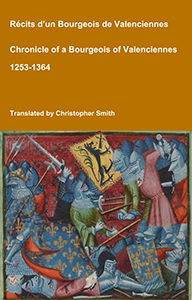
Chronicle of a Bourgeois of Valenciennes
Récits d’un bourgeois de Valenciennes aka The Chronicle of a Bourgeois of Valenciennes is a vivid 14th-century vernacular chronicle written by an anonymous urban chronicler from Valenciennes in the County of Hainaut. It survives in a manuscript that describes local and regional history from about 1253 to 1366, blending chronology, narrative episodes, and eyewitness-style accounts of political, military, and social events in medieval France, Flanders, and the Low Countries. The work begins with a chronological framework of events affecting Valenciennes and its region under rulers such as King Philip VI of France and the shifting allegiances of local nobility. It includes accounts of conflicts, sieges, diplomatic manoeuvres, and the impact of broader struggles like the Hundred Years’ War on urban life in Hainaut. Written from the perspective of a burgher (bourgeois) rather than a monastery or royal court, the chronicle offers a rare lay viewpoint on high politics and warfare, reflecting how merchants, townspeople, and civic institutions experienced the turbulence of the 13th and 14th centuries. Its narrative style combines straightforward reporting of events with moral and civic observations, making it a valuable source for readers interested in medieval urban society, regional politics, and the lived experience of war and governance in pre-modern Europe.
Available at Amazon in eBook and Paperback format.
Chronicon ex Chronicis by Florence and John of Worcester. 7th January 1121. Meanwhile, two clerks were chosen to fill sees which had been vacant for some time; namely, Richard, who was keeper of the king's seal under the chancellor, and Robert, who had filled the office of steward of the meat and drink in the king's household with great industry. The first of these was preferred to the see of Hereford, the latter to the see of Chester [Note. Bishop of Coventry?]. Herbert, also, a monk of Westminster, was made abbot of that monastery.
Richard, chosen bishop of Hereford on Friday the seventh of the ides [the 7th] of January, was consecrated at Lambeth on Sunday the seventeenth of the calends of February [17th January] by Ralph, archbishop of Canterbury, with the assistance of Richard, bishop of London, and the bishops, Robert of Lincoln, Arnulph of Rochester, Urban of Glamorgan [aged 45], and Bernard of St. David's.
Chronicon ex Chronicis by Florence and John of Worcester. 13th March 1121. After this, the archbishop, having accompanied the king [aged 53] to Abingdon [Map], consecrated on Sunday the third of the ides [the 13th] of March, Robert, before named, as bishop of Chester, there being present and assisting at this sacrament William, bishop of Winchester, William, bishop of Exeter, and the Welsh bishops, Urban [aged 45] and Bernard.
Chronicon ex Chronicis by Florence and John of Worcester. 12th June 1121. After a few days, one named Everard, attached to the king's chapel, was elected bishop of Norwich, and consecrated at Canterbury [Map] by archbishop Ralph on the second of the ides [the 12th] of June; Arnulph, bishop of Rochester, Richard, bishop of Hereford, and Robert, bishop of Coventry, having met for the purpose.
In 1239 Bishop Nicholas Farnham was elected Bishop of Coventry but he refused the offer.