

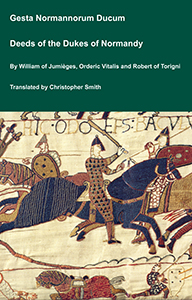
The Deeds of the Dukes of Normandy
The Gesta Normannorum Ducum [The Deeds of the Dukes of Normandy] is a landmark medieval chronicle tracing the rise and fall of the Norman dynasty from its early roots through the pivotal events surrounding the Norman Conquest of England. Originally penned in Latin by the monk William of Jumièges shortly before 1060 and later expanded at the behest of William the Conqueror, the work chronicles the deeds, politics, battles, and leadership of the Norman dukes, especially William’s own claim to the English throne. The narrative combines earlier historical sources with firsthand information and oral testimony to present an authoritative account of Normandy’s transformation from a Viking settlement into one of medieval Europe’s most powerful realms. William’s history emphasizes the legitimacy, military prowess, and governance of the Norman line, framing their expansion, including the conquest of England, as both divinely sanctioned and noble in purpose. Later chroniclers such as Orderic Vitalis and Robert of Torigni continued the history, extending the coverage into the 12th century, providing broader context on ducal rule and its impact. Today this classic work remains a foundational source for understanding Norman identity, medieval statesmanship, and the historical forces that reshaped England and Western Europe between 800AD and 1100AD.
Available at Amazon in eBook and Paperback format.
Bishop of Norwich is in Bishop. See Norwich Cathedral [Map].
In 1096 Bishop Herbert of Losinga commissioned the building of Norwich Cathedral [Map] and was appointed Bishop of Norwich.
Chronicon ex Chronicis by Florence and John of Worcester. 12th June 1121. After a few days, one named Everard, attached to the king's chapel, was elected bishop of Norwich, and consecrated at Canterbury [Map] by archbishop Ralph on the second of the ides [the 12th] of June; Arnulph, bishop of Rochester, Richard, bishop of Hereford, and Robert, bishop of Coventry, having met for the purpose.
In 1147 Bishop William Turbeville (age 52) was appointed Bishop of Norwich.
Around 7th September 1200 Bishop John de Gray was appointed Bishop of Norwich.
On 20th December 1226 Bishop Thomas Blunville was consecrated Bishop of Norwich.
On 4th February 1335 Bishop Thomas Percy was appointed Bishop of Norwich.
On 23rd January 1344 Bishop William Bateman (age 46) was elected Bishop of Norwich.
On 3rd April 1370 Bishop Henry Despencer (age 29) was appointed Bishop of Norwich.
In 1413 Bishop Richard Courtenay was appointed Bishop of Norwich.
On 21st September 1437 Bishop Thomas Brunce (age 49) was collated to Bishop of Norwich.
The History of William Marshal was commissioned by his son shortly after William’s death in 1219 to celebrate the Marshal’s remarkable life; it is an authentic, contemporary voice. The manuscript was discovered in 1861 by French historian Paul Meyer. Meyer published the manuscript in its original Anglo-French in 1891 in two books. This book is a line by line translation of the first of Meyer’s books; lines 1-10152. Book 1 of the History begins in 1139 and ends in 1194. It describes the events of the Anarchy, the role of William’s father John, John’s marriages, William’s childhood, his role as a hostage at the siege of Newbury, his injury and imprisonment in Poitou where he met Eleanor of Aquitaine and his life as a knight errant. It continues with the accusation against him of an improper relationship with Margaret, wife of Henry the Young King, his exile, and return, the death of Henry the Young King, the rebellion of Richard, the future King Richard I, war with France, the death of King Henry II, and the capture of King Richard, and the rebellion of John, the future King John. It ends with the release of King Richard and the death of John Marshal.
Available at Amazon in eBook and Paperback format.
On 17th July 1472 Bishop James Goldwell was elected Bishop of Norwich.
On 4th October 1472 Bishop James Goldwell was consecrated Bishop of Norwich at Saints Blaise and Charles in Catinari Church.
In 1501 Bishop Richard Nix aka Nykke (age 54) was appointed Bishop of Norwich.
On 13th April 1560 Bishop John Parkhurst (age 48) was elected Bishop of Norwich.
In September 1560 Bishop John Parkhurst (age 48) was installed as Bishop of Norwich.
In 1585 Bishop Edmund Scambler (age 65) was translated to Bishop of Norwich.

In 1611 Bishop John King (age 52) was appointed Bishop of Norwich.
In 1618 Bishop Thomas Morton (age 53) was appointed Bishop of Norwich.
On 22nd January 1629 Bishop Francis White (age 65) was elected Bishop of Norwich.
In 1635 Bishop Matthew Wren (age 49) was appointed Bishop of Norwich.
In 1641 Bishop Joseph Hall (age 66) was translated to Bishop of Norwich.
The History of William Marshal was commissioned by his son shortly after William’s death in 1219 to celebrate the Marshal’s remarkable life; it is an authentic, contemporary voice. The manuscript was discovered in 1861 by French historian Paul Meyer. Meyer published the manuscript in its original Anglo-French in 1891 in two books. This book is a line by line translation of the first of Meyer’s books; lines 1-10152. Book 1 of the History begins in 1139 and ends in 1194. It describes the events of the Anarchy, the role of William’s father John, John’s marriages, William’s childhood, his role as a hostage at the siege of Newbury, his injury and imprisonment in Poitou where he met Eleanor of Aquitaine and his life as a knight errant. It continues with the accusation against him of an improper relationship with Margaret, wife of Henry the Young King, his exile, and return, the death of Henry the Young King, the rebellion of Richard, the future King Richard I, war with France, the death of King Henry II, and the capture of King Richard, and the rebellion of John, the future King John. It ends with the release of King Richard and the death of John Marshal.
Available at Amazon in eBook and Paperback format.
John Evelyn's Diary. 2nd December 1657. Dr. Raynolds (age 58) (since Bishop of Norwich) preached before the company at St. Andrew Under-shaft [Map], on Nehemiah xiii. 31, showing, by the example of Nehemiah, all the perfections of a trusty person in public affairs, with many good precepts apposite to the occasion, ending with a prayer for God's blessing on the company and the undertaking.
In 1685 Bishop William Lloyd (age 48) was appointed Bishop of Norwich.
In 1691 Bishop John Moore (age 45) was appointed Bishop of Norwich.
John Evelyn's Diary. 5th June 1698. Dr. White, late Bishop of Norwich, who had been ejected for not complying with Government, was buried in St. Gregory's Churchyard, or vault, at St. Paul's. His hearse was accompanied by two non-juror bishops, Dr. Turner of Ely, and Dr. Lloyd, with forty other non-juror clergymen, who would not stay the Office of the burial, because the Dean of St. Paul's had appointed a conforming minister to read the Office; at which all much wondered, there being nothing in that Office which mentioned the present King.

In 1721 Bishop Thomas Green (age 63) was appointed Bishop of Norwich.
On 13th October 1749 Bishop Thomas Hayter (age 47) was elected Bishop of Norwich.
On 3rd December 1749 Bishop Thomas Hayter (age 47) was consecrated Bishop of Norwich.
In 1783 Bishop Lewis Bagot (age 42) was appointed Bishop of Norwich.
In 1837 Bishop Edward Stanley (age 57) was appointed Bishop of Norwich.
In 1942 Bishop Percy Herbert (age 56) was appointed Bishop of Norwich whic office he held until 1959.
Abbot John Whethamstede’s Chronicle of the Abbey of St Albans
Abbot John Whethamstede's Register aka Chronicle of his second term at the Abbey of St Albans, 1451-1461, is a remarkable text that describes his first-hand experience of the beginning of the Wars of the Roses including the First and Second Battles of St Albans, 1455 and 1461, respectively, their cause, and their consequences, not least on the Abbey itself. His text also includes Loveday, Blore Heath, Northampton, the Act of Accord, Wakefield, and Towton, and ends with the Coronation of King Edward IV. In addition to the events of the Wars of the Roses, Abbot John, or his scribes who wrote the Chronicle, include details in the life of the Abbey such as charters, letters, land exchanges, visits by legates, and disputes, which provide a rich insight into the day-to-day life of the Abbey, and the challenges faced by its Abbot.
Available at Amazon in eBook and Paperback format.
In or after 672 Bishop Bedwinus was consecrated the first Bishop of Elmham after its creation following the division of the Bishop of Dunwich aka East Anglia.
Before 824 Bishop Humbertus was consecrated Bishop of Elmham.
In 1043 Archbishop Stigand was appointed Bishop of Elmham.
In 1047 Bishop Æthelmaer was consecrated Bishop of Elmham.
In 1070 Herfast Bishop Chancellor was consecrated Bishop of Elmham.
Flowers of History. After 4th April 1070. Moreover, the whole Anglican Church held a great council in Easter week, at Winchester, Hampshire [Map], by the management of the king, where many of the things which concerned the kingdom were changed. At that council too, Stigand, archbishop of Canterbury, was ignominiously degraded, and his brother, Aylmer, bishop of East Anglia, and many other bishops and abbots were deposed at the same time. Aegelwin, bishop of Durham, alone, of all the prelates of England, seeing the unjust oppression of his brethren, and sympathizing with them, and feeling zeal for God, went of his own accord into banishment from England, wishing to entangle the oppressors in the knot of excommunication. Stigand was succeeded by Lanfranc (age 65), a monk, a man of elegant learning, and adorned with many and various other accomplishments, who, among other magnificent works, composed a treatise on the Sacrament of the Altar, confirming the Catholic Faith. Aylmer was succeeded by Arfast, the king's chaplain; and he transferred the seat of his diocese to Thetford.
Around 27th May 1072 Herfast Bishop Chancellor moved the seat of the see of the Bishop of Thetford to Thetford, Norfolk [Map] becoming the Bishop of Thetford.