

Chronicle of Walter of Guisborough
A canon regular of the Augustinian Guisborough Priory, Yorkshire, formerly known as The Chronicle of Walter of Hemingburgh, describes the period from 1066 to 1346. Before 1274 the Chronicle is based on other works. Thereafter, the Chronicle is original, and a remarkable source for the events of the time. This book provides a translation of the Chronicle from that date. The Latin source for our translation is the 1849 work edited by Hans Claude Hamilton. Hamilton, in his preface, says: 'In the present work we behold perhaps one of the finest samples of our early chronicles, both as regards the value of the events recorded, and the correctness with which they are detailed; Nor will the pleasing style of composition be lightly passed over by those capable of seeing reflected from it the tokens of a vigorous and cultivated mind, and a favourable specimen of the learning and taste of the age in which it was framed.'
Available at Amazon in eBook and Paperback format.
1380-1389 Peasants' Revolt and Lords Appellant is in 14th Century Events.
Life of Charles VI by a Monk of St Denis. After the princes and baronsENDNOTE1ENDNOTE had rendered to the king, now adorned with the precious diadem, the feudal duties and the oaths of fidelity by manual homage, followed by a humble kiss, they hastened, before two days had passed, to bring him back to Paris through Champagne and Picardy. Yet they did not allow him to enter the walled towns or cities, where he was being awaited with the greatest favour and with great preparations. They knew that until then it had been the custom of former kings that, when passing through such places, they exercised royal generosity by confirming liberties and releasing prisoners. But they by no means allowed this, as many who knew the secret reasons reported, lest the livelihood of the inhabitants of the kingdom, through strong petitions, might obtain some relaxation of the royal subsidies. Nevertheless, during this journey it seemed most displeasing to everyone that, while traveling toward Paris, although he was only a mile distant from the church of the blessed Denis, the special patron of France, where the venerable abbot and convent were waiting for him in solemn procession, yet, at the suggestion of certain malicious persons, he decided to postpone the prayers owed to that glorious martyr, something which is not recorded to have happened to any of the earlier kings.
Cum feodalia jura et fidelitatis juramenta regi precioso dyademate insignito principes et barones manualiter, subsequente humili osculo, persolvissent, ipsum, biduo non exacto, per Campaniam et Picardiam Parisius reducere maturaverunt, non sinentes eum tamen villas muratas aut civitates ingredi, ubi cum summo favore expectabatur et ingenti apparatu. Antecessorum regum morem sciebant hucusque inolevisse, quod per eas transeuntes liberalitatem regiam in confirmandis libertatibus et liberandis captivis exercebant. Sed hoc minime permiserunt, multis referentibus, qui cause secreta noverant, ne regnicolarum victus vallidis precibus de regiis subsidiis aliquid relaxaret. Hoc tamen in itinere cunctis displicencius visum fuit, quod, cum tendens Parisius, ab ecclesia beati Dyonisii, Francie peculiaris patroni, solum per miliare distaret, ubi venerabiles abbas et conventus in processione solempni ipsum expectabant, quorumdaur tamen malignancium monitu, oraciones debitas ipsi glorioso martiri, quod nec cuiquam priscorum legitur contigisse, censuit differendas.
Note 1. This taking of the oath took place on the day after the coronation, and on the same day, Monday, 5th November 1380, "the king came," says Froissart, "to dine in the abbey of Saint-Thierry, two leagues from Reims, for those there owed him this meal."
1. Cette prestation de serment eut lieu le lendemain du couronnement, et le même jour (lundi, 5 novembre ) «si vint le roi, dit Froissart, dîner en l’abbaye de Saint-Thierry, à deux lieues de Reims; car ceux de léans lui doivent ce past.»
Life of Charles VI by a Monk of St Denis. QQQHEADING2Chapter 1.3. Of the coronation of the king.
CAPITULUM III. De coronacione regis.
Life of Charles VI by a Monk of St Denis. QQQHEADING2Chapter 1.9. The English, in hostility toward the duke of Brittany, attempted to capture the city of Nantes.
CAPITULUM IX. Anglici in odium ducis Britanie Namnetensem urbem capere conati sunt.
Life of Charles VI by a Monk of St Denis. The duke of Berry, however, mindful of his oath, together with the count of Armagnac, whose sister he had married, led great forces of chosen soldiers into Aquitaine around the beginning of June. For three months they ravaged the country like enemies, carrying out everything that enemies usually inflict upon enemies, except for slaughter and arson. The inhabitants, worn down by such hardships, appealed to the count of Foix, earnestly begging him to avenge the injuries done to them by force. He immediately sent the duke of Berry notice of a day for battle and, marching out from Toulouse with a very large force of nobles and common soldiers, reached the battlefield first. When the duke arrived there and had surveyed the enemy's position, he realized that they greatly outnumbered his own men. Because of the disadvantage of the terrain, several brave men advised that the battle should be postponed. But he replied: "May God turn away from the heart of the king's son such a sign of cowardice as to have the enemy nearby and refuse battle! For I swear an oath that I will not withdraw from here." Thus the engagement took place. Once the battle lines had been drawn up, the fight did not last long: the smaller force quickly gave way to the greater, and the count gained the victory. Three hundred of the duke's men were killed, and he himself, spurring his horse, took flightENDNOTE1ENDNOTE. The duke tried several times during that year to redeem this disgrace, now near Toulouse, now near Béziers, sometimes by assaults on castles, sometimes by bloody raids, but always in vain, since the men of Aquitaine were constantly ready to resist. At last, however, the noble count of Foix, moved by compassion for the devastation of the land, decided to prefer the common good to his own advantage. Content that he had honourably defeated the duke, he made a treaty of peace with him, confirmed by oaths, and voluntarily resigned from the government of the countryENDNOTE2ENDNOTE.
Dux vero Biturie, juramenti non immemor, cum comite Armeniaci, cujus sorori nupserat, electorum bellatorum ingentes copias circa principium junii secum in Aquitaniam traxit; que trium mensium spacio per patriam grassando hostiliter sevierunt, quidquid hostis in hostem consuevit exercentes, duntaxat cedibus et incendiis exceptis. Tantis gravaminibus incole attediati, comitem Fuxi adeunt, vallidis precibus requirentes ut dampna illata viribus susciperet vindicanda; qui mox duci Biturie diem belli mutui intimavit, quo eciam, cum cuneo nobilium et ignobilium permaximo exiens de Tholosa anticipavit locum pugne. Illic eciam dux accedens, statu hostium explorato, cum eos comperisset suos longe antecedere numero, et propter iniquitatem loci nonnulli viri strenui ad tempus bellum differre censerent: «Ab animo, inquit, filii regis Deus avertat tante pusillanimitatis signum, ut hostes habeat in vicino et bellum detrectet! Nam jurejurando firmo inde me non recessurum, consulciüs dictum fuit; nam, instructis aciebus, non diu pugna duravit, sed paucitas multitudini cito cessit, sicque comes victoria potitus est, trecentisque ex parte ducis occisis, ipse, equo calcaribus adacto, fuga dilabitur; Quod dedecus anno illo pluries temptavit redimere, nunc prope Tholosam, nunc prope Besiers, nunc oppugnacionibus castrorum, nunc discursibus cruen tis, frustra tamen, Aquitanis semper-ad. resistenciam paratis. Tandem tamen vastacioni patrie nobilis comes Fuxi compaciens, bonum commune utilitati proprie preferre excogitavit, et contentus ducem laudabiliter debellasse, cum eodem. federe pacis inito et sacramentis vallato, a regimine patrie se voluntarie abdicavit.
Note 1. The Monk gives neither the day nor the place of the battle. The Duke of Berry having besieged Revel, in the diocese of Lavaur, the Count of Foix appointed for the Duke of Berry, as the place of combat, the plain which lies around that town, and the battle took place on 15th or 16th July 1381. Histoire générale de Languedoc, vol. IV, p. 378.
1. Le Religieux ne marque ni le jour, ni le lieu du combat. Le due de Berri ayant asiégé Revel, dans le diocèse de Lavaur, le comte de Foix assigna au duc de Berri, pour le combat, la plaine qui est aux environsde cette ville, et la bataille eut lieu le 15 ou le 16 juillet. Hist. gener. de Languedoc, tom. IV, page 378.
Note 2. The Cardinal of Amiens, having intervened by order of Pope Clement to pacify the province, went to Capestang towards the end of December, and finally mediated an agreement between the Duke of Berry and the Count of Foix. Histoire générale de Languedoc, vol. IV, p. 580.
2. Le cardinal d’Amiens s’étant entremis, par ordre du pape Clément, pour pacifier la province, se rendit à Capestang vers la fin du mois de décembre, et moyenna enfin un accord entre le duc de Berri et le comte de Foix. Hist. génér. de Languedoc, tom. IV, p. 580.
Life of Charles VI by a Monk of St Denis. The illustrious Prince of Taranto, called Charles of Durazzo, who had married the granddaughter of the niece of the aforesaid lady, and by that claim asserted a right to the said dominions, bore the queen's adoption very impatiently. Therefore, having consulted with leading men of the land, he stirred up a grave conspiracy against the same queen, this being certainly approved by Urban, who at Rome acted as the supreme pontiff and favoured his cause. For he knew that she adhered to Pope Clement, and in hatred of him had appointed this same Charles as defender and guardian of the rights and liberties of the Roman Church. Supported by this authority, he quickly gathered great forces of soldiers and, marching hostilely through the queen's land, harassed it with many injuries. Although these harms were serious, they did not change her resolve. Instead, to repel the enemy incursions she summoned by letters Lord Philip of Artois, a most valiant knight and kinsman of the King of France, so that he might command her army and wage war against Charles. Obeying her orders and hastening toward her with forced marches, he prepared to accomplish promptly what had been entrusted to him; but events turned out otherwise than he had hoped. For when battle was joinedENDNOTE1ENDNOTE, victory fell to Charles; and after many of the supporters of Clement had been killed, he captured the queen herself, together with her husband Lord Otto of Brunswick and Philip of Artois, and imprisoned them. Then, with the consent of Urban the antipope, he had himself crowned King of Sicily and Jerusalem in the city of Naples. Having thus been raised to the height of royal power, after he had kept the aforesaid Philip and Otto imprisoned for nearly three months, he at last restored them to freedom upon receiving a large monetary ransom. The queen, however, overcome by the misery of long suffering, or, as was more commonly said, strangled in prison by order of Charles, met her final day.
Adopcionem regine illustris princeps Tarentinus, dictus Karolus de Pace, qui neptem neptis prefate domine uxorem duxerat, racione cujus jus in prefatis dominiis reclamabat, impacientissime tulit. Unde majorum patrie sibi consiliatis animis, in eamdem reginam gravem conspiracionem concitavit, hoc certe Urbano, qui Rome se pro summo pontifice gerebat, annuente et partem ejus favente. Sciebat eam Clementi-pape adherere, in eujus odium. ipsum Karolum, jurium et libertatum romane Ecclesie advocatum constituerat et custodem. Qua fultus aucto'ritate, mox ingentes copias pugnatorum congregavit, et patriam regine perlüstrans hostiliter, multis. incommodis lacessivit. Que, quamvis irreparabilia fuerint, non tamen ejus propositum mutaverunt; sed ad discursiones hostiles propellendas dominum Philippum de Artesio, strenuissimum militem, cognatum regis Francie, litteris accersivit, ut. suo preesset exercitui et Karolum debellaret. Qui jussionibus parens, et ad eam magnis itineribus;contendens, quod sibi injunttum fuit, propere-statuit adimplere; sed aliter contigit quam sperabat. Commisso namque prelio, Karolo cessit victoria, et multis.ex Clementinis occisis, ipsam reginam cum domino Othone de Bresouich, viro suo, et Philippo de Artesio capiens, incarceravit; et tunc, consensu Urbani antipape, in civitate Neapolis se fecit in regem Sicilie et Jerusalem coronari. Sic assumptus ad regni fastigium, cum fere trium mensium spacio prefatos Philippum et Othonem incarceratos tenuisset, eos tandem, ingenti. peccuniali redempcione recepta, sue restituit libertati. Regina vero, tedio longe molestie affecta, vel, ut communius dicebatur, jussu Karoli in ergastulis strangulata, diem ultimum signavit.
Note 1. The Battle of St Germano was fought on 6th August 1381.
On 20th January 1382 King Richard II of England [aged 15] and Anne of Bohemia Queen Consort England [aged 15] were married at Westminster Abbey [Map] by Bishop Robert Braybrooke. She by marriage Queen Consort England. She the daughter of Charles IV King Bohemia Holy Roman Emperor Luxemburg and Elizabeth Pomerania Holy Roman Empress Luxemburg [aged 35]. He the son of Edward "Black Prince" and Joan "Fair Maid of Kent" Princess Wales [aged 53]. They were fourth cousins. He a grandson of King Edward III of England.
It was the first royal wedding that including a Royal Procession from the Tower of London [Map] to Westminster Abbey [Map].
Arranged by Michael de la Pole 1st Earl Suffolk [aged 52] the marriage not popular since it brought no dowry and little prospect of increased trade since Bohemia not a primary English trade partner.


On 22nd January 1382 Anne of Bohemia Queen Consort England [aged 15] was crowned Queen Consort England by Archbishop William Courtenay [aged 40] (even though he had not received his Pall from the Pope.)
Life of Charles VI by a Monk of St Denis. While Flanders was tossed about amid the winding storms of rebellions, the count, seizing an opportunity to avenge the injuries, disgraces, and shameful flights he had suffered, summoned French auxiliaries from the county of Artois and again took up arms against the people of Ghent. When Philip van Artevelde, their leader and chief captain, learned of this, and boasting that in that year he had repeatedly defeated the men of Bruges, he did not wish to let favourable fortune pass by. Therefore, having quickly assembled his forces, he sought a pitched battle in order to fight the count. On both sides they were driven by such implacable hatred that, at the mere sight of one another, the formalities of battle being set aside, discordant shouts immediately arose from both sides, echoing again and again through the nearby air as they rushed to death [3rd May 1382]. While a thick shower of arrows filled the air like hail, and lances and goedendags were hurled here and there, the terrible contest began [....] and with great slaughter, not long after the attack the ground was already reddened, stained with much blood, and on both sides many fell dying or mortally wounded. At that moment armed men came to Philip's aid, who with hostile spear-points and drawn swords scattered the tightly packed wedge of the count's troops from the flanks and from the rear. Thus their ranks thinned, and with their spirits broken they collapsed in defeat. Since the defeated had to yield to hostile fortune, the count, fearing for his safety, spurred his horse and fled in long and unbroken flight through wooded and thorny paths toward Lille with a few companions. The men of Bruges, following his example, quickly withdrew to their own town. The French auxiliaries, however, because they did not trust them either, entered the fortified town of Oudenaarde, bordering France and difficult to approach because of the surrounding marshes, as though it were a safe refuge. In that encounter, out of forty thousand men of Ghent, four thousand fell; but from the count's side ten thousand are reported to have been slain.
Inter rebellionum anfractuosas procellas Flandria fluctuante, comes occasionem nactus iterum injurias et ignominiosas, quas passus fuerat, fugas ulciscendi, accitis ex comitatu Artesii subsidiariis Gallicis, in Gandavenses iterum movit arma. Quod comperiens Philippus de Artevella, eorum dux et capitaueus singularis, et gloriatus hoc anno Brugenses pluries superasse, ne faventem pretermitteret fortunam, mox adunatis copiis campale bellum peciit contra comitem pugnaturus. Utrinque sic inexpiabili agitabantur odio, quod ad mutuum conspectum, preliorum sollempnitatibus obmissis, mox utrobique clamores dissoni ingeminantes ad mortem in vicino aere multipliciter echonizant. Dum instar grandinis aerem occupat sagitarum dempsitas, et dimissis hinc inde lanceis et godendardis dirum inchoatur certamens, [....] ingentique cede, non diu post adgressum jam rubricaret tellus, multo distincta cruore, et utrinque multi corruerent moribundi aut letaliter vulnerati, eo instanti ad Philippum succursum armati superveniunt, qui infestis cuspidibus gladiorum strictisque ensibus dempsissimum comitis a lateribus et a tergo dissipant cuneum, sicque sui rarescunt, et consternatis animis victi suceubuerunt; Victis quiz cedere fortune novercanti opus erat, comes saluti sue metuens, equo calcaribus adacto, diuturna atque perpetua fuga per dumosos silvososque tramites Insulam cum paucis peciit; exemplum cujus Brugenses sequti in villam propriam ocius se receperunt. Gallici vero subsidiarii, quia nec illis fidebant, villam clausam de Odenarde, Francie conterminiam, accessu difficilem ob adjacentes paludes, velut securum habitaculum intraverunt. Eo siquidem congressu ex quadraginta milibus Gandavensium quatuor milia ceciderunt, de parte vero comitis decem milia cesa referunt.
Life of Charles VI by a Monk of St Denis. [on 27th November 1382] In the eyes of those present this speech seemed worthy of every approval, and by the unanimous consent of all, the twelve thousand fully armed men found earlier in the camp were divided into five divisions. The first of these, according to the custom of the French, was placed under the command of the constable and the marshals of France, Louis of Sancerre and Mouton of Blainville. Joined to them were many men distinguished both by birth and by valour, worthy to be named: the counts of Flanders, Saint-Pol, Harcourt, Grandpré, Saumes in Germany, and Tonnerre; together with the viscount of Aulnay and the notable barons the lords of Antoing, Châtillon, La Fère, Anglure, and Hangest, as well as all those who on that very day had recently been girded with the knightly belt in order to obtain the title of valour. The Duke of Berry and the Duke of Bourbon together, as well as the lord of Sampiaco and the bishop of Beauvais called Milo of Dormans, moved along the flanks of the royal line, standing a short distance apart so that they might bring assistance to those advancing if necessity required. With a larger company of knights and squires, John of Artois, count of Eu, led the rear division. The king himself, together with the Duke of Burgundy and the Count of Valois, his uncle and his brother, with many men experienced in warfare and others who drew their noble origin from illustrious ancestors, formed the middle division.
In oculis assistencium sermo iste omni accepcione dignus visus fuit, unanimique omnium consensu duodecim milia loricatorum ad unguem, in castris prius reperta, in quinque ordines dividuntur; quorum primum, servando morem Francorum, conestabularius et marescalli Francie, Ludovicus Sacri Cesaris et Muto de Blainvilla, regendum susceperunt. Predictis se adjunxerant multi tam genere quam strenuitate clari, merito nominandi, Flandrie scilicet, Sancti Pauli, Haricurie, de Grandi Prato, de Saumes in Alemania ac Tonitrui comites; cum vicecomite eciam de Alneto insignes barones domini d'Antouain, de Castellione, de Fera, d'Anglure, de Hangest, necnon et quotquot eadem die ad strenuitatis titulum aëquirendum recenter accincti fuerant baltheo militari, Dominus dux Biturie et dux Borboniensis simnl, dominus quoque de Sampiaco et episcopus Belvacensis dietus Milo de Dormanis, latera aciei regie ambiebant, tellure modica separati, ut preeuntibus in necessitate possent opem ferre. Cum militum et armigerorum majori copia:dominus Johannes de Artesio, comes Augi, extremam aciem conducebat. Rex autem, dux Burgundie comesque de Valesio, patruus et frater ejus, cum multis emerite milicie viris, et qui a generosis proavis claram trahebant originem, mediani aciem faciebant.
On 12th April 1385 a double wedding of the Burgundian Court was celebrated with two sets of siblings:
John "Fearless" Valois Duke Burgundy [aged 13] and Margaret Wittelsbach Duchess Burgundy [aged 22] were married. She the daughter of Albert Wittelsbach I Duke Lower Bavaria [aged 48] and Margaret of Silesia Duchesa Lowwer Bavaria [aged 43]. He the son of Philip "Bold" Valois II Duke Burgundy [aged 43] and Margaret Dampierre Duchess Burgundy [aged 37]. They were third cousins. He a great x 3 grandson of King Edward I of England. She a great x 5 granddaughter of King Henry "Curtmantle" II of England.
William Wittelsbach IV Count Holland VI Count Hainaut V Count Zeeland [aged 20] and Margaret Valois Countess Holland [aged 10] were married. She the daughter of Philip "Bold" Valois II Duke Burgundy and Margaret Dampierre Duchess Burgundy. He the son of Albert Wittelsbach I Duke Lower Bavaria and Margaret of Silesia Duchesa Lowwer Bavaria. They were third cousins. He a great x 5 grandson of King Henry "Curtmantle" II of England. She a great x 3 granddaughter of King Edward I of England.
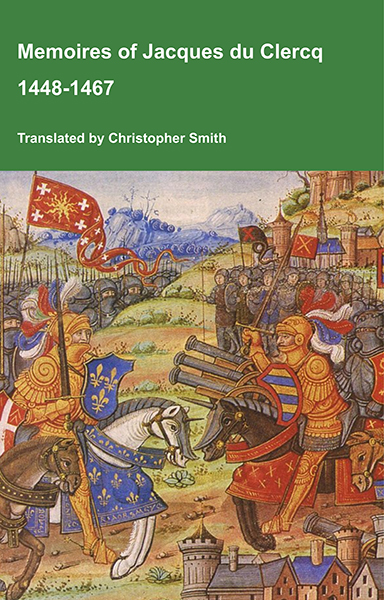
This is a translation of the 'Memoires of Jacques du Clercq', published in 1823 in two volumes, edited by Frederic, Baron de Reissenberg. In his introduction Reissenberg writes: 'Jacques du Clercq tells us that he was born in 1424, and that he was a licentiate in law and a counsellor to Philip the Good, Duke of Burgundy, in the castellany of Douai, Lille, and Orchies. It appears that he established his residence at Arras. In 1446, he married the daughter of Baldwin de la Lacherie, a gentleman who lived in Lille. We read in the fifth book of his Memoirs that his father, also named Jacques du Clercq, had married a lady of the Le Camelin family, from Compiègne. His ancestors, always attached to the counts of Flanders, had constantly served them, whether in their councils or in their armies.' The Memoires cover a period of nineteen years beginning in in 1448, ending in in 1467. It appears that the author had intended to extend the Memoirs beyond that date; no doubt illness or death prevented him from carrying out this plan. As Reissenberg writes the 'merit of this work lies in the simplicity of its narrative, in its tone of good faith, and in a certain air of frankness which naturally wins the reader’s confidence.' Du Clercq ranges from events of national and international importance, including events of the Wars of the Roses in England, to simple, everyday local events such as marriages, robberies, murders, trials and deaths, including that of his own father in Book 5; one of his last entries.
Available at Amazon in eBook and Paperback format.
On 6th August 1385 Edmund of Langley 1st Duke of York [aged 44] was created 1st Duke York by King Richard II of England [aged 18]. Isabella of Castile Duchess York [aged 30] by marriage Duchess York.
Thomas of Woodstock 1st Duke of Gloucester [aged 30] was created 1st Duke Albemarle, and around the same time, 1st Duke Gloucester. Eleanor Bohun Duchess Gloucester [aged 19] by marriage Duchess Albemarle and Duchess Gloucester.
Life of Charles VI by a Monk of St Denis. And at the end of the treaty, the length of which I have briefly summarised so as not to cause weariness, there followed: "That mutual concord may remain firm in times to come, and that our subjects may remain in the beauty of peace and in true obedience toward our lord the king and toward us, for the avoidance of all dissensions, we will and ordain that the aforesaid articles be observed inviolably. Moreover, we forbid all our subjects that, on account of the said disputes, they hinder or cause to be hindered, directly or indirectly, the men of Ghent or their associates, nor that they presume in any way to injure them by word or deed with insults; and if anyone should attempt this, we will that they be punished by our officers and judges as for a criminal act, and that, after satisfaction has been made to the injured party from their goods, the remainder shall fall to our treasury. We also command that such offenders shall not be able to enjoy any refuge, but shall be seized by the ministers of justice and delivered to the ordinary judges, so that, according to the offence, the appropriate punishment may follow, as has been stated. Given at Tournai, on the eighteenth day of the month of December [1385]."
Et in calce tractatus, cujus prolixitatem summatim perstrinxi, ne fastidium generaret, sequebatur: «Ut autem mutua eoncordia futuris temporibus stabilis maneat, et ut subditi nostri manere possint sub pulcritudine pacis et vera obediencia erga dominum nostrum regem et nos, ad evitandum dissensiones quascunque, volumus et ordinamus ut articuli pretacti inviolabiliter serventur. Prohibemus insuper omnibus subditis nostris, ne occasione dictarum dissensionum impediant vel impedire faciant directe vel indirecte Gandavenses vel eorum complices, nec eos verbo vel facto, opprobriis injuriare presumant quovis modo; et si quis hoc attemptaret, volumusquod ab officiariis et judicibus nostris velud pro facto criminali puniantur, ac de bonis eorum parti lese satisfactione facta, residuum ad fiscum nostrum devolvatur. Precipimus eciam quod dicti malefactores quibuscunque diffugiis gaudere non valeant, sed a ministris justicie capiantur, judicibus ordinariis reddantur, ut secundum delictum et punicionis modus sequatur, sicut dictum est. Datum apud Tournacum, decima octava die mensis decembris.»
Around September 1386 the Wonderful Parliament sought to reform the administration of King Richard II of England [aged 19]. Michael de la Pole 1st Earl Suffolk [aged 56] was impeached for his failures in France.
Chronicle of Adam of Usk [~1352-1430]. September 1386. Owing to the many ill-starred crises of king Richard's [aged 19] reign, which were caused by his youth, a solemn parliament was holden at Westminster, wherein twelve of the chief men of the land were advanced, by full provision of parliament, to the government of the king and the kingdom, in order to bridle the wantonness and extravagance of his servants and flatterers, and, in short, to reform the business of the realm; but alas! only to lead to the weary deeds which are hereinafter written1.
Note 1. The actual number of the commissioners appointed by the Wonderful Parliament of 1386 was eleven, or fourteen if the three principal officers of state be included. The eleven were: the archbishops of Canterbury [aged 44] and York [aged 45], the dukes of York [aged 45] and Gloucester [aged 31], the bishops of Winchester [aged 66] and Exeter, the abbot of Waltham, the earl of Arundel, John de Cobham, Richard le Scrope, and John Devereux. Thomas Arundel [aged 33], bishop of Ely, had replaced Michael de la Pole [aged 25], earl of Suffolk, as chancellor; John Gilbert, bishop of Hereford, was treasurer; and John de Waltham, keeper of the privy seal. It will be remembered that John of Gaunt [aged 46] was at this time in Spain, as a reason for his name not appearing on the commission.
On 6th January 1387 Peter IV King Aragon [aged 67] died. His son John [aged 36] succeeded I King Aragon.
On 11th March 1387 the Battle of Castagnaro was fought between the army of Verona, commanded by Giovanni Ordelaffi and Ostasio II da Polenta, and the victorious Paduans commanded by John Hawkwood [aged 67] [Giovanni Acuto i.e. John the Astute] and Francesco Novello da Carrara [aged 27], son of Francesco I, lord of Padua [aged 61]. Castagnaro is hailed as Sir John Hawkwood's greatest victory. Following a Fabian-like strategy, Hawkwood goaded the Veronese into attacking him on a field of his own choosing, by laying waste to the Veronese lands nearby.
On 6th August 1388 Ulrich of Württemberg was killed at the Battle of Döffingen.
In September 1389 the Scrope vs Grosvenor Case was brought to the Court of Chivalry. Up to that time two families, Scrope and Grosvenor, had been using the armorial  Scrope Arms: Azure, a bend or.
Several hundred witnesses were called including John of Gaunt 1st Duke Lancaster [aged 49], Geoffrey Chaucer [aged 46] and John Savile of Shelley and Golcar [aged 64].
On 3rd September 1386 Owain ap Gruffudd "Glyndŵr" Mathrafal Prince Powys [aged 27] gave evidence at the Church of John the Baptist, Chester [Map].
The Court decided in favour of Scrope.
Neither party was happy with the decision so King Richard II [aged 22] was called upon to give his personal verdict.
On 27th May 1390 he confirmed that Grosvenor could not bear the undifferenced arms.
As a consequence of the case the Grosvenor has for many years used the name Bendor for horses and nicknames.
In December 1389 King Richard II of England [aged 22] held his Christmas Court at Woodstock Palace, Oxfordshire [Map].
On 30th December 1389 John Hastings 3rd Earl Pembroke [aged 17] was killed in a tournament during the Christmas Court at Woodstock Palace, Oxfordshire [Map]. Earl Pembroke and Baron Manny, Baron Abergavenny Feudal Creation extinct. He was struck in the groin by the lance of Sir John Des.
John Hastings 6th Baron Hastings [aged 61] de jure 6th Baron Hastings. His claim was contested by Reginald Grey 3rd Baron Grey Ruthyn [aged 27] who was the son of Elizabeth Hastings Baroness Grey Ruthyn daughter of John Hastings 13th Baron Abergavenny 1st Baron Hastings his case being that he was of the full blood whereas John Hastings 6th Baron Hastings was of the half-blood ie Reginald Grey 3rd Baron Grey Ruthyn, like John Hastings 3rd Earl Pembroke, was descended from John Hastings 13th Baron Abergavenny 1st Baron Hastings and Isabel Valence Baroness Bergavenny Baroness Hastings, whereas John Hastings 6th Baron Hastings was descended from John Hastings 13th Baron Abergavenny 1st Baron Hastings and Isabel Despencer Baroness Hastings and Bergavenny.