

William of Worcester's Chronicle of England
William of Worcester, born around 1415, and died around 1482 was secretary to John Fastolf, the renowned soldier of the Hundred Years War, during which time he collected documents, letters, and wrote a record of events. Following their return to England in 1440 William was witness to major events. Twice in his chronicle he uses the first person: 1. when writing about the murder of Thomas, 7th Baron Scales, in 1460, he writes '… and I saw him lying naked in the cemetery near the porch of the church of St. Mary Overie in Southwark …' and 2. describing King Edward IV's entry into London in 1461 he writes '… proclaimed that all the people themselves were to recognize and acknowledge Edward as king. I was present and heard this, and immediately went down with them into the city'. William’s Chronicle is rich in detail. It is the source of much information about the Wars of the Roses, including the term 'Diabolical Marriage' to describe the marriage of Queen Elizabeth Woodville’s brother John’s marriage to Katherine, Dowager Duchess of Norfolk, he aged twenty, she sixty-five or more, and the story about a paper crown being placed in mockery on the severed head of Richard, 3rd Duke of York.
Available at Amazon in eBook and Paperback format.
Acheson to Ayscough is in Armorials.
 Acheson Arms. Argent, a double-headed eagle displayed sable, beaked and membered or, on a chief vert, two mullets or. Source.
 Acland Arms. Chequy argent and sable, a fess gules. Source.
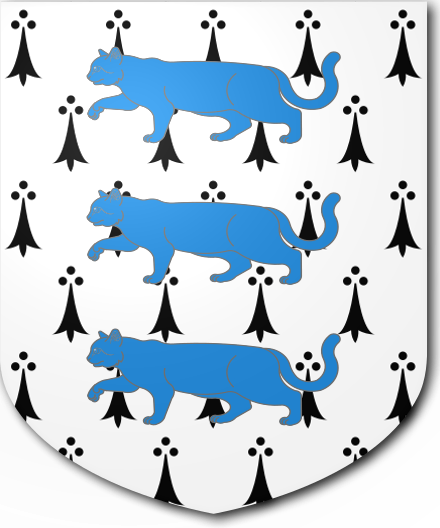 Adams Arms. Ermine three cats argent. Source
 Addington Arms. Per pale ermine and ermines a chevron charged with five lozenges counterchanged between three fleurs-de-lys or. Source.
 Agar Arms. Azure, a lion rampant or. Source.
 Aragon Arms. Or, four pallets gules. Source.
 Arden Arms. Ermine, a fess chequy or and azure. Source.
 Arundell Arms. Sable, six martlets argent. Source.

Anne Boleyn. Her Life as told by Lancelot de Carle's 1536 Letter.
In 1536, two weeks after the execution of Anne Boleyn, her brother George and four others, Lancelot du Carle, wrote an extraordinary letter that described Anne's life, and her trial and execution, to which he was a witness. This book presents a new translation of that letter, with additional material from other contemporary sources such as Letters, Hall's and Wriothesley's Chronicles, the pamphlets of Wynkyn the Worde, the Memorial of George Constantyne, the Portuguese Letter and the Baga de Secrets, all of which are provided in Appendices.
Available at Amazon in eBook and Paperback format.
 Ashley Arms. Argent three bulls passant sable, armed and unguled or.
 Earl Shaftesbury Arms. Quarterly: 1&4 Ashley Arms; 2&3: gules, a bend engrailed between six lions rampant or (Cooper). Source.
 Atholl Arms. Paly or and sable. Source.
 Duke Atholl Arms.
  Earl Atholl Arms overall, an inescutcheon en surtout azure three mullets argent within a double tressure flory or ensigned of a Marquess's coronet. Source.
Earl Atholl Arms. Quartered  Stewart Arms and Atholl Arms.
NO IMAGE.  Murray Arms, Stewart Arms, Atholl Arms,
  Stanley Arms,
  Isle of Man Arms and Unknown Arms.
 Marquess Atholl Arms. Quartered Earl Atholl Arms and Murray Arms.
 Audley Arms. Gules, fretty. Source.
 Audley of Walden Arms. Quarterly per pale indented or and azure, in the 2nd and 3rd an eagle displayed of the 1st on a bend of the 2nd a fret between two martlets of the 1st. The fret or knot is a reference to the arms of Audley Arms, which family died out in the male line in 1391. Source.
 Avenell Arms. Argent, a fess between five annulets gules. Modified from source.
Anne Boleyn. Her Life as told by Lancelot de Carle's 1536 Letter.
In 1536, two weeks after the execution of Anne Boleyn, her brother George and four others, Lancelot du Carle, wrote an extraordinary letter that described Anne's life, and her trial and execution, to which he was a witness. This book presents a new translation of that letter, with additional material from other contemporary sources such as Letters, Hall's and Wriothesley's Chronicles, the pamphlets of Wynkyn the Worde, the Memorial of George Constantyne, the Portuguese Letter and the Baga de Secrets, all of which are provided in Appendices.
Available at Amazon in eBook and Paperback format.

Around 1400. Window in the Chicheley Chapel at St Andrew's Church, Wimpole [Map] from the late 14th early 15th Century depicting alliances of the Ufford family (who are thought to have owned the manor of Wimpole before the Chicheleys) and the Plantagenets through the marriage of Ralph Ufford and Maud Plantagenet Countess Ulster, daughter of Henry Plantagenet 3rd Earl of Leicester 3rd Earl Lancaster .
From top to bottom, left to right:
 Tiptoft Arms. The Tiptoft family owned the nearby manor of Harleston.
Avenell Arms. The Avenell family once held a manor in Wimpole.
Telemache Arms.
 Ufford Arms. Believed to be the arms of William Ufford 2nd Earl Suffolk. Note the difference of an annulet argent (white) in the top left corner.
 Bohun Arms. Possibly William Bohun 1st Earl of Northampton.
 Henry Plantagenet 3rd Earl of Leicester 3rd Earl Lancaster 1281 1345 Arms. Possibly Henry Plantagenet 3rd Earl of Leicester 3rd Earl Lancaster although the label doesn't appear to have the fleur de lys of France.
Bassingbourne Arms.
Engaine Arms. John de Engaine lived in Huntingdonshire.
 Lisle Arms. Possibly Robert Lisle 1st Baron Lisle. Robert settled at nearby Rampton.
Robert Ufford 1st Earl Suffolk who married Margaret Norwich Countess Suffolk whose father Walter Norwich owned the manor of Cobbs in Wimpole.
Ufford Arms with a label three points. Believed to be Robert Ufford who predeceased his father Robert Ufford 1st Earl Suffolk.
Bassingbourne Arms.
The figure in the middle is believed to represent William Ufford 2nd Earl Suffolk.
From an original description by James C Powell 1903.
 Aylesbury Arms. Azure, a Cross argent. Source.
 Edward Hyde 1st Earl Clarendon 1609 1674 Arms. Quartered 1&4
  Hyde Arms 2 Langford 3 Aylesbury Arms.


.svg)
.svg)


#/media/File:Blason_Comtes_d'Atholl.svg)


