

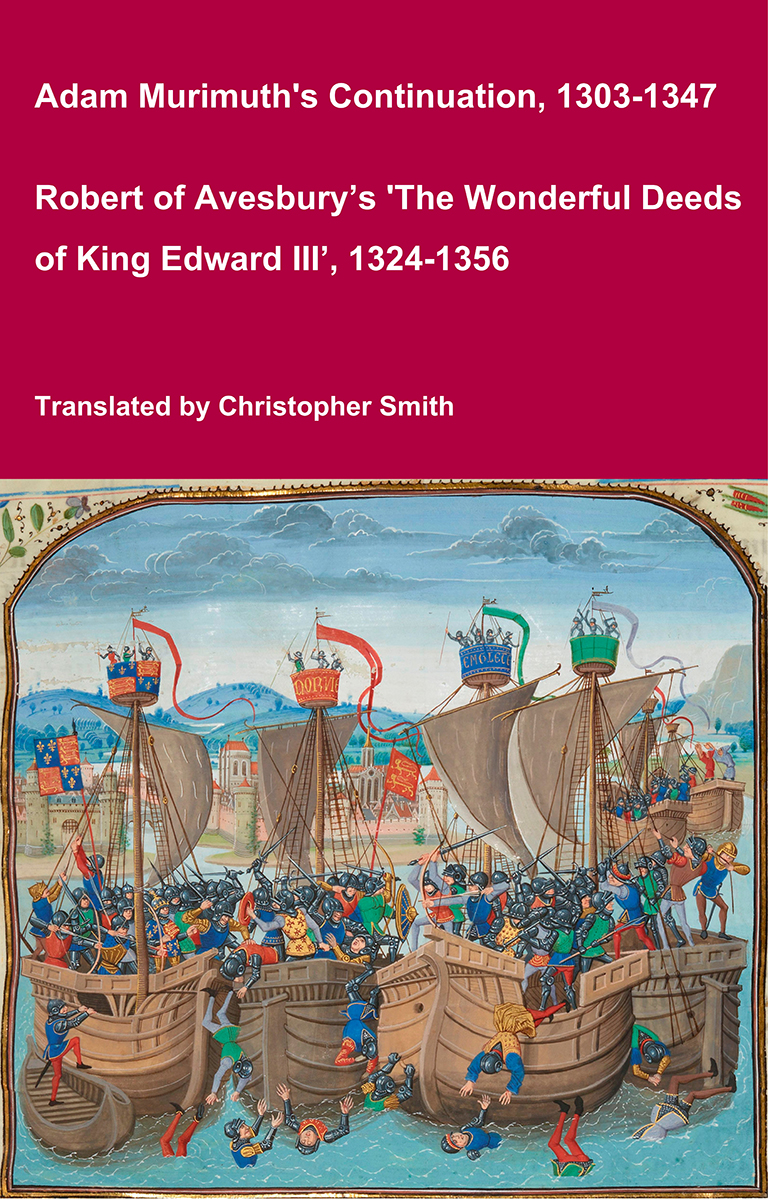
Adam Murimuth's Continuation and Robert of Avesbury’s 'The Wonderful Deeds of King Edward III'
This volume brings together two of the most important contemporary chronicles for the reign of Edward III and the opening phases of the Hundred Years’ War. Written in Latin by English clerical observers, these texts provide a vivid and authoritative window into the political, diplomatic, and military history of fourteenth-century England and its continental ambitions. Adam Murimuth Continuatio's Chronicarum continues an earlier chronicle into the mid-fourteenth century, offering concise but valuable notices on royal policy, foreign relations, and ecclesiastical affairs. Its annalistic structure makes it especially useful for establishing chronology and tracing the development of events year by year. Complementing it, Robert of Avesbury’s De gestis mirabilibus regis Edwardi tertii is a rich documentary chronicle preserving letters, treaties, and official records alongside narrative passages. It is an indispensable source for understanding Edward III’s claim to the French crown, the conduct of war, and the mechanisms of medieval diplomacy. Together, these works offer scholars, students, and enthusiasts a reliable and unembellished account of a transformative period in English and European history. Essential for anyone interested in medieval chronicles, the Hundred Years’ War, or the reign of Edward III.
Available at Amazon in eBook and Paperback format.
Paternal Family Tree: Burgh
In or before 1160 [his father] Walter Burgh [aged 29] and [his mother] Alice Unknown were married.
Around 1170 Hubert de Burgh Count Mortain 1st Earl Kent was born to [his father] Walter Burgh [aged 40] and [his mother] Alice Unknown.
In 1183 William Fitzrobert 2nd Earl Gloucester died. His daughter [his future wife] Isabella [aged 10] succeeded 3rd Countess Gloucester.
On 29th August 1189 King John of England [aged 22] and [his future wife] Isabella Fitzrobert 3rd Countess Gloucester and Essex [aged 16] were married at Marlborough Castle [Map]. He by marriage Earl Gloucester. See Gesta Regis Henrici and Gesta Regis Henrici by Benedict of Peterborough. She the daughter of William Fitzrobert 2nd Earl Gloucester and Hawise Beaumont Countess Gloucester. He the son of King Henry "Curtmantle" II of England and Eleanor of Aquitaine Queen Consort Franks and England [aged 67]. They were half second cousins. She a great granddaughter of King Henry I "Beauclerc" England.
Around April 1200 King John of England [aged 33] and [his future wife] Isabella Fitzrobert 3rd Countess Gloucester and Essex [aged 27] marriage annulled due to consanuinity but more likely because John's new status as heir to the English throne mean't he had better prospects. He may have already decided to marry Isabella of Angoulême Queen Consort England [aged 12] who he married on 24th August 1200.
Before 1202 Hubert de Burgh Count Mortain 1st Earl Kent [aged 31] was appointed Count Mortain Mortagne, and as Constable of Dover Castle, Constable of Windsor Castle, Constable of Chinon Castle.
In 1206 [his father] Walter Burgh [aged 76] died.
On 20th January 1214 Geoffrey Mandeville 2nd Earl Essex [aged 23] and [his future wife] Isabella Fitzrobert 3rd Countess Gloucester and Essex [aged 41] were married. She by marriage Countess Essex, Countess Gloucester. She the daughter of William Fitzrobert 2nd Earl Gloucester and Hawise Beaumont Countess Gloucester. He the son of Geoffrey Fitzpeter 1st Earl Essex and Beatrice Saye.
On 18th December 1214 [his future wife] Beatrice Warenne [aged 40] died.
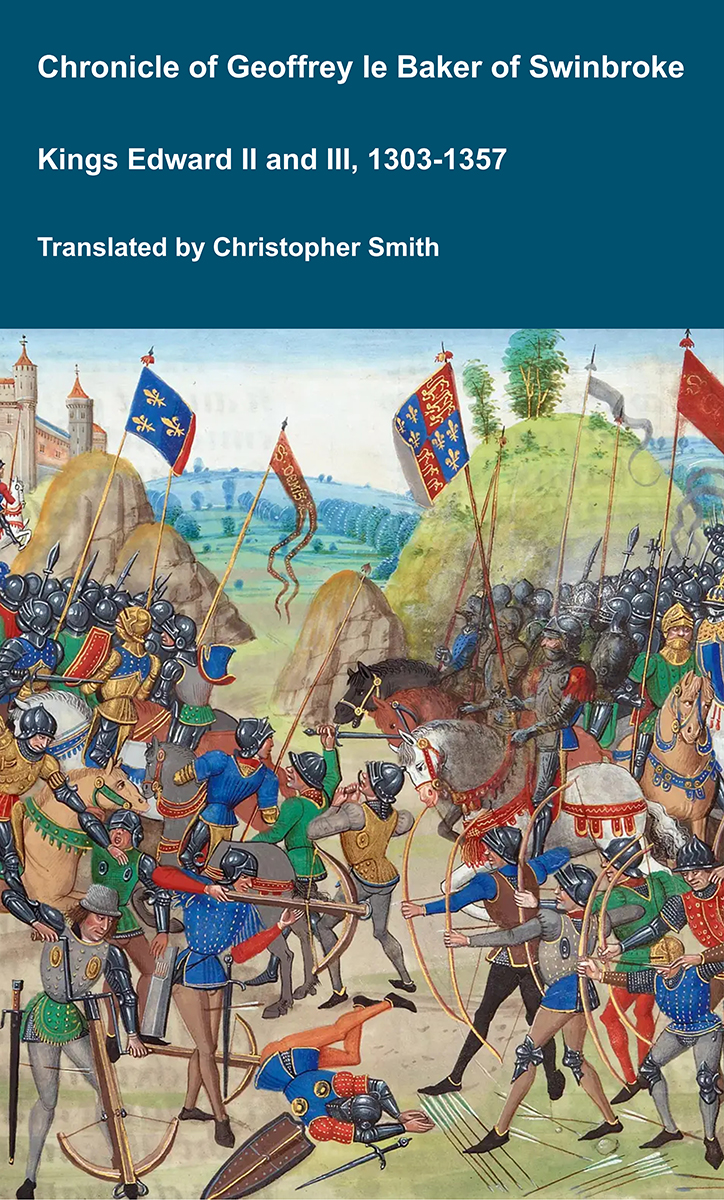
Chronicle of Geoffrey le Baker of Swinbroke
Baker was a secular clerk from Swinbroke, now Swinbrook, an Oxfordshire village two miles east of Burford. His Chronicle describes the events of the period 1303-1356: Gaveston, Bannockburn, Boroughbridge, the murder of King Edward II, the Scottish Wars, Sluys, Crécy, the Black Death, Winchelsea and Poitiers. To quote Herbert Bruce 'it possesses a vigorous and characteristic style, and its value for particular events between 1303 and 1356 has been recognised by its editor and by subsequent writers'. The book provides remarkable detail about the events it describes. Baker's text has been augmented with hundreds of notes, including extracts from other contemporary chronicles, such as the Annales Londonienses, Annales Paulini, Murimuth, Lanercost, Avesbury, Guisborough and Froissart to enrich the reader's understanding. The translation takes as its source the 'Chronicon Galfridi le Baker de Swynebroke' published in 1889, edited by Edward Maunde Thompson.
Available at Amazon in eBook and Paperback format.
Before 1217 Hubert de Burgh Count Mortain 1st Earl Kent [aged 46] and Beatrice Warenne were married.
On 24th August 1217 Hubert de Burgh Count Mortain 1st Earl Kent [aged 47] commanded the King's forces at Sandwich, Kent [Map] during the Battle of Sandwich aka Dover. French re-enforcements had left Calais to join with the future Prince Louis's [aged 29] forces who were in short supply following the Second Battle aka Fair of Lincoln. Hubert Burgh's men routed the French ships. The battle marked the end of Prince Louis's invasion with the Treaty of Kingston aka Lambeth being signed shortly afterwards.
In September 1217 Hubert de Burgh Count Mortain 1st Earl Kent [aged 47] and Isabella Fitzrobert 3rd Countess Gloucester and Essex [aged 44] were married. She the daughter of William Fitzrobert 2nd Earl Gloucester and Hawise Beaumont Countess Gloucester.
On 14th October 1217 [his wife] Isabella Fitzrobert 3rd Countess Gloucester and Essex [aged 44] died.
Around 1222 [his daughter] Margaret Burgh Countess Gloucester and Hertford was born to Hubert de Burgh Count Mortain 1st Earl Kent [aged 52] and [his future wife] Margaret Dunkeld Countess Kent [aged 29]. She a great x 3 granddaughter of King Henry I "Beauclerc" England. She married before November 1237 her half third cousin once removed Richard de Clare 6th Earl Gloucester 5th Earl Hertford, son of Gilbert Clare 5th Earl Gloucester 4th Earl Hertford and Isabel Marshal Countess Cornwall, Gloucester and Hertford.
In 1225 [his brother] Bishop Geoffrey Burgh [aged 45] was appointed Bishop of Ely.
On 7th March 1226 William Longespée Earl Salisbury [aged 50] died at Old Sarum [Map]. Roger of Wendover in his Flowers of History writes that some accused Hubert de Burgh Count Mortain 1st Earl Kent [aged 56] of having poisoned him.
Effigy at Salisbury Cathedral [Map].


In 1227 Hubert de Burgh Count Mortain 1st Earl Kent [aged 57] was created 1st Earl Kent.
On 8th December 1228 [his brother] Bishop Geoffrey Burgh [aged 48] died.
Flowers of History by Roger of Wendover 1232. When people saw the king's regard for Hubert [aged 61], whom he had once so particularly favoured, changed into hatred, many of his enemies rose against him and accused him of many enormous crimes. Some accused him of having caused the death of the two nobles, William earl of Salisbury and William Marshal earl of Pembroke, by poison, and that he had killed Falcasius and Richard archbishop of Canterbury by the same wicked means. The citizens of London laid a complaint before the king that the said Hubert had hung their fellow citizen Constantine unjustly, and without any trial, for which crime they demanded justice; the king therefore issued a proclamation throughout London, calling on all who had any complaint against Hubert, for any injury to them soever, to come to him when they should have justice done them. When Hubert heard of this, he fled in alarm to the church at Merton, where he concealed himself amongst the canons.
In 1232 Hubert de Burgh Count Mortain 1st Earl Kent [aged 62] was imprisoned at Devizes Castle [Map].
Flowers of History by Roger of Wendover 1233. How Hubert [aged 62] was dragged by violence from the church and imprisoned.
When the garrison awoke and found that Hubert was not in the usual place, they were greatly alarmed, and sallying forth in troops with lanthorns and weapons, they traversed the country round in search of him; after some time they heard that Hubert was in the church, released from his fetters, on which they tuinultuously rushed thither and found him before the great altar, with the holy cross in his hands; they at once fiercely seized him, and striking and driving him along with their weapons and fists, they took him back to the castle as well as his two liberators, where they confined him more strictly than before. When this event reached the ears of Robert bishop of Salisbury [aged 52], he went to the castle and ordered these violators of the church at once to release Hubert and to restore him to the sanctuary of the church in the same condition as they found him; but the castellans noisily told him they would rather that Hubert should be hung than they; on which, as they refused to give him up, the bishop, by virtue of the power entrusted to him, excommunicated by name all those who detained him and who had laid violent hands on him. The said bishop then, accompanied by Roger bishop of London, went to the king and laid a complaint before him of the injury inflicted on Hubert, and did not leave the king till he had obtained his release; so on the 18th of October he was sent back to the church much against the king's wish, who sent orders by letter to the sheriff of that county to blockade the church'in order to starve Hubert to death.
Chronicle of Geoffrey le Baker of Swinbroke
Baker was a secular clerk from Swinbroke, now Swinbrook, an Oxfordshire village two miles east of Burford. His Chronicle describes the events of the period 1303-1356: Gaveston, Bannockburn, Boroughbridge, the murder of King Edward II, the Scottish Wars, Sluys, Crécy, the Black Death, Winchelsea and Poitiers. To quote Herbert Bruce 'it possesses a vigorous and characteristic style, and its value for particular events between 1303 and 1356 has been recognised by its editor and by subsequent writers'. The book provides remarkable detail about the events it describes. Baker's text has been augmented with hundreds of notes, including extracts from other contemporary chronicles, such as the Annales Londonienses, Annales Paulini, Murimuth, Lanercost, Avesbury, Guisborough and Froissart to enrich the reader's understanding. The translation takes as its source the 'Chronicon Galfridi le Baker de Swynebroke' published in 1889, edited by Edward Maunde Thompson.
Available at Amazon in eBook and Paperback format.
Flowers of History by Roger of Wendover 1233. Of the escape of Hubert de Burgh [aged 63].
About this time Peter bishop of Winchester, who above all things desired the death of Hubert de Burgh, who was a prisoner in Devizes castle [Map], without mentioning Hubert's name, earnestly begged of the king to give him charge of the said castle, being, as was said, in hopes of thus obtaining a chance of putting him to death. Hubert however was forewarned of all these plans by his friends at the king's court, and disclosed them to two retainers of the garrison of the castle who attended on him, and they, pitying his sufferings, devised a plan by which he might escape from death. They therefore watched their opportunity, and on the night of Michaelmas eve, when the garrison were asleep, one of them, whilst the other kept watch, took Hubert, fettered as he was, on his shoulders, and descended from the tower carrying his pious theft with which he passed entirely through the castle, unheard by the garrison, till he reached the great gate, where he went out, and, crossing a deep trench, though with much difficulty, made his way to the parochial church, and did not set down his burden till he arrived before the great altar. The two men who had set Hubert at liberty then refused to leave him, considering that it would be to their glory if they should suffer a temporal death for preserving the life of such a great man.
Flowers of History by Roger of Wendover 1233. About this same time Hubert de Burgh [aged 63] the ex-justiciary, was taken away from the church at Devizes by some armed men, and, after being properly clad in knightly apparel, was carried into Wales, where he joined the enemies of the king about the first hour of the day on the 30th of October.
In 1236 Hubert de Burgh Count Mortain 1st Earl Kent [aged 66] and Margaret Dunkeld Countess Kent [aged 43] were married. She by marriage Countess Kent. The difference in their ages was 23 years. She the daughter of King William I of Scotland and Ermengarde Beaumont Sarthe Queen Consort Scotland.
Chronica Majora by Matthew Paris. March 1237. About the same time, the king's anger was again kindled against the earl of Kent, Hubert de Burgh [aged 67], because [his future son-in-law] Richard, earl of Gloucester [aged 14], still a boy, under the king's care, secretly married Earl Hubert's daughter Margaret [aged 15], without his, the king's, permission or connivance. For he had determined (as it was stated) to unite the said youth, the earl of Gloucester, together with his county and all his honours, to a young lady, a near relative of William, bishop elect of Valentia, a native of Provence. The king's anger was, however, at length set at rest by the intercession of a great many people, and on Hubert's declaring that he had not been aware of it, and that it had not been done by him, and on his promising a sum of money to the king. In the same year, by the management of the emperor Frederick [aged 42], another senator was created at Rome, in order that, by the united skill and power of two senators, the insolence of the Romans might be checked, and the city be pacified, and governed more safely, and easily ruled by their counsels.
Before November 1237 [his son-in-law] Richard de Clare 6th Earl Gloucester 5th Earl Hertford [aged 15] and Margaret Burgh Countess Gloucester and Hertford [aged 15] were married. She by marriage Countess Gloucester, Countess Hertford. She the daughter of Hubert de Burgh Count Mortain 1st Earl Kent [aged 67] and Margaret Dunkeld Countess Kent [aged 44]. He the son of Gilbert Clare 5th Earl Gloucester 4th Earl Hertford and Isabel Marshal Countess Cornwall, Gloucester and Hertford [aged 37]. They were half third cousin once removed. He a great x 3 grandson of King Henry I "Beauclerc" England. She a great x 3 granddaughter of King Henry I "Beauclerc" England.
In November 1237 [his daughter] Margaret Burgh Countess Gloucester and Hertford [aged 15] died.
In 1239 [his brother-in-law] King Alexander II of Scotland [aged 40] and Marie Coucy [aged 21] were married. She by marriage Queen Consort Scotland. He the son of King William I of Scotland and Ermengarde Beaumont Sarthe Queen Consort Scotland. They were third cousin once removed. He a great x 2 grandson of King Henry I "Beauclerc" England.
Before 5th May 1243 Hubert de Burgh Count Mortain 1st Earl Kent [aged 73] died at Banstead, Surrey. He was buried at Blackfriars Church Holborn. Earl Kent extinct.
In 1259 [his former wife] Margaret Dunkeld Countess Kent [aged 66] died. She was buried at Blackfriars Church Holborn.
[his son] Hubert Burgh was born to Hubert de Burgh Count Mortain 1st Earl Kent and Margaret Dunkeld Countess Kent. He a great x 3 grandson of King Henry I "Beauclerc" England.
[his son] John Burgh was born to Hubert de Burgh Count Mortain 1st Earl Kent and Beatrice Warenne. He married Hawise Valey and had issue.
Elizabeth Burgh Queen Consort Scotland [1]
King Richard III of England [1]
Queen Anne Boleyn of England [1]
Jane Grey I Queen England and Ireland [2]
George Wharton [7]
Brigadier-General Charles Fitz-Clarence [25]
Queen Elizabeth II of the United Kingdom [112]
Queen Consort Camilla Shand [30]