This is a translation of the 'Memoires of Jacques du Clercq', published in 1823 in two volumes, edited by Frederic, Baron de Reissenberg. In his introduction Reissenberg writes: 'Jacques du Clercq tells us that he was born in 1424, and that he was a licentiate in law and a counsellor to Philip the Good, Duke of Burgundy, in the castellany of Douai, Lille, and Orchies. It appears that he established his residence at Arras. In 1446, he married the daughter of Baldwin de la Lacherie, a gentleman who lived in Lille. We read in the fifth book of his Memoirs that his father, also named Jacques du Clercq, had married a lady of the Le Camelin family, from Compiègne. His ancestors, always attached to the counts of Flanders, had constantly served them, whether in their councils or in their armies.' The Memoires cover a period of nineteen years beginning in in 1448, ending in in 1467. It appears that the author had intended to extend the Memoirs beyond that date; no doubt illness or death prevented him from carrying out this plan. As Reissenberg writes the 'merit of this work lies in the simplicity of its narrative, in its tone of good faith, and in a certain air of frankness which naturally wins the reader’s confidence.' Du Clercq ranges from events of national and international importance, including events of the Wars of the Roses in England, to simple, everyday local events such as marriages, robberies, murders, trials and deaths, including that of his own father in Book 5; one of his last entries.
Available at Amazon in eBook and Paperback format.
Reticulated is in Armour.
Reticulated. Constructed, arranged, or marked like a net.
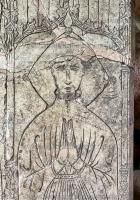
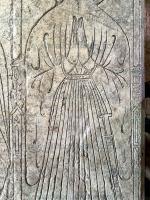
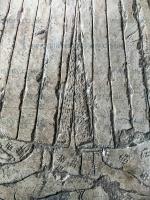
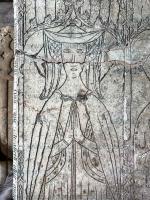
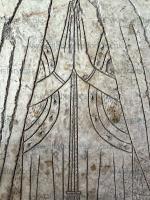
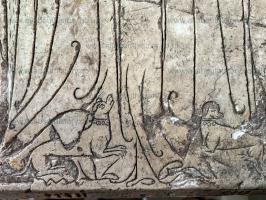
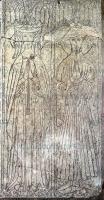
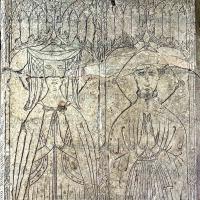
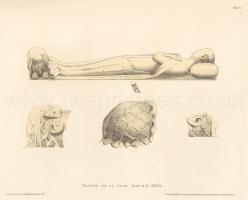
On 4th August 1432 Peter Pole [aged 50] died. He was buried at St Andrew's Church, Radbourne [Map]. Grave slab of him and his wife Elizabeth Laughton [aged 48] exceptionally well carved. The ermine lining of his long gown and her mantle visible. She has her feet resting on two dogs, both with bells on their collars; His feet are resting on one dog which also has a collar alebit not with bells on that may be seen. Note his belt with the initial 'P' on it, his long, pointed, shoes, his six buttoned cuffs and her reticulated head-dress with its outer edges of the extending upwards into vertical points.
Peter Pole: Around 1382 he was born to John Pole at Newborough, Staffordshire. On or before 1408 he and Elizabeth Laughton were married.
Elizabeth Laughton: Around 1384 she was born.


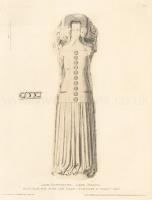
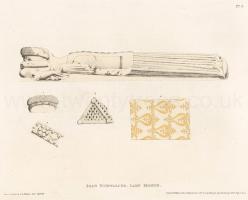
Effigy of Joam Burwaschs, Lady Mohun. The attire of the Lady Mohun presents us with an example of the fret or reticulated coiffure adopted by court ladies of the fourteenth century; and of the cote hardie, which appears to have been a vestment fitting close to the body, leaving the neck bare, and became much in vogue with the ladies towards the latter end of the fourteenth century. The wimpled attire of Aveline Countess of Lancaster will shew how chary they were of their charms in the preceding age. The wimpled costume seems, indeed, to have been borrowed from the females of the East. Mr. Charles Stothard relates a humorous anecdote of a damsel who wore the cote hardie in one of his original letters inserted in the Memoir of his Lifea.
Details. Plate 1. Jewelled lace on the hips of the cote hardie. Plate II. 1. Top of the coiffure. 5. Portion of the circlet enlarged. 3. Reticulation of the coiffure. 4. Pattern on the cote hardie.
Note a. Memoirs including Original Letters, &c. of C. A. Stothard, F. S. A. by Mrs. Charles Stothard. London, 3823, p. 331.

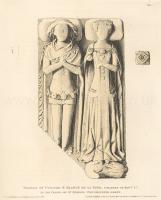
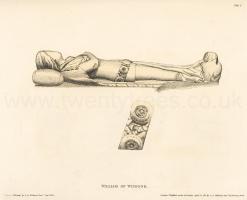
Effigy of William of Windsor and Blanche de la Tour. EDWARD gave another of his sons by Philippa the name of William, who died so young that nothing more is known of him than the place of his birth, as affixed to his name, and that he was buried at Westminster, in the chapel of St. Edmund [Map], in the abbey church. In the same tomb are also deposited the remains of Blanch de la Tour, their third daughter, so called from her birthplace, the Tower of London [Map]. She was born and died in 1340. Their effigies in alabaster, scarcely eighteen inches in length, are placed on an altar-tomb. Sandford says that an inscription on brass, which had been affixed on the monument, was not extant in his time. The costume of the male figure much resembles that of William of Hatfield. The cote hardie of the female, flanches, jewelled stomacher, girdle, cordon and clasps of the mantle, are worthy attention.
Details. Plate 1. One of the fermails of the Princess's mantle. Plate II. Ornaments on the Prince's girdle. Plate III. Details of the Princess's circlet and reticulated head-dress.