Annals of Kings Richard II and Henry IV 1393-1406
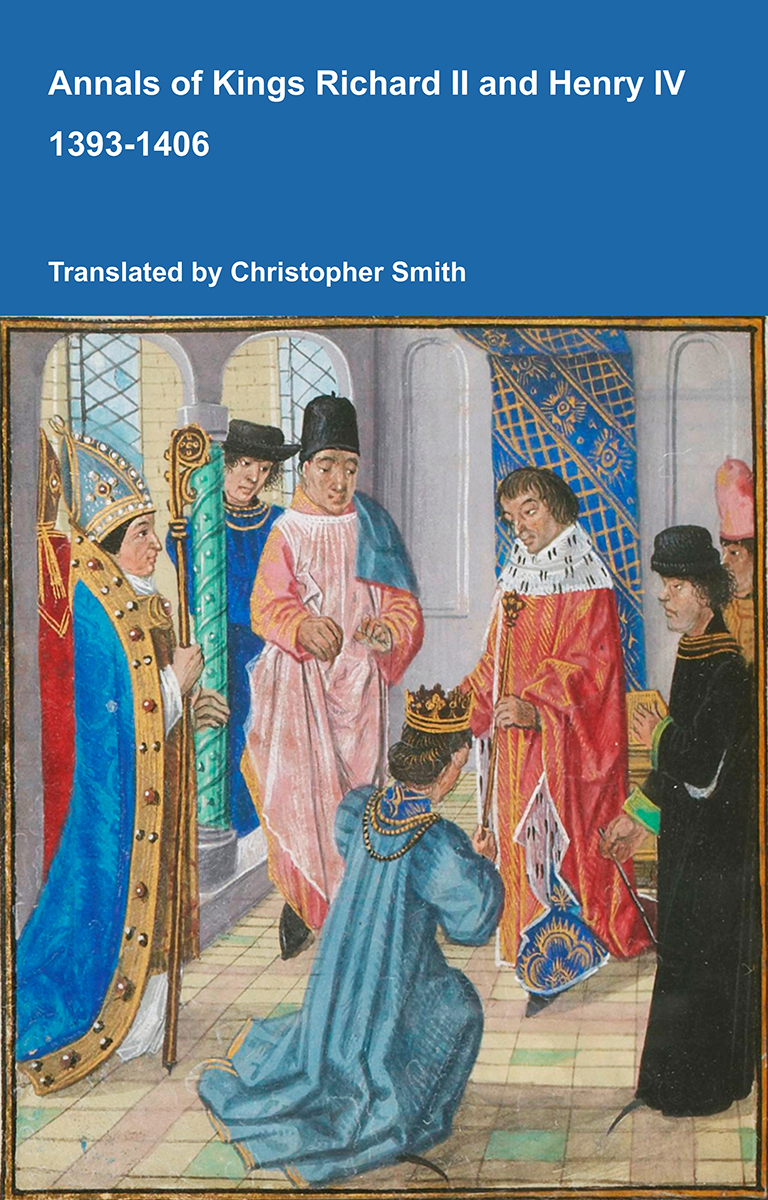
The Annals of Kings Richard II and Henry IV offers a vivid contemporary account of one of the most turbulent periods in late medieval England. Covering the reigns of Richard II and Henry IV, the chronicle records royal ceremonies, political conflict, rebellion, war, taxation, religious controversy, executions, popular unrest and remarkable portents. Its pages include a detailed description of Richard II’s coronation, the fall and deposition of the king, Henry IV’s seizure of the throne, the Percy rebellion, the execution of Archbishop Richard Scrope, the campaigns of Owain Glyndŵr, and England’s relations with Scotland, France, Portugal and Scandinavia. Alongside affairs of state, the annalist preserves reports of miracles, eclipses, prophecies, supernatural events and the experiences of ordinary townspeople, clergy, soldiers and travellers. Written from a monastic perspective, the work combines political observation with moral judgement, presenting victories and disasters as evidence of divine favour or punishment. At once a historical record and a reflection of medieval belief, the Annals provides an invaluable window into the challenges, ceremonies and conflicts of England at the turn of the fifteenth century.
Available at Amazon in eBook and Paperback format.
Sappho is in Romans People.
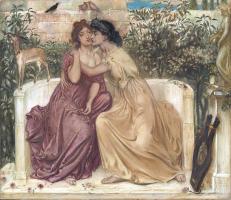
1857. Simeon Solomon [aged 16]. "Sappho and Erinna in a garden at Mytilene ".
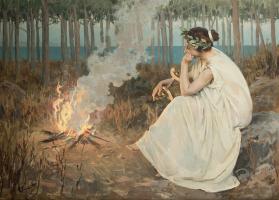
Around 1860. Soma Orlai Petrich [aged 37]. "Sappho".
1875. Jean-Baptiste Bertrand [aged 51]. "Lesbie and the sparrow". The subject of our painting is both a praise of the favorite animal and a lamentation over its death, a common theme in antiquity. It can also bear an erotic significance, with the death of the sparrow, an animal whose melodious voice endowed it with a reputation for sensuality, symbolizing the end of a passionate love. Lesbia was the mistress of the poet Catullus (87-54 BC) to whom he dedicated many poems (half of the 118 that have survived). The wife of a consul, she was famous for her libertine ways and inspired the artists of her time. Catullus is said to have given her the nickname Lesbia in reference to the Greek poet Sappho, who lived on the island of Lesbos. Sappho ran a school for women there, where eroticism and poetry were taught.
1877. Charles Mengin [aged 23]. "Sappho".
1881. Lawrence Alma-Tadema [aged 44]. "Sappho and Alcaeus". It depicts a concert in the late 7th century BC, with the poet Alcaeus of Mytilene playing the kithara. In the audience is fellow Lesbos poet Sappho, accompanied by several of her female friends. Sappho is paying close attention to the performance, resting her arm on a cushion which bears a laurel wreath, presumably intended for the performer. The painting is based on Athenaeus' "The Deipnosophists" Book 13 Chapter 7:
With the fond love of Lesbian Alcæus,
Who sang the praises of the amorous Sappho,
And grieved his Teian rival, breathing songs
Such as the nightingale would gladly imitate;
1881. Miquel Carbonell Selva [aged 26]. "The Death of Sappho". The painting depicts a myth about Sappho's death, that she fell off of a cliff and drowned to death after having her heart broken by a young sailor named Phaon.
1884. Jules Joseph Lefebvre [aged 47]. "Sappho".
1895. Francis Coates Jones [aged 37]. "Sappho".
1904. John William Godward [aged 42]. "Sappho of Lesbos".
Before 1911. Jules Joseph Lefebvre [aged 74]. "Sappho".
Before 1927. Enrique Simonet Lombardo [aged 60]. "Sappho".