

Before 1506 Bishop Richard Sampson commenced his educated at Trinity Hall, Cambridge University receiving B.Civ.L in 1506 and D.Civ.L in 1513. Thereafter the studied at the College of Sorbonne and Sens.
In 1516 Bishop Richard Sampson was appointed Dean of St Stephens Chapel in Westminster Abbey.

Before 1517 Bishop Richard Sampson was appointed diocesan chancellor and vicar-general of the Bishop Tournai by Cardinal Thomas Wolsey [aged 43].
In 1517 Bishop Richard Sampson was appointed Archdeacon of Cornwall.
In 1517 Bishop Richard Sampson was appointed Prebendary of Newbald.
In 1523 Bishop Richard Sampson was appointed Dean of Windsor.
In 1526 Bishop Richard Sampson was appointed Vicar of Stepney.
In 1529 Bishop Richard Sampson was appointed Archdeacon of Suffolk.

Archives of Venice. Oct. 11. [1529] Sanuto Diaries, v. lii. p. 153.
515. Lodovico Falier to the Signory.
Narrates conversations held with Cardinal Wolsey, and Cardinal Campeggio, late Legate in England, who has departed on his way to Rome.
King Henry has sent two ambassadors to the Emperor1, and two ambassadors to the King of France2, with congratulations on the peace made; and he has also sent an ambassador to the Pope.
London, 11th October. Registered, by Sanuto 9th November.
[Italian.]
Note 1. Qu., Sir Nicholas Carew [aged 33] and Dr. Richard Sampson,
Note 2. Qu., George Boleyn [aged 26] and Dr. John Stokesley [aged 54].
In 1533 Bishop Richard Sampson was appointed Dean of Lichfield.
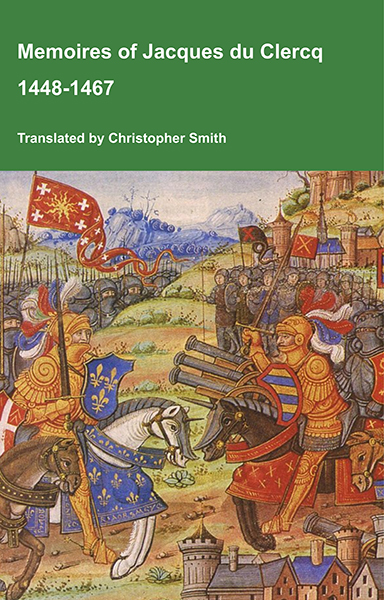
This is a translation of the 'Memoires of Jacques du Clercq', published in 1823 in two volumes, edited by Frederic, Baron de Reissenberg. In his introduction Reissenberg writes: 'Jacques du Clercq tells us that he was born in 1424, and that he was a licentiate in law and a counsellor to Philip the Good, Duke of Burgundy, in the castellany of Douai, Lille, and Orchies. It appears that he established his residence at Arras. In 1446, he married the daughter of Baldwin de la Lacherie, a gentleman who lived in Lille. We read in the fifth book of his Memoirs that his father, also named Jacques du Clercq, had married a lady of the Le Camelin family, from Compiègne. His ancestors, always attached to the counts of Flanders, had constantly served them, whether in their councils or in their armies.' The Memoires cover a period of nineteen years beginning in in 1448, ending in in 1467. It appears that the author had intended to extend the Memoirs beyond that date; no doubt illness or death prevented him from carrying out this plan. As Reissenberg writes the 'merit of this work lies in the simplicity of its narrative, in its tone of good faith, and in a certain air of frankness which naturally wins the reader’s confidence.' Du Clercq ranges from events of national and international importance, including events of the Wars of the Roses in England, to simple, everyday local events such as marriages, robberies, murders, trials and deaths, including that of his own father in Book 5; one of his last entries.
Available at Amazon in eBook and Paperback format.
In 1534 Bishop Richard Sampson was appointed Rector of Hackney.
In 1535 Bishop Richard Sampson was appointed Treasurer of Salisbury Cathedral [Map].
On 11th June 1536 Bishop Richard Sampson was elected Bishop of Chichester.
Chronicle of Edward Hall [1496-1548]. January 1541. You have heard before in the beginning of this year, that Doctor Wilson, and Doctor Sampson Bishop of Chichester, were sent unto the Tower who now were pardoned of the King, and set again at their liberty.
On 19th February 1544 Bishop Richard Sampson was translated to Bishop of Lichfield.
On 25th September 1554 Bishop Richard Sampson died at Eccleshall Castle, Staffordshire [Map]. He was buried at Holy Trinity Church, Eccleshall [Map].
Chronicle of Edward Hall [1496-1548]. In this month was sent to the Tower, Doctor Wilson, and docter Sampson Bishop of Chichester, for relieving of certain traitorous persons, which denied the King's Supremacy and for the same offence was one Richard Farmer Grocer of London, a riche and wealthy man, and of good estimation in the City, committed to the Marshall See [Map], and after in Westminster Hall was arraigned and attainted in the Premunire, and lost all his goods.