

Battle of Shrewsbury is in 1400-1414 Epiphany Rising and Rebellions Against Henry IV.

On 21st July 1403 King Henry IV of England [aged 36], with his son the future King Henry V of England [aged 16], defeated the rebel army of Henry "Hotspur" Percy [aged 39] at the Battle of Shrewsbury at the site now known as Battlefield, Shrewsbury [Map]. King Henry V of England took an arrow to the side of his face. John Stanley [aged 53] was wounded in the throat. Thomas Strickland [aged 36] fought and was awarded £38 and two of the rebel Henry's horses. Richard Beauchamp 13th Earl Warwick [aged 21] fought for the King. Walter Blount [aged 55], the King's Standard Bearer, was killed by Archibald Douglas 1st Duke Touraine [aged 31].
Thomas Wendesley [aged 59], Edmund Cockayne [aged 47] and Robert Goushill were killed.
Edmund Stafford 5th Earl Stafford [aged 25] was killed. His son Humphrey Stafford succeeded 6th Earl Stafford, 7th Baron Stafford.
Hugh Shirley [aged 52] was killed; he was one of four knights dressed as King Henry IV of England.
Of the rebels, Henry "Hotspur" Percy, Madog Kynaston [aged 43] and John Clifton were killed.
John Rossall was killed. His sister Eleanor Rossall [aged 26] inherited a half-share in the Rossall Shrewsbury [Map] estates.
John Massey [aged 65] was killed.
On 23rd July 1403 ...
Thomas Percy 1st Earl of Worcester [aged 60] was beheaded. Earl Worcester extinct.
Richard Venables 9th Baron Kinderton [aged 38] was beheaded.
Richard Vernon 11th Baron Shipbrook [aged 48] was beheaded. Baron Shipbrook forfeit.
Chronicle of Adam of Usk [~1352-1430]. 21st July 1401 In the next year, on behalf of the crown of England claimed for the earl of March, as is said, a deadly quarrel arose between the king and the house of Percy of Northumberland, as kin to the same earl, to the great agitation of the realm as it took part with one side or the other; and a field being pitched for the morrow of Saint Mary Magdalene (23rd July), the king, by advice of the earl of Dunbar of Scotland, because the father of the lord Henry Percy and Owen Glendower were then about to come against the king with a great host, anticipating the appointed day, brought on a most fearful battle against the said lord Henry and the lord Thomas Percy, then earl of Worcester. And, after that there had fallen on either side in most bloody slaughter to the number of sixteen thousand men, in the field of Berwick1 where the king afterwards founded a hospice for the souls of those who there fell two miles from Shrewsbury, on the eve of the said feast, victory declared for the king who had thus made the onslaught. In this battle the said lord Percy, the flower and glory of the chivalry of Christendom, fell, alas!, and with him his uncle. Whereby is the prophecy fulfilled: 'The cast-off beast shall carry away the two horns of the moon.'2 There fell also two noble knights in the king's armour, each made conspicuous as though a second king, having been placed for the king's safety in the rear line of battle. Whereat the earl of Douglas of Scotland, then being in the field with the said lord Henry, as his captive, when he heard victory shouted for king Henry, cried in wonder: 'Have I not slain two king Henries (meaning the said knights) with mine own hand? Tis an evil hour for us that a third yet lives to be our victor.'3
Note 1. Berwick was the village where Hotspur passed the night before the battle of Shrewsbury.
Note 2. The application of the 'two horns of the moon' to the two Percys who fell is no doubt suggested by the Percy badge, a crescent. See a memorandum in Nicolas, Acts of the Privy Council, i. 209, in which the Percy retainers are described at this very time as wearing the badge: 'et pluseurs chivachent devers lui, leur cressans as braas' i.e. 'and several rode toward him, their crests on their arms.'
Note 3. "This battell lasted three long houres, with indifferent fortune on both parts, till at length, the king crieng Saint George! victorie! brake the arraie of his enemies, and adventured so farre, that (as some write) the earle Dowglas strake him downe, and at that instant slue sir Walter Blunt, and three other, apparelled in the king's sute and clothing, saieng: I marvell to see so many kings thus suddenlie arise one in the necke of an other." Holinshed, iij. 26. "Another king! they grow like Hydra's heads." Shakespeare's Henry IV, pt. I, act V. sc. iv.
Chronicle of Gregory. 21st July 1403. And that year, the year of our lord Mcccc iiij, was the batylle of Shrouysbury, that was uppon Mary Mawdelyn Evyn, in the whyche bataylle Syr Harry Percy [aged 39] was sayle1, and Thomas Percy [aged 60] was i-takynne and kept iij dayes aftyr, and thenne he was drawe, hanggyd, quarteryd, and be-heddyd; and the quarters was sende one unto London Brygge. And in the same bataylle was the Prynce [aged 16] shotte thorowe the hedde with an arowe, and the Erle of Stafforde [aged 25] was i-slayne in the kyngys cote armure undyr his baner, and many mo lordys and knyghtes lost there lyvys, and squyers and many a goode yemon. For hit was one of the wyrste bataylys that evyr came to Inglonde, and unkyndyst, for there was the fadyr a-yenst the son and the son ayenste the fadyr, and brother and cosyn a-yenste eche othyr.
Note 1. sayle. So in MS., but the reading ought certainly to have been slain.
Chronicle of John Benet. 21st July 1403. In the year of our Lord 1403, a great battle took place near Shrewsbury between King Henry and Henry Percy, the son of the Earl of Northumberland. On the king's side, the Earl of Stafford was slain, and on the opposing side, Henry Percy was killed. The Lord granted victory to the king on the eve of the feast of Saint Mary Magdalene.
Anno Domini MCCCCIII fuit grande bellum iuxta Solopiam inter regem Henricum et Henricum de Percey filium comitis de Northumberland, et ex latere regis interfectus est comes Stafordie et ex alia latere Henricus Percey, et victoriam dedit Dominus Regi in vigilia sancte Marie Magdalene.
Chronicle of Dieulacres Abbey. On Saturday [21st July 1403], the eve of St Mary Magdalene, the King, with a great army of nearly sixty-one thousand men, crossed the River Severn and displayed his force in the fields beyond the town of Shrewsbury and Atcham Bridge, awaiting the unknown army of Henry Percy. When Henry learned of the King’s approach, he drew up his army, numbering about seven thousand men, in the field of Harlescott, commonly called "the Old Field", on the northern side of the town of Shrewsbury. Seeing this, the King moved his army across fords previously unknown to the local inhabitants and made his way successfully, although many others were not so fortunate. Beneath Haughmond Abbey, on Haughmond Hill, and within sight of Henry, he drew up his battle line.
The King repeatedly sent ambassadors, including the abbots of Shrewsbury and Haughmond and others, urging the said Henry to abandon his purpose and promising that whatever he justly sought would gladly be granted to him. In doing so, the merciful King followed the counsel of the wise man, "The greater you are, the more you must humble yourself in all things", and also the words of Scripture, "Whoever sheds human blood, his blood shall be shed." When Henry refused to yield, the King sent peacefully to him through Thomas Percy, Earl of Worcester, asking the cause of the war and why they had assembled against him. Worcester immediately replied that the cause was the Crown, which had been unjustly seized and which belonged by hereditary right to the son of the Earl of March. The King then proposed that they should withdraw without bloodshed and settle the matter in Parliament, notwithstanding that he had been specially chosen by them and by the nobles. There was, however, a probable sign that Henry Percy had not consented to this, because he had not attended the coronation feast, the coronation having certainly taken place against his wishes. Henry, then Duke of Lancaster, had sworn to the other two Henries upon the relics at Bridlington that he would never seek the Crown, and had declared that, should anyone worthier of it be found, he would gladly yield. He professed that the duchy of Lancaster was sufficient for him. They appeared unwilling to accept this, however, but sought either to recover the Crown for themselves or to fight for it. Despite Worcester’s insolent reply, the King still strove repeatedly to save human blood, even offering to fight Henry in single combat so that no more men should die on their account. When this was flatly refused, and they persisted in their former purpose, the King said: "Your wicked plan has been made known to me. I declare that, while I live, it shall never come to pass. You intend to declare the sons of the Earl of March legitimate, to approve Edmund Mortimer the traitor, and thus to crown Henry Percy, or his son, as king by the hereditary right of his wife." While they were thus discussing peace, which was by no means granted, the day declined towards the hour of Vespers. When they still refused in any way to refrain from bloodshed, the King said: "Let the standard advance in the name of the Lord." The King’s army was arranged in three divisions. The infantry of both armies met and fought fiercely in the field named above. Those who were present affirmed that they had never seen, nor read in chronicles, of so fierce a battle since the coming of Christianity, fought in so short a time, nor of a greater slaughter than occurred there.
The Earl of Stafford, who commanded the King’s first division, was killed together with his men by Percy’s archers. The King then advanced with the second division. When both sides had nearly exhausted their arrows, they fought first with spears, and then with axes and swords. Many were struck down on both sides. A large part of the King’s army, namely the men from the east, abandoned him, seized the horses and baggage of their companions and fled. When the King was in great danger in the more open part of the field, Prince Henry arrived with the third division and a great force of armed men, and fought fiercely. The King himself took up an axe and, with his own hands, cut a broad path through the enemy, inflicting great slaughter and striking down many himself. No one could withstand the force of his blows. Henry Percy’s standard fell, and Percy himself was struck to the ground by the King. Gilbert Halsall was killed, and many others, it is said, were slain by the King’s own hand. And so Saul slew his thousands, and David his tens of thousands.
Scarcely any armour worn that day could withstand the arrows. Many fell on both sides, and there was great and deadly slaughter, for in our age it was never thought that so great a multitude anywhere in the world could be destroyed in a battle lasting only two hours. The armed men on both sides fought fiercely, but those of Henry Percy’s force were defeated, chiefly through the valour of the Prince’s division, and turned their backs. By the grace of God, the King gained possession of the field. As the victors pursued them, many more were mortally struck down. At length, the King removed the helmet from his head and repeatedly cried out in a loud voice: "Do not kill any more of my men." When the killing had ceased, all the wounded and dead from both sides were stripped almost at once and left naked. Between five and six thousand men fell in the battle, besides many who lingered for a long time and later died at home. Many others survived while suffering from the loss of limbs. The noble Prince Henry, then a boy of about sixteen years of age, was gravely wounded in the face by an arrow near the nostril, but by the grace of God he recovered. It is said that about twenty-eight knights were killed on the King’s side, and about eight on Henry Percy’s. In a single grave in that same field, according to the account of the man who counted them, 1,847 bodies were buried, besides those interred elsewhere.
Henry Percy, who had been buried at Whitchurch, was exhumed on the following Sunday, and his body was brought back to Shrewsbury, so that the people would not believe he had escaped alive. The said body, naked, was placed upon a pointed stone set on a millstone, to be displayed in view of passersby. For the King had often said to Henry Percy before the beginning of the war: 'I shall call you to account on the Day of Judgment for the shedding of human blood, slain against my will, as though by your own fault.' On the following Monday, his supporters were condemned as traitors. The body of the said Henry was quartered, that is, divided into four parts. One quarter was sent to Chester, where it hung for a long time above the eastern gate of the city.
Thomas Percy, Richard Venables, Baron of Kinderton, Richard le Vernon, Baron of Shipbrook, along with many others, were drawn, hanged, and quartered; and the King granted grace and peace to all, though it was sooner out of fear than out of love, etc.
Here ends the third part and the conclusion.
Sabbato in vigilia sancte Marie Magdalene cum exercitu grandi quasi LXI milia virorum ultra flumen Sabrine in campo ultra villam Salopie et pontem de Attingham monstrabat exercitum incognitum Henrici Percy expectando. Cum autem notum ei fieret regis adventus disposuit exercitum quasi vii milia virorum in campo de Harlescot evocato vulgariter le Oldefelde a latere aquilonari ville Salopie. Quod cernens rex movit exercitum per vada prius incolis incognita prosperum iter arripuit sed multis non sic contigit etc., et subtus monasterium in monte Hamonis in conspectu dicti Henrici aciem ordinavit.
Misit sepius ambassiatores et abbates Salopie et Hamonis et alios ut dictus Henricus a proposito desisteret et quicquid iuste peteret gratanter optineret. Sequens vero rex mitis consilium sapientis quanto magnus es tanto te humilia in omnibus et eciam scripture dicentis qui effunderit humanum sanguinem effundetur sanguis eius. Cum dictus Henricus cedere nollet, misit rex pacifice per Thomam Percy comitem Wygornie investigans ab eo belli causam et quare adversus eum convenerunt. Qui protinus regi respondit quod causa corone iniuste occupate que iure hereditario filio comitis Marchie cederet. Consiluit roinde rex discedere sine cede et convenire ad parliamentum non obstante quad specialiter per eos et per proceres electus fuerat ; sed probabile signum erat quod Henricus Percy ad hoc non consenciit quia in die coronacionis ad festum non incedit quia pro certo ipso invito coronacio facta fuit quia Henricus dux iuravit aliis duobus Henricis super reliquias de Bridlpton quod coronam nunquarn affectaret, et tunc dixit si aliquis dignior corona inveniretur libenter cederet ; ducatum Lancastrie sibi sufficere fatebatur. Quod nequaquam consentire videbantur, sed coronam sibi reddere aut pro ea pugnare affectabant. Rex vero non obstante proterva eius responsione adhuc ut sepius humanum sanguinem salvare satagens ut cum dicto Henrico duellaret affectans ne plures causa eorum occumberent. Cum vero hoc plane negatum foret et in priori proposito perseverassent ait rex. "Divulgatum mihi esse vestrum nequam consilium. Profiteor quod me vivente in eternum non fiet : disponitis siquidem filios comitis Marchie spurios et Edmundum de Mortuo mari proditorem approbare sicque Henricum Percy vel filium eius iure hereditario uxoris sue in regern coronare." Sicque tractando de pace quod minime concedebatur dies ad horam vesperarum3 declinaverit. Ait quoque rex cum nullo modo a cede vellent quiescere, " Precedat vexillum in nomine Domini." Exercitus quoque regis in tribus aciebus dispositus erat utriusque exercitus pedites obviantes congressum est fortiter in campo suoranominato. Affirmabant autem qui interfuerunt se nunquam vidisse, nec in cronicis legisse a tempore christianitatis tam acrum bellum in tam parvo tempore nec maiorem stragem quam inibi acciderat.
Comes ergo Staffordie qui primam aciem regis ducebat una cum suis a sagittis Percii interemptus est. Deinde venit rex in secunda acie. Cumque utraque pars fere sagittas expendissent primo hastis secundo securibus et gladiis dirnicabant. Prosternuntur multi ex- utraque parte. Magna pars exercitus regis scilicet orientalis relicto eo equis cariagiis sociorum assumptis fugerunt. Cumque rex in magno periculo in laciore parte esset supervenit princeps Henricus cum tercia acie et magna valitudine armatorum : confligebat acriter. Rex vero accepta secure propriis manibus latam viam et magnam stragem in hostibus fecit et multos propriis manibus prosternabat. Nullus vero validis eius ictibus obstare valebat. Ceciditque vexillum Henrici Percy etiam ipse a rege in terram prosternitur. Mortuus Gilbertus Halsall et multi alii ut ferunt manu regia perimuntur. Et sic occidit Saul mille et David decem milia.
Vix fuerunt arma aliqua illo die que sagittis obstare valebant Cadebant ex utraque parte plures, fitque grandis et letalis strages quoniam in nostro evo nunquam pictabatur in toto mundo tanta multitudo acreari pugna duarum horarum spacio : armati siquidem inter ae acriter confligentes ex parte dicti Henrici Percy disconflicti mediante laudabiliter acie principis dorsa verterunt. Dei gracia factus est rex victor campi insequentibus autem eos victoribus multi letaliter occumbebant. Denique rex galea capitis deposita viva voce sepius acclam. avit ne interficiatis plures hominum meorum. Sicque cessantes omnes utriusque partis tam vulnerati quam mortui quasi in momento spoliati sunt et nudi relicti. Ceciderunt in dicto pelio inter v et vi milia virorurn extra multis diu languentibus domoque occumbentibus multi vero mutilacione membrorum pacientes superfuerunt. Venerabilis princeps Henricus tunc puer quasi XVI annorum graviter vulneratus est in facie cum sagitta prope narem : dei gracia convaluit. Mortui sunt milites ex parte regis ut dicitur circa xxviii, ex parte vero Henrici Percy circa viii. Sepulti sunt enim in uno sarcofago in eodern carnpo ut qui numeravit retulit mille octimgenti xlvijtem extra illis qui aliis locis sepulti sunt.
Henricus Percy, qui apud Whitchurch fuerat sepultus, in crastino die Dominico exhumatus est, ejusque corpus Salopiæ reductum, ne putaretur a populo vivus evasisse, positumque corpus prædictum nudum supra unam apicem in mola positam in conspectu transeuntium intuendum. Loquebatur siquidem Rex, ut sæpius ante initium belli Henrico Percy, 'Quasi vitio ego appello te in die Judicii de humano sanguine, me invite, perempto.' Die vero Lunæ sequenti dampnati sunt fideles quasi proditores: corpus dicti Henrici quarteriatum sive quadripartitum, unumque quarterium Cestriæ missum, diuque super orientalem portam civitatis pendebatur.
Thomas Percy, Ricardus Venables baro de Kinderton, Ricardus le Vemon baro de Shybrook, cum multis aliis, tracti, suspensi, et quarteriati sunt; deditque Rex gratiam et pacem universis, citiiis etiam metus quam amoris, etc.
Explicit tertia pars et finis.
 Annals of Kings Richard II and Henry IV. A wondrous thing! Suddenly those who were with Henry came together in one resolve, to the number of fourteen thousand most select men, who promised that they would remain steadfast with him. They chose a field which, as it seemed, was more suitable for them, so that the king’s army, if it wished to join battle, had to approach over an area sown with many peas. These peas they had so bound and entangled that their stretched-out tendrils would be an obstacle to those approaching. And when Henry knew that he would without doubt have to fight, and the sword which he loved was missing, he asked where that sword was. He was answered that it was in that little village behind him, commonly called "Berwick." At this word he grew so pale that those standing by marvelled. Drawing a deep sigh, he said to his servant, "I see that now my plough has reached its final furrow. For I learned from a prophet, while I was still in my own parts, that I would without doubt die at Berwick. But alas, the double meaning of this name has deceived me." Therefore he skilfully arranged his men for battle, promising them that on that day [21st July 1403] they would obtain an end of their evils, if they survived, and afterwards would be rich and glorious from the fame of so great a deed, and named forever.1
The nobles followed him to this place and purpose, his uncle, the Earl of Worcester, Lord Thomas Percy, concerning whom no suspicion of treachery had ever before crept up in his whole life. And among the English, who are especially marked out by foreigners for fickleness, he alone won praise for loyalty, so that the kings of France and Spain gave more trust in treaties and agreements to his word alone than to anyone else’s handwriting. The Earl Douglas, a Scot, also followed him, who had recently been captured in the battle of Homildon Hill, a man warlike in every respect, whose spirit, prudence, and strength very few at that time could equal. The Baron of Kinderton [aged 38] also, and Lord Hugh Browne, as well as Lord Richard Vernon, following Henry’s purpose, were present, with ten others who were equal in rank to barons.
Seeing the battle-lines arrayed against him, and the chief archers positioned, the king also drew up his own army with the cheerfulness befitting a king. He entrusted one part to his firstborn son, the prince, and kept one part under his own command. The forward line of the royal formation was entrusted to the Earl of Stafford, a man of great probity, who had been appointed constable of the kingdom on that day. When the lines of both sides were facing one another, and only the signal for battle was being awaited, the Abbot of Shrewsbury and the clerk of the Privy Seal went to Henry on the king’s behalf, offering him peace on the king’s part if he would be willing to desist from his undertakings, and asking the causes of his grievance and of those who were with him. They promised on the king’s behalf that these would be corrected if he were willing for them to be set forth publicly. But if he decided to declare them to the king privately, they begged him to send one of his own men in whom he trusted, who, going to the king as he wished, would disclose his wishes to the king, and who, God willing, would bring back to him news most pleasing.
Mira res! repente conveniunt in votum unum, qui cum Henrico fuerunt, ad numerum quatuordecim millium lectissimorum hominum, qui secum perstituturos fore promittunt; elegeruntque campum, prout videbatur, eis magis accommodum; sic quod oportebat Regis exercitum, si conserere manus vellet, accedere super aream satam pisis multis, quas pisas etiam ita nexuerant et tricaverant, ut impedimento forent accedentibus prætensi laquei earundem. Cumque cognovisset Henricus se absque dubio pugnaturum, et defuisset sibi gladius quem dilexit, quæsivit ubinam gladius ille foret; responsum fuit sibi quod in illa parva villa retro se, vulgariter "Berwicus" nuncupata,. Ad quod vocabulum, ita palluit ut mirarentur astantes; ducensque ab alto suspirium, servo inquit; — "Cerno quod modo meum aratrum ad suleum pertingit ultimum; nam et accepi per fatidieum, dum adhuc in propriis partibus essem, apud Berwicum me proculdubio moriturum. Sed decepit me, proh dolor! nominis hujus æquivocum." Proinde suos sagaciter disponit ad bellum, promittens ipsos eo die finem malorum consecuturos, si superstiterint, et expost divites et gloriosos futuros de tanti fama facti, et in perpetuaum nominatos.
Secuti sunt eum nobiles ad hune locum atque propositum; patruus ejus, Comes Wygorniæ, Dominus Thomas Percy, de quo nunquam perante surrepserat ulla suspicio in tota vita perfidiæ; et inter Anglos, qui de levitate præcipue notantur apud exteros, iste solus de fidelitate laudem promeruit, ita ut Reges Franciæ et Hispaniæ ejus solo verbo, plusquam ullius chirographo, in tractatibus et conventionibus fidem darent. Secutus est eum Comes Duglas, Scotieus, qui dudum captus fuerat in bello de Homeldon Hul, vir per omnia bellicosus, cujus animositati et prudentiæ, sive fortitudini, perpauci eo tempore poterant æquiparari. Baro quoque de Kyndertone, et Dominus Hugo Brow[n]e, necnon Dominus Ricardus Vernone, Henrici sequentes propositum, affuerunt, cum decem aliis qui pares Baronibus extiterunt.
Cernens Rex contra se dispositas acies, et arcitenentes præcipuos collocatos, et ipse suum disponit exercitum, alacritate qua regem decuit; partem committens primogenito suo, Principi, partem retinens propriæ gubernationi, Anterior acies regalis cunei Staffordiæ commissa fuit Comiti, magnæ probitatis [viro], qui fuerat eo die regni Constabularius constitutus. Cumque partis utriusque acies ad invicem prospicerent, et expectaretur signum belli solummodo, Abbas Solopiæ, et clericus de Privato Sigillo, pro parte Regis ad Henricum perrexerunt, offerentes sibi pacem, ex parte Regis, si vellet conquiescere ab inceptis, et requirentes causas sui gravaminis, et eorum qui cum eo fuerant; quas pro parte Regis promittebant corrigi, si vellet eas in commune referri, Si vero tacite denunciare eas Regi decerneret, orabant nt mitteret ex suis in quo confidebat, qui, cum vis Regem adiens, vota sua Regi proderet; qui, Deo volente, sibi nova gratissima reportaret.
Note 1. Compare with the account of the Chronicle of Dieulacres Abbey, forty km north of Shrewsbury: "On Saturday, the eve of St Mary Magdalene, the King, with a great army of nearly sixty-one thousand men, crossed the River Severn and displayed his force in the fields beyond the town of Shrewsbury and Atcham Bridge, awaiting the unknown army of Henry Percy. When Henry learned of the King’s approach, he drew up his army, numbering about seven thousand men, in the field of Harlescott, commonly called 'the Old Field', on the northern side of the town of Shrewsbury. Seeing this, the King moved his army across fords previously unknown to the local inhabitants and made his way successfully, although many others were not so fortunate. Beneath Haughmond Abbey, on Haughmond Hill, and within sight of Henry, he drew up his battle line."
"The King repeatedly sent ambassadors, including the abbots of Shrewsbury and Haughmond and others, urging the said Henry to abandon his purpose and promising that whatever he justly sought would gladly be granted to him. In doing so, the merciful King followed the counsel of the wise man, "The greater you are, the more you must humble yourself in all things", and also the words of Scripture, "Whoever sheds human blood, his blood shall be shed." When Henry refused to yield, the King sent peacefully to him through Thomas Percy, Earl of Worcester, asking the cause of the war and why they had assembled against him. Worcester immediately replied that the cause was the Crown, which had been unjustly seized and which belonged by hereditary right to the son of the Earl of March. The King then proposed that they should withdraw without bloodshed and settle the matter in Parliament, notwithstanding that he had been specially chosen by them and by the nobles. There was, however, a probable sign that Henry Percy had not consented to this, because he had not attended the coronation feast, the coronation having certainly taken place against his wishes. Henry, then Duke of Lancaster, had sworn to the other two Henries upon the relics at Bridlington that he would never seek the Crown, and had declared that, should anyone worthier of it be found, he would gladly yield. He professed that the duchy of Lancaster was sufficient for him. They appeared unwilling to accept this, however, but sought either to recover the Crown for themselves or to fight for it. Despite Worcester’s insolent reply, the King still strove repeatedly to save human blood, even offering to fight Henry in single combat so that no more men should die on their account. When this was flatly refused, and they persisted in their former purpose, the King said: 'Your wicked plan has been made known to me. I declare that, while I live, it shall never come to pass. You intend to declare the sons of the Earl of March legitimate, to approve Edmund Mortimer the traitor, and thus to crown Henry Percy, or his son, as king by the hereditary right of his wife.' While they were thus discussing peace, which was by no means granted, the day declined towards the hour of Vespers. When they still refused in any way to refrain from bloodshed, the King said: 'Let the standard advance in the name of the Lord.' The King’s army was arranged in three divisions. The infantry of both armies met and fought fiercely in the field named above. Those who were present affirmed that they had never seen, nor read in chronicles, of so fierce a battle since the coming of Christianity, fought in so short a time, nor of a greater slaughter than occurred there."
"The Earl of Stafford, who commanded the King’s first division, was killed together with his men by Percy’s archers. The King then advanced with the second division. When both sides had nearly exhausted their arrows, they fought first with spears, and then with axes and swords. Many were struck down on both sides. A large part of the King’s army, namely the men from the east, abandoned him, seized the horses and baggage of their companions and fled. When the King was in great danger in the more open part of the field, Prince Henry arrived with the third division and a great force of armed men, and fought fiercely. The King himself took up an axe and, with his own hands, cut a broad path through the enemy, inflicting great slaughter and striking down many himself. No one could withstand the force of his blows. Henry Percy’s standard fell, and Percy himself was struck to the ground by the King. Gilbert Halsall was killed, and many others, it is said, were slain by the King’s own hand. And so Saul slew his thousands, and David his tens of thousands."
"Scarcely any armour worn that day could withstand the arrows. Many fell on both sides, and there was great and deadly slaughter, for in our age it was never thought that so great a multitude anywhere in the world could be destroyed in a battle lasting only two hours. The armed men on both sides fought fiercely, but those of Henry Percy’s force were defeated, chiefly through the valour of the Prince’s division, and turned their backs. By the grace of God, the King gained possession of the field. As the victors pursued them, many more were mortally struck down. At length, the King removed the helmet from his head and repeatedly cried out in a loud voice: 'Do not kill any more of my men.' When the killing had ceased, all the wounded and dead from both sides were stripped almost at once and left naked. Between five and six thousand men fell in the battle, besides many who lingered for a long time and later died at home. Many others survived while suffering from the loss of limbs. The noble Prince Henry, then a boy of about sixteen years of age, was gravely wounded in the face by an arrow near the nostril, but by the grace of God he recovered. It is said that about twenty-eight knights were killed on the King’s side, and about eight on Henry Percy’s. In a single grave in that same field, according to the account of the man who counted them, 1,847 bodies were buried, besides those interred elsewhere. "
"Henry Percy, who had been buried at Whitchurch, was exhumed on the following day, namely Sunday, and his body was brought back to Shrewsbury, so that the people would not believe that he had escaped alive. His naked body was then placed upon a board set over a millstone, where it could be seen by those passing by. Before the battle began, the King had repeatedly spoken to Henry Percy as though he were still alive: 'I summon you before the Day of Judgement to answer for the human blood shed against my will.' On the following Monday, loyal men were condemned as though they were traitors. Henry Percy’s body was quartered, and one quarter was sent to Chester, where it hung for a long time above the eastern gate of the city. Thomas Percy, Richard Venables, Baron of Kinderton, Richard le Vernon, Baron of Shipbrook, and many others were drawn, hanged and quartered. The King granted mercy and peace to everyone, more quickly out of fear than affection, as some said."
Annals of Kings Richard II and Henry IV. Meanwhile very many fell on both sides, pierced indiscriminately by flying arrows, which were sent back and forth like hail. There the prince [aged 16], making his first trial of battle, was wounded in the face by the strike of an arrow. Yet his countenance, although he was a boy, did not fall. Rather, beyond what his age required, he both made light of the wound inflicted on him and inspired the army to vengeance. From this it happened that, with the line entrusted to him reaching the hostile formation first, he penetrated the opposing battle-line and passed through it, striking down those who stood in his way. Thus the enemy were enclosed between the prince’s forces and the royal companies. And because of this great confusion arose among the adversaries, since they did not know whether they were fighting against the king’s men or against their own comrades.
Interea ceciderunt ex utraque parte plurimi, à sagitta volante indifferenter perforati, quæ ad instar grandinis hine inde mittebantur. Ibi Princeps, pertentans prœliandi primitias, ictu sagittæ in facie vulneratus; cujus tamen vultus, licet puer esset, non concidit, sed, super ætatis exigentiam, et vulnus parvipendit inflictum, et ad vindictam animavit exercitum. Unde contigit quod, acie sibi commissa prius perveniens ad hostilem cuneum, penetraret aciem contrapositam, et pertransiit, prostratis obstantibus; sic quod hostes inter Principis! clauderentur copias et cohortes regias, Factaque proinde fuit adversariis magna dubietas, dum nescirent vel contra regios vel proprios socios dimicarent.
Holinshed's Chronicle [1525-1582]. 21st July 1403. It was reported for a truth, that now when the king had condescended unto all that was resonable at his hands to be required, and seemed to humble himselfe more than was meet for his estate, the earle of Worcester (upon his returne to his nephue) made relation cleane contrarie to that the king had said, in such sort that he set his nephues hart more in displeasure towards the king, than ever it was before, driving him by that meanes to fight whether he would or not: then suddenlie blew the trumpets, the kings part crieng S. George upon them, the adversaries cried Esperance Persie, and so the two armies furiouslie joined. The archers on both sides shot for the best game, laieng on such load with arrowes, that manie died, and were driven downe that never rose againe.
The Scots (as some write) which had the fore ward on the Persies side, intending to be revenged of their old displeasures doone to them by the English nation, set so fiercelie on the kings fore ward, led by the earle of Stafford, that they made the same draw backe, and had almost broken their adversaries arraie. The Welshmen also which before had [...]aine lurking in the woods, mounteines, and marishes, heari[...]g of this battell toward, came to the aid of the Persies, and refreshed the wearied people with new succours. The king perceiving that his men were thus put to distresse, what with the violent impression of the Scots, and the tempestuous stormes of arrowes, that his adversaries discharged freely against him and his people, it was no need to will him to stirre: for suddenlie with his fresh battell, he approched and relieved his men; so that the battell began more fierce than before. Here the lord Henrie Persie, and the earle Dowglas, a right stout and hardie capteine, not regarding the shot of the kings battell, nor the close order of the ranks, pressing forward togither bent their whole forces towards the kings person, comming upon him with speares and swords so fiercelie, that the earle of March the Scot, perceiving their purpose, withdrew the king from that side of the field (as some write) for his great benefit and safegard (as it appeared) for they gave such a violent onset upon them that stood about the kings standard, that slaieng his standard-bearer sir Walter Blunt, and overthrowing the standard, they made slaughter of all those that stood about it, as the earle of Stafford, that daie made by the king constable of the realme, and diuerse other.
The prince that daie holpe his father like a lustie yoong gentleman: for although he was hurt in the face with an arrow, so that diverse noble men that were about him, would have conueied him foorth of the field, yet he would not suffer them so to doo, least his departure from amongst his men might happilie have striken some feare into their harts: and so without regard of his hurt, he continued with his men, & never ceassed, either to fight where the battell was most hot, or to incourage his men where it seemed most need. This battell lasted three long houres, with indifferent fortune on both parts, till at length, the king crieng saint George victorie, brake the arraie of his enimies, and aduentured so farre, that (as some write) the earle Dowglas strake him downe, & at that instant slue sir Walter Blunt, and three other, apparelled in the kings sute and clothing, saieng: I maruell to see so many kings thus suddenlie arise one in the necke of an other. The king in deed was raised, & did that daie manie a noble feat of armes, for as it is written, he slue that daie with his owne hands six and thirtie persons of his enimies.
The other on his part incouraged by his doings, fought valiantlie, and slue the lord Persie, called sir Henrie Hotspurre. To conclude, the kings enimies were vanquished, and put to flight, in which flight, the earle of Dowglas, for hast, falling from the crag of an hie mounteine, brake one of his cullions, and was taken, and for his valiantnesse, of the king frankelie and freelie deliuered.
There was also taken the earle of Worcester, the procuror and setter foorth of all this mischeefe, sir Richard Vernon, and the baron of Kinderton, with diverse other. There were slaine upon the kings part, beside the earle of Stafford, to the number of ten knights, sir Hugh Shorlie, sir John Clifton, sir John Cokaine, sir Nicholas Gausell, sir Walter Blunt, sir John Caluerleie, sir John Massie of Podington, sir Hugh Mortimer, and sir Robert Gausell, all the which receiued the same morning the order of knighthood: sir Thomas Wendesleie was wounded to death, and so passed out of this life shortlie after. There died in all upon the kings side sixteene hundred, and foure thousand were greevouslie wounded. On the contrarie side were slaine, besides the lord Persie, the most part of the knights and esquiers of the countie of Chester, to the number of two hundred, besides yeomen and footmen, in all there died of those that fought on the Persies side, about five thousand. This battell was fought on Marie Magdalene even, being saturdaie. Upon the mondaie folowing, the earle of Worcester, the baron of Kinderton, and sir Richard Vernon knights, were condemned and beheaded. The earles head was sent to London, there to be set on the bridge.
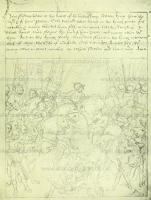
Beauchamp Pageant. [21st July 1403] 7. Here shewes howe at the batell of Shrewesbury betwen Kyng Henry the iiijth and Sir Henry Percy Erle Richard [aged 21] there beyng on the kynges party ful notably and manly behaved hym self to his greet lawde and worship In which batell was slayne the said Sir Henry Percy and many other with him. And on the kynges party there was slayne in the kynges cote armour chef of other, the Erle of Safford. Earl Richardes Auntes son with many others in greet nombre. on whos sowles God have mercy Amen.
Note. This plate refers to the battle of Shrewsbury fought on 21st. July, 1403 between King Henry IV. and Sir Henry Percy. On the left side are seen the forces of the King with the royal banner and that of the Earl of Warwick, who is recognisable by his helmet crest of the bear and ragged staff; the three other horsemen have no distinguishing mark. Beneath them are the English archers in salades, jacks, and shirts of chain mail. One foot soldier with a spear stands over a fallen archer of the enemy's party. On the right are the forces of Percy, the horsemen in retreat; while one mounted man staggers from a lance thrust delivered by the Earl of Warwick, and Hotspur, with the Percy crescent as a crest, himself falls backward pierced in the breast by an English arrow. The archers of Percy, armed and equipped like the King's troops, and bearing small buckles on their sword hilts, are making a stand against the English archers. The banner of Percy's troops is reversed, and accordingly the lions rampant in the first and fourth quarters are in wrong positions. In plate 40 the same mistake is made with the Earl's banner. Strutt in his engraving has carelessly placed the arrow of one of the English archers on the right or wrong side of the bow. A similar mistake is made on plate 40. The Percy banner (reversed as before stated), bears 1 and 4, gold a lion rampant azure, the ancient arms of the Dukes of Brabant and Lovaine, and 2 and 3 gules three lucies hauriant silver for Lucy, the arms of Hotspur's stepmother.
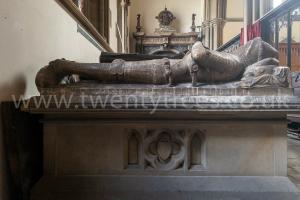
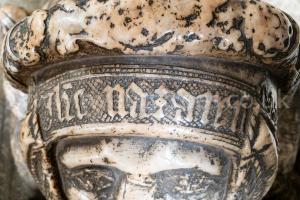
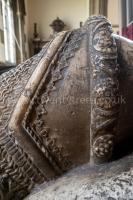
After 21st July 1403 Thomas Wendesley [deceased] was buried at All Saint's Church, Bakewell, Derbyshire [Map]. Camail and Jupon Period armour. IHC NASARE Lettering. His Coat of Arms just visible. Lancastrian Esses Collar.
Abbot John Whethamstede’s Chronicle of the Abbey of St Albans
Abbot John Whethamstede's Register aka Chronicle of his second term at the Abbey of St Albans, 1451-1461, is a remarkable text that describes his first-hand experience of the beginning of the Wars of the Roses including the First and Second Battles of St Albans, 1455 and 1461, respectively, their cause, and their consequences, not least on the Abbey itself. His text also includes Loveday, Blore Heath, Northampton, the Act of Accord, Wakefield, and Towton, and ends with the Coronation of King Edward IV. In addition to the events of the Wars of the Roses, Abbot John, or his scribes who wrote the Chronicle, include details in the life of the Abbey such as charters, letters, land exchanges, visits by legates, and disputes, which provide a rich insight into the day-to-day life of the Abbey, and the challenges faced by its Abbot.
Available at Amazon in eBook and Paperback format.
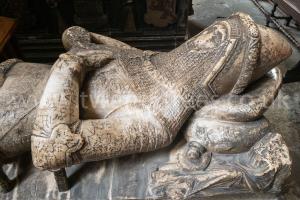
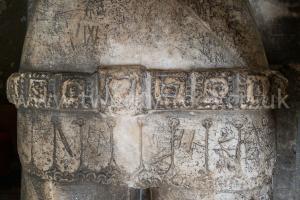
After 21st July 1403 Edmund Cockayne [deceased] was buried at St Oswald's Church, Ashbourne [Map]. Monument to Edmund Cockayne and his first wife Margaret Longford. Camail and Jupon Period. Cockerel Crest. St Oswald's Church, Ashbourne [Map]. Chest with Weepers holding Shields.
Edmund Cockayne: Edmund Cockayne and Elizabeth Harthill were married. In 1356 he was born to John Cockayne and Cecilia Vernon at Ashbourne, Derbyshire [Map].
Margaret Longford: Before 1410 John Cockayne and she were married.

