Possagno Rome, Italy St Peter and St Paul Church, Belton Lichfield Cathedral

Antonio Canova 1757-1822

On 1st November 1757 Antonio Canova was born in Possagno [Map].

In 1793 Richard Westmacott [aged 17] travelled to Rome, Italy [Map] to study under Antonio Canova [aged 35]. Within a year of his arrival in Rome he won the first prize for sculpture offered by the Florentine academy of arts, and in the following year (1795) he gained the papal gold medal awarded by the Roman Academy of St Luke with his bas-relief of Joseph and his brethren.

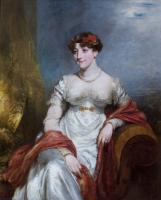
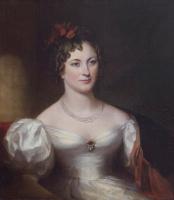
After 21st February 1814. Monument to Amelia Sophia Hume [deceased] in St Peter and St Paul Church, Belton [Map]. Sculpted by Antonio Canova [aged 56].

1817. George Hayter [aged 24]. Portrait of Antonio Canova [aged 59].

Memorials of Francis Chantrey RA in Hallamshire and Elsewhere Part V London Life and Works. Montgomery, whose opinions I quote the more freely, not merely because he has himself looked upon sculpture with a poet's eye, but also because he oft endeavoured to excite a similar taste in his gifted friend-says, "Nothing in sculpture is truly excellent but that which is pre-eminently so, because nothing less than the most successful strokes of the happiest chisel can powerfully affect the spectator, fix him in dumb astonishment, touch his heart strings with tender emotion, stir thought from its depths into ardent and earnest exercise. I appeal to all who hear me, whether, among a hundred of the monuments in our cathedrals, and the statues in our public places, they ever met with more than one or two that laid hold of their imagination, so as to haunt it both in retirement and in society? "Such are the Apollo Belvidere, the Venus de Medici, and other inestimable relics of antiquity; such the Moses and David of Michael Angelo; and such- ( to give an English example worthy to be named with these, judging solely by the power which it exercises over the purest and most universal of human sympathies, -- sympathies which can no more be bribed by artifice than they can help yielding to the impulse of nature ) -such, I say, is the simple memorial by our own Chantrey [aged 35], in Lichfield Cathedral [Map], of two children that were 'lovely in their lives, and in death are undivided. Of these specimens, it may be affirmed, that they have shown how the narrow bonds of vulgar precedent may be left as far behind as a star in the heavens leaves a meteor in the air."1 There is not, indeed, a more exquisite group in the whole range of modern sculpture than Chantrey's "Two Children" in marble. The sisters lie asleep in each others arms in the most unconstrained and graceful repose. The snowdrops which the youngest had plucked are undropped from her hand, and both are images of artless beauty, and innocent and unaffected race. Such was the press to see these children in the London Exhibition, that there was no getting near them: mothers, with tears in their eyes, lingered, and went away, and returned; while Canova's [aged 59] now far-famed figures of Hebe and Terpsichore stood almost unnoticed by their side. Chantrey modelled two other figures of this class, viz., a "Sleeping Child," the daughter of Sir Thos. Dyke Acland; and a "Reposing Infant," for Mr. Boswell, of Auchinleck.

Note 1. "Lectures on Poetry," p. 20.

In October 1817 John Gibson [aged 27] travelled to Rome, Italy [Map] where he studied under Antonio Canova [aged 59].

1819. John Jackson [aged 40]. Portrait of Antonio Canova [aged 61].

In 1819 Francis Leggatt Chantrey [aged 37] and John Jackson [aged 40] travelled together to Italy. In Rome, Italy [Map] Chantrey met Antonio Canova [aged 61].

In 1821 Richard James Wyatt [aged 25] left England, and, after studying for a few months in Paris under Bosio, proceeded to Rome, and entered the studio of Antonio Canova [aged 63], where he had John Gibson (1790–1866) as a fellow pupil.

Annals of the six Kings of England by Nicholas Trivet

Translation of the Annals of the Six Kings of England by that traces the rise and rule of the Angevin aka Plantagenet dynasty from the mid-12th to early 14th century. Written by the Dominican scholar Nicholas Trivet, the work offers a vivid account of English history from the reign of King Stephen through to the death of King Edward I, blending political narrative with moral reflection. Covering the reigns of six monarchs—from Stephen to Edward I—the chronicle explores royal authority, rebellion, war, and the shifting balance between crown, church, and nobility. Trivet provides detailed insight into defining moments such as baronial conflicts, Anglo-French rivalry, and the consolidation of royal power under Edward I, whose reign he describes with particular immediacy. The Annals combines careful year-by-year reporting with thoughtful interpretation, presenting history not merely as a sequence of events but as a moral and political lesson. Ideal for readers interested in medieval history, kingship, and the origins of the English state, this chronicle remains a valuable and accessible window into the turbulent world of the Plantagenet kings.

Available at Amazon in eBook and Paperback format.

In 1822 Joseph Gott [aged 36] was sent to Rome on a pension from Sir Thomas Lawrence [aged 52] who provided him with a personal letter of introduction to Antonio Canova [aged 64]. Gott remained in Rome for the rest of his life.

On 13th October 1822 Antonio Canova [aged 64] died.