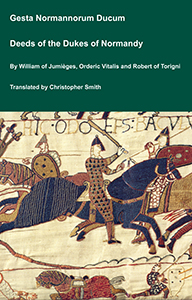
The Deeds of the Dukes of Normandy
The Gesta Normannorum Ducum [The Deeds of the Dukes of Normandy] is a landmark medieval chronicle tracing the rise and fall of the Norman dynasty from its early roots through the pivotal events surrounding the Norman Conquest of England. Originally penned in Latin by the monk William of Jumièges shortly before 1060 and later expanded at the behest of William the Conqueror, the work chronicles the deeds, politics, battles, and leadership of the Norman dukes, especially William’s own claim to the English throne. The narrative combines earlier historical sources with firsthand information and oral testimony to present an authoritative account of Normandy’s transformation from a Viking settlement into one of medieval Europe’s most powerful realms. William’s history emphasizes the legitimacy, military prowess, and governance of the Norman line, framing their expansion, including the conquest of England, as both divinely sanctioned and noble in purpose. Later chroniclers such as Orderic Vitalis and Robert of Torigni continued the history, extending the coverage into the 12th century, providing broader context on ducal rule and its impact. Today this classic work remains a foundational source for understanding Norman identity, medieval statesmanship, and the historical forces that reshaped England and Western Europe between 800AD and 1100AD.
Available at Amazon in eBook and Paperback format.
Lion is in Feet Resting On.
After 22nd March 1354. Monument to Edmund Cornwall [deceased] at St Mary's Church, Burford [Map]. Early Plate Bascinet and Gorget Period. Feet resting on a Lion. Curious laminated gorget.
Edmund Cornwall: he and Elizabeth Brampton were married. Around 1280 he was born to Richard Cornwall and Joan Fitzalan at Asthall Leigh, Oxfordshire. He a great grandson of King John of England. On 22nd March 1354 he died at Cleobury Mortimer, Shropshire. He was buried at St Mary's Church, Burford [Map].


After 22nd January 1502 John Strelley [deceased] was buried at All Saints' Church, Strelley [Map]. Monument to John Strelley and Sanchia Willoughby [aged 50]. Fluted Period. Described as the finest alabaster monument in the country. Chellaston alabaster. Bobbed hair to the shoulder. Feet resting on a Lion, two fine Bedesmen, one male, one female;possibly Harpur and Moorecock of Burton on Trent. Great helm with Saracen's Head Crest, strangled as denoted by the tongue out. Extended mantling. Four arms above the effigies represent, from left to right: Strelley impaled Kempe - his father Robert Strelley and his mother Isabel Kempe, Strelley Arms impaled Willoughby - John and his wife, Strelley impaled Pierrepoint - John's paternal great-grandfather Nicholas Strelley and great-grandmother Elizabeth Pierrepoint.


After 1503. Monument to John de la Pole 2nd Duke of Suffolk and Elizabeth York Duchess Suffolk [aged 58] in St Andrew's Church, Wingfield [Map]. Finely made Fluted Period alabaster monument. Both wearing their ducal coronets. He wearing a Leg Garter. His head resting on a great helm with Saracen's Head Crest, feet resting on a Lion. Chunky Lions Mane.


