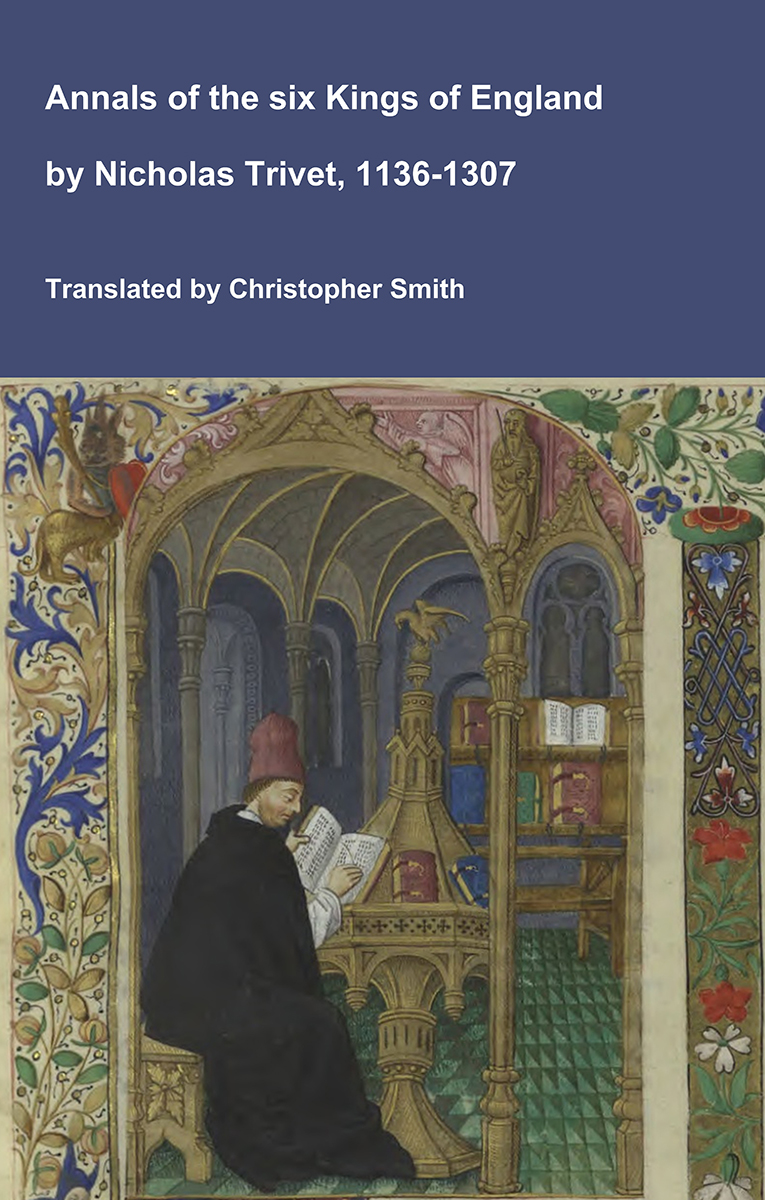
Annals of the six Kings of England by Nicholas Trivet

Translation of the Annals of the Six Kings of England by that traces the rise and rule of the Angevin aka Plantagenet dynasty from the mid-12th to early 14th century. Written by the Dominican scholar Nicholas Trivet, the work offers a vivid account of English history from the reign of King Stephen through to the death of King Edward I, blending political narrative with moral reflection. Covering the reigns of six monarchs—from Stephen to Edward I—the chronicle explores royal authority, rebellion, war, and the shifting balance between crown, church, and nobility. Trivet provides detailed insight into defining moments such as baronial conflicts, Anglo-French rivalry, and the consolidation of royal power under Edward I, whose reign he describes with particular immediacy. The Annals combines careful year-by-year reporting with thoughtful interpretation, presenting history not merely as a sequence of events but as a moral and political lesson. Ideal for readers interested in medieval history, kingship, and the origins of the English state, this chronicle remains a valuable and accessible window into the turbulent world of the Plantagenet kings.

Available at Amazon in eBook and Paperback format.

Bishop Richard Newport -1318

Annals Londonienses. In the same year, Ralph le Balauncer and William de Causton were sheriffs of London. In the same year, John de Wengrave, Recorder of the Guildhall and under-coroner, was elected mayor, while still holding the aforesaid offices. In the same year, on the fifteenth day before the Kalends of January [18th December [1316]], Gilbert de Segrave [aged 50], Bishop of London, died, and Richard de Newport succeeded him.

Eodem anno, vicecomites Londoniarum fuerunt Radulfus le Balauncer et Willelmus de Causton. Eodem anno Johannes de Wengrave, recordator Gildaulæ et subcoronator, electus est in majorem, qui tunc habuit Succession illa prædicta officia. Eodem anno, XV kalendas Januarii, Gilbertus de Segrave episcopus Londoniensis obiit, et successit Ricardus de Neuporte.

On 27th January 1317 Bishop Richard Newport was elected BIshop of London.

Annales Paulini. In the year of our Lord 1317, and in the tenth year of the reign of King Edward, the dominical letter being B, on the sixth day before the Kalends of February [27th January 1317], which was a Thursday, Master Richard de Newport was elected Bishop of London. On the Sunday immediately following the Ascension of the Lord [15th May], he was consecrated at Canterbury by Sir Walter, Archbishop of Canterbury. Around the same time, the Countess of Lancaster [aged 35] was abducted by the Earl of Warenne [aged 30].

Anno Domini MCCCXVII, et anno regni regis Edwardi X, littera Dominicalis B; VI kalendas Februarii, qui fuit dies Jovis, electus fuit magister Ricardus de Neuport in episcopum Londoniensem; et die Dominica proxima post Ascensionem Domini consecratus fuit apud Cantuariam a domino Waltero archiepiscopo Cantuariensi. Circa idem tempus rapta fuit comitissa Lancastriæ per comitem Warenniæ.

On 15th May 1317 Bishop Richard Newport was consecrated Bishop of London.

On 24th August 1318 Bishop Richard Newport died.

Annales Paulini. In the same year, on the feast of St Bartholomew [24th August 1318], Master Richard de Newport, Bishop of London, died suddenly at Ilford, in the house of the vicar of that place, and was immediately carried from there by night to Stepney. In the same year, on the Sunday, namely the third day before the Nones [3rd] of September, the aforesaid cardinals excommunicated Robert Bruce and all the Scots from the pulpit of St Paul's, and caused a certain formal sentence issued against them by a Dominican friar to be publicly proclaimed and explained there to the people in English. On the Monday, the third day before the Ides [11th] of September, the cardinals departed from London with a great company of horsemen, heading towards the sea. On that same Monday, Master Stephen de Gravesend was elected Bishop of London.

Eodem anno, die Sancti Bartholomæi, obiit magister Ricardus de Neuport, episcopus Londoniensis, apud Ylleford, ad domum vicarii ejusdem loci, subito; et statim ab illo loco apud Stebbenhethe noctanter delatus est. Eodem anno, die Dominica, scilicet iii nonas Septembres, prædicti cardinales excommunicaverunt in pulpito Sancti Pauli Robertum de Brus et omnes Scotos, et quendam processum contra eos factum per quendam fratrem Prædicatorem coram populo fecerunt ibidem in Anglico pupplicari et exponi. Et die Lunæ, III idus Septembres, recesserunt cardinales de Londoniis cum multitudine equitantium versus mare. Et eodem die Lunæ, magister Stephanus de Gravesende electus fuit in episcopum Londoniensem.