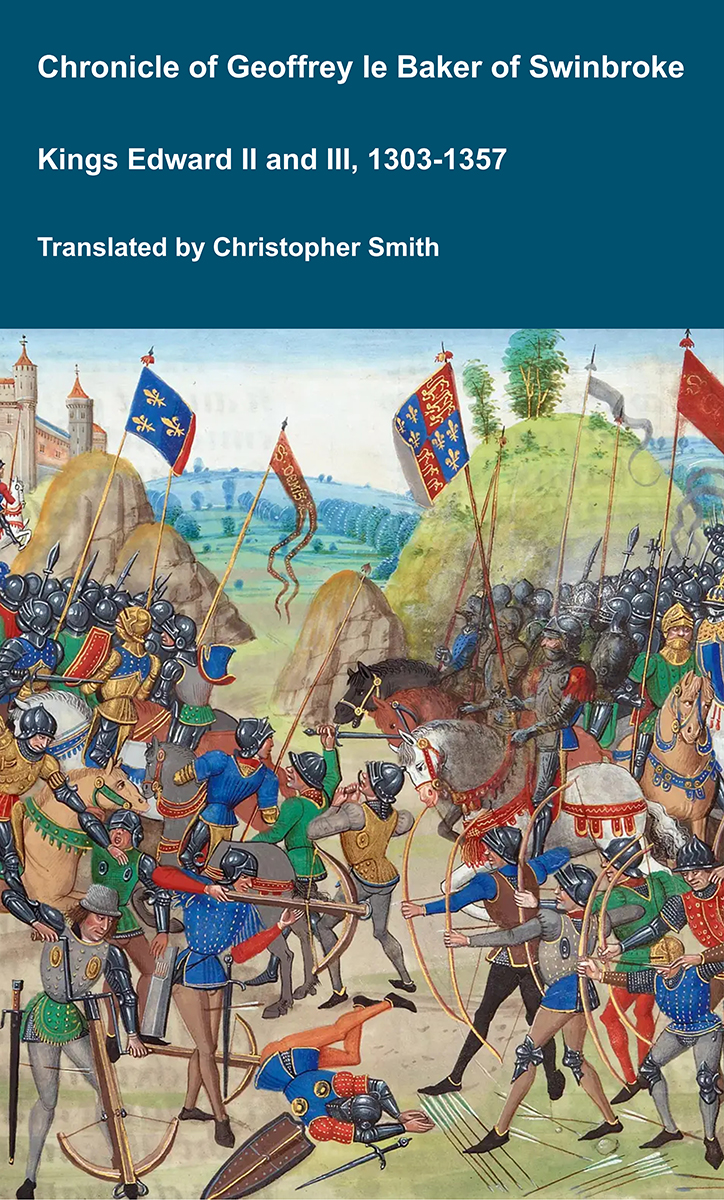
Chronicle of Geoffrey le Baker of Swinbroke

Baker was a secular clerk from Swinbroke, now Swinbrook, an Oxfordshire village two miles east of Burford. His Chronicle describes the events of the period 1303-1356: Gaveston, Bannockburn, Boroughbridge, the murder of King Edward II, the Scottish Wars, Sluys, Crécy, the Black Death, Winchelsea and Poitiers. To quote Herbert Bruce 'it possesses a vigorous and characteristic style, and its value for particular events between 1303 and 1356 has been recognised by its editor and by subsequent writers'. The book provides remarkable detail about the events it describes. Baker's text has been augmented with hundreds of notes, including extracts from other contemporary chronicles, such as the Annales Londonienses, Annales Paulini, Murimuth, Lanercost, Avesbury, Guisborough and Froissart to enrich the reader's understanding. The translation takes as its source the 'Chronicon Galfridi le Baker de Swynebroke' published in 1889, edited by Edward Maunde Thompson.

Available at Amazon in eBook and Paperback format.

Bishop Gilbert Segrave 1266-1316

Paternal Family Tree: Segrave

Maternal Family Tree: Nichole Cantilupe 1217-1252

In 1256 [his father] Nicholas Segrave 1st Baron Segrave [aged 18] and [his mother] Maud de Lucy [aged 16] were married.

In 1266 Bishop Gilbert Segrave was born to Nicholas Segrave 1st Baron Segrave [aged 28] and Maud de Lucy [aged 26].

In 1270 [his brother] John Segrave 2nd Baron Segrave [aged 14] and [his sister-in-law] Christiana Plessey Baroness Segrave were married.

In 1283 [his father] Nicholas Segrave 1st Baron Segrave [aged 45] was created 1st Baron Segrave.

On 12th November 1295 [his father] Nicholas Segrave 1st Baron Segrave [aged 57] died at Chaucombe, Northamptonshire. His son [his brother] John [aged 39] succeeded 2nd Baron Segrave. [his sister-in-law] Christiana Plessey Baroness Segrave by marriage Baroness Segrave.

Annales Paulini. In the same year, on the vigil of St James the Apostle [24th July 1313], Ralph de Baldock, Bishop of London, died at Stepney. During his tenure he had given 200 marks sterling each year towards the new work of St Paul's Cathedral in London, and he was buried in the new work. In the same year, on the seventeenth day before the Kalends of September [16th August], which was a Friday, Master Gilbert de Segrave [aged 47], precentor of St Paul's Cathedral, a man noble in birth and character, was elected Bishop of London. In the same year, on the feast of St Katherine [of Alexandria] the Virgin [25th November], he was consecrated at Canterbury.

Eodem anno, in vigilia Sancti Jacobi apostoli, obiit Radulfus de Baldok, episcopus Londoniarum, apud Stebendockhethe; qui quolibet anno pro tempore suo dedit novo operi Sancti Pauli Londoniensis cc. marcas sterlingorum; sepultusque est in novo opere. Eodem anno, XVII kalendas Septembris, qui fuit dies Veneris, magister Gilbertus de Segrave, cantor ecclesiæ Sancti Pauli, vir nobilis genere et moribus, electus est in episcopum Londoniensem; et eodem anno, in festo Sanctæ Katerinæ virginis, apud Cantuariam consecratus est.

On 17th August 1313 Bishop Gilbert Segrave [aged 47] was elected Bishop of London.

On 25th November 1313 Bishop Gilbert Segrave [aged 47] was consecrated as Bishop of London by Bishop Henry Woodlock.

Annales Paulini. In the year of our Lord 1314, and in the seventh year of the reign of King Edward, the dominical letter being F, on the thirteenth day before the Kalends of March [17th February 1314], namely a Sunday, Sir Walter Reynolds, formerly Bishop of Worcester, upon whom the pope had conferred the archbishopric of Canterbury at the request of the lord king, Master Thomas de Cobham [aged 46], the archbishop-elect, having been rejected, was enthroned at Canterbury in the presence of the lord king and many magnates. In the same year, on Passion Sunday, which fell on the ninth day before the Kalends of April [24th March], Master Gilbert de Segrave [aged 48], Bishop of London, was enthroned, and on the same day, as though its founder, he laid the first stones of the new shrine of St Erkenwald.

Anno Domini MCCCXIIII, et anno regni regis Edwardi VII; litera Dominicalis F. XIII kalendas Martii, videlicet die Dominica, dominus Walterus Reginaldi, quondam episcopus Wygorniensis, cui dominus papa archiepiscopatum Cantuariensem ad rogatum domini regis contulerat, magistro Thoma de Cobeham electo repulso, intronizatus fuit apud Cantuariam, domino rege præsente et magnatibus multis. Eodem anno, Dominica in Passione, quæ fuit Segrave IX kalendas Aprilis, intronizatus fuit magister Gilbertus de Segrave episcopus Londoniensis, et eodem die posuit primos lapides novi feretri Sancti Erkenwaldi quasi fundator.

Annales Paulini. Around the feast of All Saints [1st November 1314], a certain woman named Juliana de Lambeth, who was the daughter of a convert, was arrested within the jurisdiction of the Bishop of London. She was accused of sorcery by Sir Walter, Archbishop of Canterbury, and was rigorously examined before him and his clerks. Eventually she was handed over for examination and correction by the Bishop of London [aged 48]. The bishop had her brought into St Paul's Cathedral in London, dressed in a black cloak with long sleeves in the manner of a philosopher, and made her walk at the head of the procession carrying a certain wax image, because she had been accustomed to practise her sorcery by means of images of this kind. Afterwards she was stripped of this clothing and placed upon a high scaffold erected for the purpose above the consistory, in full view of all the people. There the bishop caused all her books, together with some of her hair, to be burned. In addition, she swore an oath that she would not make use of [....].

Circa festum Omnium Sanctorum, mulier quædam nomine Juliana de Lamhethe, quæ fuitde filia cujusdam conversi, comprehensa, in jurisdictione domini episcopi Londoniensis; cui imponebatur sortilegium per dominum Walterum archiepiscopum Cantuariensem, et coram ipso et clericis suis districte examinata. Tandem examinationi et correctioni episcopi Londoniensis fuit tradita. Episcopus vero fecit eam adduci in ecclesiam Sancti Pauli Londoniis, indutam capa nigra cum longis manicis ad modum philosophi, et fecit eam antecedere processionem portantem quandam ymaginem de cera, eo quod solebat de hujusmodi ymaginibus maleficia sua operari. Postea despoliata fuit, et in scaffoldo eminenti super consistorium, ad hoc præparato, in conspectu totius populi fuit statuta, et omnes libellos suos cum aliqua parte capillorum suorum ibidem facto fecit episcopus comburi, facto insuper juramento per ipsain de non utendo in [....]

Click to read more ...

Annals Londonienses. In the same year, Ralph le Balauncer and William de Causton were sheriffs of London. In the same year, John de Wengrave, Recorder of the Guildhall and under-coroner, was elected mayor, while still holding the aforesaid offices. In the same year, on the fifteenth day before the Kalends of January [18th December [1316]], Gilbert de Segrave [aged 50], Bishop of London, died, and Richard de Newport succeeded him.

Eodem anno, vicecomites Londoniarum fuerunt Radulfus le Balauncer et Willelmus de Causton. Eodem anno Johannes de Wengrave, recordator Gildaulæ et subcoronator, electus est in majorem, qui tunc habuit Succession illa prædicta officia. Eodem anno, XV kalendas Januarii, Gilbertus de Segrave episcopus Londoniensis obiit, et successit Ricardus de Neuporte.

On 18th December 1316 Bishop Gilbert Segrave [aged 50] died.

Annales Paulini. In the same year, on the fifteenth day before the Kalends of January [18th December 1316], which was a Saturday, Gilbert de Segrave [aged 50], Bishop of London, died, and was buried on the Thursday after the feast of St Thomas the Martyr [23rd December], during Christmas week. In this year the Scots invaded Ireland in hostility. Edward Bruce, who had caused himself to be called King of Ireland, was killed there1, together with many others who were with him, and the remainder abandoned Ireland and departed.

Eodem anno, XV kalendas Januarii, qui fuit dies Sabbati, obiit Gilbertus de Segrave episcopus Londoniensis, et sepultus fuit die Jovis in crastino Sancti Thomæ martyris, in hebdomada Natalis Domini. Hoc anno Scoti hostiliter Hyberniam intraverunt, et interfecto ibidem Edwardo le Brus, qui se fecit regem Hyberniæ nominari, et multis aliis cum eo interfectis, reliqui relicta Hybernia abierunt.

Note 1. The Chronicler is mistaken. Edward Bruce was killed on 14th October 1318 at the Battle of Faughart.

Annals Londonienses. In the same year, on the vigil of St James the Apostle [24th July], Sir Ralph de Baldock, Bishop of London, died at Stepney. He was succeeded in the bishopric by Gilbert de Segrave. In the same year, Robert Burdeyn, goldsmith, and Hugh de Garton, spicer, were sheriffs of London. In the same year, at the feast of Saints Simon and Jude [28th October], Nicholas de Farndone was elected mayor of London.

Eodem anno, in vigilia London Sancti Jacobi apostoli, dominus Radulfus de Baldok, episcopus Londoniensis, obiit apud Stebenhethe; post quem in episcopatum successit Gilbertus de Segrave. Eodem anno fuerunt vicecomites Londoniarum Robertus Burdeyn aurifaber et Hugo de Garton spicer. Eodem anno, ad festum Simonis et Judæ, electus fuit major Londoniarum Nicholaus de Farndone.

Ancestors of Bishop Gilbert Segrave 1266-1316

Great x 2 Grandfather: Gilbert Segrave

Great x 1 Grandfather: Stephen Segrave

Grandfather: Gilbert Segrave

Great x 3 Grandfather: Geoffrey Despencer

Great x 2 Grandfather: Thomas Despencer

Great x 1 Grandmother: Rohese Despencer

Great x 2 Grandmother: Recuara Harcourt

Father: Nicholas Segrave 1st Baron Segrave

Bishop Gilbert Segrave

Grandfather: Geoffrey de Lucy of Newington in Kent

Mother: Maud de Lucy

Great x 3 Grandfather: Walter Cantilupe

Great x 2 Grandfather: William Cantilupe Baron

Great x 1 Grandfather: William Cantilupe

Grandmother: Nichole Cantilupe