

Bishop of Ely is in Bishop, Ely Cathedral [Map].
On 6th October 1174 Bishop Geoffrey Ridel was consecrated Bishop of Ely at Canterbury Cathedral [Map].
On 15th September 1189 King Richard "Lionheart" I of England [aged 32] held a Council meeting at Pipewell [Map] at which he appointed a number of Bishops:
Bishop William Longchamp was elected Bishop of Ely.
Bishop Godfrey Lucy was elected Bishop of Winchester.
Bishop Richard Fitzneal [aged 59] was elected Bishop of London.
Archbishop Hubert Walter [aged 29] was elected Bishop of Salisbury.
On 31st December 1189 two of Richard I's new bishops were consecrated...
Bishop William Longchamp was consecrated Bishop of Ely.
Bishop Richard Fitzneal [aged 59] was consecrated Bishop of London.
On 6th January 1190 Bishop William Longchamp was enthroned Bishop of Ely at Ely Cathedral [Map].
In 1225 Bishop Geoffrey Burgh [aged 45] was appointed Bishop of Ely.
On 3rd February 1229 Bishop Hugh of Northwold was elected Bishop of Ely.
On 19th June 1229 Bishop Hugh of Northwold was consecrated Bishop of Ely at Canterbury Cathedral [Map].
In 1257 Bishop Hugh de Balsham was elected Bishop of Ely by the monks of Ely contrary to King Henry III of England and the Archbishop of Canterbury Boniface of Savoy [aged 50]. Boniface declared the election invalid, and attempted to install Adam Marsh in the see. Both sides appealed to Rome. The election was confirmed by Pope Alexander IV in 1257.
On 14th October 1257 Bishop Hugh de Balsham was consecrated Bishop of Ely by the Pope in Rome.
On 26th July 1283 Bishop John Kirkby was elected Bishop of Ely.
On 22nd September 1286 Bishop John Kirkby was consecrated Bishop of Ely.
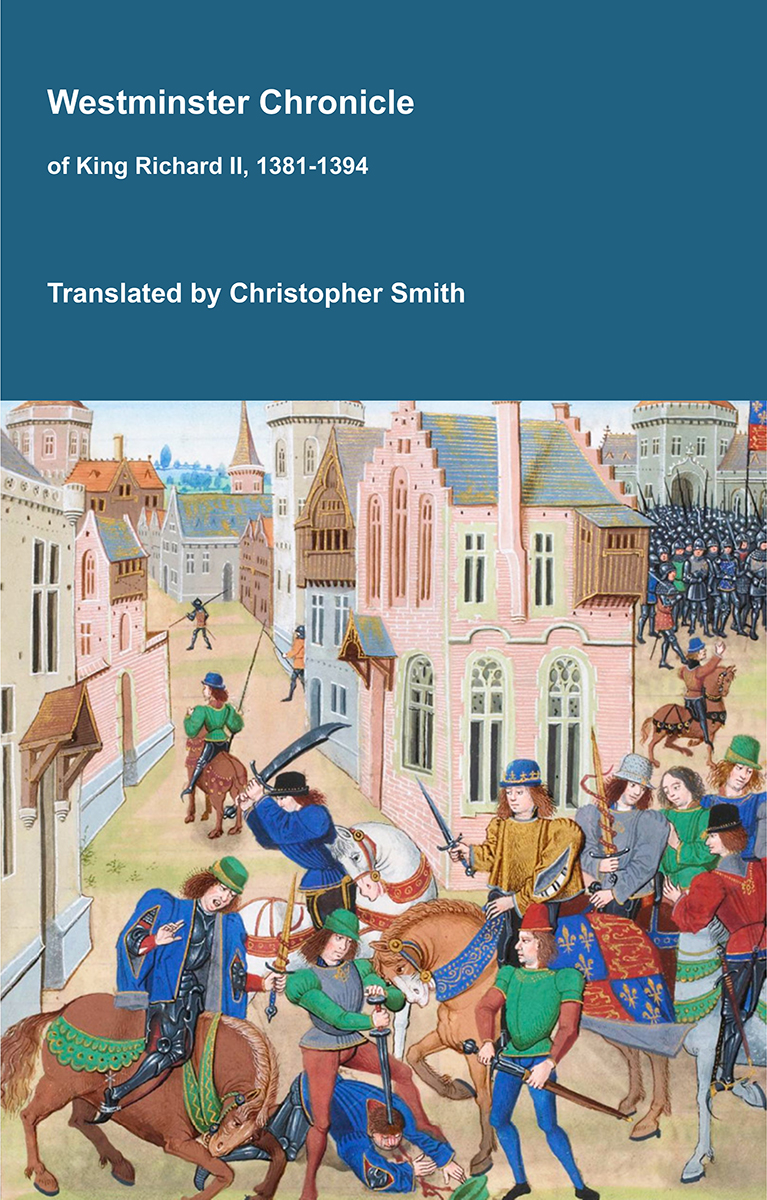
Westminster Chronicle of King Richard II, 1381-1394
The Westminster Chronicle is one of the most vivid and important narrative sources for the reign of Richard II. Written by an anonymous chronicler closely connected with Westminster Abbey, it covers the years 1381 to 1394, from the Peasants’ Revolt to the political tensions, court ceremonies, diplomatic negotiations, royal progresses, and public crises of Richard’s later reign. Rich in detail the chronicle records major events such as the conflicts between the King and Lords Appellant, King and the City of London, negotiations with France and Scotland, the death and funeral of Queen Anne of Bohemia, the illness of Charles VI of France, and the changing fortunes of leading nobles including John of Gaunt, Thomas of Gloucester, Robert de Vere, and the Earl of Arundel. The Chronicle offers readers a remarkable window into late fourteenth-century England, combining political observation, courtly spectacle, urban drama, ecclesiastical affairs, and moral judgement. It is an essential source for anyone interested in medieval monarchy, London, Westminster, and the troubled reign of Richard II.
Available at Amazon in eBook and Paperback format.
On 24th December 1286 Bishop John Kirkby was enthroned Bishop of Ely.
Around 20th June 1316 Bishop John Hotham was elected Bishop of Ely.
On 3rd October 1316 Bishop John Hotham was consecrated Bishop of Ely.
In 1337 Bishop Simon Montagu was appointed Bishop of Ely.
In July 1345 Bishop Thomas Lisle [aged 47] was consecrated as Bishop of Ely.
On 15th July 1345 Bishop Thomas Lisle [aged 47] was elected Bishop of Ely.
On 13th August 1373 Archbishop Thomas Fitzalan aka Arundel [aged 20] was appointed Bishop of Ely.
On 3rd April 1388 Bishop John Fordham was translated to Bishop of Ely.
Around 1437 Louis of Luxembourg travelled to England where he was appointed Bishop of Ely.
Around 1437 Louis of Luxembourg travelled to England where he was appointed Bishop of Ely.
In 1443 Cardinal Thomas Bourchier [aged 25] was appointed Bishop of Ely.
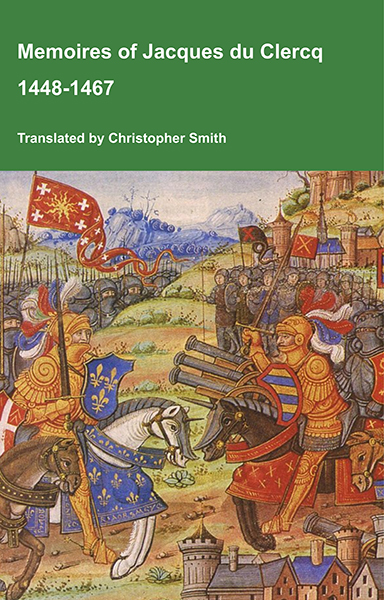
This is a translation of the 'Memoires of Jacques du Clercq', published in 1823 in two volumes, edited by Frederic, Baron de Reissenberg. In his introduction Reissenberg writes: 'Jacques du Clercq tells us that he was born in 1424, and that he was a licentiate in law and a counsellor to Philip the Good, Duke of Burgundy, in the castellany of Douai, Lille, and Orchies. It appears that he established his residence at Arras. In 1446, he married the daughter of Baldwin de la Lacherie, a gentleman who lived in Lille. We read in the fifth book of his Memoirs that his father, also named Jacques du Clercq, had married a lady of the Le Camelin family, from Compiègne. His ancestors, always attached to the counts of Flanders, had constantly served them, whether in their councils or in their armies.' The Memoires cover a period of nineteen years beginning in in 1448, ending in in 1467. It appears that the author had intended to extend the Memoirs beyond that date; no doubt illness or death prevented him from carrying out this plan. As Reissenberg writes the 'merit of this work lies in the simplicity of its narrative, in its tone of good faith, and in a certain air of frankness which naturally wins the reader’s confidence.' Du Clercq ranges from events of national and international importance, including events of the Wars of the Roses in England, to simple, everyday local events such as marriages, robberies, murders, trials and deaths, including that of his own father in Book 5; one of his last entries.
Available at Amazon in eBook and Paperback format.
In 1454 Bishop William Grey was appointed Bishop of Ely.
On 8th August 1478 Cardinal John Morton [aged 58] was appointed Bishop of Ely.
On 6th October 1486 Bishop John Alcock [aged 56] was translated to Bishop of Ely.
On 26th May 1501 Bishop Richard Redman was appointed Bishop of Ely.
In 1506 Bishop James Stanley [aged 41] was appointed Bishop of Ely.
In 1515 Bishop Nicholas West [aged 54] was appointed Bishop of Ely.
Before 19th April 1534 Bishop Thomas Goodrich was elected Bishop of Ely.

On 19th April 1534 Bishop Thomas Goodrich was consecrated Bishop of Ely by Archbishop Thomas Cranmer [aged 44] assisted by Bishop John Longland [aged 61] and Bishop Christopher Lord.
In July 1554 Bishop Thomas Thirlby [aged 48] was translated to Bishop of Ely.
In 1559 Bishop Richard Cox [aged 66] was appointed Bishop of Ely where he remained for twenty-one years.


Henry Machyn's Diary. 5th July 1559. The v day of July was deposyd of ther byshopeprykes the archebyshope of Yorke doctur Heth [aged 58], and the bysshope of Ely docthur Thurlbe [aged 53], at my lord treysorer('s) [aged 76] plasse at Frers Augustyne.
The Deeds of the Dukes of Normandy
The Gesta Normannorum Ducum [The Deeds of the Dukes of Normandy] is a landmark medieval chronicle tracing the rise and fall of the Norman dynasty from its early roots through the pivotal events surrounding the Norman Conquest of England. Originally penned in Latin by the monk William of Jumièges shortly before 1060 and later expanded at the behest of William the Conqueror, the work chronicles the deeds, politics, battles, and leadership of the Norman dukes, especially William’s own claim to the English throne. The narrative combines earlier historical sources with firsthand information and oral testimony to present an authoritative account of Normandy’s transformation from a Viking settlement into one of medieval Europe’s most powerful realms. William’s history emphasizes the legitimacy, military prowess, and governance of the Norman line, framing their expansion, including the conquest of England, as both divinely sanctioned and noble in purpose. Later chroniclers such as Orderic Vitalis and Robert of Torigni continued the history, extending the coverage into the 12th century, providing broader context on ducal rule and its impact. Today this classic work remains a foundational source for understanding Norman identity, medieval statesmanship, and the historical forces that reshaped England and Western Europe between 800AD and 1100AD.
Available at Amazon in eBook and Paperback format.
On 22nd September 1609 Bishop Lancelot Andrewes [aged 54] was elected Bishop of Ely.
In 1628 Bishop John Buckeridge [aged 66] was translated to Bishop of Ely.
On 15th November 1631 Bishop Francis White [aged 67] was elected Bishop of Ely.
In 1638 Bishop Matthew Wren [aged 52] was appointed Bishop of Ely.
In 1667 Bishop Benjamin Lany [aged 75] was appointed Bishop of Ely.

In 1674 Bishop Peter Gunning [aged 60] was translated to Bishop of Ely.
John Evelyn's Diary. 26th March 1675. Dr. Brideoak [aged 62] was elected Bishop of Chichester, on the translation of Dr. Gunning [aged 61] to Ely.
John Evelyn's Diary. 20th February 1676. Dr. Gunning [aged 62], Bishop of Ely, preached before the King [aged 45] from St. John xx. 21, 22, 23, chiefly against an anonymous book, called "Naked Truth", a famous and popular treatise against the corruption in the Clergy, but not sound as to its quotations, supposed to have been the Bishop of Hereford and was answered by Dr. Turner, it endeavoring to prove an equality of order of Bishop and Presbyter.

On 16th July 1684 Bishop Francis Turner [aged 46] was translated to Bishop of Ely.
John Evelyn's Diary. 4th November 1684. Dr. Turner [aged 47], now translated from Rochester to Ely upon the death of Dr. Peter Gunning, preached before the King [aged 54] at White-hall on 3 Romans 8, a very excellent sermon, indicating the Church of England against the pernicious doctrines of the Church of Rome. He challenged the producing but of five Cleargymen who forsooke our Church and went over to that of Rome, during all the troubles & rebellion In England, which lasted neere twenty yeares; and this was to my certaine observation a greate truth.
William of Worcester's Chronicle of England
William of Worcester, born around 1415, and died around 1482 was secretary to John Fastolf, the renowned soldier of the Hundred Years War, during which time he collected documents, letters, and wrote a record of events. Following their return to England in 1440 William was witness to major events. Twice in his chronicle he uses the first person: 1. when writing about the murder of Thomas, 7th Baron Scales, in 1460, he writes '… and I saw him lying naked in the cemetery near the porch of the church of St. Mary Overie in Southwark …' and 2. describing King Edward IV's entry into London in 1461 he writes '… proclaimed that all the people themselves were to recognize and acknowledge Edward as king. I was present and heard this, and immediately went down with them into the city'. William’s Chronicle is rich in detail. It is the source of much information about the Wars of the Roses, including the term 'Diabolical Marriage' to describe the marriage of Queen Elizabeth Woodville’s brother John’s marriage to Katherine, Dowager Duchess of Norfolk, he aged twenty, she sixty-five or more, and the story about a paper crown being placed in mockery on the severed head of Richard, 3rd Duke of York.
Available at Amazon in eBook and Paperback format.
In 1691 Bishop Simon Patrick [aged 64] was translated to Bishop of Ely.
In 1707 Bishop John Moore [aged 61] was translated to Bishop of Ely.

In 1723 Bishop Thomas Green [aged 65] was appointed Bishop of Ely.
In 1781 Bishop James Yorke [aged 50] was appointed Bishop of Ely.
In May 1812 Bishop Bowyer Sparke [aged 53] was translated to Bishop of Ely which position he held until his death in 1836.

In 1836 Bishop Joseph Allen [aged 66] was translated to Bishop of Ely.
In 1886 Bishop Alwyne Compton [aged 61] was appointed Bishop of Ely.
In 1924 Bishop Leonard Jauncey White Thompson [aged 60] was appointed Bishop of Ely.