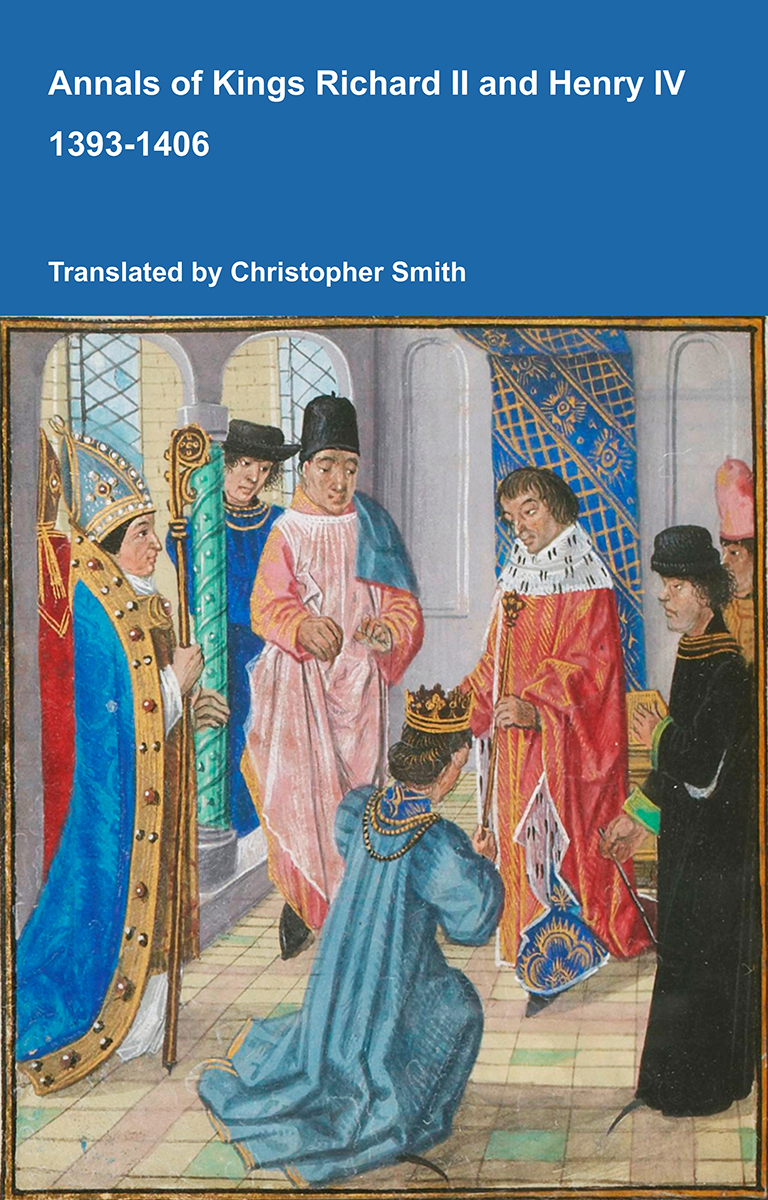
Annals of Kings Richard II and Henry IV 1393-1406

The Annals of Kings Richard II and Henry IV offers a vivid contemporary account of one of the most turbulent periods in late medieval England. Covering the reigns of Richard II and Henry IV, the chronicle records royal ceremonies, political conflict, rebellion, war, taxation, religious controversy, executions, popular unrest and remarkable portents. Its pages include a detailed description of Richard II’s coronation, the fall and deposition of the king, Henry IV’s seizure of the throne, the Percy rebellion, the execution of Archbishop Richard Scrope, the campaigns of Owain Glyndŵr, and England’s relations with Scotland, France, Portugal and Scandinavia. Alongside affairs of state, the annalist preserves reports of miracles, eclipses, prophecies, supernatural events and the experiences of ordinary townspeople, clergy, soldiers and travellers. Written from a monastic perspective, the work combines political observation with moral judgement, presenting victories and disasters as evidence of divine favour or punishment. At once a historical record and a reflection of medieval belief, the Annals provides an invaluable window into the challenges, ceremonies and conflicts of England at the turn of the fifteenth century.

Available at Amazon in eBook and Paperback format.

Jarl Haakon Sigurdsson -1030

Jarl Haakon Sigurdsson was born to Unknown Sigurdsson.

In or before 1029 Jarl Haakon Sigurdsson and Gunilda were married. They were uncle and niece.

Chronicon ex Chronicis by Florence and John of Worcester. 1029. Canute [aged 34], king of England, Denmark, and Norway, returned to England, and after the feast of St. Martin [11 Nov] banished Hakon, a Danish earl, who had married the noble lady [his wife] Gunilda, his [his sister] sister's daughter by Wyrtgeorn, king of the Winidi, sending him away under pretence of an embassy; for he feared that the earl would take either his life or his kingdoms.

Chronicon ex Chronicis by Florence and John of Worcester. 1030. The before-mentioned earl Haco perished at sea: some, however, say that he was killed in the islands of Orkney. Olaf [aged 35], king and martyr, son of Harold, king of Norway, was wickedly slain by the Norwegians.

Chronicon ex Chronicis by Florence and John of Worcester. 1044. At a general synod, held about that time in London, Wulfmar, a devout monk of Evesham, also called Manni, was elected abbot of that monastery. The same year, the noble lady, Gunhilda, daughter of king Wyrtgeorn, by king Canute's sister, and successively the wife of earls Hakon and Harold, was banished from England with her two sons, Hemming and Thurkill. She went over to Flanders, and resided for some time at a place called Bruges [Map], and then went to Denmark. Stigand, the king's chaplain, was appointed bishop of East-Anglia.