

On 20th April 1808 Emperor Napoléon III was born to Louis Bonaparte [aged 29].
On 25th July 1846 [his father] Louis Bonaparte [aged 67] died.

1847. Alexandre Cabanel [aged 23]. Portrait of Emperor Napoléon III [aged 38].
On 22nd January 1853 Emperor Napoléon III [aged 44] and Empress Eugénie of France [aged 26] were married at the Tuileries Palace. A much grander ceremony was held a few days later at Notre Dame de Paris Cathedral [Map].


In 1855. Franz Xaver Winterhalter [aged 49]. The Emperor Napoléon III [aged 46].
In 1855 Queen Victoria of the United Kingdom [aged 35] appointed five Knights of the Garter:
709th George Howard 7th Earl Carlisle [aged 52].
711th Francis Leveson Gower aka Egerton 1st Earl Ellesmere [aged 54].
712th George Hamilton-Gordon 4th Earl Aberdeen [aged 70].
713th Emperor Napoléon III [aged 46].
714th King Victor Emmanuel II of Sardinia [aged 34].
On 16th March 1856 [his son] Prince Imperial Louis-Napoléon was born to Emperor Napoléon III [aged 47] and [his wife] Empress Eugénie of France [aged 29].
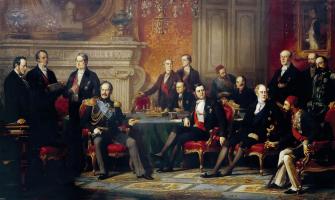
30th March 1856. Édouard Dubufe [aged 36]. The Congress of Paris. Those portayed include Camillo Benso, conte di Cavour, Henry Wellesley [aged 51], Earl Cowley, Karl Ferdinand von Buol-Schauenstein, Aleksej Fëdorovič, Orlov François-Adolphe de Bourqueney, Alexander von Hübner, Otto Theodor von Manteuffel, Alexandre Colonna Walewski, George Villiers [aged 56], Earl of Clarendon, Mehmed Alì Pascià, Philipp von Brunnow, Salvatore Pes, VIII marchese di Villamarina, Max von Hatzfeldt, Mehemmed Djemil Bey, Vincent Benedetti, Napoleone III di Francia [aged 47], Napoleone Bonaparte.
On 9th January 1873 Emperor Napoléon III [aged 64] died.
On 11th July 1920 [his former wife] Empress Eugénie of France [aged 94] died.
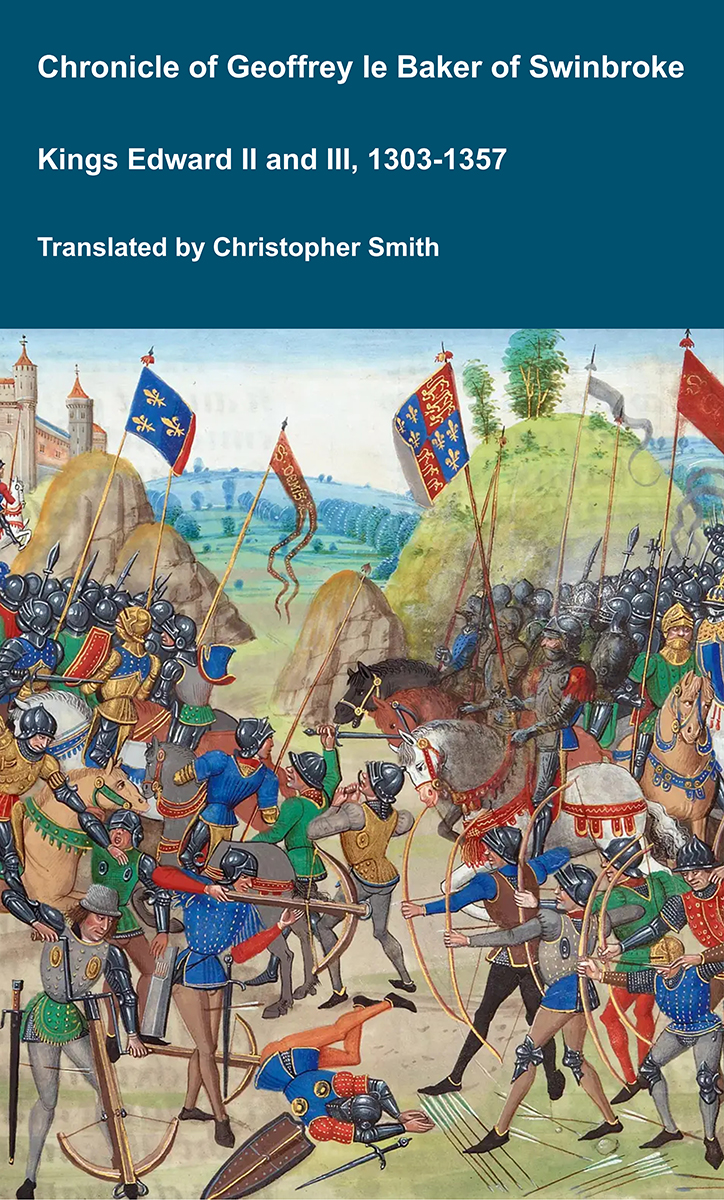
Chronicle of Geoffrey le Baker of Swinbroke
Baker was a secular clerk from Swinbroke, now Swinbrook, an Oxfordshire village two miles east of Burford. His Chronicle describes the events of the period 1303-1356: Gaveston, Bannockburn, Boroughbridge, the murder of King Edward II, the Scottish Wars, Sluys, Crécy, the Black Death, Winchelsea and Poitiers. To quote Herbert Bruce 'it possesses a vigorous and characteristic style, and its value for particular events between 1303 and 1356 has been recognised by its editor and by subsequent writers'. The book provides remarkable detail about the events it describes. Baker's text has been augmented with hundreds of notes, including extracts from other contemporary chronicles, such as the Annales Londonienses, Annales Paulini, Murimuth, Lanercost, Avesbury, Guisborough and Froissart to enrich the reader's understanding. The translation takes as its source the 'Chronicon Galfridi le Baker de Swynebroke' published in 1889, edited by Edward Maunde Thompson.
Available at Amazon in eBook and Paperback format.
Adeline Horsey Recollections. Paris was then a city of delight, revelling in the palmy days of the Second Empire, and I greatly enjoyed my visit there. One night I went to the Opera with Cardigan and we saw Mr. and Mrs. Clarence Trelawney in a box. Mrs. Trelawney was the famous Miss Howard, once the English mistress of Louis Napoleon, who paid her £250,000 when he renounced her to marry Eugenie de Montijo. Mrs. Trelawney annoyed the Emperor and Empress as much as she dared by sitting opposite the Royal box at the Opera, and driving almost immediately behind the Empress's carriage in the Bois de Boulogne. She was a very fat woman, and her embonpoint increased to such an extent that the doors of her carriage had to be enlarged to allow her to get in and out with comfort.
Grandfather: Charles-Marie Bonaparte
father: Louis Bonaparte
Grandmother: Maria-Letizia Ramolino