

In 1645 Prince Pyotr Prozorovsky was born.
Samuel Pepys' Diary. 27th November 1662. At my waking, I found the tops of the houses covered with snow, which is a rare sight, that I have not seen these three years. Up, and put my people to perfect the cleaning of my house, and so to the office, where we sat till noon; and then we all went to the next house upon Tower Hill [Map], to see the coming by of the Russia Embassador [aged 17]; for whose reception all the City trained-bands do attend in the streets, and the King's life-guards, and most of the wealthy citizens in their black velvet coats, and gold chains (which remain of their gallantry at the King's coming in), but they staid so long that we went down again home to dinner. And after I had dined, I heard they were coming, and so I walked to the Conduit in the Quarrefowr1, at the end of Gracious-street and Cornhill [Map]; and there (the spouts thereof running very near me upon all the people that were under it) I saw them pretty well go by. I could not see the Embassador in his coach; but his attendants in their habits and fur caps very handsome, comely men, and most of them with hawkes upon their fists to present to the King [aged 32] But Lord! to see the absurd nature of Englishmen, that cannot forbear laughing and jeering at every thing that looks strange.
Note 1. In two ordinances of the reign of Edward III, printed in Riley's "Memorials of London" (pp. 300, 389), this is called the "Carfukes", which nearly approaches the name of the "Carfax", at Oxford, where four ways also met. Pepys's form of the word is nearer quatre voies, the French equivalent of quadrivium.
John Evelyn's Diary. 27th November 1662. Went to London to see the entrance of the Russian Ambassador [aged 17], whom his Majesty [aged 32] ordered to be received with much state, the Emperor not only having been kind to his Majesty in his distress, but banishing all commerce with our nation during the Rebellion.
Samuel Pepys' Diary. 3rd December 1662. Home and did a little business, and so taking Mr. Pett [aged 52] by the way, we walked to the Temple [Map], in our way seeing one of the Russia Embassador's [aged 17] coaches go along, with his footmen not in liverys, but their country habits; one of one colour and another of another, which was very strange. At the Temple [Map] spoke with Mr. Turner and Calthrop [aged 38], and so walked home again, being in some pain through the cold which I have got to-day by water, which troubles me. At the office doing business a good while, and so home and had a posset, and so to bed.
Samuel Pepys' Diary. 29th December 1662. Thence to White Hall, and got up to the top gallerys in the Banquetting House [Map], to see the audience of the Russia Embassadors [aged 17]; which [took place] after long waiting and fear of the falling of the gallery (it being so full, and part of it being parted from the rest, for nobody to come up merely from the weakness thereof): and very handsome it was. After they were come in, I went down and got through the croude almost as high as the King [aged 32] and the Embassadors, where I saw all the presents, being rich furs, hawks, carpets, cloths of tissue, and sea-horse teeth. The King took two or three hawks upon his fist, having a glove on, wrought with gold, given him for the purpose. The son of one of the Embassadors was in the richest suit for pearl and tissue, that ever I did see, or shall, I believe.
John Evelyn's Diary. 29th December 1662. Saw the audience of the Muscovy Ambassador [aged 17], which was with extraordinary state, his retinue being numerous, all clad in vests of several colors, with buskins, after the Eastern manner! their caps of fur; tunics, richly embroidered with gold and pearls, made a glorious show. the King [aged 32] being seated under a canopy in the Banqueting House, Whitehall Palace [Map], the Secretary of the Embassy went before the Ambassador in a grave march, holding up his master's letters of credence in a crimson taffeta scarf before his forehead. The Ambassador then delivered it with a profound reverence to the King, who gave it to our Secretary of State: it was written in a long and lofty style. Then came in the presents, borne by 165 of his retinue, consisting of mantles and other large pieces lined with sable, black fox, and ermine; Persian carpets, the ground cloth of gold and velvet; hawks, such as they said never came the like; horses said to be Persian; bows and arrows, etc. These borne by so long a train rendered it very extraordinary. Wind music played all the while in the galleries above. This finished, the Ambassador was conveyed by the master of the ceremonies to York House [Map], where he was treated with a banquet, which cost £200, as I was assured.
Samuel Pepys' Diary. 5th January 1663. Up and to the Duke [aged 29], who himself told me that Sir J. Lawson [aged 48] was come home to Portsmouth, Hampshire [Map] from the Streights, who is now come with great renown among all men, and, I perceive, mightily esteemed at Court by all. The Duke did not stay long in his chamber; but to the King's chamber, whither by and by the Russia Embassadors [aged 18] come; who, it seems, have a custom that they will not come to have any treaty with our or any King's Commissioners, but they will themselves see at the time the face of the King [aged 32] himself, be it forty days one after another; and so they did to-day only go in and see the King; and so out again to the Council-chamber. The Duke returned to his chamber, and so to his closett, where Sir G. Carteret [aged 53], Sir J. Minnes [aged 63], Sir W. Batten [aged 62], Mr. Coventry [aged 35], and myself attended him about the business of the Navy; and after much discourse and pleasant talk he went away.


John Evelyn's Diary. 30th May 1663. This morning was passed my lease of Sayes Court [Map] from the Crown, for the finishing of which I had been obliged to make such frequent journeys to London. I returned this evening, having seen the Russian Ambassador [aged 18] take leave of their Majesties with great solemnity.
Samuel Pepys' Diary. 6th June 1663. Lay in bed till 7 o'clock, yet rose with an opinion that it was not 5, and so continued though I heard the clock strike, till noon, and would not believe that it was so late as it truly was. I was hardly ever so mistaken in my life before. Up and to Sir G. Carteret [aged 53] at his house, and spoke to him about business, but he being in a bad humour I had no mind to stay with him, but walked, drinking my morning draft of whay, by the way, to York House [Map], where the Russia Embassador [aged 18] do lie; and there I saw his people go up and down louseing themselves: they are all in a great hurry, being to be gone the beginning of next week. But that that pleased me best, was the remains of the noble soul of the late Duke of Buckingham [aged 35] appearing in his house, in every place, in the doorcases and the windows.


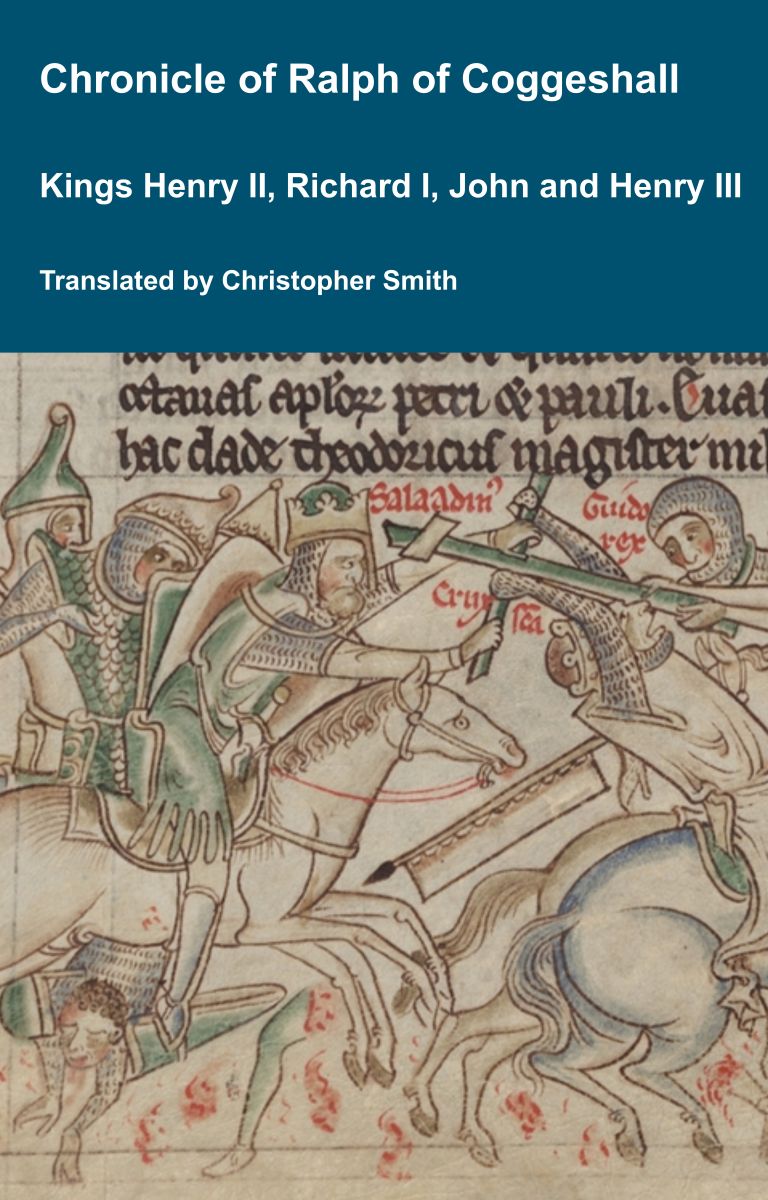
Chronicle of Abbot Ralph of Coggeshall
The Chronicle of Abbot Ralph of Coggeshall (Chronicon Anglicanum) is an indispensable medieval history that brings to life centuries of English and European affairs through the eyes of a learned Cistercian monk. Ralph of Coggeshall, abbot of the Abbey of Coggeshall in Essex in the early 13th century, continued and expanded his community’s chronicle, documenting events from the Norman Conquest of 1066 into the tumultuous reign of King Henry III. Blending eyewitness testimony, careful compilation, and the monastic commitment to record-keeping, this chronicle offers a rare narrative of political intrigue, royal power struggles, and social upheaval in England and beyond. Ralph’s work captures the reigns of pivotal figures such as Richard I and King John, providing invaluable insights into their characters, decisions, and the forces that shaped medieval rule. More than a simple annal, Chronicon Anglicanum conveys the texture of medieval life and governance, making it a rich source for scholars and readers fascinated by English history, monastic authorship, and the shaping of the medieval world.
Available at Amazon in eBook and Paperback format.
In 1720 Prince Pyotr Prozorovsky [aged 75] died.