

Herald of Arms in Ordinary is in .
In 1546 William Flower [aged 48] was appointed Chester Herald of Arms in Ordinary.
On 29th January 1561 Robert Cooke [aged 26] was appointed Chester Herald of Arms in Ordinary.
Henry Machyn's Diary. 8th February 1562. The viij day of February William Flower [aged 64], Chester herald, was appointed Norrey King of Arms from the Trent north-ward; and pursewant [Blanch-Rose,] [aged 27] the servand unto my lord Robart Dudley [aged 29], was appointed Chester herald.
On 22nd November 1553 Nicholas Tubman was appointed Lancaster Herald of Arms in Ordinary.
On 13th January 1559 John Cocke was appointed Lancaster Herald of Arms in Ordinary.
Henry Machyn's Diary. 13th January 1559. The sam day was creatyd at Crechyrche at my lord of Norffoke('s) plasse Cokes, Perkollys, mad Lanckostur the harold.
In 1641 William Riley was appointed Lancaster Herald of Arms in Ordinary.
On 12th April 1547 Lawrence Dalton [aged 37] was appointed Richmond Herald of Arms in Ordinary.
In 1557 Nicholas Narboone was appointed Richmond Herald of Arms in Ordinary.
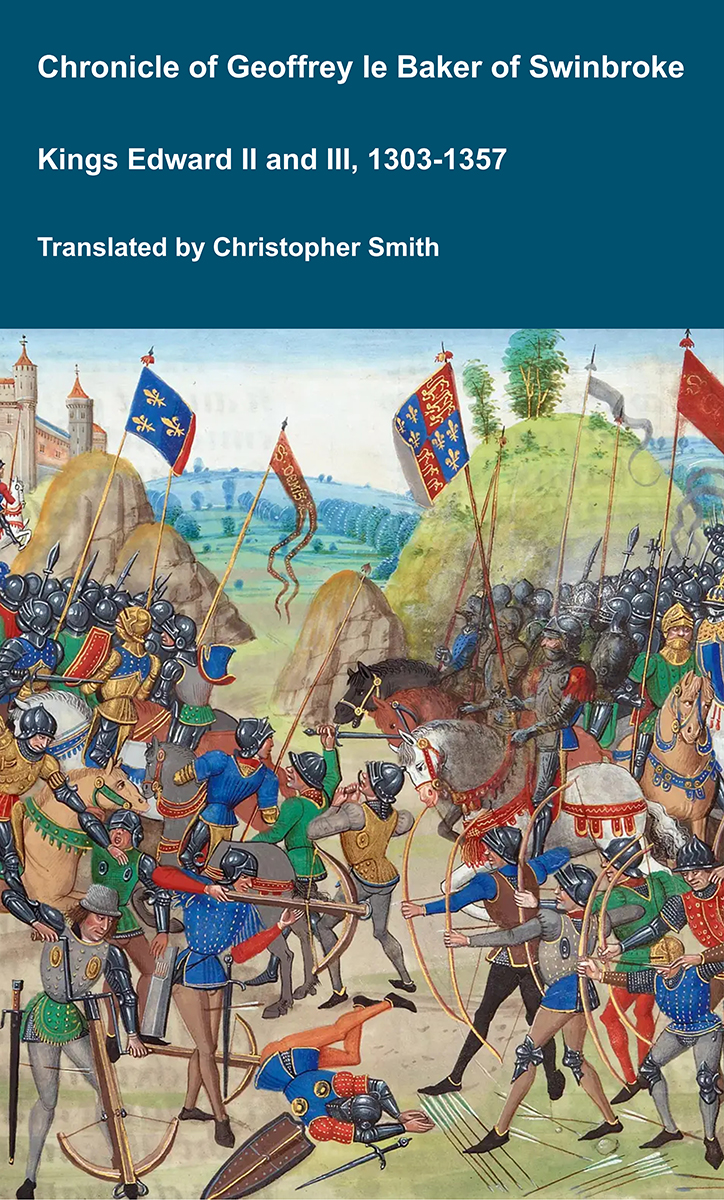
Chronicle of Geoffrey le Baker of Swinbroke
Baker was a secular clerk from Swinbroke, now Swinbrook, an Oxfordshire village two miles east of Burford. His Chronicle describes the events of the period 1303-1356: Gaveston, Bannockburn, Boroughbridge, the murder of King Edward II, the Scottish Wars, Sluys, Crécy, the Black Death, Winchelsea and Poitiers. To quote Herbert Bruce 'it possesses a vigorous and characteristic style, and its value for particular events between 1303 and 1356 has been recognised by its editor and by subsequent writers'. The book provides remarkable detail about the events it describes. Baker's text has been augmented with hundreds of notes, including extracts from other contemporary chronicles, such as the Annales Londonienses, Annales Paulini, Murimuth, Lanercost, Avesbury, Guisborough and Froissart to enrich the reader's understanding. The translation takes as its source the 'Chronicon Galfridi le Baker de Swynebroke' published in 1889, edited by Edward Maunde Thompson.
Available at Amazon in eBook and Paperback format.
Henry Machyn's Diary. 8th January 1559. The sam day was creatyd of my lorde of Norfolk a pursewantt, Bluwe mantyll, and creatyd Rychemund, [who] cam latt over the see owt of Franche.
From 1707 until 1721 Peter Le Neve [aged 45] was Richmond Herald of Arms in Ordinary.
In 1554 John Hollingworth was appointed Rysbank Herald of Arms in Ordinary.
Henry Machyn's Diary. 10th October 1559. The x day of October was bered Bluw-mantyll the harold, the wyche latt was Rysbanke, in sant Brydes in Fletstrett, with (unfinished)
After 18th June 1536 William Harvey [aged 26] was appointed Somerset Herald of Arms in Ordinary.
In 1551 Edmond Atkinson was appointed Somerset Herald of Arms in Ordinary which position he held until 1571.
In 1589 William Segar [aged 35] was appointed Somerset Herald of Arms in Ordinary.
On 18th June 1720 John Warburton [aged 38] was appointed Somerset Herald of Arms in Ordinary.
The London Gazette 23152. Whitehall, August 16, 1866.
The Queen [aged 47] has been pleased to direct letters patent to be passed under the Great Seal of the United Kingdom of Great Britain and Ireland, granting unto John von Sonnentag Haviland, gentleman, the office of Rouge Croix Pursuivant of Arms, vacant by the promotion of James Robinson Planche", Esq., to the office of Somerset Herald.
On 6th May 1504 Thomas Benolt was appointed Windsor Herald of Arms in Ordinary.
Abbot John Whethamstede’s Chronicle of the Abbey of St Albans
Abbot John Whethamstede's Register aka Chronicle of his second term at the Abbey of St Albans, 1451-1461, is a remarkable text that describes his first-hand experience of the beginning of the Wars of the Roses including the First and Second Battles of St Albans, 1455 and 1461, respectively, their cause, and their consequences, not least on the Abbey itself. His text also includes Loveday, Blore Heath, Northampton, the Act of Accord, Wakefield, and Towton, and ends with the Coronation of King Edward IV. In addition to the events of the Wars of the Roses, Abbot John, or his scribes who wrote the Chronicle, include details in the life of the Abbey such as charters, letters, land exchanges, visits by legates, and disputes, which provide a rich insight into the day-to-day life of the Abbey, and the challenges faced by its Abbot.
Available at Amazon in eBook and Paperback format.
After 24th November 1534 Charles Wriothesley [aged 26] was appointed Windsor Herald of Arms in Ordinary.
Henry Machyn's Diary. 27th January 1562. The xxvij day of January was bered master Charlys Wrys[seley] [aged 52] alyas Wyndsore, with all the haroldes of armes, master Garter [aged 52], master Clarenshux, master Chaster alleas Norrey, master Somersett, [master York,] master Rychmond, master Lankester, Rugecrosse, Ruge-dragon, [Portcullis,] and Blumantylle, with vj skochyons of armes, in sant P[ulcher's] parryche, bered in the body of the chyrche; and they [ie the heralds] payd the ch[arges].
Note. P. 275. Funeral of Charles Wryothesley, Windsor herald. He died "at Camden's howsse, in the parish of St. Pulcres in London." (MS. Harl. 897, f. 27b.) "Item. On Sounday the 25th of January, An°. 1561, departed out of this world about sixe of the cloacke, Charles Wryotheley al's Windsour herauld, who was buryed at Saint Sepulcres churche w'hout Newgate, on Tuesday in the morning, at the which buriall the sayd corsse was covered with a pall of blacke velvett, and on the same was laid a rich coate of armes, and of each corner of the sayd corpes went a pursivant of armes in a mourning gowne and hood, and in their coates of armes. And after the corsse went Somersett herauld in his gowne and hood, and after him Mr. Garter and Mr. Clarencieux, and after them the rest of the office of armes not in blacke." From the Papers of Sir Edward Walker, Garter, "Heralds, vol. I. p. 120, Coll. Arm." See also the MS. I. 13, f. 34.
Preface. 19th April 1566. By patent dated the 25th Jan. 1565, he [Richard Turpin] was promoted to be Windsor Herald, and so created on Maundy Thursday the 19th of April following. Some years after, being in pecuniary difficulties, he was suspended from receiving the profits of his office because he owed certain sums to his successor Bluemantle and to York herald, but he was restored by the Earl Marshal on the 19th July, 1570, having previously presented the following petition to his grace, — how long before does not appear, for it is undated:
To the right honorable the duke of Norffolkes grace.
Shevveth unto your good grace your poor oratour Richard Turpyn, alias Wyndsor heraulde of arms, so it is, gracious honorable lord. That, whereas your saide oratour was a pursuyvant of armes in Caleys, at the losse therof, and there dwelled and inhabyted, his wages beinge ther above xU'. by the yere, and his londes above c. markes by the yere, as also his goods, plate, and moveables, and others esteemed above and better than uhi^li. so that by mysfortune of the saide losse of Caleys [he] was spoyled of londes, goodes, and wages, as also havinge ther another ofFyce of the Queues Majestie called by the name of Clarke of the Victuals, and their havinge the victuallinge, lodginge of all the workemen Shevveth unto your good grace your poor oratour Richard Turpyn, alias Wyndsor heraulde of arms, so it is, gracious honorable lord. That, whereas your saide oratour was a pursuyvant of armes in Caleys, at the losse therof, and there dwelled and inhabyted, his wages beinge ther above xU'. by the yere, and his londes above c. markes by the yere, as also his goods, plate, and moveables, and others esteemed above and better than uhi^li. so that by mysfortune of the saide losse of Caleys [he] was spoyled of londes, goodes, and wages, as also havinge ther another ofFyce of the Queues Majestie called by the name of Clarke of the Victuals, and their havinge the victuallinge, lodginge of all the workemen Shevveth unto your good grace your poor oratour Richard Turpyn, alias Wyndsor heraulde of arms, so it is, gracious honorable lord. That, whereas your saide oratour was a pursuyvant of armes in Caleys, at the losse therof, and there dwelled and inhabyted, his wages beinge ther above xU'. by the yere, and his londes above c. markes by the yere, as also his goods, plate, and moveables, and others esteemed above and better than uhi^li. so that by mysfortune of the saide losse of Caleys [he] was spoyled of londes, goodes, and wages, as also havinge ther another ofFyce of the Queues Majestie called by the name of Clarke of the Victuals, and their havinge the victuallinge, lodginge of all the workemen by that meanes now at this present 1 am greatly indebted, to ray utter undoyenge, oneles that your honorable lordshipp wyll and comaunde my company the kings andheraulds of amies that I may enjoie all such larges, comodities, and proffyts as shall growe to me by vertue of my saide offyce, I beinge an herauld of armes, seinge that I have not offended the prince, nor no part of your grace's comandements and decrees set forth by your grace, nor being no droncard, dycer, nor carder, no ruffyan, nor no spot of vylonny. I trust none of my companye can stayne me. Howbeit certain of my company hath dysbarred me of all my droytes and comodytees dew to me by my sayde servyce, which I have served by the space of this xx^i yeres in my saide call, and hath not received one penny out of the saide ofFyce syns the first of Aprill last past, so that, most honorable Lord, I have ben fayne to laye to gage all my rayment and my wyffes, with all suche poore stuff as I had. Furthermore I have served as paynfuUy and as daungerously as ony in the sayde offyce hath done, for ther hath ben no service thes xxiiijt' yeres past done beyonde the seas but lyghtly I have been at them, and I trust I am as well able to serve as any other are in the sayde offyce, and that wyll I stande to their judgementts, as also my good lord of Warwycke wyll testifie, with others, of my honest and paynfull service lately done with the sayde lord of Warwyck in Newhaven in Normandye, when ther I served under his lordship. Therefore, honorable lord, for so moche as I have loste all my londes and goodes which I was well able to lyve in Caleys before the losse thereof, and now a poore man, and not able to lyve oneless your good lordship do comaunde the saide companye the kings and heraulds of arms that I may receive all suche dewties and droicts as shall growe, with all other comodities, as all other the heraulds hathe, and so by that means I trust in God, with your good lordship's favour, shortely to come to some end with my credytors, that I am indebted unto, and to be at lyberty, and so yerely to paye unto them a portition of my saide proffitts, as shall growe unto me. And your saide poore oratour, accordinge to his bounden dewtie, shall dayly praye to God for your noble grace in moche felicitie, with th'increase of the same, long to contenewe.
The London Gazette 26494. Whitehall, March 12, 1894. THE Queen has been pleased to direct Letters Patent to be passed under the Great Seal of the United Kingdom of Great Britain and Ireland, granting unto William Alexander Lindsay [aged 47], Esq., Portcullis Pursuivant of Arms, the office of Windsor Herald, vacant by the promotion of William Henry Weldon [aged 57], Esq., to the office of Norroy King of Arms.
In 1509 William Wriothesley [aged 20] was appointed York Herald of Arms in Ordinary.
In 1553 Martin Maroffe was appointed York Herald of Arms in Ordinary.
In 1570 William Dethick [aged 28] was appointed York Herald of Arms in Ordinary.
In 1993 Henry Edgar Paston-Bedingfeld 10th Baronet [aged 49] was appointed York Herald of Arms in Ordinary.