

Pre-Raphaelite Brotherhood Stunners is in Paintings.
Letters of Dante Gabriel Rossetti 1857. IX. Hastings. Monday 26th June 1854. My dear Allingham,
I am here again you see, but return immediately to London ; so when you write again, write thither (Chatham Place). I shall not fail to keep up our correspondence. Miss S. returns with me for the present, till she can get her picture en train at any rate. I think she has certainly benefited a good deal by her stay in Hastings, and has done some more sketches from the ballads. She desires particularly to be remembered to you, and did so- several times when writing to me in London, which I always forgot to convey.
I should certainly have seen you in town before your exodus, if I had known in time. As it was, I only heard of your change of plan on Saturday evening at Munro's [aged 28]. The day before, perhaps, you heard that I called on you with the mighty Mac Cracken, who was in town for a few days, but we did not find you. What do you think of Mac coming to town on purpose to sell his Hunt, his Millais, his Brown, his Hughes, and several other pictures! He squeezed my arm with some pathos on communicating his purpose, and added that he should part with neither of mine. Full well he knows that the time to sell them is not come yet. The Brown he sold privately to White of Maddox Street. The rest he put into a sale at Christie's, after taking my advice as to the reserve he ought to put on the Hunt, which I fixed at 500 gs. It reached 300 in real biddings, after which Mac's touters ran it up to 430, trying to revive it, but of course it remains with him. The Millais did not reach his reserve, either, but he afterwards exchanged it with White for a small Turner. The Hughes sold for 67 gs., which really, though by no means a large price for it, surprised me, considering that the people in the sale-room must have heard of Hughes for the first time, though the auctioneer unblushingly described him as "a great artist, though a young one." I have no doubt, if Mac had put his pictures into the sale in good time, instead of adding them on at the last moment, they would all have gone at excellent prices.
Some of the pictures in the body of the sale went tremendously. Goodall's daub of Raising the May-Pole fetched (at least ostensibly) 850. I like Mac Crac pretty well enough, but he is quite different in appearance — of course — from my idea of him. My stern treatment of him was untempered by even a moment's weakness. I told him I had nothing whatever to show him, and that his picture was not begun, which placed us at once on a perfect understanding. He seems hard up.
If I were to send you one of those Australian paragraphs about Woolner and the statue do you think you could get it in anywhere with or without a short accessory) puff of your own? Millais and I have both besieged Eastlake, and Millais and Dickinson Mulready. Dyce will be written to by one of us. Hannay is going to get a paragraph in somewhere, and I think of trying for the same sort of thing with Masson and Patmore, or any one else who seems likely. Hannay was in town the other day, and I am going down to Barnet on Friday to see him, and take a walk to Saint Albans. He is looking much better than I have seen him look for a year or two, and had just parted with the copyright of his Lectures to Bogue for 50 in addition to the 50 he got first.
I hope my next letter will have more news and be a longer one. There are dense fogs of heat here now, through which sea and sky loom as one wall, with the webbed craft creeping on it like flies, or standing there as if they would drop off dead. I wander over the baked cliffs, seeking rest and finding none. And it will be even worse in London. I shall become like the Messer Brunetto of the "cotto aspetto," which, by the bye, Carlyle bestows upon Sordello instead ! It is doing him almost as shabby a turn as Browning's.
The crier is just going up this street and moaning out notices of sale. Why cannot one put all one's plagues and the skeletons of one's house into his hands, and tell them and sell them "without reserve"? Perhaps they would suit somebody at least except this horrid fork of a pen! I went to the Belle S. the other clay, and was smiled on by the cordial stunner, who came in on purpose in a lilac walking costume. I am quite certain she does not regret you at all.
Your D. G. R.
[On the envelope.] P.S. — We can send you The Athenaeum every week, if you like. Rest assured that a certain little matter of £ s. d. is not forgotten.
Nous pouvons vous envoyer L' Athenaeum chaque semaine, si vous voulez. Soyez certain qu'une certaine petite affaire de £ s. d. n'est pas oubliee.
Note. Of White the picture-dealer Madox Brown has the following entries in his diary : "Jany. 27, 1856. On Monday White called, but did not like the Hayfield — said the hay was pink, and he had never seen such. — Thursday. After much moaning over my brick-dusty colour he took off King Lear for £20. — March 6. Called on Gabriel. I saw a lot of his works gathered there from Ruskin's and others, as a bait to induce Old White to come and buy his works."
Rossetti's humorous sallies against Francis MacCracken must not be taken too seriously. "He really liked him," says Mr. W. M. Rossetti, "and had reason for doing- so." This Belfast shipping-agent was a profound believer in the 'graduate,' as he termed Ruskin. He was always hard up for money, but he was devoted to Preraphaelitism." In 1852 he bought Madox Brown's Wickliffe, giving for it £63 together with a picture by Dighton, "which," says Brown, "I sold for £8 10s." The following letter with which Mr. Holman Hunt has honoured me gives an account of his doings with MacCracken.
Mr. W. M. Rossetti has no doubt that "the cordial stunner" was a waitress with whom his brother had an innocent flirtation." In these early days," writes Mr. Holman Hunt, " with all his headstrongness and a certain want of consideration, Rossetti's life within was untainted to an exemplary degree, and he worthily rejoiced in the poetic atmosphere of the sacred and spiritual dreams that then encircled him, however some of his noisy demonstrations at the time might hinder this from being recognised by a hasty judgment."
Diary of Ford Madox Brown. 10th March 1855. Up at 9 to work by 11. Drew at the mans hand again, then painted in the womans glove from Lucy holding the Nurse's hand — dined, then at 4 P.M. out into back yard & painted the mans hand from my own with Lucy holding it (in a Glass). Snow on the ground & very cold. Tea in Emma's bed room she having a sore throat. Paid nurse £4, she going this even. Found the hand too small & arm to long, the eveng worked towards remedying it — but not energy enough to rub it out. Accoumpts, & this filled up since the 3rd of current (6% hours). I had a letter from Rossetti, Thursday, saying that Ruskin had bought all Miss Siddal's ("Guggum's") drawings41 & said they beat Rossettis own. This is like R. the incarnation of exageration, however he is right to admire them. She is a stunner & no mistake. Rossetti once told me that when he first saw her he felt his destiny was defined; why does he not marry her? He once told me that Hannay when he first knew him used to be so hard up, that he used never to be at home in the day time because of the "rent". He used to go out before the people were up & go home when they were in bed.42 This was constant with him & he never apparantly eat at all — when he had a little money he used to go & get beer or grog with it. Rossetti & he having been all the fore noon together found about sixpence between them on which to refresh themselves. Rossetti proposed to go to some "alamode beef" place & get as much to eat as it would afford, Hannay quite stared — he expected it was to go for beer, however Rossetti stuck out for food of a solid nature & prevailed. Hannay now does well, only is so precious idle. His satire & satirists is a delightful book & will last. They say his wife & child are very beautiful. I hope Oliver will be better looking than my two other chicks promis to be. Katty seems if she
Note 41. "Ruskin saw and bought on the spot every scrap of designs hitherto produced by Miss Siddal. He declared that they were far better than mine, or almost than anyone's, and seemed quite wild with delight at getting them. He asked me to name a price for them ... He is going to have them splendidly mounted and bound together in gold" (Letters, PP-244-5). Rossetti was aware of the encouragement this brought her.
Note 42. James Hannay (1827-73), journalist and novelist, was the author of Satire and Satirist, 1854, a collection of lectures given the previous year. Impecunious and dissipated in youth, he changed his lodgings seven times in the space of two years. His wife, Margaret Thompson [aged 22], whom he had married in February 1853 bore him several children (the second, a daughter, Elizabeth, had been born on 1 Mar. ). She sat to Rossetti for Beatrice in Dante's Dream (1856).
Note 43. Eating houses in the commercial quarters of London, where stewed beef was served.


Letters of Dante Gabriel Rossetti 1855. 4th July 1855. London. To William Allingham [aged 31].
I had to break off in the above, and go on with it to-day, instead of beginning afresh, to prove that I was not waiting for you to write, as I remembered well owing you two or three, though one of mine had been lost for some time. Yours was very welcome on Monday. Going on about The Music Master, I see the sentence already written looks very iniquitous, and perhaps is ; but one can only speak of one's own needs and cravings : and I must confess to a need, in narrative dramatic poetry (unless so simple in structure as Auld Robin Gray, for instance), of something rather "exciting," and indeed I believe something of the "romantic" l element, to rouse my mind to anything like the moods produced by personal emotion in my own life. That sentence is shockingly ill worded, but Keats's narratives would be of the kind I mean. Not that I would place the expressions of pure love and life, or of any calm, gradual feeling or experience, one step below their place, — the very highest ; but I think them better conveyed at less length, and chiefly as from oneself Were I speaking to any one else, I might instance (as indeed I often do) the best of your own lyrics as examples ; and these will always have for me much more attraction than The Music Master. The latter, I think, by its calm subject and course during a longish reading, chiefly awakens contemplation, like a walk on a fine day with a churchyard in it, instead of rousing one like a part of one's own life, and leaving one to walk it off as one might live it off. The only part where I remember being much affected was at the old woman's narrative of Milly's gradual decline. Of course the poem has artistic beauties constantly, though I think it flags a little at some of its joints, and am not sure that its turning-point would not, have turned, in vain for me at first reading, if I had not in time remembered your account of the story one day on a walk. After all, I fancy its chief want is that it should accompany a few more stories of deeper incident and passion from the same hand, when what seem to me its shortcomings might, I believe, as a leavening of the mass, become des qualith. As I have stated them, too, they are merely matters of feeling, and those who felt differently (as Patmore, who thinks the poems perfect) might probably be at the higher point of view. P. was here last night with Cayley and one or two more. We sat all the evening on my balcony, and had ice and strawberries there, and I wished for you many times, and meanwhile put in your book as a substitute (having, you may be sure, torn out that thing of Dalziel's).
I have propagated you a little — among other cases, to a man named Dallas the other day, who has just come to settle in London, having written a book called Poetics, and being a great chum of A. Smith — i.e., the Smith — and Dobell. After reading him much of you I enunciated opinions of a decisive kind as to the relative positions of our rising geniuses, and was rather sorry for argument's sake to find him not unsympathising.
I'm glad you've heard from Ruskin, and hope that you may find time in your week to arrange somehow a meeting with him. He has been into the country, and unwell part of the time, but is now set up again and very hard at work. I have no more valued friend than he, and shall have much to say of him. Of other friends, you'll find Woolner (27, Rutland St., Hampstead Road, his house; 64, Margaret St., Cavendish Sq., his study). Patmore, and Hannay get-at-able, besides Munro [aged 29] and Hughes, with whom you've been en rapport. My rapports you ask of with that "stunner" stopped some months ago, after a long stay away from Chatham Place, partly from a wish to narrow the circle of flirtations, in which she had begun to figure a little ; but I often find myself sighing after her, now that "roast beef, roast mutton, gooseberry tart," have faded into the light of common day. "O what is gone from them I fancied theirs?"
Have you seen Eustace Conyers? It is admirable in all Hannay's qualities, and a decided advance on Fontenoy. I congratulate you on your change of place, and myself on the prospect of your going farther, i.e., London, so soon for a while, and I trust not faring worse. Mind, I have nothing to show worth showing. Ruskin has been reading those translations since you, and says he could wish no better than to ink your pencil-marks as his criticisms. He sent here, the other day, a stunner, called the Marchioness of Waterford [aged 37], who had expressed a wish to see me paint in watercolours, it seems, she herself being really first-rate as a designer in that medium. I think I am going to call on her this afternoon. There, sir! R. has asked to be introduced to my sister, who accordingly, will accompany Miss S. and myself to dinner there on Friday.
That building you saw at Dublin is the one. I must have met Woodward, the architect of it, at Oxford (where he is doing the new museum), and talked of you to him, just at the time you were in Dublin, as I heard immediately after, and therefore did not send on to you his full directions how you should find him (or his partner, if he were away) and see all his doings there, which, however, can come off another time. He is a particularly nice fellow, and very desirous to meet you. Miss S. made several lovely designs for him, but Ruskin thought them too good for his workmen at Dublin to carve. One, however, was done (how I know not), and is there ; it represents an angel with some children and all manner of other things, and is, I believe, close to a design by Millais of mice eating corn. Perhaps though they were carved after your visit.
I haven't seen Owen Meredith, and don't feel the least curiosity about him. There is an interestingish article on the three "Bells" in Tail this month, where Wtithering Heights is placed above Currer for dramatic individuality, and it seems C. B. herself quite thought so.
I'll say no more, as I hope so soon to see you, but am ever your affectionate friend,
D. G. R.
Note. Rossetti had been at Clevedon with Miss Siddal, who had gone there for the sake of her health. Writing to his mother he said : — " The junction of the Severn with the Bristol Channel is there, so that the water is hardly brackish, but looks like sea, and you can see across to Wales, only eight miles off, I think. Arthur Hallam, on whom Tennyson wrote In Memoriam, is buried at Clevedon, and we visited his grave."
"That 'stunner'" was clearly the "Belle pas Sauvage" of Letters VII and IX. In my undergraduate days at Oxford when not unfrequently I was in Rossetti's company, I one day heard him maintain that a beautiful young woman, who was on her trial on a charge of murdering her lover, ought not to be hanged, even if found guilty, as she was "such a stunner." When I ventured to assert that I would have her hanged, beautiful or ugly, there was a general outcry of the artistic set. One of them, now famous as a painter, cried out, "Oh, Hill, you would never hang a stunner!"
"O what is gone from them I fancied theirs?" is borrowed with a slight change from the last line of Æolian Harp in the second series of Allingham's Day and Night Songs.
"Gift books have rather poured in on me lately," wrote Rossetti to his mother a few days after the date of this letter; "Hannay's new novel, Eustace Conyers, very first-rate in Hannay's qualities, and a decided advance on Fontenoy."
A little earlier he had written to her: — "An astounding event is to come off to-morrow. The Marchioness of Waterford has expressed a wish to Ruskin to see me paint in water-colour, as she says my method is inscrutable to her. She is herself an excellent artist, and would have been really great, I believe, if not born such a swell and such a stunner."
Mr. Holman Hunt gives the following account of a visit he received from her : — " With The Light of the TJ^orM standing nearly complete upon the easel, I was surprised one morning by the sound of carriage wheels driven up to the side door, a very loud knocking, and the names of Lady Canning and the Countess of Waterford preluding the ascent of the ladies. I think they said that Mr. Ruskin had assured them that they might call to see the picture. My room, with windows free, overlooking the river, was as cheerful as any to be found in London ; but I had not made any effort to remove traces of the pinching suffered till the previous month or so, and to find chairs with perfect seats to them was not easy. But the beautiful sisters were supremely superior to giving trace of any surprise. It might have seemed that they had always lived with broken furniture by preference." An account of the sisters has been lately written by Mr. Augustus J. C. Hare under the title of The Story of Two Noble Lives. There is no mention of these visits to the two painters.


Diary of Ford Madox Brown. 19th February 1856. All day after the tickets for the Princess' Theatre. In the evening went there to the Dress Circle with Emma & the 2 children & William Rossetti. Gabriel who had chiefly made up the party having decided that he could not go because he must go again that night to the strand Theatre to see a certain stunner.10 Katty after the play told William who was allud- ing to the Angels in Henry VIII "that she once saw some real angels up in the sky".
Note 10. The Princess's Theatre was giving Shakespeare's Henry VIII with Mr and Mrs Charles Kean in the roles of Cardinal Wolsey and Queen Katherine. Meanwhile Rossetti had gone to admire his "Stunner No 1" Louisa Ruth Herbert [aged 25], who was playing that evening in a "Favourite Commedietta", Time Tries all, and a farce, Never Despair.


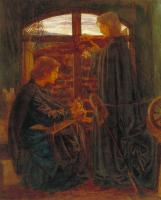


The Diary of George Price Boyce 1858. 15th December 1858. To Rossetti [aged 30]. The new things I noticed were an intensely impressive water colour of the Virgin in the house of John, the latter seated at the window and striking a light and looking out upon Jerusalem at twilight. The Virgin is spinning. A Knight girded for combat embracing his Lady Love [The Chapel before the Lists]. Several studies of Miss Herbert [aged 27] (Mrs. Crabbe). A most beautiful pen and ink study of Topsy's (Morris's) "Stunner" at Oxford. He showed me some fine medieval drapery and some gorgeous Eastern pieces lent him from the India House. We went off at dusk and dined at the Cock, and afterwards adjourned to 24 Dean St., Soho, to see "Fanny [aged 23]." Interesting face and jolly hair and engaging disposition.
The Diary of George Price Boyce 1859. 6th March 1859. (Sunday). (At Oxford.) Crowe, Faulkner, Jones and self rowed to Godstow where we saw the "Stunner" [Jane Morris nee Burden [aged 19]] (the future Mrs. William Morris); on our return we all dined (Swinburne included) at Topsy's (Morris'). He and Swinburne [aged 21] mad and deafening with excitement; adjourned to Crowe's to dessert; the chaff and row continued with great spirit and cleverness. Swinburne, a man of great reading, memory, and intellectual cleverness and accomplishment, seemed to be wanting in human feeling. In the evening we all went round to Johnson's, where we looked over a bundle of sketches among which were some beautiful things of Rossetti's.
Letters of Dante Gabriel Rossetti 1864. [Fragment]. Paris. November 1864. ... I have done no work at all here for three weeks, and am sorely wanting to get home, but I stick in the mud everywhere and day after day I fail to get away .... Really, Gérome [aged 40] is not a painter, though a stunner of a sort. There is a man named Millet who is the best going by far. Old Ingres is done for. Delacroix is worth the journey with all his faults, and I have looked a great deal at his collected works which are to close at the end of this month.
PS. To-day I went to the Zool: Gardens and scratched a wombat, who liked it.
Letters of Dante Gabriel Rossetti 1865. To James Anderson Rose. 11th February 1865. My dear Rose,
An Uncle1 of mine has spontaneously offered me a loan of money, and though he asks no security, I am anxious he should have such as I can give, and propose depositing with him my lease in that capacity. He is to be in town on Tuesday, so if you could conve- niently let me have it some time on Monday, I should be much obliged. However, it would not in the least matter if it reached me some days later, as I could send it on to him just as well.
Could you dine with me next Friday, and I will ask Sandys. I saw your blue china (though not you) the other evening. That dragon bottle is the gem of your collection and a real stunner. Also the little polygonal bowl is a beauty. I hope there is no irregularity in my request as to the lease. I fully appreciate your kind and valuable assistance given at the time I took this house, but should be sorry not to give my uncle such security as I can in case of my death.
Yours ever sincerely,
D. G. Rossetti.
Note 1. Henry Francis Polydore.