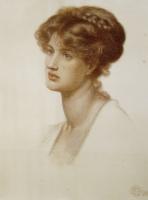
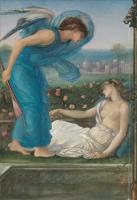
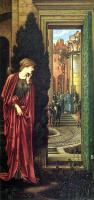
On 6th May 1833 [her father] Robert Burden [aged 23] and [her mother] Ann Maizey [aged 27] were married at St Mary Magdalen's Church.
On 19th October 1839 Jane Morris nee Burden was born to Robert Burden [aged 29] and Ann Maizey [aged 33] at St Helen's Passage, Holywell Street, Oxford. She was baptised on 28th December 1840 at St Peter-in-the-East Church, Oxford. Her father a stableman, her mother a domestic servant.
In 1851 the Census records [her father] Robert Burden [aged 41], Groom, [her mother] Ann Maizey [aged 45], [her brother] William Burden [aged 14], Jane Morris nee Burden [aged 11] and [her sister] Elizabeth Burden [aged 9] living at 1 King's Head Gardens.
In October 1857 Jane Morris nee Burden [aged 17] and her sister Elizabeth Burden [aged 15] attended a performance of the Drury Lane Theatre Company in Oxford. Jane Burden was noticed by Dante Gabriel Rossetti [aged 29] and Edward Burne-Jones [aged 24] who asked her to model for them.


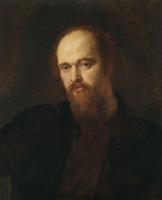


1858. William Morris [aged 23]. "La Belle Iseult", sometimes referred to as "Queen Guinevere", is Morris' only surviving easel painting, now in the Tate Gallery. The model Jane Morris nee Burden [aged 18], his future wife.
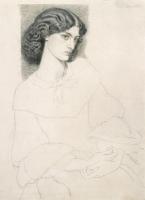
1858. Dante Gabriel Rossetti [aged 29]. "Study for Guenevere". Model Jane Morris nee Burden [aged 18].
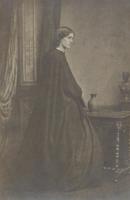
1858. George Herbert Watkins [aged 30]. Photograph of Jane Morris nee Burden [aged 18].
The Diary of George Price Boyce 1859. 6th March 1859. (Sunday). (At Oxford.) Crowe, Faulkner, Jones and self rowed to Godstow where we saw the "Stunner" [Jane Morris nee Burden [aged 19]] (the future Mrs. William Morris); on our return we all dined (Swinburne included) at Topsy's (Morris'). He and Swinburne [aged 21] mad and deafening with excitement; adjourned to Crowe's to dessert; the chaff and row continued with great spirit and cleverness. Swinburne, a man of great reading, memory, and intellectual cleverness and accomplishment, seemed to be wanting in human feeling. In the evening we all went round to Johnson's, where we looked over a bundle of sketches among which were some beautiful things of Rossetti's.

On 26th April 1859 William Morris [aged 25] and Jane Morris nee Burden [aged 19] were married at St Michael at the Northgate Church, Oxford after which they moved to the Red House.


Memorials of Edward Burne-Jones 1860. It will be taken for granted that the two men visitors had endless jokes together at the expense of their beloved host. The dinner hour, at middle day, was a great time for them because Mrs Morris [aged 20] and I were there, either as eager onlookers at the fun or to take sides for and against. The dining-room was not yet finished, and the drawing-room upstairs, whose beautiful ceiling had been painted by Mr. and Mrs. Morris, was being decorated in different ways, so Morris' studio, which was on the same floor, was used for living in, and a most cheerful place it was, with windows looking three ways and a little horizontal slip of a window over the door, giving upon the red-tiled roof of the house where we could see birds hopping about all unconscious of our gaze.
Perhaps the joke which made two out of the three men happiest at dinner-time was that of sending Morris to Coventry for some slight cause and refusing to exchange a word with him at his own table: it was carried on with an unflinching audacity that I cannot hope to describe, and occasionally reached the height of their asking Mrs. Morris if she would be good enough to communicate with her husband for them and tell him anything they wished to say - but a stranger coming in upon our merriment would never have guessed from the faces of the company who were the teasers and who the teased.
Memorials of Edward Burne-Jones 1860. Oh, how happy we were, Janey [aged 20] and I, busy in the morning with needlework or wood-engraving, and in the afternoon driving to explore the country round by the help of a map of Kent; we went to the Crays one day and to Chislehurst Common another, finding some fresh pleasure everywhere and bringing back tales of our adventures to amuse the men we had left working at home. Sometimes, but not often, they would go with us, for Edward always hated "expeditions," and was only supported in them by good fellowship; nor did he at any time seek the country for its own sake. At this I have often wondered, for the backgrounds of his pictures shew how deeply it touched his imagination and feeling: and I came to the conclusion that one reason why he found so little peace and rest in it might be that he did not, and perhaps could not, submit himself passively to its influence, but was for ever dealing with it as an instrument. In a note written to his father during this very visit to Red House he says, "I hate the country - apples only keep me in good spirits - Topsy's garden is perfectly laden with them." I remember his dread of anything that appealed to the sadness which he shared with all imaginative natures, who "don't need to be made to feel," he said, and I believe that this "hatred" was partly an instinct of self-preservation from the melancholy of autumn in the country.
The Niebelungen Lied design of which Edward speaks was never finished, and if it was begun upon the back of either of the beautiful "Salutations of Beatrice" which Rossetti [aged 32] painted on the outside of the doors of the big settle, it may perhaps still remain there.

Around 25th December 1860. Dante Gabriel Rossetti [aged 32]. Portrait of Mrs William Morris aka Jane Morris nee Burden [aged 21]. Signed top-left Upton (ie the Red House) Xmas 1860.
1861. The Census records William Morris [aged 26], Jane Morris nee Burden [aged 21], Algernon Charles Swinburne [aged 23], Visitor, four servants and Jane Alicia Morris at Red House.
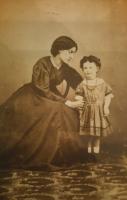


On 17th January 1861 Jane Alicia Morris was born to William Morris [aged 26] and Jane Morris nee Burden [aged 21] at the Red House.

On 25th March 1862 Mary "May" Morris was born to William Morris [aged 28] and Jane Morris nee Burden [aged 22] at the Red House. She was baptised 30th May 1862 at Christ Church, Bexleyheath. She married 14th June 1890 Henry Halliday Sparling.

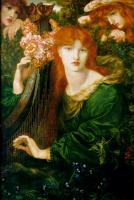


Around 1864. Unknown Photographer. Jane Morris nee Burden [aged 24] and Jane Alicia Morris [aged 2].

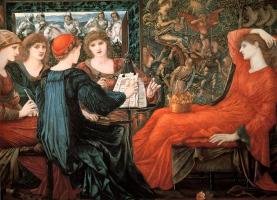
1864. Edward Coley Burne-Jones 1st Baronet [aged 30]. Portrait of Jane Morris nee Burden [aged 24], and his sisters-in-law Alice Macdonald [aged 26], Agnes Macdonald Lady Poynter [aged 21] and Louisa Macdonald [aged 19] listening to his wife Georgiana [aged 23] reading aloud.
Alice Macdonald: On 4th April 1837 she was born to Reverend George Browne Macdonald and Hannah Jones at Birmingham, Warwickshire. On 18th March 1865 John Lockwood Kipling and she were married at St Mary Abbots Church, Kensington. On 22nd November 1910 she died. She was buried at St John's Church, Tisbury.
Louisa Macdonald: In 1845 she was born to Reverend George Browne Macdonald and Hannah Jones at Birmingham, Warwickshire. In 1925 she died.
On or before 10th February 1864 [her father] Robert Burden [aged 54] died. He was buried on 10th February 1864 at Holywell St Cross Church, Oxford.
Around 1865. Unknown Photographer. Jane Morris nee Burden [aged 25] and Jane Alicia Morris [aged 3].
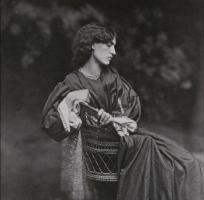
June 1865. John Robert Parsons [aged 39]. Photograph of Jane Morris nee Burden [aged 25].

1868. Dante Gabriel Rossetti [aged 39]. "Pia de' Tolomei" [An Italian noblewoman from Siena identified as "la Pia," a minor character in Dante's Divine Comedy who was murdered by her husband]. Model Jane Morris nee Burden [aged 28].
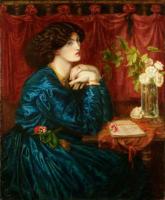
1868. Dante Gabriel Rossetti [aged 39]. Blue Silk Dress. Model Jane Morris nee Burden [aged 28].
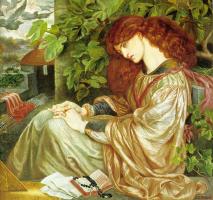
1869. Dante Gabriel Rossetti [aged 40]. "The Salutation of Beatrice". Half-length portrait with a cartouche in the upper left corner bearing the Vita Nuova's sonnet "Tanto gentile e tanto onesta pare". Model Jane Morris nee Burden [aged 29].
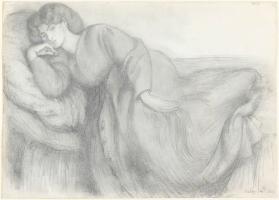
1869. Dante Gabriel Rossetti [aged 40]. Mrs William Morris aka Jane Morris nee Burden [aged 29].
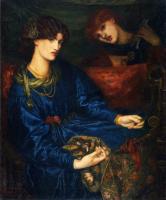
1870. Dante Gabriel Rossetti [aged 41]. Mariana. The bottom of the frame has these words from Shakespeare's Measure for Measure "Take, O Take those lips away, That so sweetly were forsworn, And those eyes, the break of day, Lights that do mislean the morn. But my kisses bring again, bring again, Seals of love, but sealed in vain, sealed in vain." Model Jane Morris nee Burden [aged 30].

1870. Dante Gabriel Rossetti [aged 41]. La Donna della Fiamina aka The Woman of Flames. Model Jane Morris nee Burden [aged 30].
In 1871 William Morris [aged 36], and Dante Gabriel Rossetti [aged 42] took out a joint tenancy on Kelmscott Manor, Oxfordshire. Moris went to Iceland leaving Dante Gabriel Rossetti and Jane Morris nee Burden [aged 31] to furnish the house. A relationship between Rossetti and Jane is believed to have begun some years before.
1871. The census records William Morris [aged 36], Jane Morris nee Burden [aged 31], Elizabeth Burden, sister-in-law, Jane Alicia Morris [aged 9], Mary "May" Morris [aged 8] and three servants living at 21 Queen Square, Bloomsbury.

1871. Dante Gabriel Rossetti [aged 42]. "Dante's Dream at the Time of the Death of Beatrice". Models: Beatrice: Jane Morris nee Burden [aged 31], far left Alice aka Alexa Wilding [aged 24], far right Annie Miller [aged 36].

1871. Dante Gabriel Rossetti [aged 42]. Pandora. Holding the box - see Hesiod's Works and Days Lines 83 to 108 lines 90-94. Model Jane Morris nee Burden [aged 31].
1874. Frederick Hollyer [aged 35]. Photograph of the Burne-Jones and Morris families including William Morris [aged 39], Jane Morris nee Burden [aged 34], Edward Coley Burne-Jones 1st Baronet [aged 40] and Georgiana Macdonald Lady Burne-Jones [aged 33].

1875. Dante Gabriel Rossetti [aged 46]. Study of Mrs William Morris aka Jane Morris nee Burden [aged 35].
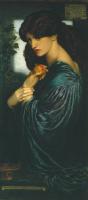
1877. Dante Gabriel Rossetti [aged 48]. "Proserpine". Model Jane Morris nee Burden [aged 37].

1877. Dante Gabriel Rossetti [aged 48]. Astarte Syriaca. Model Jane Morris nee Burden [aged 37].
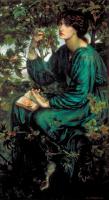
1880. Dante Gabriel Rossetti [aged 51]. "The Daydream". Model Jane Morris nee Burden [aged 40].
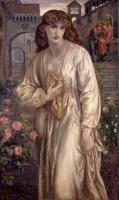
1880. Dante Gabriel Rossetti [aged 51]. "The Salutation of Beatrice". Model Jane Morris nee Burden [aged 40].
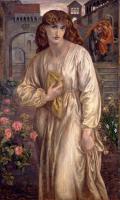
1880 to 1882. Dante Gabriel Rossetti [aged 51]. "The Salutation of Beatrice". Model Jane Morris nee Burden [aged 40].
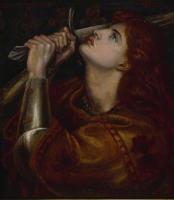
1881. Dante Gabriel Rossetti [aged 52]. Joan of Arc. Model Jane Morris nee Burden [aged 41].

1881. Dante Gabriel Rossetti [aged 52]. La Donna della Finestra aka The Woman at the Window. Model Jane Morris nee Burden [aged 41].
In 1883 Jane Morris nee Burden [aged 43] met the poet and political activist Wilfrid Scawen Blunt [aged 42] at a house party given by her close friend, Rosalind Howard [aged 37] who would become Countess of Carlisle in 1889. At sometime after, probably around 1887, they had commenced a relationship.
On 14th June 1890 [her son-in-law] Henry Halliday Sparling [aged 30] and Mary "May" Morris [aged 28] were married at Fulham Register Office. She the daughter of William Morris [aged 56] and Jane Morris nee Burden [aged 50].
On 3rd October 1896 William Morris [aged 62] died after several months of "general organic degeneration", at Kelmscott House, Hammersmith. He died, Mackail says, 'quietly and without visible suffering' (II, 335)'
On 6th October 1896 William Morris [deceased] was buried at St George's Church, Kelmscott [Map]. His gravestone was designed by his friend Philip Webb. His wife Jane Morris nee Burden [aged 56] and daughter Mary "May" Morris [aged 34] attended. The funeral is described by William Fredeman here.
In 1898 [her son-in-law] Henry Halliday Sparling [aged 38] and Mary "May" Morris [aged 35] were divorced.
1901. The Census records Jane Morris nee Burden [aged 61], Jane Alicia Morris [aged 39], Louisa C Strong, companion, and three servants living at Kelmscott Manor, Oxfordshire.
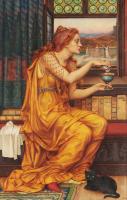
1903. Evelyn de Morgan aka Mary Evelyn Pickering [aged 47]. Model Jane Morris [aged 63].
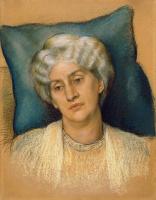
1904. Evelyn de Morgan aka Mary Evelyn Pickering [aged 48]. "Jane Morris [aged 64]". This drawing was a study for "The Hourglass".
1904 - 1905. Evelyn de Morgan aka Mary Evelyn Pickering [aged 49]. "The Hourglass". Also according to Mrs Stirling, Evelyn De Morgan described this work as "an echo of a movemnet in the Waldstein Sonata of 'Beethoven'." Model Jane Morris [aged 65].
In 1906 Wilfrid Scawen Blunt [aged 65] and Anne King-Noel 15th Baroness Wentworth [aged 68] were legally separated as a consequence of the numerous mistresses he had taken which included Jane Morris nee Burden [aged 66], Catherine Walters aka "Skittles", his cousin Mary Wyndham [aged 43] and, possibly, her mother Madeline Caroline Frances Eden Campbell.

2nd April 1911. The Census records Jane Morris nee Burden [aged 71], [her sister] Elizabeth Burden [aged 69] and a Lady's Maid living at 33 St George's Place.
In 1913 Jane Morris nee Burden [aged 73] puchased Kelmscott Manor, Oxfordshire to secure it for her daughters' future.

On 26th January 1914 Jane Morris nee Burden [aged 74] died at 5 Brock Street, Bath. On 29th January 1914 she was buried at St George's Church, Kelmscott [Map] in the same grave as her husband William Morris. Her body was driven in a 'motor' from Bath to the manor house just before the service. Her coffin was 17th century style and in oak with brass furniture and a simple inscription of her name and date of death, and was carried into the church by six village men. The church was well attended by the villagers as well as familiar names from the world of art and literature including Marie Stillman [aged 69] whose wreath was noted in the papers. The hymn 'Now the labourer's task is o'er' was sung and the organist played the Dead March as the coffin was carried out to where William was already buried.