The History of William Marshal was commissioned by his son shortly after William’s death in 1219 to celebrate the Marshal’s remarkable life; it is an authentic, contemporary voice. The manuscript was discovered in 1861 by French historian Paul Meyer. Meyer published the manuscript in its original Anglo-French in 1891 in two books. This book is a line by line translation of the first of Meyer’s books; lines 1-10152. Book 1 of the History begins in 1139 and ends in 1194. It describes the events of the Anarchy, the role of William’s father John, John’s marriages, William’s childhood, his role as a hostage at the siege of Newbury, his injury and imprisonment in Poitou where he met Eleanor of Aquitaine and his life as a knight errant. It continues with the accusation against him of an improper relationship with Margaret, wife of Henry the Young King, his exile, and return, the death of Henry the Young King, the rebellion of Richard, the future King Richard I, war with France, the death of King Henry II, and the capture of King Richard, and the rebellion of John, the future King John. It ends with the release of King Richard and the death of John Marshal.
Available at Amazon in eBook and Paperback format.
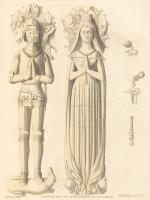
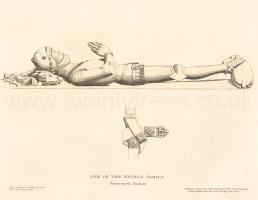
Effigy of a Nevill and Lady in Brancepeth Church, Durham is in Monumental Effigies of Great Britain.
THESE are most probably the effigies of Ralph second Earl of Westmorland, and one of his wives. He was the son of John Nevill (who died in the lifetime of his father, Ralph, first Earl of Westmorland), by Elizabeth, daughter of Thomas Holland, Earl of Kent.

He had two wives; his first was Elizabeth, widow of Lord Clifford, daughter of that remarkable historical character Henry Lord Percy, son of the Earl of Northumberland, surnamed, for his promptitude in military emprize, Hotspur. By Elizabeth he had a son, John, who was slain during his life-time in the battle of Towton. His second wife was Margaret, daughter of Sir Reginald Cobham, knight. He died in the year 1484, the second of the reign of Richard the Third. The remarkable points in these effigies are the collars which decorate the necks of the figures. The Lancaster badge of SS is now discarded, and we find that of York, the white rose in the suna, adopted; from which is suspended the white boar, Richard the Third's device.
Note a. The parhelion which appeared in the Heavens at the battle of Mortimer's Cross occasioned Edward the Fourth to add the device of the sun to the white rose; and this assumed omen of success was indeed the occasion of victory to him at Barnet Field; for, being embroidered on the coats of his men, (much as we see, at this day, the crown, &c. on those of the yeomen of the Royal Guard,) and the Earl of Oxford, on the other side, having either a blazing star, or the silver mullet of his arms, on the jacks of his retainers, indistinctly seen gleaming through the mists of a spring morning, it was taken by the Earl of Warwick's soldiers for the badge of the foe, and assailed as such. Oxford, in consequence, suspected treachery in Warwick, and fled the field. Warwick's valour could not repair the mistake; he was defeated and slain.