High Sheriff Wales is in Wales Titles.
In 1374 Rhys ap Tudor was appointed High Sheriff of Anglesey.
In 1381 Rhys ap Tudor was appointed High Sheriff of Anglesey.
In 1587 John Griffith was appointed High Sheriff of Anglesey.
In 1593 John Griffith was appointed High Sheriff of Anglesey.
In 1597 William Glynne [aged 31] was appointed High Sheriff of Anglesey.
In 1618 William Glynne [aged 52] was appointed High Sheriff of Anglesey.
In 1783 Thomas Assheton-Smith of Ashley in Cheshire [aged 31] was appointed High Sheriff of Anglesey.
In 1847 Spencer Bulkeley Wynn 3rd Baron Newborough [aged 43] was appointed High Sheriff of Anglesey.
In 1741 Jeffrey Jeffreys was appointed High Sheriff of Breconshire.
William of Worcester's Chronicle of England
William of Worcester, born around 1415, and died around 1482 was secretary to John Fastolf, the renowned soldier of the Hundred Years War, during which time he collected documents, letters, and wrote a record of events. Following their return to England in 1440 William was witness to major events. Twice in his chronicle he uses the first person: 1. when writing about the murder of Thomas, 7th Baron Scales, in 1460, he writes '… and I saw him lying naked in the cemetery near the porch of the church of St. Mary Overie in Southwark …' and 2. describing King Edward IV's entry into London in 1461 he writes '… proclaimed that all the people themselves were to recognize and acknowledge Edward as king. I was present and heard this, and immediately went down with them into the city'. William’s Chronicle is rich in detail. It is the source of much information about the Wars of the Roses, including the term 'Diabolical Marriage' to describe the marriage of Queen Elizabeth Woodville’s brother John’s marriage to Katherine, Dowager Duchess of Norfolk, he aged twenty, she sixty-five or more, and the story about a paper crown being placed in mockery on the severed head of Richard, 3rd Duke of York.
Available at Amazon in eBook and Paperback format.
In 1821 Charles Morgan 1st Baron Tredegar [aged 28] was appointed High Sheriff of Breconshire.
In 1582 John Griffith was appointed High Sheriff of Caernarfonshire.
In 1622 William Glynne was appointed High Sheriff of Caernarfonshire.
In 1644 John Owen [aged 44] was appointed High Sheriff of Caernarfonshire.
In 1646 William Glynne was appointed High Sheriff of Caernarfonshire.
In 1650 Griffith Williams 1st Baronet was appointed High Sheriff of Caernarfonshire.
In 1712 Thomas Wynn 1st Baronet [aged 35] was appointed High Sheriff of Caernarfonshire.
In 1774 Thomas Assheton-Smith of Ashley in Cheshire [aged 22] was appointed High Sheriff of Caernarfonshire.
In 1840 Edward Lloyd aka Lloyd-Mostyn 2nd Baron Mostyn [aged 44] was appointed High Sheriff of Caernarfonshire.
In 1619 Edward Vaughan was appointed High Sheriff of Cardiganshire.
This is a translation of the 'Memoires of Jacques du Clercq', published in 1823 in two volumes, edited by Frederic, Baron de Reissenberg. In his introduction Reissenberg writes: 'Jacques du Clercq tells us that he was born in 1424, and that he was a licentiate in law and a counsellor to Philip the Good, Duke of Burgundy, in the castellany of Douai, Lille, and Orchies. It appears that he established his residence at Arras. In 1446, he married the daughter of Baldwin de la Lacherie, a gentleman who lived in Lille. We read in the fifth book of his Memoirs that his father, also named Jacques du Clercq, had married a lady of the Le Camelin family, from Compiègne. His ancestors, always attached to the counts of Flanders, had constantly served them, whether in their councils or in their armies.' The Memoires cover a period of nineteen years beginning in in 1448, ending in in 1467. It appears that the author had intended to extend the Memoirs beyond that date; no doubt illness or death prevented him from carrying out this plan. As Reissenberg writes the 'merit of this work lies in the simplicity of its narrative, in its tone of good faith, and in a certain air of frankness which naturally wins the reader’s confidence.' Du Clercq ranges from events of national and international importance, including events of the Wars of the Roses in England, to simple, everyday local events such as marriages, robberies, murders, trials and deaths, including that of his own father in Book 5; one of his last entries.
Available at Amazon in eBook and Paperback format.
In 1594 Francis Mansel 1st Baronet [aged 36] was appointed High Sheriff of Carmarthenshire.
In 1610 Francis Mansel 1st Baronet [aged 52] was appointed High Sheriff of Carmarthenshire.
In 1611 Edward Mansel 4th Baronet was appointed High Sheriff of Carmarthenshire.
In 1622 Edward Trevor [aged 42] was appointed High Sheriff of Denbighshire.
In 1682 Johsua Edisbury was appointed High Sheriff of Denbighshire.
In 1688 Richard Myddelton 3rd Baronet [aged 32] was appointed High Sheriff of Denbighshire at which time he lost his positions as Recorder and Custos Rotulorum.
In 1890 Herbert Lloyd Watkin Williams-Wynn 7th Baronet [aged 29] was appointed High Sheriff of Denbighshire.
In 1582 Hugh "The Elder" Cholmondeley [aged 69] was appointed High Sheriff of Flintshire.
In 1595 Thomas Ravenscroft was appointed High Sheriff of Flintshire.
In 1607 Thomas Ravenscroft was appointed High Sheriff of Flintshire.
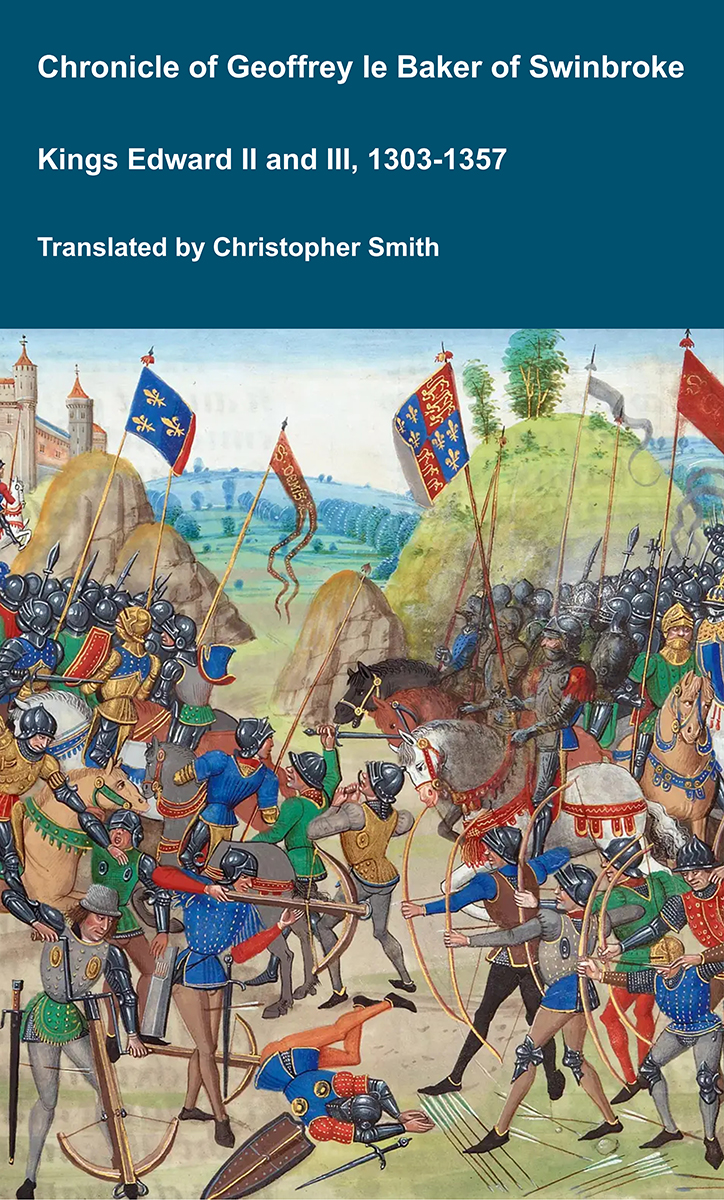
Chronicle of Geoffrey le Baker of Swinbroke
Baker was a secular clerk from Swinbroke, now Swinbrook, an Oxfordshire village two miles east of Burford. His Chronicle describes the events of the period 1303-1356: Gaveston, Bannockburn, Boroughbridge, the murder of King Edward II, the Scottish Wars, Sluys, Crécy, the Black Death, Winchelsea and Poitiers. To quote Herbert Bruce 'it possesses a vigorous and characteristic style, and its value for particular events between 1303 and 1356 has been recognised by its editor and by subsequent writers'. The book provides remarkable detail about the events it describes. Baker's text has been augmented with hundreds of notes, including extracts from other contemporary chronicles, such as the Annales Londonienses, Annales Paulini, Murimuth, Lanercost, Avesbury, Guisborough and Froissart to enrich the reader's understanding. The translation takes as its source the 'Chronicon Galfridi le Baker de Swynebroke' published in 1889, edited by Edward Maunde Thompson.
Available at Amazon in eBook and Paperback format.
In 1637 Thomas Whitley of Aston in Flintshire was appointed High Sheriff of Flintshire.
In 1673 William Glynne 1st Baronet [aged 34] was appointed High Sheriff of Flintshire.
In 1832 John Hamner 1st Baron Hamner [aged 22] was appointed High Sheriff of Flintshire.
In 1608 John Stradling 1st Baronet [aged 45] was appointed High Sheriff of Glamorganshire.
In 1620 John Stradling 1st Baronet [aged 57] was appointed High Sheriff of Glamorganshire.
In 1630 Anthony Mansel of Ischoed was appointed High Sheriff of Glamorganshire.
In 1803 John Morris 1st Baronet [aged 57] was appointed High Sheriff of Glamorganshire.
In 1900 Ivor Churchill Guest 1st Viscount Wimborne [aged 26] was appointed High Sheriff of Glamorganshire.
In 1839 Edward Lloyd aka Lloyd-Mostyn 2nd Baron Mostyn [aged 43] was appointed High Sheriff of Merionethshire.
In 1612 William Morgan [aged 52] was appointed High Sheriff of Monmouthshire.
This is a translation of the 'Memoires of Jacques du Clercq', published in 1823 in two volumes, edited by Frederic, Baron de Reissenberg. In his introduction Reissenberg writes: 'Jacques du Clercq tells us that he was born in 1424, and that he was a licentiate in law and a counsellor to Philip the Good, Duke of Burgundy, in the castellany of Douai, Lille, and Orchies. It appears that he established his residence at Arras. In 1446, he married the daughter of Baldwin de la Lacherie, a gentleman who lived in Lille. We read in the fifth book of his Memoirs that his father, also named Jacques du Clercq, had married a lady of the Le Camelin family, from Compiègne. His ancestors, always attached to the counts of Flanders, had constantly served them, whether in their councils or in their armies.' The Memoires cover a period of nineteen years beginning in in 1448, ending in in 1467. It appears that the author had intended to extend the Memoirs beyond that date; no doubt illness or death prevented him from carrying out this plan. As Reissenberg writes the 'merit of this work lies in the simplicity of its narrative, in its tone of good faith, and in a certain air of frankness which naturally wins the reader’s confidence.' Du Clercq ranges from events of national and international importance, including events of the Wars of the Roses in England, to simple, everyday local events such as marriages, robberies, murders, trials and deaths, including that of his own father in Book 5; one of his last entries.
Available at Amazon in eBook and Paperback format.
In 1689 Thomas Morgan [aged 24] was appointed High Sheriff of Monmouthshire.
In 1821 Charles Morgan 1st Baron Tredegar [aged 28] was appointed High Sheriff of Monmouthshire.
In 1613 William Herbert 1st Baron Powis [aged 40] was appointed High Sheriff of Montgomeryshire.
In 1704 William Williams-Wynn 2nd Baronet [aged 39] was appointed High Sheriff of Montgomeryshire.
In 1619 Henry Lort of Stackpole Court in Pembrokeshire [aged 28] was appointed High Sheriff of Pembrokeshire.