

 Westminster Chronicle. The king and the other nobles of the realm, having heard the promises of the aforesaid duke, with the consent of the said commons of the realm, freely granted what he had asked. Also, on the twenty-seventh day of November, news came to the lord king of the death of Sir John Bacon, his clerk, who had died in the city of Genoa. He had been sent by the king and his council to the pope, so that he might remove the privilege concerning the debt owed by the church of Westminster. For this reason Sir John Waltham, the king’s clerk of the rolls, in his own name, sought pardon from the abbot and convent of Westminster, earnestly asking them mercifully to forgive him. And because John Bacon had been overtaken by death before the pope’s arrival, he achieved his wish neither in these matters nor in others. Also, on the twenty-seventh day of November, because it pleased the king that Lord John Holland [aged 33], for the killing of the son and heir of the earl of Stafford, should undergo the common law, the same earl had him summoned in the King’s Bench by a writ of exigent, with seven other earls present there, and with them a great company of nobles. But he did not appear, nor did anyone else in his place.
Rex autem et alii nobiles regni, auditis promissis ducis prædicti, cum consensu dictæ communitatis regni sui quod petivit liberaliter concesserunt. Item xxvii die Novembris venerunt nova domino regi de morte domini Johannis Bacon clerici sui apud urbem Januæ decedentis, qui fuit missus a rege et ejus consilio ad papam ut tolleret privilegium pro debito ab ecclesia Westmonasterii, qua de causa dominus Johannes Waltham clericus regis de rotulorum nomine suo petiit veniam ab abbate et convéntu Westmonasterii rogans eos instanter ut sibi misericorditer perdonarent, et quia erat morte præventus ante adventum papæ non est votum neque in his neque in aliis consecutus. Item xxvii die Novembris quia placuit regi dominum Johannem Holand pro nece filii et heredis comitis Staffordi communem legem debere subire, igitur idem comes fecit eum in banco regis per breve de exigent vocari, præsentibus ibidem septem aliis comitibus et cum illis magno nobilium comitatu. Sed non comparuit neque quispiam alius loco ejus.
Westminster Chronicle. The king, however, was astonished at so sudden an assembling of so many men. Therefore, after counsel had been taken on this matter, on the fourteenth day of November he sent to them the archbishop of Canterbury and the duke of York, and also the bishops of Winchester and Ely, Lord John Waltham, clerk and keeper of the privy seal, Sir John Cobham, a nobleman, and Sirs Richard Scrope and John Devereux, prudent and discreet knights, to negotiate with the aforesaid lords and to ask for what reason they had risen with so great a multitude. To this the aforesaid lords answered that they clearly foresaw that, through traitors continually standing beside the king, the kingdom of England would shortly be overthrown unless a remedy were applied to this more quickly. "Therefore we, faithful to the king and kingdom, had to proceed against such men as swiftly as possible, so that we, indeed the whole kingdom, might be saved from blind ambushes and deadly snares." And so they then steadfastly appealed of treason Alexander, archbishop of York, Robert de Vere, duke of Ireland, Michael de la Pole, earl of Suffolk, Robert Tresilian the justice, and Nicholas Brembre, knight and Londoner. They said that they wished to prove that these men were most wicked traitors against anyone opposing them, sparing no one in this case, always excepting the king. Nor, they said, did they wish to desist from what they had begun until they had the aforesaid traitors in safe custody, to answer the charges to be laid against them in the next Parliament following.
Rex vero stupefactus ad tam subitam tantorum coadunationem. Unde super hoc habito consilio xiiii die Novembris misit ad eos Cantuariensem archiepiscopum et ducem Eboracensem, episcopos etiam Wyntonensem et Elyensem, dominum Johannem de Waltham portitorem privati sigilli clericum, dominum Johannem de Coboham nobilem, et dominos Ricardum Scrop et Johannem Deverose milites providos et discretos ad tractandum cum præfatis dominis qua de causa cum tanta multitudine surrexerunt. Ad quod responderunt domini prædicti quia clare prospiciebant quod per proditores juxta latus regis jugiter assistentes regnum Angliæ in brevi subverteretur nisi remedium super hoc celerius apponatur. Igitur nos fideles regi et regno contra tales procedere quantocius habebamus ut nos immo totum regnum a cœcis insidiis et a laqueis mortiferis salvare possimus. Sicque tunc constanter appellabant de proditione Alexandrum archiepiscopum Eboracensem, Robertum de Veer ducem Hiberniæ, Michaelem de la Pole comitem Southfolchiæ, Robertum Tresilian justiciarum et Nicholaum Brembre militem Londoniensem. Et quod isti sunt nequissimi proditores vellent probare contra quemlibet opponentem nulli parcendo in hoc casu rege semper excepto. Nec ab incepto desistere eos velle dixerunt quousque habuerunt præfatos proditores in tuta custodia ad respondendum objectis sibi imponendis in proximo parliamento sequenti.
Westminster Chronicle. Also, on the 10th day of September, the king began his Parliament at Cambridge. First of all, before anything else, they ordained that all bishops translated to their sees by provision of the Pope should go to their sees and, without delay, take bodily possession through their vicars. When this had been done, they consecrated Lord John Waltham, clerk of the privy seal of our lord the king, as Bishop of Salisbury. They also ordained that the staple of wools should remove itself from Middelburg and establish itself as quickly as possible at Calais. Nevertheless, it remained there beyond the appointed day for a long time, until the 3rd day of February. The day fixed for this limitation had been the 1st day of December next following. Also, those of the Commons in this Parliament complained gravely about the badges of the lords, because those wearing them, on account of the power of their lords, were raised up into such stiff-necked pride that they did not fear to commit various extortions in the country round about with rash boldness. Thus they tore apart and confounded the poor in the courts of princes and others wherever they were; and the middling sort and others, without distinction, in whatever places where justice was rendered, they stripped and weakened of their rights, because they did not allow law and justice to proceed along the path of reason. These things, indeed, and others, they did not fear to commit through the boldness given by badges. When they heard this, the aforesaid lords, wishing to blunt the general nature of this complaint, ordered the Commons to hand over to them specifically such wrongdoers who committed these things, and said that they would punish them in such a way that others would fear to perpetrate the like. This promise did not please the Commons. Rather, they wished altogether that the said badges should be laid aside, if the lords desired to have peace and tranquillity in the kingdom. To this, the king, desiring that there should be tranquillity in the realm for the good of peace, and so that he might give an example to others, offered to lay aside his own badges, which greatly pleased the aforesaid Commons. But the lords, after many insults and shameful words had been spoken by them against the Commons, refused to consent to what the Commons’ eagerness demanded. Therefore dissension arose between them. When the king saw them thus disagreeing with one another over the laying aside of the aforesaid badges, wishing to avoid common discord, he first recalled them to concord. Afterwards, so that all matter of dissension might be rooted out, he granted the often-mentioned lords the use of their badges until the next Parliament, as is set out more fully here in the French language.
Item x, die Septembris apud Cantebrigiam rex suum parliamentum incepit. Primo namque ante omnia statuerunt quod episcopi omnes provisione papæ translati ad sedes suas transirent et possessionem corporalem per eorum vicarios assumerent indilate. Quo facto dominum Johannem Waltham clerieum privati sigilli domini nostri regis in Sarum episcopum consecrarunt. Statuerunt etiam quod stapula lanarum moveret se de Middelbourgh et apud Calesias se quantocius stabiliret, Nihilominus remansit ibidem ultra diem assignatum per magnum tempus usque ad tertium diem Februarii, Erat namque dies hujus limitationis primus dies Decembris proxime futuri. Item illi de communitate in isto parliamento de signis dominorum graviter sunt conquesti eo quod ea gestantes propter suorum potentiam dominorum in tam cervicosam superbiam sunt elati quod varias extorsiones in patria circumcirca ausu temerario committere non verentur, Unde pauperes in curiis principum et aliorum ubicunque dilaniant et confundunt. Mediocres vero et alios indifferenter in quibuscunque locis ubi jus redditur jure suo expoliant et enervant quia jus cum justitia rationis tramite procedere non permittunt. Hæc itaque et alia profecto signorum audacia committere non formidant. His quoque auditis præfati domini generalitatem hujus querimoniæ elidere cupientes jusserunt ipsos in specie illis tradere hujusmodi malefactores talia committentes, et taliter eos castigarent quod similia perpetrare cæteri pertimescant. Ista promissio illis non placuit; immo omnino vellent quod prædicta signa deponerent si pacem et tranquillitatem in regno habere exoptent. Ad hæc rex affectans ut tranquillitas foret in regno pro bono pacis et ut aliis daret exemplum obtulit se deponere sua signa, quod summe placuit communitati prædictæ. Sed domini post multa convicia, et verba probrosa illis de communitate prolata, noluerunt consentire ad id quod eorum aviditas flagitabat, quare inter eos dissensio est exorta. Rex autem vidit eos sic adinvicem discordare propter depositionem signorum prædictorum volens commune dissidinm evitare, eos primo ad concordiam revocavit. Postea vero ut omuia materia dissensionis radicitus exstirpetur concessit dominis sæpedictis uti eorum signis usque in proximum parliamentum, prout in Gallico idiomate hic seriosius continetur.
On 20th September 1388 Bishop John Waltham was consecrated Bishop of Salisbury at a ceremony attended by King Richard II of England [aged 21].
Westminster Chronicle. When this had been done, the king and his household returned to his manor of Woodstock, and the archbishop turned aside to Salisbury for the purpose of visiting that church, both in head and in members1. First, a citation having been made once, twice, and three times for the Bishop of Salisbury to appear and humbly admit the visitation of his archbishop, the procurator of the aforesaid bishop at length appeared before him, asserting that his bishop had such a privilege that he ought not to be visited by anyone. From this a great dispute arose between them. At that time Master Thomas Montagu had been installed in the deanery of Salisbury and was then making his residence there, as though just beginning it. He received the aforesaid archbishop into his house and served him with various rich dishes. Through the mediation of friends, the archbishop and the Bishop of Salisbury2 were brought to concord. Thus pacified, and the visitation there completed, the archbishop continued further with his visitation in the province appointed to him.
Quo peracto rex cum suis rediit ad manerium suum de Wodestok et archiepiscopus divertit Sarum causa visitandi ecclesiam illam tam in capite quam in membris, Primo enim facta citatione primo sehæceundo et tertio pro episcopo Sarum quod compareret et humiliter admitteret visitationem sui archiepiseopi, coram quo tandem comparuit procurator præfati episcopi asserens suum episcopum habere tale prihæcvilegium se non debere visitari a quoquam. Unde orta est grandis discordia inter cos. Quo in tempore magister Thomas Montagu fuerat in decanatu Sarum installatus et fecit residentiam suam ibi tune quasi incipiendo qui præfatum archiepiscopum in suam domum excepit et ipsum diversis et lautis ferculis deservivit et mediantibus amicis inter archiepiscopum et Sarum episcopum ad concordiam sunt reducti, sieque pacificati ac completa visitatione ihidem archiepiscopus continuavit ulterius in provincia sua sibi decreta suam visitationem.
Note 1. 'both in head and in members' meaning he was going to conduct a full visitation, both of the head, i.e. the bishop, and the members, i.e. the chapter, clergy, officers, dependants, and wider cathedral personnel.
Note 2. John Waltham, died 1395. Consecrated Bishop of Salisbury in 1388.
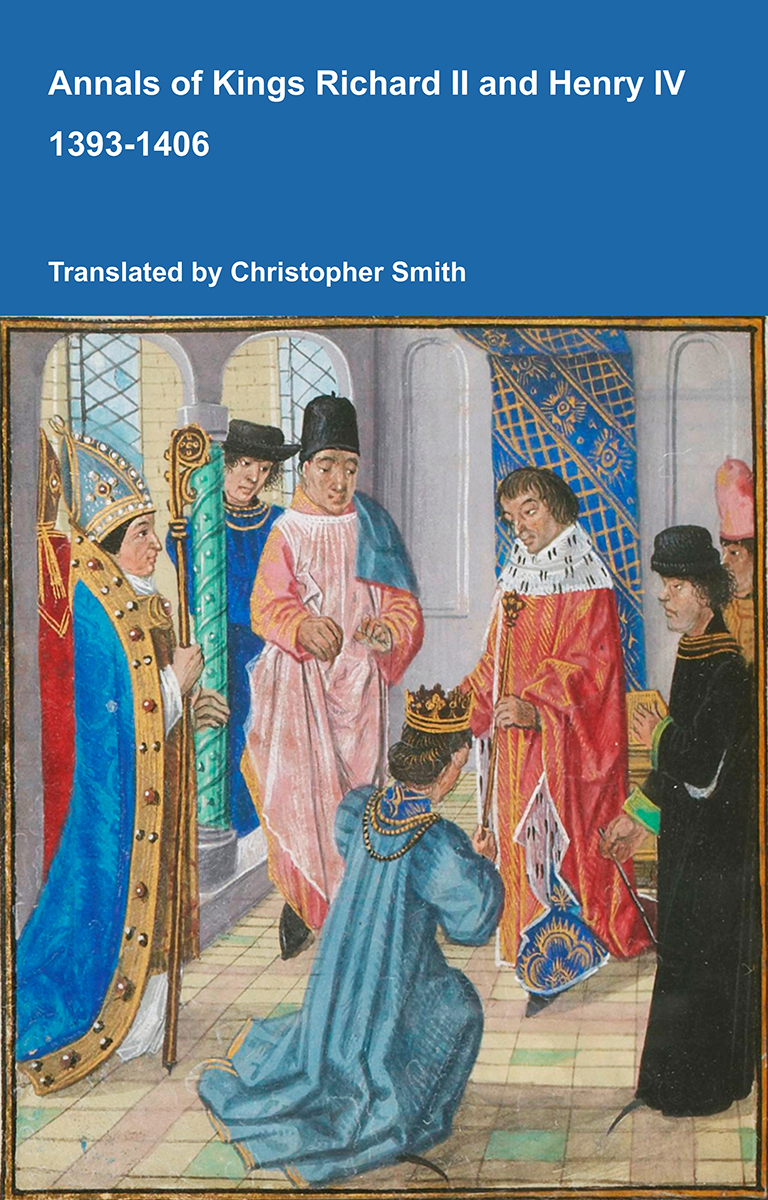 Annals of Kings Richard II and Henry IV. In this year John Waltham, Bishop of Salisbury and Treasurer of the realm, died. He had so pleased the King that, although many murmured at it, by the King’s command he received burial at Westminster among the kings. He was succeeded in the office of Treasurer by Sir Roger Walden, formerly the King’s Secretary and Treasurer of Calais. In the bishopric, however, he was succeeded by Sir John [Richard] Mitford, Bishop of Chichester. To Mitford’s bishopric the Archbishop of Dublin [Robert Waldby] was translated, because the greater bishopric was lesser in secular substance. Thomas Brantingham, Bishop of Exeter, also died. By the King’s insistence, he was succeeded by Master Edmund Stafford [aged 51], Keeper of the Privy Seal.
Hoc anno obiit J[ohannes] Waltham, Sarisburiensis Episcopus, regni Thesaurarius; qui tantum Regi complacuerat, ut, licet multis murmurantibus, Rege jubente, apud Westmonasterium inter Reges acciperet sepulturam. Huic successit, in officio Thesaurarii, Dominus Rogerus Waldene, prius Regis Secretarius, et Calesiæ Thesaurarius: in Episcopatu vero Dominus J[ohannes] Mytford, Cicestrensis; ad cujus Episcopatum Dublinensis Archiepiscopus est translatus, quia major pontificatus in sæculari substantia minor erat. Obiit etiam Thomas Brantyngham, Exoniensis Episcopus; cui successit, Regis instantia, Magister Edmundus de Staffor[d], Portitor Privati Sigilli.
On 17th September 1395 Bishop John Waltham died. He had wished to buried at Salisbury Cathedral but King Richard intervened and ordered that Waltham should be given a tomb in Westminster Abbey, London. He was duly buried in the Chapel of St Edward the Confessor, Westminster Abbey [Map].
Westminster Chronicle. Around the beginning of the month of May, the Earl of Derby landed in England, safe and cheerful. On the 3rd day of May, at Tothill, there was a duel between two felons, namely between an appellant and a defendant. The appellant was defeated, although he had the more just complaint. For he freely confessed before everyone that, in the previous year, by his persuasion and urging, a certain fugitive, who had fled to the sanctuary of St Peter’s, Westminster, came out, and was thus deceitfully captured and finally hanged. That man, he said, had now fiercely attacked and hindered him in the fight, so that he could not obtain the victory, as seemed to him to be true. He confirmed by oath that this assertion was valid, just as he wished to have his soul saved before Almighty God on the Day of Judgement. Also, around the beginning of the month of May, Lord John Waltham, Bishop of Salisbury, was made the lord king’s treasurer.
Circa principium mensis Maii comes Derbeye sanus et hilaris in Angliam applicuit. Tertio die Maii apud Toothull erat duellum inter duos felones, scilicet inter appellatorem et defensorem; victus est appellator quamvis habuerit justiorem querelam. Nam sponte fatebatur coram omnibus quod, alio anno, ejus suasu et hortatu, quidam fugitivus, [qui] ad sanctuarium sancti Petri Westmonasterium confugiebat, exivit sicque dolose fuit comprehensus et tandem suspensus. Qui ipsum jam pugnando acriter infestavit ac impedivit quominus posset victoriam obtinere, prout sibi videbatur pro vero. Hanc autem assertionem fore validam jurejurando firmavit sicut ipse in die judicii vellet animam suam salvam habere coram summo deo. Item circa principium mensis Maii dominus Johannes Waltham, episcopus Sarum, factus est thesaurarius domini regis.
Westminster Chronicle. At that time the pope sought a subsidy from the clergy, but those in parliament, perceiving this shrewdly, ordained that he should make translations of bishops, namely that he should grant that the Bishop of Ely should pass to the Church of York, the Bishop of Durham to the Church of Ely, the Bishop of Bath to the Church of Durham, and the Bishop of Salisbury to the Church of Bath, and that he should confirm Sir John Waltham, clerk of the Privy Seal, as Bishop of Salisbury. All these matters were sent to the lord pope. The pope, having been consulted on these things, assented to their petition, and translated the Archbishop of York to the archbishopric of St Andrews in Scotland. But because the whole place was schismatic, he could not have entry there unless by strong hand he had manfully overcome the same Scots in battle.
Quo in tempore papa petiit subsidium a clero sed illi de parliamento hoc sagaciter advertentes ordinarunt quod faceret translationes episcoporum videlicet quod Elyensem ad Eboracensem, Dunelmensem ad Eliensem, Bathoniensem ad Dunelmensem et Salesburyensem ad Bathoniensem ecclesias concederet pertransire, et dominum Johannem Waltham clericum privati sigilli in Sarum episcopum confirmaret. Quæ omnia domino papæ fuerunt directa. Papa vero super istis consultus annuit petitioni eorum et transtulit archiepiscopum Eboracensem ad archiepiscopatum sancti Andreæ in Scotia. Sed quia tota fuit schismatica ibidem habere introitum non potuit nisi manu forti eosdem Scotos viriliter debellasset.