

On 26th January 1657 Archbishop William Wake was born in Blandford Forum, Dorset [Map].
John Evelyn's Diary. 1st January 1687. Mr. Wake [aged 29] preached at St. Martin's on 1 Tim. iii. 16, concerning the mystery of godliness. He wrote excellently, in answer to the Bishop of Meaux.
John Evelyn's Diary. 20th March 1687. The Bishop of Bath and Wells [aged 49] (Dr. Ken) preached at St. Martin's [Map] to a crowd of people not to be expressed, nor the wonderful eloquence of this admirable preacher; the text was Matt. xxvi. 36 to verse 40, describing the bitterness of our Blessed Savior's agony, the ardor of his love, the infinite obligations we have to imitate his patience and resignation; the means by watching against temptations, and over ourselves with fervent prayer to attain it, and the exceeding reward in the end. Upon all which he made most pathetical discourses. The Communion followed, at which I was participant. I afterward dined at Dr. Tenison's [aged 50] with the Bishop and that young, most learned, pious, and excellent preacher, Mr. Wake [aged 30]. In the afternoon, I went to hear Mr. Wake at the newly built church of St. Anne, on Mark viii. 34, upon the subject of taking up the cross, and strenuously behaving ourselves in time of persecution, as this now threatened to be.
In 1688 Archbishop William Wake [aged 30] and Ethelreda Hovell [aged 18] were married.
In 1693 Archbishop William Wake [aged 35] was appointed Rector of St James' Church, Piccadilly.
In 1703 Archbishop William Wake [aged 45] was appointed Dean of Exeter.
In 1705 Archbishop William Wake [aged 47] was consecrated Bishop of Lincoln.
In 1716 Archbishop William Wake [aged 58] was translated to Archbishop of Canterbury.
On 20th July 1729 William Stukeley [aged 41] was ordained as a Deacon by Archbishop William Wake [aged 72].
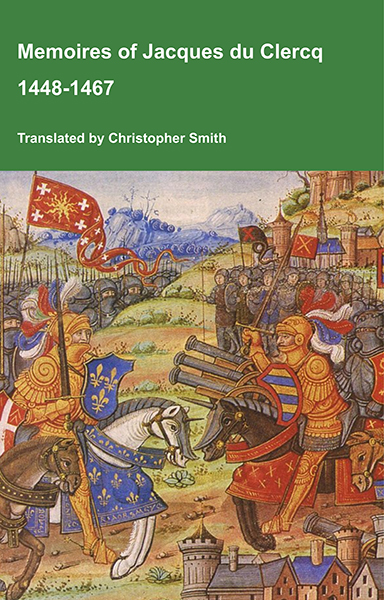
This is a translation of the 'Memoires of Jacques du Clercq', published in 1823 in two volumes, edited by Frederic, Baron de Reissenberg. In his introduction Reissenberg writes: 'Jacques du Clercq tells us that he was born in 1424, and that he was a licentiate in law and a counsellor to Philip the Good, Duke of Burgundy, in the castellany of Douai, Lille, and Orchies. It appears that he established his residence at Arras. In 1446, he married the daughter of Baldwin de la Lacherie, a gentleman who lived in Lille. We read in the fifth book of his Memoirs that his father, also named Jacques du Clercq, had married a lady of the Le Camelin family, from Compiègne. His ancestors, always attached to the counts of Flanders, had constantly served them, whether in their councils or in their armies.' The Memoires cover a period of nineteen years beginning in in 1448, ending in in 1467. It appears that the author had intended to extend the Memoirs beyond that date; no doubt illness or death prevented him from carrying out this plan. As Reissenberg writes the 'merit of this work lies in the simplicity of its narrative, in its tone of good faith, and in a certain air of frankness which naturally wins the reader’s confidence.' Du Clercq ranges from events of national and international importance, including events of the Wars of the Roses in England, to simple, everyday local events such as marriages, robberies, murders, trials and deaths, including that of his own father in Book 5; one of his last entries.
Available at Amazon in eBook and Paperback format.
In 1731 [his wife] Ethelreda Hovell [aged 61] died.

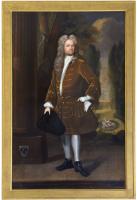
Before 1737 Thomas Gibson [aged 56]. Portrait of Archbishop William Wake [aged 79].
On 24th January 1737 Archbishop William Wake [aged 79] died at Lambeth Palace [Map].
[his daughter] Dorothy Wake was born to Archbishop William Wake and Ethelreda Hovell. She married James Pennyman, son of James Pennyman 3rd Baronet and Mary Wharton.