

In May 1500 Thomas Wendy was born to John Wendy of Clare in Suffolk. He was educated at Gonville College, Cambridge University receiving a BA in 1519, MA in 1522 and MD in 1527.
In July 1534 Thomas Wendy [aged 34] was employed by Henry Percy 6th Earl of Northumberland [aged 32] with an annuity of £3 6s.8d. from Fountains Abbey, North Yorkshire [Map], the grant being made at the instance of the earl, a benefactor of the abbey. Wendy was employed by Northumberland in a number of other capacities. In March 1535 he executed with the earl a deed transferring the Percy lands in Sussex to the crown. He carried a number of letters from the earl to Cromwell in 1536 and 1537 and attended him at Hackney in his last illness in June 1537.
Before 1541 Thomas Wendy [aged 40] had married Margaret Butler.

In June 1541 Thomas Wendy [aged 41] bought the manor and advowson of Haslingfield where he settled. One of his feoffees was William Paget [aged 35] who became a close friend.
Before October 1546 Thomas Wendy [aged 46] had appointed physician to Catherine Parr Queen Consort England [aged 34].


In 1547 Thomas Wendy [aged 46] was appointed Justice of the Peace for Cambridgeshire.
On 28th January 1547 Henry VIII [aged 55] died at Whitehall Palace [Map]. His son Edward [aged 9] succeeded VI King of England. Earl Chester merged with the Crown.
Thomas Wendy [aged 46] attended the King. He was one of the witnesses to the King's last will and testament, for which he received £100.


In March 1547 Thomas Wendy [aged 46] was appointed physician to King Edward VI of England and Ireland [aged 9].
In September 1547 Thomas Wendy [aged 47] took a thirty year lease on the Bishop of Hereford's mansion near Old Fish Street.
On 22nd December 1551 Thomas Wendy [aged 51] was admitted to the Royal College of Physicians.
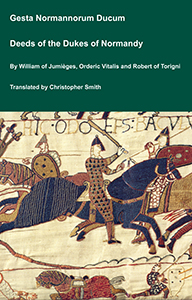
The Deeds of the Dukes of Normandy
The Gesta Normannorum Ducum [The Deeds of the Dukes of Normandy] is a landmark medieval chronicle tracing the rise and fall of the Norman dynasty from its early roots through the pivotal events surrounding the Norman Conquest of England. Originally penned in Latin by the monk William of Jumièges shortly before 1060 and later expanded at the behest of William the Conqueror, the work chronicles the deeds, politics, battles, and leadership of the Norman dukes, especially William’s own claim to the English throne. The narrative combines earlier historical sources with firsthand information and oral testimony to present an authoritative account of Normandy’s transformation from a Viking settlement into one of medieval Europe’s most powerful realms. William’s history emphasizes the legitimacy, military prowess, and governance of the Norman line, framing their expansion, including the conquest of England, as both divinely sanctioned and noble in purpose. Later chroniclers such as Orderic Vitalis and Robert of Torigni continued the history, extending the coverage into the 12th century, providing broader context on ducal rule and its impact. Today this classic work remains a foundational source for understanding Norman identity, medieval statesmanship, and the historical forces that reshaped England and Western Europe between 800AD and 1100AD.
Available at Amazon in eBook and Paperback format.
On 13th June 1552 Thomas Wendy [aged 52] and Margaret Porter were married.

On 6th July 1553 King Edward VI of England and Ireland [aged 15] died at Palace of Placentia, Greenwich [Map]. His first cousin once removed Lady Jane Grey [aged 17] succeeded I Queen of England.
Thomas Wendy [aged 53] attended the King as physician.
In 1554 Thomas Wendy [aged 53] was appointed physician to Queen Mary I of England and Ireland [aged 37].


In 1554 Thomas Wendy [aged 53] was elected MP St Albans.
In 1555 Thomas Wendy [aged 54] was elected MP Cambridgeshire.
On 17th November 1558 Queen Mary I of England and Ireland [aged 42] died at St James's Palace [Map]. Her half sister Elizabeth [aged 25] succeeded I Queen of England. William Brooke 10th Baron Cobham [aged 31] was deputed with informing Philip "The Prudent" II King Spain [aged 31].
Thomas Wendy [aged 58] attended the Queen as physician; the third monarch's death he attended.
Before 1559 Thomas Wendy [aged 58] was elected President of Gonville College, Cambridge University.

On 11th May 1560 Thomas Wendy [aged 60] died. He was buried at All Saints Church, Haslingfield [Map].
In his will he left his Thomas Percy [aged 32], nephew of his former employer, in his will a silver ewer and basin "in remembrance of such benefits which I have received at the hands of my very good lord and late master the late earl of Northumberland his uncle".
He left Anne Preston Baroness Geneville Beaudasert and Parr Kendal his lands at Coton and Whitwell, Cambridgeshire 'as a poor token of the good will which I have ever borne to her ladyship and in remembrance that in that place she had her first acquaintance with my lord her husband [aged 54]'.
He also remembered Anthony Browne [aged 51], Henry Percy 8th Earl of Northumberland [aged 28], Humphrey Radclyffe [aged 51] and Richard Weston [aged 33].
Henry Machyn's Diary. 27th May 1560. The xxvij day of May was the obseque and fen[eral] of master docthur Wende [deceased], fessyssyon [physician] at Cambryge, a penon of armes and a cott armur, and vj dosen and d' of skochyons of armes, and a harold of armes master Somersett, and .. morners in blake, and he gayff mony gownes to pore men, and ther was a grett dolle, and thether resortyd xx m[iles] off vC. pepull and had grett plente of mett and drynke, boyth hosses [houses] and barnes and feldes, grett store as has bene [seen] for a men [mean ie middle rank] gentyllman, and gret mone mad [moan made].
Note. P. 235. Funeral of Dr. Wendy. Thomas Wendy, M.D. was one of the witnesses to the will of king Henry VIII. together with doctor George Owen and doctor Thomas Huicke, and they each received a legacy of 100l. (Rymer, xv. 117.) He was re-appointed physician to king Edward VI. March 3, 1546–7, with an annuity of 100l. (ibid. 143); and on the 22d Nov. 1548, was appointed one of the commissioners to visit the university of Cambridge (ibid. 178).