

The Diary of George Price Boyce 1854 is in The Diary of George Price Boyce.

28th January 1854. To Wells [aged 25]; he had had an audience of the Queen, who was gracious and complimentary, liking his miniature of the Princess much. The latter [Princess Mary Adelaide Hanover [aged 20]], Wells says, is a gleeful damsel, and retails to him with spirit and cleverness whole scenes from Box and Cox and other farces.
4th February 1854. J. Jenkins and his brother to tea. He seems to admire most of my drawings, but said they were rather studies than drawings, having no prevailing sentiment or harmony of impression. He saw more of this in one or two of the smaller and hastier sketches, and liked much the small Pyrenaean one (Cabas) and Babbacombe Bay and the interior of S. Sauveur, Dinan.
6th February 1854. Took to Old Water-Colour Society's Galleries 7 drawings and studies in competition for the associateship. Met Mr. Topham [aged 45] and his daughter Polly at the door.
8th February 1854. Topham [aged 45] took me to the Graphic Society's Exhibition, a host of fine things were exhibited—John Millais' Ophelia, several beautiful drawings by Girtin and Turner, by W. Hunt [aged 26]. Wallis said he liked my drawings and asked the price of the Westminster Abbey—15 gns .— 1st nibble.
13th February 1854. Mr. Duncan [aged 50] told me that at the meeting to-day of the Old Water-Colour Society, not one of the 13 candidates was elected. He was surprised at this himself, but thought that members having on the last few occasions elected men of no great performance or promise, were frightened and had gone to the other extreme.
2nd March 1854. Took drawing of Anstey's Cove, S. Devon, to Portland Gallery, priced at £10. Charles Keene came back with me to Russell St.
5th March 1854. (Sunday). In the evening mother entered upon Miss 's attractions and desirability as a wife for me. Told her that I knew her wishes were entirely for my welfare, but that I had no sympathy or particular partiality for Miss —, and that I did not intend to think of marriage for 2 or 3 years at least—and that Miss's large fortune was not the least allurement to me; thought her a pleasant kind and amiable girl and nothing more.
13th March 1854. To Rossetti's [aged 25]. Found him at home but unwell; he sleeps little at nights. A young man of the name of Hughes [aged 22] was painting a picture of Orlando inscribing his mistress' name on a tree. Parts nicely painted. Rossetti showed me an exquisite drawing of his from the Vita Nuova, Dante receiving visitors on the anniversary of Beatrice's death. He showed me too a little unfinished drawing of Dante, Beatrice, and two others, in Paradise, he promised to finish for me, as I liked it, and would like some work in exchange. On the wall he has pen and ink outlines by J. E. Millais [aged 24], W. H. Hunt [aged 26], Deverell, and W. B. Scott, pencil design by Woolner, chalk study by F. M. Brown [aged 32]. A lovely hasty rub in of a cornfield against a deep blue sky, by W. H. Hunt. We read a long critique of the National Exhibition in the Daily News by Coventry Patmore; intensive praise of my small drawing, finding fault with the others. Rossetti came round to Russell St. and took ten of the drawings I showed him. He liked the long Sunset, Moel Siabod—Autumn Study, Thought the 3 greatest men in art were Giotto, Durer, Hogarth.


8th April 1854. J. E. Millais [aged 24] and Munro [aged 28] called on me at Russell St. The former stayed some time and appeared much interested in my sketches, especially those taken in the neighbourhood of Dinan, and some few near Bettws. He thought I painted a good like old Hunt—wish I had a little of his genius! He wanted to finish his picture of Ruskin (looking on falling water) from some spot nearer than the Highlands. I recommended him the neighbourhood of Capel Curig. He suggested our exchanging sketches. Rossetti [aged 25] came in at 3 and stayed till 10, working a greater part of the time on the old drawing I have of his, in which I cut out the head of the dancing boy and inserted a fresh piece of paper at the back. He improved it much in parts, especially the heads, but left it unfinished. He said he thought the most beautiful combination of colour in a picture to be green, blue, and carmine, all inclining to purplish, but the general tone of picture colour to incline to vellow. An opal I showed him elicited this. He gave me 2 pen and ink sketches made some time ago—one of his first idea of the drawing "to caper nimbly in a lady's chamber," and the other a Siren followed by two men in a boat. I am to give him a sketch in return. He lent me F. & G.'s edition of Hugo's "Notre Dame de Paris" with some fine illustrations by Meissonier and Legrand. He told me in conversation that W. H. Hunt [aged 27] had a morbid conviction of his own ugliness and desired that all record of him to the present in the way of portraits or letters should be destroyed.


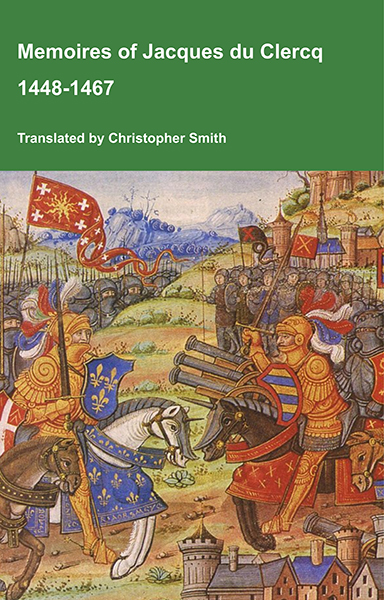
This is a translation of the 'Memoires of Jacques du Clercq', published in 1823 in two volumes, edited by Frederic, Baron de Reissenberg. In his introduction Reissenberg writes: 'Jacques du Clercq tells us that he was born in 1424, and that he was a licentiate in law and a counsellor to Philip the Good, Duke of Burgundy, in the castellany of Douai, Lille, and Orchies. It appears that he established his residence at Arras. In 1446, he married the daughter of Baldwin de la Lacherie, a gentleman who lived in Lille. We read in the fifth book of his Memoirs that his father, also named Jacques du Clercq, had married a lady of the Le Camelin family, from Compiègne. His ancestors, always attached to the counts of Flanders, had constantly served them, whether in their councils or in their armies.' The Memoires cover a period of nineteen years beginning in in 1448, ending in in 1467. It appears that the author had intended to extend the Memoirs beyond that date; no doubt illness or death prevented him from carrying out this plan. As Reissenberg writes the 'merit of this work lies in the simplicity of its narrative, in its tone of good faith, and in a certain air of frankness which naturally wins the reader’s confidence.' Du Clercq ranges from events of national and international importance, including events of the Wars of the Roses in England, to simple, everyday local events such as marriages, robberies, murders, trials and deaths, including that of his own father in Book 5; one of his last entries.
Available at Amazon in eBook and Paperback format.
21st April 1854. Ruskin [aged 35] and his father called. They admired Rossetti's [aged 25] drawings much, especially the Dante and Beatrice one. They praised also the Welsh sunset study I have promised Dante Rossetti, the study of the twisted birch tree, and Ruskin commended the portrait of Miss Nicholl in hat and feather. On my expressing my liking for after sunset and twilight effects, he said I must not be led away by them, as on account of the little light requisite for them, they were easier of realisation than sun-light effects. He was very friendly and pleasant and encouraging in manner, and showed no conceit, grandeur, or patronising mien. A most delightful feeling seemed to exist between himself and father. He said he would be glad to call again and see my drawings.


22nd April 1854. While working on drawing in Edward the Confessor's Chapel, a sociable intelligent looking American gentleman accosted me and asked me to make him two sketches, one of a gloomy desolate character and the other cheerful and sunny and vernal. He wished to send them to his wife as descriptive of the state of his feelings during a recent sea voyage. I learnt he was a friend of Dean Milman and Samuel Rogers, his name, Dr. Magoon, of New York, U.S.A.
27th April 1854. Dr. Magoon came to the Abbey and took away the two little sketches and paid me £1 10s. for them, He was very pleased with them and hoped to meet me in Venice and in New York if I came there.
29th April 1854. Mr. Boone told me he had lately seen Ruskin [aged 35], who had commended my work.
1st May 1854. In to-day's Spectator my drawing of Anstey's Cove at the National Institution characterised as the best in the Exhibition. Oh Lor!
9th December 1854. Dec. 9. To Architectural Museum, Cannon Row. Ruskin [aged 35] gave an excellent lecture on colour to a crowded audience. After the lecture I spoke to him and he immediately asked when he might come and see my drawings, I said in about a fortnight. He said, "Not before? Pray don't go and botch them in the studio." Hoped I was a confirmed Pre-Raphaelite, etc.
4th January 1854. (Paris). To Corot's. Whilst I was with him a friend of his, Eugéne de Varennes,l came in, who turned out to be the painter of one of the little studies I bought of Anthony, and not Corot.