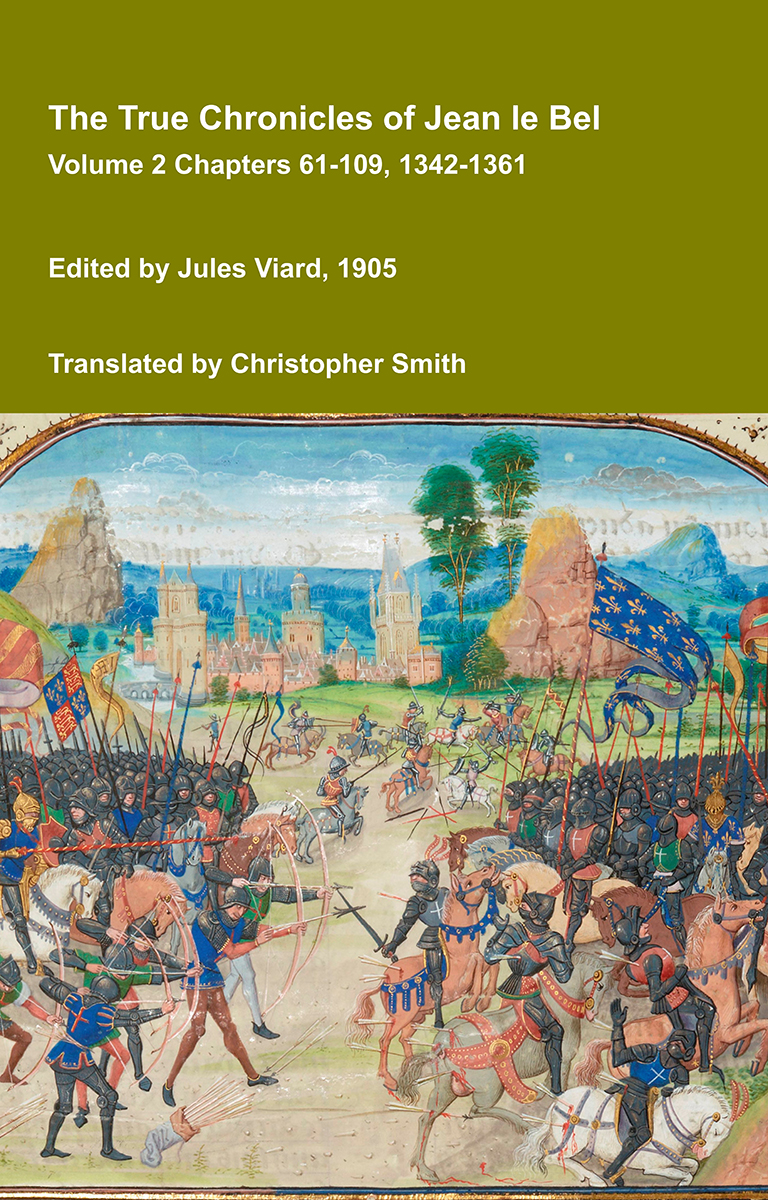
The True Chronicles of Jean le Bel Volume 2 Chapters 61-109 1342-1361
The Chronicle of Jean le Bel, Volume 2 continues one of the most important fourteenth-century accounts of the early Hundred Years’ War. Written by the Liège chronicler Jean le Bel, this vivid narrative follows the fortunes of Edward III, Jean II of France, the Black Prince, the great nobles of France and England, and the soldiers, captains and companies who shaped the conflict. This volume covers some of the most dramatic events of the period, including the battles of Crécy and Poitiers, the siege and capture of Calais, the captivity of King John, the rise of the Jacquerie, the turmoil in Paris under Étienne Marcel and Charles of Navarre, the devastation caused by the free companies, Edward III’s great campaign of 1359–1360, and the negotiations leading to the Treaty of Brétigny. Jean le Bel’s chronicle is especially valuable for its lively detail, its interest in chivalry, warfare, politics and reputation, and its influence on later chroniclers, most famously Froissart. This English translation presents the text in clear, readable British English while preserving the force and character of the original narrative. The translation includes extensive notes to help the reader better understand Jean le Bel's text. Volume 2 also includes translated appendices drawn from royal and administrative records, many from the English Record Office, which illuminate Edward III’s campaigns in Brittany, the siege and occupation of Calais, naval preparations, military finance, appointments, safe conducts and related affairs.
Available at Amazon in eBook and Paperback format.
In 855 Edmund "The Martyr" King East Anglia was appointed King East Anglia.
Anglo-Saxon Chronicle. This year the army rode over Mercia into East-Anglia, and there fixed their winter-quarters at Thetford [Map]. And in the winter King Edmund fought with them; but the Danes gained the victory, and slew the king [20th November 869]; whereupon they overran all that land, and destroyed all the monasteries to which they came. The names of the leaders who slew the king were Hingwar and Hubba. At the same time came they to Medhamsted [Map], burning and breaking, and slaying abbot and monks, and all that they there found. They made such havoc there, that a monastery [Map], which was before full rich, was now reduced to nothing. The same year died Archbishop Ceolnoth; and Ethered, Bishop of Witshire, was chosen Archbishop of Canterbury.
The Passion of St Edmund by Abbo of Fleury. X. The saintly man [Edmund "The Martyr" King East Anglia] had but just ended his speech, and the soldier taken his departure from the palace to carry back the answer, when, behold! Inguar met him, and bade him waste no words in declaring the final purport of the king's reply. As the messenger obeyed this behest, the tyrant ordered the crowd of his attendants to form a ring round the place, and to take the king alone prisoner, as showing palpable defiance of the conditions laid down. Then the holy King Eadmund was taken in his palace, as a member of Christ, his weapons thrown aside, and was pinioned and tightly bound with chains, and in his innocence was made to stand before the impious general, like Christ before the governor Pilate, and eager to follow in the footsteps of Him who was sacrificed as a victim for us. And so in chains he was mocked in many ways, and at length, after being savagely beaten, he was brought to a tree in the neighbourhood, tied to it, and for a long while tortured with terrible lashes. But his constancy was unbroken, while without ceasing he called on Christ with broken voice. This roused the fury of his enemies, who, as if practising at a target, pierced his whole body with arrow-spikes, augmenting the severity of his torment by frequent discharges of their weapons, and inflicting wound upon wound, while one javelin made room for another. And thus, all haggled over by the sharp points of their darts, and scarce able to draw breath, he actually bristled with them, like a prickly hedgehog or a thistle fretted with spines, resembling in his agony the illustrious martyr Sebastian. But when it was made apparent to the villainous Inguar that not even by these means could the king be made to yield to the agents of his cruelty, but that he continued to call upon the name of Christ, the Dane commanded the executioner to cut off his head forthwith. The king was by this time almost lifeless, though the warm life-stream still throbbed in his breast, and he was scarcely able to stand erect. In this plight he was hastily wrenched from the blood-stained stem, his ribs laid bare by numberless gashes, as if he had been put to the torture of the rack, or had been torn by savage claws, and was bidden to stretch forth the head which had ever been adorned by the royal diadem. Then, as he stood in all his meekness, like a ram chosen out of the whole flock, and desirous of hastening by a happy exchange this life for eternity, absorbed as he was in the mercies of God, he was refreshed by the vision of the light within, for the satisfaction of which he earnestly yearned in his hour of agony. Thus, while the words of prayer were still on his lips, the executioner, sword in hand, deprived the king of life, striking off his head with a single blow. And so, on the 20th November [869], as an offering to God of sweetest savour, Eadmund, after he had been tried in the fire of suffering, rose with the palm of victory and the crown of righteousness, to enter as king and martyr the assembly of the court of heaven.
Assers Life of Alfred 870. 33. The Danes triumph.74 That same year Edmund, King of the East Angles, fought most fiercely against that army; but, lamentable to say, the heathen triumphed, for he and most of his men were there slain [20th November 869], while the enemy held the battle-field, and reduced all that region to subjection.
Note 74. From the Chronicle.
On 20th November 869 Edmund "The Martyr" King East Anglia died.
Vesta Monumenta. 1752. Plate 2.7. Greensted Church with Objects Commemorating St. Edmund. The central image of the Church of St. Andrew, Greensted [Map], Essex, is rendered along with the burial shrine of St. Edmund and a seal fragment from the Abbey of Bury St. Edmunds [Map], both in Suffolk. Engraving by George Vertue [aged 68] after Smart Lethieullier [aged 50] and John Lydgate.