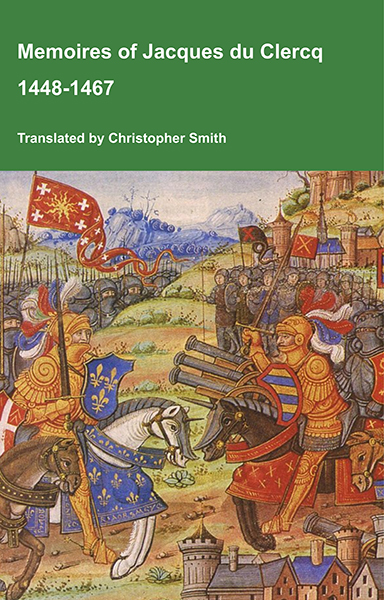
This is a translation of the 'Memoires of Jacques du Clercq', published in 1823 in two volumes, edited by Frederic, Baron de Reissenberg. In his introduction Reissenberg writes: 'Jacques du Clercq tells us that he was born in 1424, and that he was a licentiate in law and a counsellor to Philip the Good, Duke of Burgundy, in the castellany of Douai, Lille, and Orchies. It appears that he established his residence at Arras. In 1446, he married the daughter of Baldwin de la Lacherie, a gentleman who lived in Lille. We read in the fifth book of his Memoirs that his father, also named Jacques du Clercq, had married a lady of the Le Camelin family, from Compiègne. His ancestors, always attached to the counts of Flanders, had constantly served them, whether in their councils or in their armies.' The Memoires cover a period of nineteen years beginning in in 1448, ending in in 1467. It appears that the author had intended to extend the Memoirs beyond that date; no doubt illness or death prevented him from carrying out this plan. As Reissenberg writes the 'merit of this work lies in the simplicity of its narrative, in its tone of good faith, and in a certain air of frankness which naturally wins the reader’s confidence.' Du Clercq ranges from events of national and international importance, including events of the Wars of the Roses in England, to simple, everyday local events such as marriages, robberies, murders, trials and deaths, including that of his own father in Book 5; one of his last entries.
Available at Amazon in eBook and Paperback format.
Thetford, Norfolk is in Norfolk.
Anglo-Saxon Chronicle. This year the army rode over Mercia into East-Anglia, and there fixed their winter-quarters at Thetford [Map]. And in the winter King Edmund fought with them; but the Danes gained the victory, and slew the king [20th November 869]; whereupon they overran all that land, and destroyed all the monasteries to which they came. The names of the leaders who slew the king were Hingwar and Hubba. At the same time came they to Medhamsted [Map], burning and breaking, and slaying abbot and monks, and all that they there found. They made such havoc there, that a monastery [Map], which was before full rich, was now reduced to nothing. The same year died Archbishop Ceolnoth; and Ethered, Bishop of Witshire, was chosen Archbishop of Canterbury.
Assers Life of Alfred 870. 870. 32. The Danes at Thetford.74 In the year of our Lord's incarnation 870, which was the twenty-second of King Alfred's life, the above-mentioned army of heathen passed through Mercia into East Anglia, and wintered at Thetford [Map].75
Note 74. From the Chronicle.
Note 75. In Norfolk.
Anglo-Saxon Chronicle. 952. This year the Northumbrians expelled King Anlaf [aged 25], and received Eric the son of Harold. This year also King Edred ordered Archbishop Wulfstan to be brought into prison at Jedburgh; because he was oft bewrayed before the king: and the same year the king ordered a great slaughter to be made in the town of Thetford, Norfolk [Map], in revenge of the abbot, whom they had formerly slain.
Anglo-Saxon Chronicle. 1004. This year came Sweyne with his fleet to Norwich, Norfolk [Map], plundering and burning the whole town. Then Ulfkytel agreed with the council in East-Anglia, that it were better to purchase peace with the enemy, ere they did too much harm on the land; for that they had come unawares, and he had not had time to gather his force. Then, under the truce that should have been between them, stole the army up from their ships, and bent their course to Thetford, Norfolk [Map]. When Ulfkytel understood that, then sent he an order to hew the ships in pieces; but they frustrated his design. Then he gathered his forces, as secretly as he could. The enemy came to Thetford, Norfolk [Map] within three weeks after they had plundered Norwich; and, remaining there one night, they spoiled and burned the town; but, in the morning, as they were proceeding to their ships, came Ulfkytel with his army, and said that they must there come to close quarters. And, accordingly, the two armies met together; and much slaughter was made on both sides. There were many of the veterans of the East-Angles slain; but, if the main army had been there, the enemy had never returned to their ships. As they said themselves, that they never met with worse hand-play in England than Ulfkytel brought them.
Anglo-Saxon Chronicle. This year came the aforesaid army, after Easter, into East Anglia; and went up at Ipswich, Suffolk [Map], marching continually till they came where they understood Ulfcytel was with his army. This was on the day called the first of the Ascension of our Lord [5th May 1010]. The East-Angles soon fled. Cambridgeshire stood firm against them. There was slain Athelstan, the king's relative, and Oswy, and his son, and Wulfric, son of Leofwin, and Edwy, brother of Efy, and many other good thanes, and a multitude of the people. Thurkytel Myrehead first began the flight; and the Danes remained masters of the field of slaughter. There were they horsed; and afterwards took possession of East-Anglia, where they plundered and burned three months; and then proceeded further into the wild fens, slaying both men and cattle, and burning throughout the fens. Thetford, Norfolk [Map] also they burned, and Cambridge [Map]; and afterwards went back southward into the Thames; and the horsemen rode towards the ships.
Around 27th May 1072 Herfast Bishop Chancellor moved the seat of the see of the Bishop of Thetford to Thetford, Norfolk [Map] becoming the Bishop of Thetford.
In 1398 Elizabeth Mowbray Countess Suffolk was born to Thomas Mowbray 1st Duke of Norfolk [aged 29] and Elizabeth Fitzalan Duchess Norfolk [aged 32] in Thetford, Norfolk [Map]. She a great x 3 granddaughter of King Edward I of England. Coefficient of inbreeding 2.69%. She married before 6th May 1410 her half fourth cousin once removed Michael de la Pole 3rd Earl Suffolk, son of Michael de la Pole 2nd Earl Suffolk and Katherine Stafford Countess Suffolk, and had issue.
John Evelyn's Diary. 5th September 1677. I went to Thetford, Norfolk [Map], to the borough-town, where stand the ruins of a religious house: there is a round mountain artificially raised, either for some castle, or monument, which makes a pretty landscape. As we went and returned, a tumbler showed his extraordinary address in the Warren. I also saw the Decoy; much pleased with the stratagem.
The Little rises near Rickenhall, Suffolk [Map] from where it flows past Cracken Corner, Suffolk [Map]. It also appears to rises near and Redgrave And Lopham Fen [Map]; it isn't clear which is the source of the Little. Thereafter it flows past Blo' Norton, Norfolk [Map], Knettishall, Suffolk [Map], Rushford, Norfolk [Map], Barham, Suffolk [Map], Thetford, Norfolk [Map], where it is joined by the River Thet.
After Thetford the Little Ouse flows past Santon Downham, Suffolk [Map], through Brandon, Suffolk [Map], past Hockwold cum Wilton, Norfolk [Map] to Brandon Creek, Norfolk [Map] where it joins the River Great Ouse.
The River Thet rises near Buckenham Castle, Norfolk [Map] from where it flows past Wilby, Norfolk [Map], North End, Norfolk [Map], Snetterton, Norfolk [Map], Larling, Norfolk [Map], East Harling, Norfolk [Map], Bridgeham, Norfolk [Map], Brettenham, Norfolk [Map], Kilverstone, Norfolk [Map] to Thetford, Norfolk [Map] were it joins the Little.
See Priories in England.
On 6th November 1461 John Mowbray 3rd Duke of Norfolk [aged 46] died. He was buried at Thetford Priory, Norfolk [Map]. His son John [aged 17] succeeded 4th Duke Norfolk, 7th Earl Norfolk, 5th Earl Nottingham, 10th Baron Mowbray, 11th Baron Segrave and Earl Marshal.
On 21st May 1524 Thomas Howard 2nd Duke of Norfolk [aged 81] died at Framlingham Castle, Suffolk [Map]. He was buried at Thetford Priory, Norfolk [Map] and subsequently reburied at the Church of St Michael the Archangel, Framlingham [Map]. His son Thomas [aged 51] succeeded 3rd Duke Norfolk, 2nd Earl Surrey. Elizabeth Stafford Duchess Norfolk [aged 27] by marriage Duchess Norfolk.
Letters and Papers Foreign and Domestic Henry VIII 1529. 16th July 1529. 5778. The Divorce. i. Deposition of Mary [aged 31] wife of Henry Bourchier Earl of Essex, taken at Stanstede, on Thursday, 15 July 1529, in the presence of Robert Johnson, notary public (of Norwich diocese). Her age is 44 years and over. She says that prince Arthur and Catharine [aged 43] lived as man and wife together; that the two occupied the same bed after the wedding, at London House, and were generally reputed as man and wife.
ii. Deposition of Agnes [aged 52] widow of Thomas late Duke of Norfolk, taken on Friday, 16 July 1529, in the church of St. Mary [Map], of the Cluniac priory of Thetford, by Sampson Mychell, canon, in the presence of John [Fletcher] and [William] Molyneux, M.A., her chaplain. Her age is 52 years and over. She knew Henry VII. and his Queen Elizabeth from the time she was 15, and remembers Catharine coming from Spain, and the marriage of Arthur and Catharine in St. Paul's. "He was then about the stature that the young [earl of] Derby is now at, but not fully so high as the same Earl is." Also, that the said Prince Arthur and [princess Ka]theryne, now being Queen, were brought to bed the next night after the said marriage; for this deponent did see them lie... me in one bed the same night, in a chamber within the said palace being prepared for them, and that this deponent left them so [lying to]gether there the said night.
On 31st October 1537 Thomas Howard [aged 26] died at the Tower of London [Map]. His body was released to his mother Agnes Tilney Duchess Norfolk [aged 60]. He was buried at Thetford Priory, Norfolk [Map].
In 1545 Eleanor Tailboys died at Thetford Priory, Norfolk [Map].