The True Chronicles of Jean le Bel Volume 2 Chapters 61-109 1342-1361
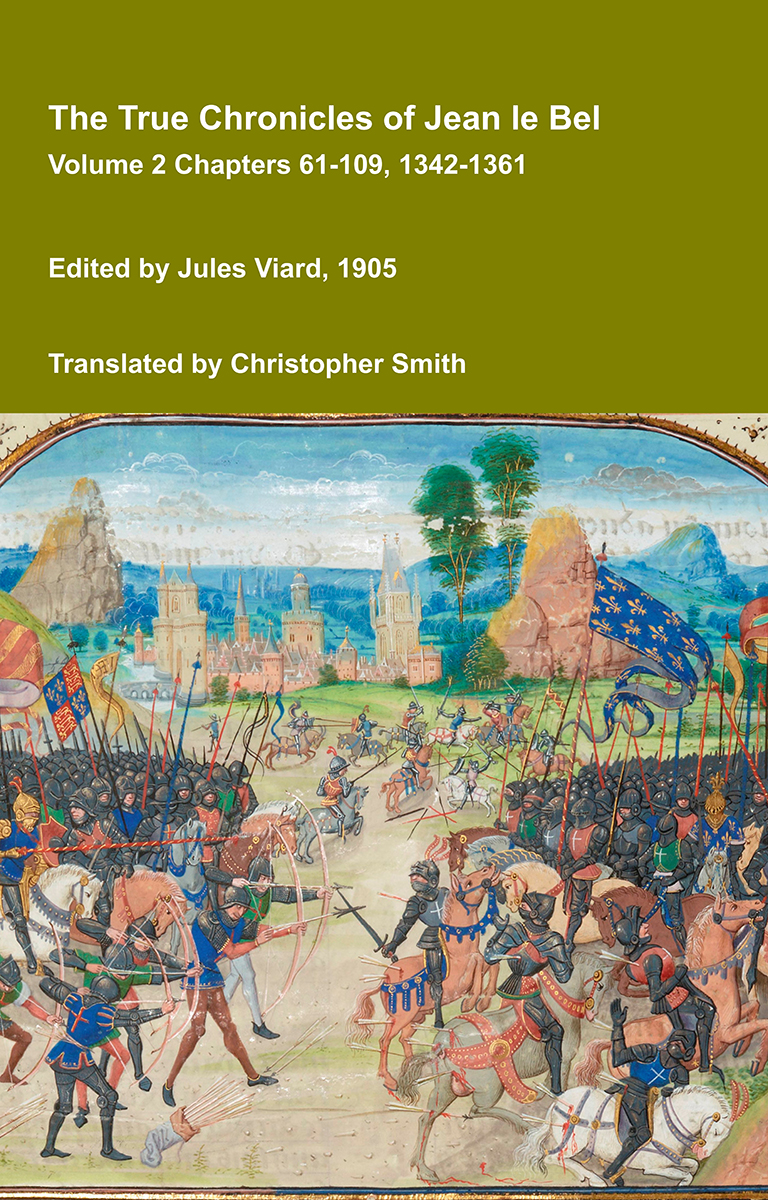
The Chronicle of Jean le Bel, Volume 2 continues one of the most important fourteenth-century accounts of the early Hundred Years’ War. Written by the Liège chronicler Jean le Bel, this vivid narrative follows the fortunes of Edward III, Jean II of France, the Black Prince, the great nobles of France and England, and the soldiers, captains and companies who shaped the conflict. This volume covers some of the most dramatic events of the period, including the battles of Crécy and Poitiers, the siege and capture of Calais, the captivity of King John, the rise of the Jacquerie, the turmoil in Paris under Étienne Marcel and Charles of Navarre, the devastation caused by the free companies, Edward III’s great campaign of 1359–1360, and the negotiations leading to the Treaty of Brétigny. Jean le Bel’s chronicle is especially valuable for its lively detail, its interest in chivalry, warfare, politics and reputation, and its influence on later chroniclers, most famously Froissart. This English translation presents the text in clear, readable British English while preserving the force and character of the original narrative. The translation includes extensive notes to help the reader better understand Jean le Bel's text. Volume 2 also includes translated appendices drawn from royal and administrative records, many from the English Record Office, which illuminate Edward III’s campaigns in Brittany, the siege and occupation of Calais, naval preparations, military finance, appointments, safe conducts and related affairs.
Available at Amazon in eBook and Paperback format.
See Painters.
Around October 1518 Tintoretto was born.
On 31st May 1594 Tintoretto [aged 75] died.
John Evelyn's Diary. 1st August 1652. Came old Jerome Lennier, of Greenwich, a man skilled in painting and music, and another rare musician, called Mell. I went to see his collection of pictures, especially those of Julio Romano, which surely had been the King's [aged 22], and an Egyptian figure, etc. There were also excellent things of Polydore, Guido, Raphael, and Tintoretto. Lennier had been a domestic of Queen Elizabeth, and showed me her head, an intaglio in a rare sardonyx, cut by a famous Italian, which he assured me was exceedingly like her.
John Evelyn's Diary. 18th January 1671. This day I first acquainted his Majesty [aged 40] with that incomparable young man, Gibbon [aged 22], whom I had lately met with in an obscure place by mere accident, as I was walking near a poor solitary thatched house, in a field in our parish, near Sayes Court, Deptford [Map]. I found him shut in; but looking in at the window, I perceived him carving that large cartoon, or crucifix, of Tintoretto, a copy of which I had myself brought from Venice, where the original painting remains. I asked if I might enter; he opened the door civilly to me, and I saw him about such a work as for the curiosity of handling, drawing, and studious exactness, I never had before seen in all my travels. I questioned him why he worked in such an obscure and lonesome place; he told me it was that he might apply himself to his profession without interruption, and wondered not a little how I found him out. I asked if he was unwilling to be made known to some great man, for that I believed it might turn to his profit; he answered, he was yet but a beginner, but would not be sorry to sell off that piece; on demanding the price, he said £100. In good earnest, the very frame was worth the money, there being nothing in nature so tender and delicate as the flowers and festoons about it, and yet the work was very strong; in the piece was more than one hundred figures of men, etc. I found he was likewise musical, and very civil, sober, and discreet in his discourse. There was only an old woman in the house. So, desiring leave to visit him sometimes, I went away.