

 John Evelyn's Diary March 1699
 John Evelyn's Diary May 1699
 Greenwich Hospital
 John Evelyn's Diary June 1699
 Rotherhithe
 Rome, Italy
 St James' Park
 John Evelyn's Diary August 1699
 Deptford, Kent
 John Evelyn's Diary September 1699
 Wotton, Surrey
 Guildford, Surrey
John Evelyn's Diary 1699 is in John Evelyn's Diary 1690s.
1st January 1699. My cousin Pierrepoint died. She was daughter to Sir John Evelyn, of Wilts, my father's nephew; she was widow to William Pierrepoint, brother to the Marquis of Dorchester, and mother to Evelyn Pierrepoint, Earl of Kingston [aged 44]; a most excellent and prudent lady.


1st January 1699. The House of Commons persist in refusing more than 7,000 men to be a standing army, and no strangers to be in the number. This displeased the Court party. Our county member, Sir R. Onslow [aged 44], opposed it also; which might reconcile him to the people, who began to suspect him.
17th February 1699. My grandson [aged 16] went to Oxford with Dr. Mander, the Master of Baliol College, where he was entered a fellow-commoner.
19th February 1699. A most furious wind, such as has not happened for many years, doing great damage to houses and trees, by the fall of which several persons were killed.
5th March 1699. The old East India Company lost their business against the new Company, by ten votes in Parliament, so many of their friends being absent, going to see a tiger baited by dogs.
5th March 1699. The persecuted Vaudois, who were banished out of Savoy, were received by the German Protestant Princes.
24th March 1699. My only remaining son died after a tedious languishing sickness, contracted in Ireland, and increased here, to my exceeding grief and affliction; leaving me one grandson [aged 17], now at Oxford, whom I pray God to prosper and be the support of the Wotton family. He was aged forty-four years and about three months. He had been six years one of the Commissioners of the Revenue in Ireland, with great ability and reputation.
26th March 1699. After an extraordinary storm, there came up the Thames a whale which was fifty-six feet long. Such, and a larger of the spout kind, was killed there forty years ago (June 1658). That year died Cromwell.
30th March 1699. My deceased son was buried in the vault at Wotton, according to his desire.
30th March 1699. The Duke of Devon [aged 59] lost £1,900 at a horse race at Newmarket, Suffolk.


30th March 1699. The King [aged 48] preferring his young favorite Earl of Albemarle [aged 29] to be first Commander of his Guard, the Duke of Ormond [aged 33] laid down his commission. This of the Dutch Lord passing over his head, was exceedingly resented by everybody.


1st April 1699. Lord Spencer [aged 23] purchased an incomparable library of ... wherein, among other rare books, were several that were printed at the first invention of that wonderful art, as particularly "Tully's Offices, etc". There was a Homer and a Suidas in a very good Greek character and good paper, almost as ancient. This gentleman is a very fine scholar, whom from a child I have known. His tutor was one Florival of Geneva.
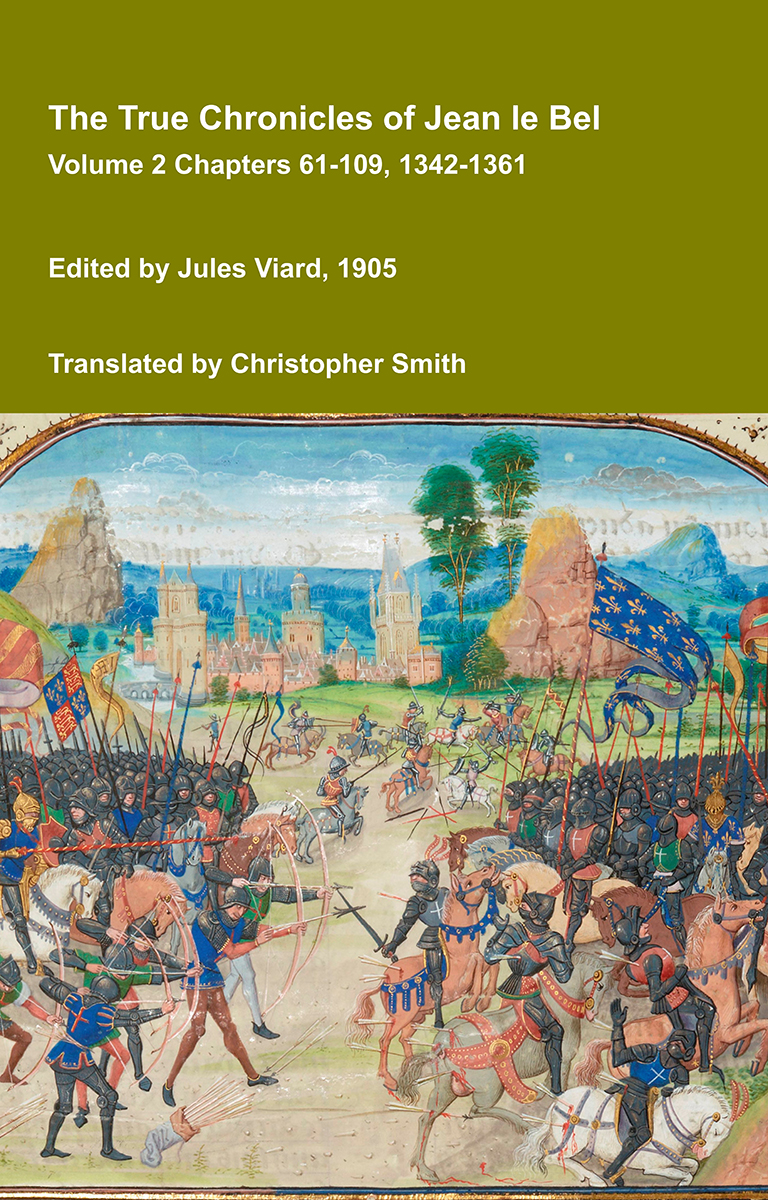
The True Chronicles of Jean le Bel Volume 2 Chapters 61-109 1342-1361
The Chronicle of Jean le Bel, Volume 2 continues one of the most important fourteenth-century accounts of the early Hundred Years’ War. Written by the Liège chronicler Jean le Bel, this vivid narrative follows the fortunes of Edward III, Jean II of France, the Black Prince, the great nobles of France and England, and the soldiers, captains and companies who shaped the conflict. This volume covers some of the most dramatic events of the period, including the battles of Crécy and Poitiers, the siege and capture of Calais, the captivity of King John, the rise of the Jacquerie, the turmoil in Paris under Étienne Marcel and Charles of Navarre, the devastation caused by the free companies, Edward III’s great campaign of 1359–1360, and the negotiations leading to the Treaty of Brétigny. Jean le Bel’s chronicle is especially valuable for its lively detail, its interest in chivalry, warfare, politics and reputation, and its influence on later chroniclers, most famously Froissart. This English translation presents the text in clear, readable British English while preserving the force and character of the original narrative. The translation includes extensive notes to help the reader better understand Jean le Bel's text. Volume 2 also includes translated appendices drawn from royal and administrative records, many from the English Record Office, which illuminate Edward III’s campaigns in Brittany, the siege and occupation of Calais, naval preparations, military finance, appointments, safe conducts and related affairs.
Available at Amazon in eBook and Paperback format.
29th April 1699. I dined with the Archbishop [aged 62]; but my business was to get him to persuade the King [aged 48] to purchase the late Bishop of Worcester's [deceased] library, and build a place for his own library at St. James's, in the Park, the present one being too small.


3rd May 1699. At a meeting of the Royal Society I was nominated to be of the committee to wait on the Lord Chancellor [aged 44] to move the King [aged 48] to purchase the Bishop of Worcester's library (Dr. Edward Stillingfleet).
4th May 1699. The Court party have little influence in this Session.
7th May 1699. The Duke of Ormond [aged 34] restored to his commission. All Lotteries, till now cheating the people, to be no longer permitted than to Christmas, except that for the benefit of Greenwich Hospital [Map]. Mr. Bridgman, chairman of the committee for that charitable work, died; a great loss to it. He was Clerk of the Council, a very industrious, useful man. I saw the library of Dr. John Moore, Bishop of Norwich, one of the best and most ample collection of all sorts of good books in England, and he, one of the most learned men.

11th June 1699. After a long drought, we had a refreshing shower. The day before, there was a dreadful fire at Rotherhithe [Map], near the Thames side, which burned divers ships, and consumed nearly three hundred houses. Now died the famous Duchess of Mazarin [aged 53]; she had been the richest lady in Europe. She was niece of Cardinal Mazarin, and was married to the richest subject in Europe [aged 67], as is said. She was born at Rome, Italy [Map], educated in France, and was an extraordinary beauty and wit but dissolute and impatient of matrimonial restraint, so as to be abandoned by her husband, and banished, when she came into England for shelter, lived on a pension given her here, and is reported to have hastened her death by intemperate drinking strong spirits. She has written her own story and adventures, and so has her other extravagant sister [aged 59], wife to the noble family of Colonna.
15th June 1699. This week died Conyers Seymour [aged 24], son of Sir Edward Seymour [aged 66], killed in a duel caused by a slight affront in St James' Park [Map], given him by one who was envious of his gallantries; for he was a vain, foppish young man, who made a great éclât about town by his splendid equipage and boundless expense. He was about twenty-three years old; his brother [aged 20], now at Oxford, inherited an estate of £7,000 a year, which had fallen to him not two years before.
19th June 1699. My cousin, George Evelyn, of Nutfield [deceased], died suddenly.
25th June 1699. The heat has been so great, almost all this month, that I do not remember to have felt much greater in Italy, and this after a winter the wettest, though not the coldest, that I remember for fifty years last past.
28th June 1699. Finding my occasions called me so often to London, I took the remainder of the lease my son had in a house in Dover Street, to which I now removed, not taking my goods from Wotton.
23rd July 1699. Seasonable showers, after a continuance of excessive drought and heat.
1st August 1699. I drank the Shooters' Hill waters. At Deptford, Kent [Map], they had been building a pretty new church. The Bishop of St. David's [aged 62] [Watson] deprived for simony. The city of Moscow burnt by the throwing of squibs.
3rd September 1699. There was in this week an eclipse of the sun, at which many were frightened by the predictions of the astrologers. I remember fifty years ago that many were so terrified by Lilly, that they dared not go out of their houses. A strange earthquake at New Batavia, in the East Indies.


Jean de Waurin's Chronicle of England Volume 6 Books 3-6: The Wars of the Roses
Jean de Waurin was a French Chronicler, from the Artois region, who was born around 1400, and died around 1474. Waurin’s Chronicle of England, Volume 6, covering the period 1450 to 1471, from which we have selected and translated Chapters relating to the Wars of the Roses, provides a vivid, original, contemporary description of key events some of which he witnessed first-hand, some of which he was told by the key people involved with whom Waurin had a personal relationship.
Available at Amazon in eBook and Paperback format.
4th September 1699. My worthy brother [aged 82] died at Wotton, Surrey [Map], in the 83d year of his age, of perfect memory and understanding. He was religious, sober, and temperate, and of so hospitable a nature, that no family in the county maintained that ancient custom of keeping, as it were, open house the whole year in the same manner, or gave more noble or free entertainment to the county on all occasions, so that his house was never free. There were sometimes twenty persons more than his family, and some that stayed there all the summer, to his no small expense; by this he gained the universal love of the county. He was born at Wotton, Surrey [Map], went from the free school at Guildford, Surrey [Map] to Trinity College, Oxford University, Oxford, thence to the Middle Temple, as gentlemen of the best quality did, but without intention to study the law as a profession. He married the daughter of Colwall, of a worthy and ancient family in Leicestershire, by whom he had one son; she dying in 1643, left George her son an infant, who being educated liberally, after traveling abroad, returned and married one Mrs. Gore, by whom he had several children, but only three daughters survived. He was a young man of good understanding, but, over-indulging his ease and pleasure, grew so very corpulent, contrary to the constitution of the rest of his father's relations, that he died. My brother afterward married a noble and honorable lady, relict of Sir John Cotton, she being an Offley, a worthy and ancient Staffordshire family, by whom he had several children of both sexes. This lady died, leaving only two daughters and a son. The younger daughter died before marriage; the other afterward married Sir Cyril Wych [aged 67], a noble and learned gentleman (son of Sir -- Wych), who had been Ambassador at Constantinople, and was afterward made one of the Lords Justices of Ireland. Before this marriage, her only brother married the daughter of Eversfield, of Sussex, of an honorable family, but left a widow without any child living; he died about 1691, and his wife not many years after, and my brother resettled the whole estate on me. His sister, Wych, had a portion of £6,000, to which was added £300 more; the three other daughters, with what I added, had about £5,000 each. My brother died on the 5th of October, in a good old age and great reputation, making his beloved daughter, Lady Wych, sole executrix, leaving me only his library and some pictures of my father, mother, etc. She buried him with extraordinary solemnity, rather as a nobleman than as a private gentleman. There were, as I computed, above 2,000 persons at the funeral, all the gentlemen of the county doing him the last honors. I returned to London, till my lady should dispose of herself and family.
1st October 1699. After an unusual warm and pleasant season, we were surprised with a very sharp frost. I presented my "Acetaria", dedicated to my Lord Chancellor [aged 45], who returned me thanks in an extraordinarily civil letter.
15th November 1699. There happened this week so thick a mist and fog, that people lost their way in the streets, it being so intense that no light of candles, or torches, yielded any (or but very little) direction. I was in it, and in danger. Robberies were committed between the very lights which were fixed between London and Kensington on both sides, and while coaches and travelers were passing. It began about four in the afternoon, and was quite gone by eight, without any wind to disperse it. At the Thames, they beat drums to direct the watermen to make the shore.

19th November 1699. At our chapel in the evening there was a sermon preached by young Mr. Horneck, chaplain to Lord Guilford [aged 25], whose lady's funeral had been celebrated magnificently the Thursday before. A panegyric was now pronounced, describing the extraordinary piety and excellently employed life of this amiable young lady. She died in childbed a few days before, to the excessive sorrow of her husband, who ordered the preacher to declare that it was on her exemplary life, exhortations and persuasion, that he totally changed the course of his life, which was before in great danger of being perverted; following the mode of this dissolute age. Her devotion, early piety, charity, fastings, economy, disposition of her time in reading, praying, recollections in her own handwriting of what she heard and read, and her conversation were most exemplary.
24th November 1699. I signed Dr. Blackwell's election to be the next year's Boyles Lecturer.
24th November 1699. Such horrible robberies and murders were committed, as had not been known in this nation; atheism, profaneness, blasphemy, among all sorts, portended some judgment if not amended; on which a society was set on foot, who obliged themselves to endeavor the reforming of it, in London and other places, and began to punish offenders and put the laws in more strict execution; which God Almighty prosper! A gentle, calm, dry, temperate weather all this season of the year, but now came sharp, hard frost, and mist, but calm.
3rd December 1699. Calm, bright, and warm as in the middle of April. So continued on 21st of January. A great earthquake in Portugal.
3rd December 1699. The Parliament reverses the prodigious donations of the Irish forfeitures, which were intended to be set apart for discharging the vast national debt. They called some great persons in the highest offices in question for setting the Great Seal to the pardon of an arch-pirate [Note. Captain Kidd], who had turned pirate again, and brought prizes into the West Indies, suspected to be connived at on sharing the prey; but the prevailing part in the House called Courtiers, out-voted the complaints, not by being more in number, but by the country party being negligent in attendance.