

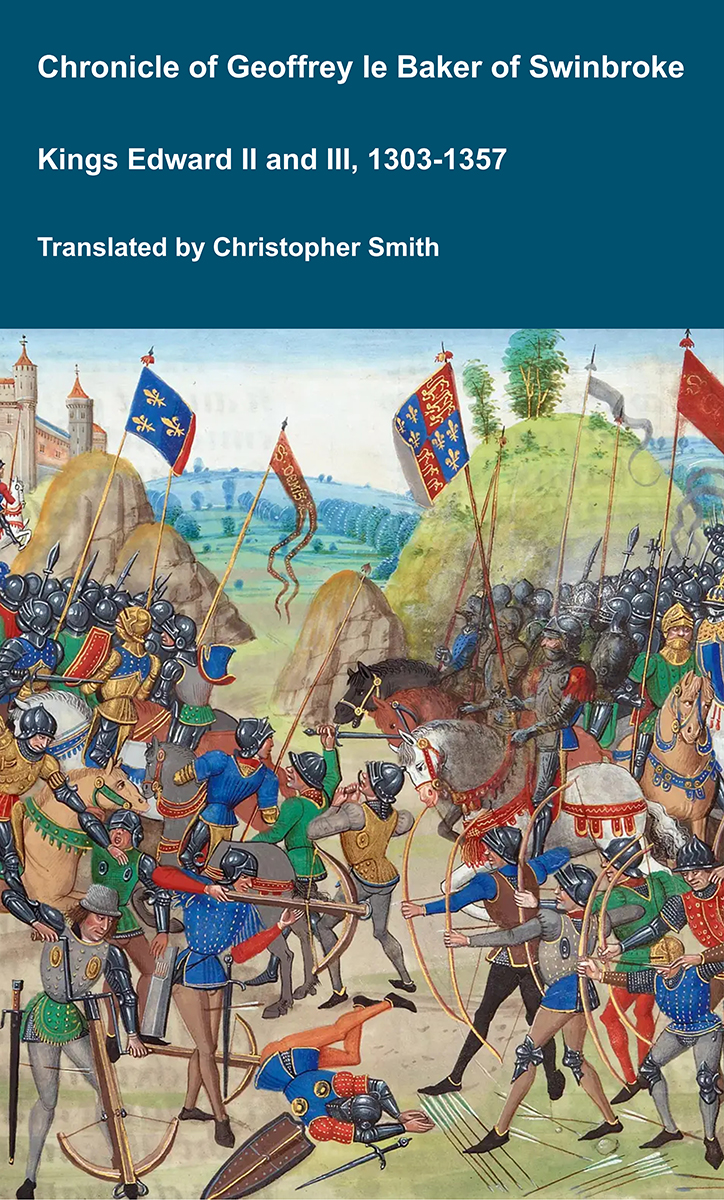
Chronicle of Geoffrey le Baker of Swinbroke
Baker was a secular clerk from Swinbroke, now Swinbrook, an Oxfordshire village two miles east of Burford. His Chronicle describes the events of the period 1303-1356: Gaveston, Bannockburn, Boroughbridge, the murder of King Edward II, the Scottish Wars, Sluys, Crécy, the Black Death, Winchelsea and Poitiers. To quote Herbert Bruce 'it possesses a vigorous and characteristic style, and its value for particular events between 1303 and 1356 has been recognised by its editor and by subsequent writers'. The book provides remarkable detail about the events it describes. Baker's text has been augmented with hundreds of notes, including extracts from other contemporary chronicles, such as the Annales Londonienses, Annales Paulini, Murimuth, Lanercost, Avesbury, Guisborough and Froissart to enrich the reader's understanding. The translation takes as its source the 'Chronicon Galfridi le Baker de Swynebroke' published in 1889, edited by Edward Maunde Thompson.
Available at Amazon in eBook and Paperback format.
Paternal Family Tree: Waller
Letters of Horace Walpole. 7th August 1572. This morning we have been to Penshurst [Map] - but, oh! how fallen!341 The park seems to have never answered its character: at present it is forlorn; and instead of Sacharissa's342 cipher carved on the beeches, I should sooner have expected to have found the milkwoman's score. Over the gate is an inscription, purporting the manor to have been a boon from Edward VI to Sir William Sydney. The apartments are the grandest I have seen in any of these old palaces, but furnished in tawdry modern taste. There are loads of portraits; but most of them seem christened by chance, like children at a foundling hospital. There is a portrait of Languet343, the friend of Sir Philip Sydney [aged 17]; and divers of himself and all his great kindred; particularly his sister-in-law, with a vast lute, and Sacharissa, charmingly handsome, But there are really four very great curiosities, I believe as old portraits as any extant in England: they are, Fitzallen, Archbishop of Canterbury, Humphry Stafford, the first Duke of Buckingham; T. Wentworth, and John Foxle; all four with the dates of their commissions as constables of Queenborough Castle, from whence I suppose they were brought. The last is actually receiving his investiture from Edward the Third, and Wentworth is in the dress of Richard the Third's time. They are really not very ill done.344 There are six more, only heads; and we have found since we came home that Penshurst belonged for a time to that Duke of Buckingham. There are some good tombs in the church, and a very Vandal one. called Sir Stephen of Penchester. When we had seen Penshurst, we borrowed saddles, and, bestriding the horses of our postchaise, set out for Hever [Map]345, to visit a tomb of Sir Thomas Bullen, Earl of Wiltshire, partly with a view to talk of it in Anna Bullen's walk at Strawberry Hill. But the measure of our woes was not full, we could not find our way and were forced to return; and again lost ourselves in coming from Penshurst, having been directed to what they call a better road than the execrable one we had gone.
Note 341. Evelyn, who visited Penshurst exactly a century before Walpole, gives the Following brief notice of the place:-"July 9, 1652. We went to see Penshurst, the Earl of Leicester's, famous once for its gardens and excellent fruit, and for the noble conversation which Was wont to meet there, celebrated by that illustrious person Sir Philip Sidney, who there composed divers of his pieces. It stands in a park, is finely watered, and was now full of company, on the marriage of my old fellow-collegiate, Mr. Robert Smith, who marries Lady Dorothy Sidney, widow of the Earl of Sunderland."-E.
Note 342. Lady Dorothy Sidney, daughter of Philip, Earl of Leicester [Note. Mistake? She was sister of Philip Earl of Leicester]; of whom Waller was the unsuccessful suitor, and to whom he addressed those elegant effusions of poetical gallantry, in which she is celebrated under the name of Sacharissa. Walpole here alludes to the lines written at Penshurst-
"Go, boy, and carve this passion on the bark
Of yonder tree, which stands the sacred mark
Of noble Sydney's birth; when such benign,
Such more than mortal-making stars did shine,
That there they cannot but for ever prove
The monument and pledge of humble love;
His humble love, whose hope shall ne'er rise higher,
Than for a pardon that he dares admire."-E.
Note 343. Hubert Tanguet, who quitted the service of the Elector of Saxony on account of his religion, and attached himself to the Prince of Orange. He died in 1581.-E.
Note 344. In Harris's History of Kent, he gives from Philpot a list of the constables of Queenborough Castle, p. 376; the last but one of whom, Sir Edward Hobby, is said to have collected all their portraits, of which number most probably were these ten.
Note 345. Hever Castle was built in the reign of Edward III, by William de Hevre, and subsequently became the property of the Boleyn family. In this castle Henry VIII passed the time of his courtship to the unfortunate Anne Boleyn; whose father, Sir Thomas Boleyn, was Created Earl of wiltshire and Ormond, 1529 and 1538.-E.


On 3rd March 1606 Edmund Waller was born to Robert Waller [aged 46] at Stocks Place, Coleshill.
On 26th August 1616 [his father] Robert Waller [aged 56] died.
In 1628 Edmund Waller [aged 21] was elected MP Amersham.
On 5th July 1631 Edmund Waller [aged 25] and Anne Banks were married in defiance of orders of the Privy Council of England and the Court of Aldermen of the City of London whose ward she was. Her father had left her £8000 when he died a year earlier. The Aldermen made a complaint to the Star Chamber, seeking that for the offence of marrying Anne without the court's permission the whole of the Banks fortune should be forfeited to the City of London, but they were denied such an outcome by a pardon from King Charles [aged 30], who took a more tolerant view of the matter. Waller was then summoned to appear before the Court of Aldermen in December 1631, when he agreed to make a jointure of £1,000 a year to his wife, also giving her the power to spend £2,000 of her inheritance, and the Court accepted this proposal but fined him 500 marks.


Around 1634 Edmund Waller [aged 27] was elected into the Great Tew Circle of Lucius Carey 2nd Viscount Falkland [aged 24].


On or before 23rd October 1634 [his wife] Anne Banks died in childbirth. She was buried on 23rd October 1634.
On or before 23rd October 1634 [his daughter] Elizabeth aka Anne Waller was born to Edmund Waller [aged 28] and [his wife] Anne Banks. Her mother died in childbirth. She married before 23rd October 1653 William Dormer "The Splendid".
In 1635 Edmund Waller [aged 28] met Dorothy Sidney Countess Sunderland [aged 17], then eighteen years of age, and formed a romantic passion for her, referring to her in a number of his poems under the name of 'Sacharissa'.
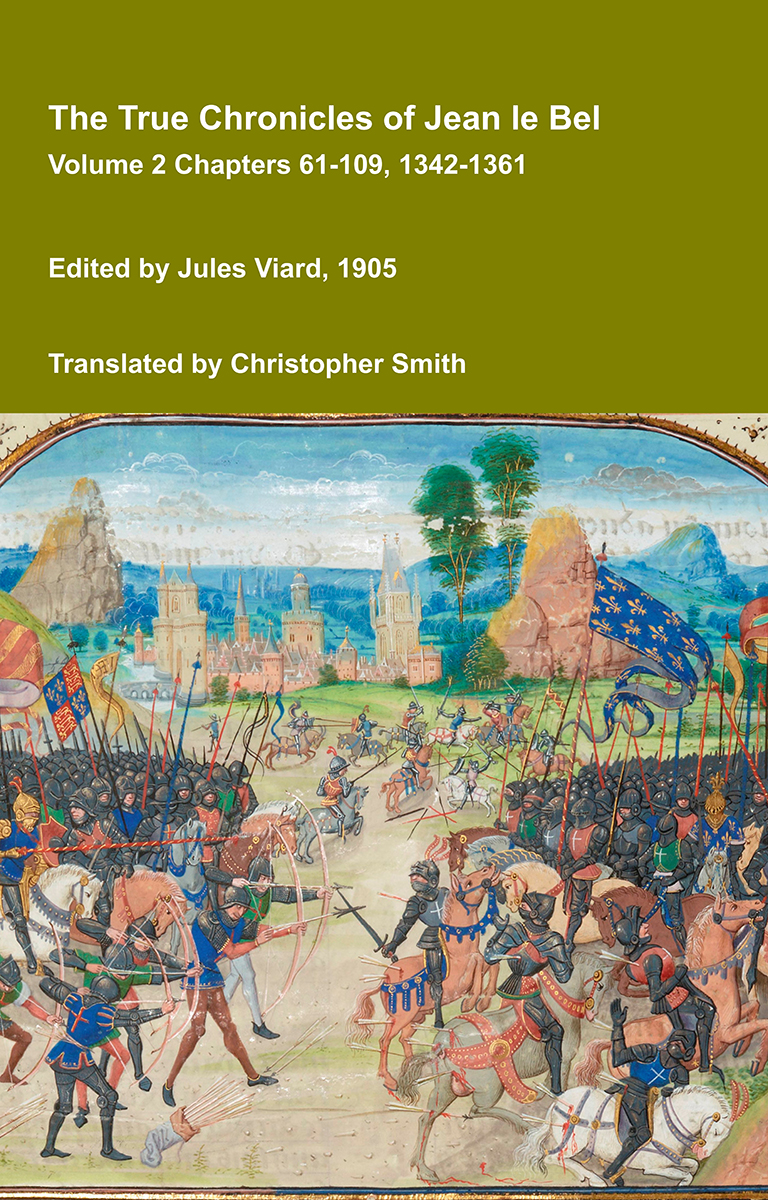
The True Chronicles of Jean le Bel Volume 2 Chapters 61-109 1342-1361
The Chronicle of Jean le Bel, Volume 2 continues one of the most important fourteenth-century accounts of the early Hundred Years’ War. Written by the Liège chronicler Jean le Bel, this vivid narrative follows the fortunes of Edward III, Jean II of France, the Black Prince, the great nobles of France and England, and the soldiers, captains and companies who shaped the conflict. This volume covers some of the most dramatic events of the period, including the battles of Crécy and Poitiers, the siege and capture of Calais, the captivity of King John, the rise of the Jacquerie, the turmoil in Paris under Étienne Marcel and Charles of Navarre, the devastation caused by the free companies, Edward III’s great campaign of 1359–1360, and the negotiations leading to the Treaty of Brétigny. Jean le Bel’s chronicle is especially valuable for its lively detail, its interest in chivalry, warfare, politics and reputation, and its influence on later chroniclers, most famously Froissart. This English translation presents the text in clear, readable British English while preserving the force and character of the original narrative. The translation includes extensive notes to help the reader better understand Jean le Bel's text. Volume 2 also includes translated appendices drawn from royal and administrative records, many from the English Record Office, which illuminate Edward III’s campaigns in Brittany, the siege and occupation of Calais, naval preparations, military finance, appointments, safe conducts and related affairs.
Available at Amazon in eBook and Paperback format.
On 20th July 1639, some sources say 11th July 1639, Henry Spencer 1st Earl of Sunderland [aged 18] and Dorothy Sidney Countess Sunderland [aged 21] were married at Penhurst Rother. She by marriage Baroness Spencer Wormleighton. Her long-term suitor, she was the 'Sacharissa' of his poems, Edmund Waller [aged 33] wrote a letter to the bride's sister [aged 12] on the occasion of the wedding. She the daughter of Robert Sidney 2nd Earl of Leicester [aged 43] and Dorothy Percy Countess Leicester [aged 41]. They were third cousins.
Madam,
In this common joy at Penshurst, I know none to whom complaints may come less unseasonably than to your ladyship, the loss of a bedfellow being almost equal to that of a mistress; and therefore you ought at least to pardon, if you consent not to the imprecations of, the deserted, which just Heaven no doubt will hear. May my lady Dorothy, if we may yet call her so, suffer as much, and have the like passion for this young lord, whom she has preferred to the rest of mankind, as others have had for her; and may his love, before the year go about, make her taste of the first curse imposed upon womankind, the pains of becoming a mother. May her first born be none of her own sex, nor so like her but that he may resemble her lord as much as herself. May she that always affected silence and retirement have the house filled with the noise and number of her children, and hereafter of her grandchildren; and then may she arrive at that great curse, so much declined by fair ladies, old age; may she live to be very old and yet seem young; be told so by her glass, and have no aches to inform her of the truth; and when she shall appear to be mortal, may her lord not mourn for her, but go hand in hand with her to that place where we are told there is neither marrying nor giving in marriage, that being there divorced we may all have an equal interest in her again! My revenge being immortal, I wish all this may befall her posterity to the world's end and afterwards! To you, madam, I wish all good things, and that this loss may in good time be happily supplied with a more constant bedfellow of the other sex. Madam, I humbly kiss your hands, and beg pardon for this trouble, from
Your ladyship's
most humble servant,
E. Waller.
In April 1640 Edmund Waller [aged 34] was elected MP Amersham in the Short Parliament.
In November 1640 Edmund Waller [aged 34] was elected MP Ives in the Long Parliament.
In 1644 Edmund Waller [aged 37] and Mary Bracey were married.
John Evelyn's Diary. 23rd March 1646. In company, then, with Mr. Waller [aged 40], one Captain Wray [aged 21] (son of Sir Christopher [deceased], whose father had been in arms against his Majesty, and therefore by no means welcome to us), with Mr. Abdy, a modest and learned man, we got that night to Vicenza, passing by the Euganéan hills, celebrated for the prospects and furniture of rare simples, which we found growing about them. The ways were something deep, the whole country flat and even as a bowling-green. The common fields lie square, and are orderly planted with fruit trees, which the vines run and embrace, for many miles, with delicious streams creeping along the ranges.
John Evelyn's Diary. 5th July 1646. The next day we arrived at Orléans, taking our turns to row, of which I reckon my share came to little less than twenty leagues. Sometimes, we footed it through pleasant fields and meadows; sometimes, we shot at fowls, and other birds; nothing came amiss: sometimes, we played at cards, while others sung, or were composing verses; for we had the great poet, Mr. Waller [aged 40], in our company, and some other ingenious persons.
John Evelyn's Diary. 4th October 1647. I sealed and declared my will, and that morning went from Paris, taking my journey through Rouen, Dieppe, Ville-dieu, and St. Vallerie, where I stayed one day with Mr. Waller [aged 41], with whom I had some affairs, and for which cause I took this circle to Calais, where I arrived on the 11th, and that night embarking in a packet boat, was by one o'clock got safe to Dover, Kent [Map]; for which I heartily put up my thanks to God who had conducted me safe to my own country, and been merciful to me through so many aberrations. Hence, taking post, I arrived at London the next day at evening, being the 2d of October, new style.
John Evelyn's Diary. 19th November 1649. Visited Mr. Waller [aged 43], where meeting Dr. Holden, an English Sorbonne divine, we fell into some discourse about religion.
John Evelyn's Diary. 28th December 1649. Going to wait on Mr. Waller [aged 43], I viewed St. Stephen's church; the building, though Gothic, is full of carving; within it is beautiful, especially the choir and winding stairs. The glass is well painted, and the tapestry hung up this day about the choir, representing the conversion of Constantine, was exceedingly rich.
John Evelyn's Diary. 29th August 1651. Was kept as a solemn fast for the calamities of our poor Church, now trampled on by the rebels. Mr. Waller [aged 45], being at St. Germains, desired me to send him a coach from Paris, to bring my wife's [aged 16] goddaughter to Paris, to be buried by the Common Prayer.
John Evelyn's Diary. 6th September 1651. I went with my wife [aged 16] to St. Germains, to condole with Mr. Waller's [aged 45] loss. I carried with me and treated at dinner that excellent and pious person the Dean of St. Paul's, Dr. Stewart, and Sir Lewis Dives [aged 52] (half-brother to the Earl of Bristol [aged 38]) [Note. Beatrice Walcott was mother to Lewis Dyve and George Digby 2nd Earl Bristol by her first and second husbands respectively. At the time of writing, 1651, the Earl of Bristol was John Digby 1st Earl Bristol [aged 71]; a case of Evelyn writing hi sdiary retrospectively], who entertained us with his wonderful escape out of prison in Whitehall [Map], the very evening before he was to have been put to death, leaping down out of a jakes two stories high into the Thames at high water, in the coldest of winter, and at night; so as by swimming he got to a boat that attended for him, though he was guarded by six musketeers. After this, he went about in women's habit, and then in a small-coal-man's, traveling 200 miles on foot, embarked for Scotland with some men he had raised, who coming on shore were all surprised and imprisoned on the Marquis of Montrose's score; he not knowing anything of their barbarous murder of that hero. This he told us was his fifth escape, and none less miraculous; with this note, that the charging through 1,000 men armed, or whatever danger could befall a man, he believed could not more confound and distract a man's thoughts than the execution of a premeditated escape, the passions of hope and fear being so strong. This knight was indeed a valiant gentleman; but not a little given to romance, when he spoke of himself. I returned to Paris the same evening.


John Evelyn's Diary. 13th January 1652. I took leave of Mr. Waller [aged 45], who, having been proscribed by the rebels, had obtained of them permission to return, was going to England.
The Deeds of the Dukes of Normandy
The Gesta Normannorum Ducum [The Deeds of the Dukes of Normandy] is a landmark medieval chronicle tracing the rise and fall of the Norman dynasty from its early roots through the pivotal events surrounding the Norman Conquest of England. Originally penned in Latin by the monk William of Jumièges shortly before 1060 and later expanded at the behest of William the Conqueror, the work chronicles the deeds, politics, battles, and leadership of the Norman dukes, especially William’s own claim to the English throne. The narrative combines earlier historical sources with firsthand information and oral testimony to present an authoritative account of Normandy’s transformation from a Viking settlement into one of medieval Europe’s most powerful realms. William’s history emphasizes the legitimacy, military prowess, and governance of the Norman line, framing their expansion, including the conquest of England, as both divinely sanctioned and noble in purpose. Later chroniclers such as Orderic Vitalis and Robert of Torigni continued the history, extending the coverage into the 12th century, providing broader context on ducal rule and its impact. Today this classic work remains a foundational source for understanding Norman identity, medieval statesmanship, and the historical forces that reshaped England and Western Europe between 800AD and 1100AD.
Available at Amazon in eBook and Paperback format.
Before 23rd October 1653 [his son-in-law] William Dormer "The Splendid" and [his daughter] Elizabeth aka Anne Waller [aged 18] were married.
On 23rd October 1653 [his daughter] Elizabeth aka Anne Waller [aged 19] died.
In 1654 [his son] Stephen Waller of Beaconsfield was born to Edmund Waller [aged 47] and [his wife] Mary Bracey. He married before 1699 Judith Vernon and had issue.
Samuel Pepys' Diary. 22nd March 1665. (4) I saw Waller [aged 59] the poet, whom I never saw before.
Samuel Pepys' Diary. 19th November 1667. Thence with W. Hewer [aged 25] and our messenger, Marlow, home by coach, and so late at letters, and then home to supper, and my wife to read and then to bed. This night I wrote to my father, in answer to a new match which is proposed (the executor of Ensum, my sister's former servant) for my sister [aged 26], that I will continue my mind of giving her £500, if he likes of the match. My father did also this week, by Shepley, return me up a 'Guinny, which, it seems, upon searching the ground, they have found since I was there. I was told this day that Lory Hide [aged 25]1, second son of my Chancellor [aged 58], did some time since in the House say, that if he thought his father was guilty but of one of the things then said against him, he would be the first that should call for judgement against him: which Mr. Waller [aged 61], the poet, did say was spoke like the old Roman, like Brutus, for its greatness and worthiness.
Note 1. Laurence Hyde, second son of Chancellor Clarendon (1614-1711). He held many important offices, and was First Lord of the Treasury, 1679-84; created Earl of Rochester in 1681, and K.G. 1685.


John Evelyn's Diary. 26th May 1671. The Earl of Bristol's [aged 58] house in Queen's Street was taken for the Commissioners of Trade and Plantations, and furnished with rich hangings of the King's [aged 40]. It consisted of seven rooms on a floor, with a long gallery, gardens, etc. This day we met the Duke of Buckingham [aged 43], Earl of Lauderdale [aged 55], Lord Culpeper, Sir George Carteret [aged 61], Vice-Chamberlain, and myself, had the oaths given us by the Earl of Sandwich [aged 45], our President. It was to advise and counsel his Majesty, to the best of our abilities, for the well-governing of his Foreign Plantations, etc., the form very little differing from that given to the Privy Council. We then took our places at the Board in the Council-Chamber, a very large room furnished with atlases, maps, charts, globes, etc. Then came the Lord Keeper, Sir Orlando Bridgeman [aged 65], Earl of Arlington [aged 53], Secretary of State, Lord Ashley, Mr. Treasurer [aged 40], Sir John Trevor [aged 34], the other Secretary, Sir John Duncomb [aged 49], Lord Allington [aged 31], Mr. Grey, son to the Lord Grey, Mr. Henry Broncher, Sir Humphrey Winch [aged 49], Sir John Finch, Mr. Waller [aged 65], and Colonel Titus [aged 48], of the bedchamber, with Mr. Slingsby, Secretary to the Council, and two Clerks of the Council, who had all been sworn some days before. Being all set, our Patent was read, and then the additional Patent, in which was recited this new establishment; then, was delivered to each a copy of the Patent, and of instructions: after which, we proceeded to business.
In 1677 [his wife] Mary Bracey died.

Around 1687. John Riley [aged 41]. Portrait of Edmund Waller [aged 80].
On 21st October 1687 Edmund Waller [aged 81] died.
John Evelyn's Diary. Having packed up my purchases of books, pictures, casts, treacle, etc. (the making an extraordinary ceremony whereof I had been curious to observe, for it is extremely pompous and worth seeing), I departed from Venice, accompanied with Mr. Waller (the celebrated poet), now newly gotten out of England, after the Parliament had extremely worried him for attempting to put in execution the commission of Array, and for which the rest of his colleagues were hanged by the rebels.
Great x 4 Grandfather: Richard Waller
Great x 3 Grandfather: John Waller
Great x 2 Grandfather: William Waller of Groombridge
Great x 1 Grandfather: Robert Waller
GrandFather: Edmund Waller of Coleshill
Father: Robert Waller