

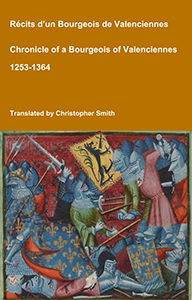
Chronicle of a Bourgeois of Valenciennes
Récits d’un bourgeois de Valenciennes aka The Chronicle of a Bourgeois of Valenciennes is a vivid 14th-century vernacular chronicle written by an anonymous urban chronicler from Valenciennes in the County of Hainaut. It survives in a manuscript that describes local and regional history from about 1253 to 1366, blending chronology, narrative episodes, and eyewitness-style accounts of political, military, and social events in medieval France, Flanders, and the Low Countries. The work begins with a chronological framework of events affecting Valenciennes and its region under rulers such as King Philip VI of France and the shifting allegiances of local nobility. It includes accounts of conflicts, sieges, diplomatic manoeuvres, and the impact of broader struggles like the Hundred Years’ War on urban life in Hainaut. Written from the perspective of a burgher (bourgeois) rather than a monastery or royal court, the chronicle offers a rare lay viewpoint on high politics and warfare, reflecting how merchants, townspeople, and civic institutions experienced the turbulence of the 13th and 14th centuries. Its narrative style combines straightforward reporting of events with moral and civic observations, making it a valuable source for readers interested in medieval urban society, regional politics, and the lived experience of war and governance in pre-modern Europe.
Available at Amazon in eBook and Paperback format.
In 1684 George Vertue was born to James Vertue [aged 24].

Vesta Monumenta. Plate 1.3: Engraving of the Baptismal Font at St. James's, Piccadilly.
Plate 1.3 of Vetusta Monumenta depicts a marble baptismal font at St. James's Church, Piccadilly, presumed to be carved by Grinling Gibbons [aged 69] in 1685. Engraving by George Vertue [aged 34] after Charles Woodfield. 457 x 283 mm. Published by the Society of Antiquaries of London in 1718. Current location: St. James's Church, Piccadilly, London, UK.

Minutes of the Society of Antiquaries. 12th February 1718. Mr Samuel Gale [aged 35] Treasurer is authorized to pay Mr Vertue [aged 34] two guineas toward engraving the font of St James church. It is proposed for the second time to engrave RII'd's picture and agreed.
Minutes of the Society of Antiquaries. 7th May 1718. Bought by the Society the Portrait of Edwrd the Third for a Guinea which Mr Treasurer [aged 35] is ordered to pay.
Mr Bostue had the Drawing of Richard II delivered to him by Mr Director [aged 40] in order for engraving, for which he is to be paid Twenty Guineas. Mr Director [?] gives the use of the Drawing to the Society.
In order to defray the expenses, it is found necessary to raise a voluntary Subscription of Seven Shillings and Six Pence aa [?] of as many [?], for which they [?] the equivalent in prints of the same when finished.
Mr Vertue [aged 34] gives the Copper Plate, he is to be paid five Guineas down, five guineas when half finished, and the rest uponm delivery.
In the margin: Pictures of Henry VII and Eliza: his wife
Bought by the Society of Dr Stukeley [aged 30], Secretary, an old picture of Elizabeth wife of Harry VII for £12 0s 6d which Mr Tresurer is order to pay.
Bought by the Society an old picture of Henry VII for £1 0s 4d which Mr Treasurer is ordered to pay to Mr Norroy [aged 57].
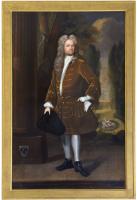
Vesta Monumenta. Plate 1.4: Engraving of a Portrait of Richard II in Westminster Abbey
Plate 1.4 of Vetusta Monumenta reproduces a portrait (c. 1395) of Richard II in Westminster Abbey, the earliest known portrait of an English monarch. The engraving preserves design elements lost when the painting was restored in 1866, but also gives a more idealized representation of the monarch's features than does the portrait itself. Engraving by George Vertue [aged 34] after Giuseppe Grisoni [aged 19]. 537 x 265 mm. Published by the Society of Antiquaries of London in 1718. Current location: Westminster Abbey, London, UK.
Giuseppe Grisoni: On or before 24th October 1699 he was born. He was baptised on 24th October 1699. In 1715 Giuseppe Grisoni travelled to London with John Talman and tried to establish himself as a portrait painter. He did not achieve enough success to stay, however, and returned to Florence in 1728. In 1769 he died.


Minutes of the Society of Antiquaries. 24th December 1718. Mr Vertue [aged 34] brought a proof of the Plate of Richard II which had the initial approbation of the Society and their thanks for his Care and Accuracy therein and Mr Treasurer [aged 36] was ordered to pay him five Guineas more in part of this Agreement for Engraving.
Mr Vice-President [aged 56] by the [?] of the Society ordered Mr Director [aged 41] to provide us a Box to lay up the Books in.
Mr Samuel Gale brough several Antique Roman Vessels dug up at Port Mahon, and likewise as Treasurer exhibited where it appears he has [?] in Money upon Amount £29:04:06 and has paid £22:4:4. So remains in his hands £07:00:02.

Minutes of the Society of Antiquaries. 28th January 1719. Ordered by the Society that Mr George Vertue [aged 35] Print off 100 Exemplar of the Font for a further Dividend to the Subscribers.

Minutes of the Society of Antiquaries. 4th March 1719. Ordered by the Society that the Treasurer pay Mr Vertue [aged 35] 2s [this may be Guineas?] in full for Engraving Ulphus's Horn.
Minutes of the Society of Antiquaries. 11th March 1719. It was proposed that [?] noblemen and persons of quality as please to be members of the Society may be admitted by Ballot.
Ordered the same day a dividend of one print more of Ulphus's Horn to every member.
Resolved that Mr Vertue [aged 35] goe to Kensington Pallace to view the pictures of Holbein, copied there by Remy, the originals being burned in Whitehall.
Resolved that in Mr Samuel Gale's [aged 36] dissertation upon Ulphus's Horn be revised by Mr President [aged 58], Mr Roger Gale [aged 46], Mr Mickleton and Mr Holmes [aged 57], or any three of them, and then printed.
NB. Ten members were present when the last resolution was made.


Around 1720 Thomas Gibson [aged 40]. Portrait of George Vertue [aged 36].

Vesta Monumenta. Plate 1.7: Engraving of Waltham Cross [Map]
Plate 1.7 of Vetusta Monumenta depicts the Waltham Cross, one of the twelve monuments that Edward I ordered to be built between 1291 and 1294 to commemorate the funeral procession of Queen Eleanor. The print documents the early preservation efforts of the Society of Antiquaries of London. The cross was re-engraved by James Basire Sr. after Jacob Schnebbelie for the third volume of Vetusta Monumenta (Plate 3.16), where it appears with two more of the Eleanor Crosses. Engraving by George Vertue [aged 37] after William Stukeley [aged 33]. 490 x 301 mm. Published by the Society of Antiquaries of London in 1721. Current location: Waltham Cross, Hertfordshire, UK.
Chronicle of Walter of Guisborough
A canon regular of the Augustinian Guisborough Priory, Yorkshire, formerly known as The Chronicle of Walter of Hemingburgh, describes the period from 1066 to 1346. Before 1274 the Chronicle is based on other works. Thereafter, the Chronicle is original, and a remarkable source for the events of the time. This book provides a translation of the Chronicle from that date. The Latin source for our translation is the 1849 work edited by Hans Claude Hamilton. Hamilton, in his preface, says: 'In the present work we behold perhaps one of the finest samples of our early chronicles, both as regards the value of the events recorded, and the correctness with which they are detailed; Nor will the pleasing style of composition be lightly passed over by those capable of seeing reflected from it the tokens of a vigorous and cultivated mind, and a favourable specimen of the learning and taste of the age in which it was framed.'
Available at Amazon in eBook and Paperback format.
Vesta Monumenta. Plates 1.9 - 1.12: Engravings of the Ruins of Fountains Abbey [Map]
Plates 1.9-1.12 of Vetusta Monumenta depict the ruins of the twelfth-century abbey church of Fountains, Yorkshire, with extant monastic structures. The images offer significant visual evidence of the site as it stood in 1722, recording subsequently lost fabric, including the late twelfth-century cloister arcades, the tracery of the main windows of the abbey, the presbytery arcades and high altar enclosure. Engravings by George Vertue [aged 39] after Samuel Buck. Published by the Society of Antiquaries of London in 1723. 190 x 367 mm, 189 x 364 mm, 192 x 370 mm, and 194 x 371 mm. Current location: Fountains, Ripon, North Yorkshire, UK.


Vesta Monumenta. 1724. Plate 1.15: Engraving of the Tomb of Robart Colles. Late fifteenth or early sixteenth-century chest tomb of Robart Colles in the Holy Innocents Church, Foulsham [Map]. Paneled sides around which runs the inscription "Robart Colles Cecili his vif." Engraving by George Vertue [aged 40] after Edmund Prideaux [aged 30]. 204 x 328 mm.


Vesta Monumenta. 1724. Plate 1.16. Engraving of the Shrine of Edward the Confessor at Westminster Abbey [Map]. Thirteenth-century shrine base and feretory canopy of St Edward at Westminster Abbey. Engraving by George Vertue [aged 40] after John Talman [aged 46]. 445 x 336 mm (bifolium).
Vesta Monumenta. 1724.Plates 1.13 and 1.14: Engravings of St. Benet's Abbey Gatehouse [Map] (1 of 2) by George Vertue [aged 40] after John Kirkpatrick and Edmund Prideaux [aged 30]. 205 x 389 mm and 206 x 318 mm. Published by the Society of Antiquaries of London in 1724.


Vesta Monumenta. 1725. Plate 1.17: Engravings of Whitehall and King Street Gates. The "Holbein Gate [Map]" (completed in 1532), and the King Street Gate (completed c. 1548). Engravings by George Vertue [aged 41] after his own drawings.


Vesta Monumenta. 1726. A nearly sixty-foot vellum roll that illustrates the jousting tournament held by Henry VIII on 12 and 13 February 1510/11, along with the "articles of the tilt". Engravings by George Vertue [aged 42] after the original manuscript.
A description of the Solemn Jousts held at Westminster the 13th day of February in the first year of King Henry VIII in honour of his Queen Katherin upon the birth of their eldest son Prince Henry AD 1510 taken from the original roll now in the College of Arms, London.


Vesta Monumenta. 1727. The ruins of Furness Abbey [Map] in Lancashire. Engraving by George Vertue [aged 43] after an untraced drawing originally commissioned by John Montagu, 2nd Duke of Montague [aged 37].


Vesta Monumenta. 1729. Copy of the Baron's Letter of 1301, including trickings of the Barons' seals. The letter, addressed to Pope Boniface VIII, asserted Edward I's right to rule over Scotland. Engravings by George Vertue [aged 45] after John Bradshaw's [Possibly John Bradshaw] 1629 copy of the herald Augustine Vincent's 1624 copy.


Vesta Monumenta. 1730. Plate 1.34: Engraving of a gilded Bronze Head of Sulis Minerva Found at Bath in 1727. Engraving by George Vertue [aged 46] after Alexander Gordon [aged 38]. 402 x 282 mm.
Alexander Gordon: Around 1692 he was born at Aberdeen. In August 1741 Alexander Gordon sailed for South Carolina as secretary to James Glen, F.S.A., the newly appointed governor of that province. In 1755 he died.
Vesta Monumenta. 1731. Corrected versions of the tables of gold and silver English coins first created by John Sharp, Archbishop of York, in 1697. Engravings by George Vertue [aged 47] after Sharp's original tables.


Vesta Monumenta. 1731. Plate 1.20: Engravings of: A silver crown of Henry VIII around 1545, a Coronation 1547 Medal of Edward VI, a 1589 "Dangers Averted" or "Armada Medal" of Elizabeth I, the Phoenix Jewel (c. 1570-1580) of Elizabeth I from around 1570-1580 along with the motto from a 1574 silver medal of the same, and a struck gold medal of James I commemorating the 1604 Peace with Spain. Engraving by George Vertue [aged 47] after his own drawings


Vesta Monumenta. 1732. Plate 1.35. The ruins of Colchester Castle and architectural plans of the site. Engravings by George Vertue [aged 48] after "Boul" (probably Cornelis Boel) and Isaac Whood.


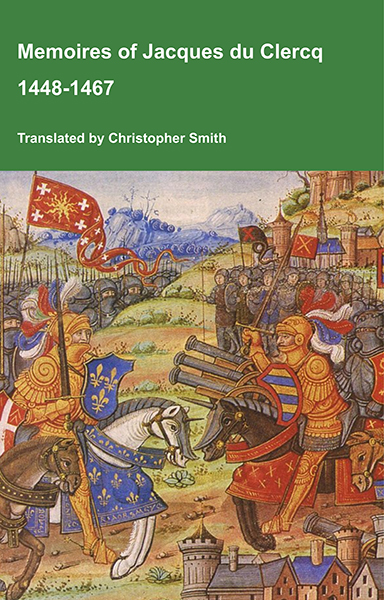
This is a translation of the 'Memoires of Jacques du Clercq', published in 1823 in two volumes, edited by Frederic, Baron de Reissenberg. In his introduction Reissenberg writes: 'Jacques du Clercq tells us that he was born in 1424, and that he was a licentiate in law and a counsellor to Philip the Good, Duke of Burgundy, in the castellany of Douai, Lille, and Orchies. It appears that he established his residence at Arras. In 1446, he married the daughter of Baldwin de la Lacherie, a gentleman who lived in Lille. We read in the fifth book of his Memoirs that his father, also named Jacques du Clercq, had married a lady of the Le Camelin family, from Compiègne. His ancestors, always attached to the counts of Flanders, had constantly served them, whether in their councils or in their armies.' The Memoires cover a period of nineteen years beginning in in 1448, ending in in 1467. It appears that the author had intended to extend the Memoirs beyond that date; no doubt illness or death prevented him from carrying out this plan. As Reissenberg writes the 'merit of this work lies in the simplicity of its narrative, in its tone of good faith, and in a certain air of frankness which naturally wins the reader’s confidence.' Du Clercq ranges from events of national and international importance, including events of the Wars of the Roses in England, to simple, everyday local events such as marriages, robberies, murders, trials and deaths, including that of his own father in Book 5; one of his last entries.
Available at Amazon in eBook and Paperback format.

Vesta Monumenta. 1733. Plate 1.39 depicts Tutbury Castle. Engraving by George Vertue [aged 49] after a drawing originally produced for a survey of the properties of the Duchy of Lancaster conducted by the Chancellor of the Duchy, Ambrose Cave, in 1561.

Vesta Monumenta. 1733. Plate 1.40 depicts Melbourne Castle [Map]. Engraving by George [aged 49] Vertue after a drawing originally produced for a survey of the properties of the Duchy of Lancaster conducted by the Chancellor of the Duchy, Ambrose Cave, in 1561.

Vesta Monumenta. 1734. Plate 1.44. Knaresborough Castle [Map]. Engraving by George [aged 50] Vertue after a drawing originally produced for a survey of the properties of the Duchy of Lancaster conducted by the Chancellor of the Duchy, Ambrose Cave, in 1561.

Vesta Monumenta. 1734. Plate 1.42. Pontefract Castle [Map]. Engraving by George [aged 50] Vertue after a drawing originally produced for a survey of the properties of the Duchy of Lancaster conducted by the Chancellor of the Duchy, Ambrose Cave, in 1561.

Vesta Monumenta. 1734. Plate 1.41. Lancaster Castle [Map] and Priory Church [Map]. Engraving by George [aged 50] Vertue after a drawing originally produced for a survey of the properties of the Duchy of Lancaster conducted by the Chancellor of the Duchy, Ambrose Cave, in 1561.
Vesta Monumenta. 1734. Plate 1.43. The golden seal of Edmund, King of Sicily, between 1254 and 1261, a royal of Edward the Black Prince around 1364, a chaise of Edward the Black Prince around 1363), a salute of Henry VI around 1423), an angelot of Henry VI around 1427), a rose noble of Henry VII between 1485 and 1489, a silver jeton of Perkin Warbeck, Pretender around 1494), and a Tournay groat of Henry VIII around 1514. Engraving by George Vertue [aged 50] after his own drawings. 459 x 273 mm.


Vesta Monumenta. 1736. Plate 1.45. Portrait of Thomas Tanner, Bishop of Asaph. Engraving by George Vertue [aged 52] after a portrait of Tanner painted by an unknown artist

Vesta Monumenta. 1737. Plate 1.47. Roman roads in Yorkshire and immediately adjacent areas originally published by Francis Drake in his Eboracum. Unsigned engraving, likely by George Vertue [aged 53], after Drake's original map.

Vesta Monumenta. 1737. Plate 1.46. Tickhill Castle [Map]. Engraving by George [aged 53] Vertue after a drawing originally produced for a survey of the properties of the Duchy of Lancaster conducted by the Chancellor of the Duchy, Ambrose Cave, in 1561.

Vesta Monumenta. 1737. Plate 1.48. Cotterstock Roman Mosaic. Engraving by George Vertue [aged 53] after William Bogdani, George Lynn Sr [aged 61], and George Lynn Jr [aged 30].
This is a translation of the 'Memoires of Jacques du Clercq', published in 1823 in two volumes, edited by Frederic, Baron de Reissenberg. In his introduction Reissenberg writes: 'Jacques du Clercq tells us that he was born in 1424, and that he was a licentiate in law and a counsellor to Philip the Good, Duke of Burgundy, in the castellany of Douai, Lille, and Orchies. It appears that he established his residence at Arras. In 1446, he married the daughter of Baldwin de la Lacherie, a gentleman who lived in Lille. We read in the fifth book of his Memoirs that his father, also named Jacques du Clercq, had married a lady of the Le Camelin family, from Compiègne. His ancestors, always attached to the counts of Flanders, had constantly served them, whether in their councils or in their armies.' The Memoires cover a period of nineteen years beginning in in 1448, ending in in 1467. It appears that the author had intended to extend the Memoirs beyond that date; no doubt illness or death prevented him from carrying out this plan. As Reissenberg writes the 'merit of this work lies in the simplicity of its narrative, in its tone of good faith, and in a certain air of frankness which naturally wins the reader’s confidence.' Du Clercq ranges from events of national and international importance, including events of the Wars of the Roses in England, to simple, everyday local events such as marriages, robberies, murders, trials and deaths, including that of his own father in Book 5; one of his last entries.
Available at Amazon in eBook and Paperback format.
Vesta Monumenta. 1738. Plates 50 to 52. Three mid fourth-century CE Roman mosaic pavements at Wellow, Somerset [Map] the first of which was found by John Aubrey c. 1685. Further investigations of the site were carried out in 1737 by Edmund Prideaux [aged 44] and James West, who found the second and third pavements, respectively. Engravings by George Vertue [aged 54] after [his father] James Vertue [aged 78] and James West.
James Vertue: In 1660 he was born.


Vesta Monumenta. 1738. Plates 1.53 and 1.54. Sixteen seals dating from the twelfth to the sixteenth centuries, most from the Office of the Duchy of Lancaster, some from the Augmentation Office at Westminster. Engravings by George Vertue [aged 54] after his own drawings.


Vesta Monumenta. 1738. Plate 1.49. Bishop's Palace, Hereford. Drawn by William Stukeley [aged 50] in 1721. Engraved by George Vertue [aged 54]. The chapel was demolished by 1746 except for the north wall, which is adjacent to the cloister.

Vesta Monumenta. 1739. Plate 1.56. Thirteen coins minted by English monarchs between the fourteenth and the early-seventeenth centuries: a gold quarter florin of King Edward III, around 1344, a gold escu of King Edward III (after 1337), a half groat of Edward III, before 1369, a half groat of Edward the Black Prince, around 1368-1372, a groat of Edward the Black Prince (c. 1362-72), a gold angel of Henry VI (c. 1470), a quadruple noble of Henry VII, Type 4 (c. 1503-04), a Tournay groat of Henry VIII (c. 1514), a George noble of Henry VIII (c. 1526-29), a sovereign in crown gold of Elizabeth I (c. 1565), a pattern piece for a gold crown of Edward VI (c. 1547), a pattern sixpence of Elizabeth I (1575), and a Portcullis crown of Elizabeth I (c. 1601). Engraving by George Vertue [aged 55] after his own drawings.
Vesta Monumenta. 1739. Plate 1.55. Eight numismatic objects associated with the Stuarts: a gold coin of Mary, Queen of Scots 1555; a silver medal commemorating Mary's marriage to Lord Darnely, featuring Darnley's name before Mary's from 1565; a silver coronation medal around 1604 for Queen Anne; a silver medal for Prince Henry from 1612; two milled gold proof pieces minted for Charles I, around 1630 and 1631-32, and two gold medals based on the same (1639 and unknown). Engraving by George Vertue [aged 55] after his own drawings in at least four states between 1723 and 1739.


Vesta Monumenta. 1740. Plate 1.57. Roman hypocaust found beneath the subdeanery near the west side of Lincoln Cathedral and first identified by Thomas Sympson on 10 February 1740. The print incorporates material from Sympson's original letter and plan documenting the discovery. Engraving by George Vertue [aged 56] after his own drawings.

Vesta Monumenta. 1741. Plate 1.62. Oxford Decree against Papal Juristiction with engravings of the shields of the twelve Oxford colleges extant in 1534, the university's thirteenth-century common seal, and Henry VIII's portrait medal as Fidei Defensor (1545). Engraving by George Vertue [aged 57] after his own drawings and a copy of the decree then in the Harleian Library.

Vesta Monumenta. 1741. Plate 1.64. The Cross at Chichester [Map]. One of the so-called "market-" or "butter crosses," as it appeared (or might have appeared) at several times in the previous half-century, including the west front of the Cross, a plan view of the Cross, and an elevation view of the "highest part" of the Cross. Engraving by George Vertue [aged 57] after Augustin Ménageot.

Vesta Monumenta. 1743. Plate 1.65. Two works of art in different media that depict the type of Roman gladiator known as a retiarius or net-fighter. The upper half reproduces a seventeenth-century drawing by Pietro Santi Bartoli of a late-third or early-fourth-century CE Roman mosaic uncovered in Rome in 1670. The lower half depicts the sculptured fragment of a second-century Romano-British stone frieze, possibly from a tomb, that was found during construction work in Chester, UK in 1738. Engraving by George Vertue [aged 59] after Pietro Santi Bartoli (upper half) and his own drawing (lower half).
Vesta Monumenta. 1744. Plates 1.66 to 1.68. Robert Cotton with Genesis Fragments. Reproduction of a portrait from around 1626 of Robert Cotton and fragments of the Cotton Genesis manuscript by Cornelius Janssens aka Johnson. Plates 1.67-1.68 depict twenty-one fragments from eighteen folio pages of the Cotton Genesis collated with transcriptions from the Codex Vaticanus. Engravings by George Vertue [aged 60] after the original portrait and his own watercolors of the Cotton Genesis fragments.


Chronicle of Walter of Guisborough
A canon regular of the Augustinian Guisborough Priory, Yorkshire, formerly known as The Chronicle of Walter of Hemingburgh, describes the period from 1066 to 1346. Before 1274 the Chronicle is based on other works. Thereafter, the Chronicle is original, and a remarkable source for the events of the time. This book provides a translation of the Chronicle from that date. The Latin source for our translation is the 1849 work edited by Hans Claude Hamilton. Hamilton, in his preface, says: 'In the present work we behold perhaps one of the finest samples of our early chronicles, both as regards the value of the events recorded, and the correctness with which they are detailed; Nor will the pleasing style of composition be lightly passed over by those capable of seeing reflected from it the tokens of a vigorous and cultivated mind, and a favourable specimen of the learning and taste of the age in which it was framed.'
Available at Amazon in eBook and Paperback format.

Vesta Monumenta. 1746. Plate 1.69. Engraving of King Henry VII's 1497 Standard for Weights and Measures based on an original parchment that was pasted on an oak table formerly in the Treasury of the King's Exchequer at Westminster and in the collection of Edward Harley, 2nd Earl of Oxford and Mortimer. Engraving by George Vertue [aged 62] after his own drawing.
Vesta Monumenta. 1747. Plates 2.1 and 2.2. Three plans for rebuilding the city of London after the great fire of 1666. The plans were originally submitted to King Charles II in September of 1666 and February of 1668 by John Evelyn and Christopher Wren. Engravings by George Vertue [aged 63] after the original plans by Evelyn and Wren.


Vesta Monumenta. 1750. Plates 2.3. Portrait from around 1732 of George Holmes, a founding member of the Society of Antiquaries and Deputy Keeper of the Tower of London. The engraving augments the original oil painting by depicting a more mature Holmes surrounded by objects symbolic of his intellectual and professional pursuits. Engraving by George Vertue [aged 66] after Richard van Bleeck.

Vesta Monumenta. 1751. Plates 2.4. Two early to mid-fourteenth-century deeds and three seals, which confirm land charters related to ecclesiastical establishments in Yorkshire. Engraving by George Vertue [aged 67].

Vesta Monumenta. 1751. Plate 2.8. Gloucester Cross [Map], framed by scaled-up images of the sculptures of English kings and queens that were located in the niches of the second story. Engraving by George Vertue [aged 67] after Thomas Ricketts.

Vesta Monumenta. 1752. Plate 2.7. Greensted Church with Objects Commemorating St. Edmund. The central image of the Church of St. Andrew, Greensted [Map], Essex, is rendered along with the burial shrine of St. Edmund and a seal fragment from the Abbey of Bury St. Edmunds [Map], both in Suffolk. Engraving by George Vertue [aged 68] after Smart Lethieullier [aged 50] and John Lydgate.

Vesta Monumenta. 1752. Plate 2.9. Three fourth-century CE Roman mosaic pavements discovered in North Lincolnshire in 1699 and 1747. Figures I-III depict two large nearly intact pavements, the Ceres and Orpheus Pavements, with a related fragment, all discovered at Winterton in 1747. Figure IV shows a fragment of a large geometric mosaic discovered nearby at Roxby in 1699. Engraving by George Vertue [aged 68] after Charles Mitley.

Vesta Monumenta. 1752. Plate 2.10. Doncaster Cross [Map], also known as the Hall Cross, which was erected at the southeastern end of Doncaster, near Hallgate, on the old London road, in honor of Otho de Tilly, land steward to the count of nearby Conisborough from about 1165 to 1188. The dense text on either side of the cross relates a brief history of Otho de Tilly. Engraving by George Vertue [aged 68]. The original cross in Doncaster, UK, was demolished in 1792 but was replaced by a replica ex-situ the following year.
Originating from the village of Tilly in Calvados (Normandy), Otho de Tilly (c. 1121-88) first appears in the historical record during the reign of Stephen of Blois (d. 1154), for instance, as witness to the charter of foundation of Kirkstall Abbey in 1152. He subsequently served as senescallus comitis de Conibroc (seneschal or land steward to the count of Conisborough), Hamelin de Warenne (1129-1202), the illegitimate half-brother of Henry II, who first came into possession of Conisborough Castle in 1163 and extensively rebuilt it – with the addition of a new polygonal stone keep – between 1180 and 1190. Given that Conisborough is located just under six miles down the road from Doncaster, it is likely that the cross that bore Otho's name was erected sometime during his tenure as seneschal to the Warennes—probably between the mid-1160s and Otho's death in 1188.

Vesta Monumenta. 1753. Plate 2.14. Plan of the Savoy Palace [Map]. Engraving by George Vertue [aged 69] after his own drawings.

Vesta Monumenta. 1753. Plate 2.25. Palace of Placentia, Greenwich [Map]. Engraving by James Basire [aged 23] after George Vertue [aged 69].

Vesta Monumenta. 1753. Plate 2.11. Sandal Castle [Map]. Engraving by George Vertue [aged 69] after a drawing originally produced for a survey of the properties of the Duchy of Lancaster conducted by the Chancellor of the Duchy, Ambrose Cave, in 1561.
This is a translation of the 'Memoires of Jacques du Clercq', published in 1823 in two volumes, edited by Frederic, Baron de Reissenberg. In his introduction Reissenberg writes: 'Jacques du Clercq tells us that he was born in 1424, and that he was a licentiate in law and a counsellor to Philip the Good, Duke of Burgundy, in the castellany of Douai, Lille, and Orchies. It appears that he established his residence at Arras. In 1446, he married the daughter of Baldwin de la Lacherie, a gentleman who lived in Lille. We read in the fifth book of his Memoirs that his father, also named Jacques du Clercq, had married a lady of the Le Camelin family, from Compiègne. His ancestors, always attached to the counts of Flanders, had constantly served them, whether in their councils or in their armies.' The Memoires cover a period of nineteen years beginning in in 1448, ending in in 1467. It appears that the author had intended to extend the Memoirs beyond that date; no doubt illness or death prevented him from carrying out this plan. As Reissenberg writes the 'merit of this work lies in the simplicity of its narrative, in its tone of good faith, and in a certain air of frankness which naturally wins the reader’s confidence.' Du Clercq ranges from events of national and international importance, including events of the Wars of the Roses in England, to simple, everyday local events such as marriages, robberies, murders, trials and deaths, including that of his own father in Book 5; one of his last entries.
Available at Amazon in eBook and Paperback format.

Vesta Monumenta. 1753. Plate 2.12. The prison and chapel buildings in the Savoy Hospital in 1736. The Hospital Chapel, depicted from two different sides in the lower half and the upper right portion of this plate, is the only Savoy building that survives today. Engraving by George Vertue [aged 69] after his own drawings.

Vesta Monumenta. 1753. Plate 2.13. Clitheroe Castle [Map]. Engraving by George Vertue [aged 69] after a drawing originally produced for a survey of the properties of the Duchy of Lancaster conducted by the Chancellor of the Duchy, Ambrose Cave, in 1561.
Vesta Monumenta. 1755. Plate 2.15 and 2.16. Two images from a twelfth-century manuscript, the Eadwine Psalter. The first is a plan of the monastery precinct at Christ Church, Canterbury, including Canterbury Cathedral [Map] as it stood prior to 1174. The second plate reproduces an author portrait of Eadwine of Canterbury, after whom the entire manuscript is named. Engravings by George Vertue [aged 71] after drawings of the manuscript made at Cambridge in 1753 by an unknown draftsman.


Vesta Monumenta. 1756. Plate 2.17. A Roman lamp, an amphora-style vase, and two hand bells from 1366 (left) and 1547 (right). Engraving by George Vertue [aged 72] (his last for Vetusta Monumenta) after his own drawings.
On 24th July 1756 George Vertue [aged 72] died.

Vesta Monumenta. 1765. Plate 2.26. East Window of St Margaret's Church, Westminster [Map]. A sixteenth-century Flemish-inspired stained-glass window produced in Holland and shipped to England around 1526. Known now as the "Great East Window at St Margaret's Church, Westminster," its three central lights show the Crucifixion, and its two outer lights feature portraits of King Henry VIII and Catherine of Aragon. The window was first installed in the Church of Waltham Abbey, and then moved to New Hall, Essex during the Dissolution of the Monasteries. The window was installed in St. Margaret's in 1758. Engraving by James Basire [aged 35] after George Vertue.
Minutes of the Society of Antiquaries. 18th February 1819. Mr Kirk Patrick brought the seals of all of the Bishops of Norwich curiously drawn by himself from the originals which he designs for the Press.
Mr Vertue was ordered to print off 100 more of Rich: II, and 100 more of the Lamp; and he is desired to add the Inscription according to the Copy delivered to him if Mr Director approves of it.

Vesta Monumenta. Plate 1.5: Engravings of Three Medieval Seals
Plate 1.5 of Vetusta Monumenta depicts three medieval seals: the Seal of Clare College, Cambridge (1359), the seal of the Cathedral Priory of St. Etheldreda, Ely [Map] (c. 1280), and seal of the Priory of Cottingham [Map] (1322) [Note. The date here somewhat confusing since the Priory was founded in 1325?]. Engraving by George Vertue after his own drawings. 173 x 233 mm [upper portion] and 172 x 228 mm [lower portion]. Published by the Society of Antiquaries of London in 1720. Current locations: The top seal is in Clare College, Cambridge University, Cambridge, UK; an impression of the center seal is in Westminster Abbey (WAM 7933), London, UK; the bottom seal is in the British Museum (1913,1105.2), London, UK.

Vesta Monumenta. Plate 1.8: Engraving of a Plan of Ancient Verulamium [Map]
Plate 1.8 of Vetusta Monumenta features an extensively labeled map of the Roman remains of Verulamium with inset images of two ancient British coins and a section of Roman wall. Engraving by George Vertue after William Stukeley. Published by the Society of Antiquaries of London in 1721. Current location: Stukeley's original map is preserved at the Society of Antiquaries of London; the Roman ruins today are encompassed by the modern city of St. Alban's in Hertfordshire, UK.
