

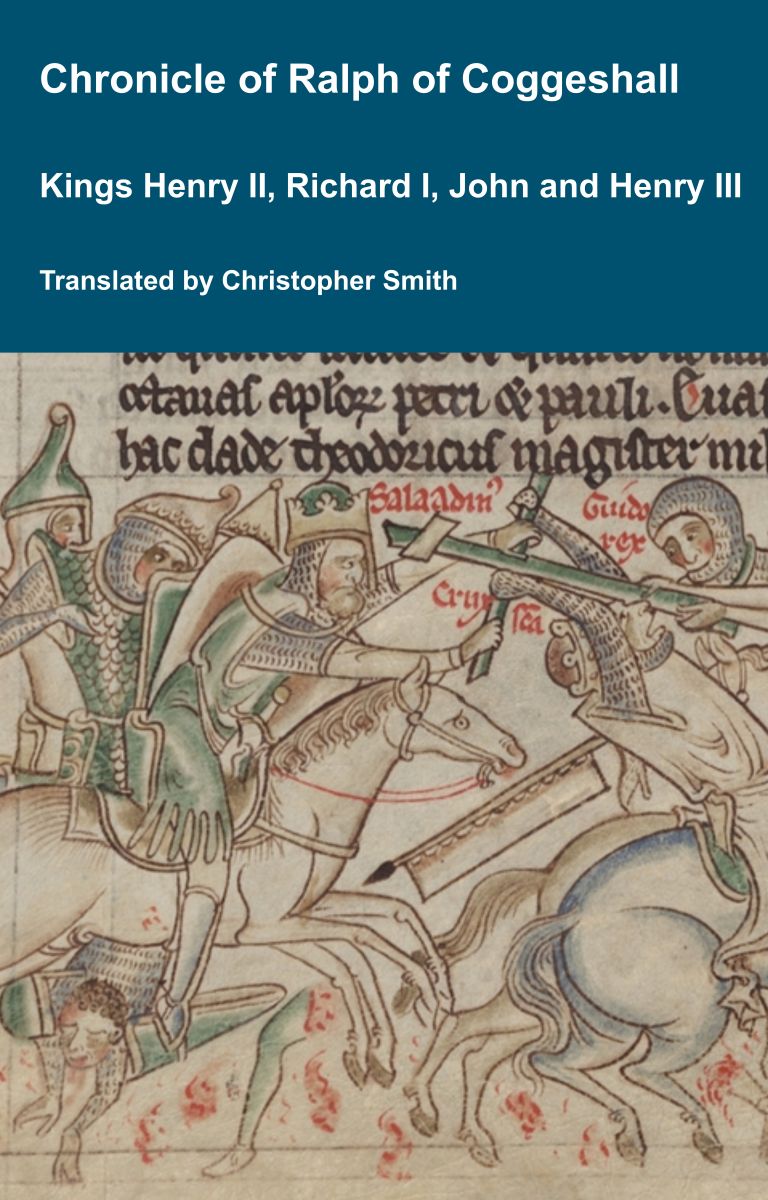
Chronicle of Abbot Ralph of Coggeshall
The Chronicle of Abbot Ralph of Coggeshall (Chronicon Anglicanum) is an indispensable medieval history that brings to life centuries of English and European affairs through the eyes of a learned Cistercian monk. Ralph of Coggeshall, abbot of the Abbey of Coggeshall in Essex in the early 13th century, continued and expanded his community’s chronicle, documenting events from the Norman Conquest of 1066 into the tumultuous reign of King Henry III. Blending eyewitness testimony, careful compilation, and the monastic commitment to record-keeping, this chronicle offers a rare narrative of political intrigue, royal power struggles, and social upheaval in England and beyond. Ralph’s work captures the reigns of pivotal figures such as Richard I and King John, providing invaluable insights into their characters, decisions, and the forces that shaped medieval rule. More than a simple annal, Chronicon Anglicanum conveys the texture of medieval life and governance, making it a rich source for scholars and readers fascinated by English history, monastic authorship, and the shaping of the medieval world.
Available at Amazon in eBook and Paperback format.
Paternal Family Tree: Anjou aka Plantagenet
Maternal Family Tree: Alice Hales Countess Norfolk 1330
Margaret Plantagenet 1st Duchess of Norfolk was born to [her father] Thomas of Brotherton 1st Earl Norfolk and [her mother] Alice Hales Countess Norfolk. She a granddaughter of King Edward I of England.
In 1312 [her father] Thomas of Brotherton 1st Earl Norfolk [aged 11] was created 1st Earl Norfolk.
Before 12th December 1325 Stephen Segrave 3rd Baron Segrave [aged 40] died. His son [her future husband] John [aged 10] succeeded 4th Baron Segrave.
Before 12th October 1326 [her father] Thomas of Brotherton 1st Earl Norfolk [aged 26] and [her mother] Alice Hales Countess Norfolk were married. She by marriage Countess Norfolk. He the son of [her grandfather] King Edward I of England and [her grandmother] Margaret of France Queen Consort England.
Before 12th October 1330 [her mother] Alice Hales Countess Norfolk died.
On 12th August 1332 Battle of Dupplin Moor was fought between the supporters of the infant King David II of Scotland [aged 8], son of King Robert the Bruce I of Scotland, and the supporters of King Edward I of Scotland [aged 49], supported by the English. The Bruce army included Robert Bruce Lord of Liddesdale and Domhnall Mar II Earl of Mar [aged 39]. The Balliol army included David III Strathbogie 11th Earl Atholl [aged 23], Ralph Stafford 1st Earl Stafford [aged 30], Thomas Ughtred 1st Baron Ughtred [aged 40] and [her future husband] Walter Manny 1st Baron Manny [aged 22]. The battle is notable for being the first to use dismounted men-at-arms supported by archers; a formation that would bring repeated success to the English both in Scotland and France.
Robert Bruce Lord of Liddesdale was killed leading a charge.
Nicholas Hay [aged 47] was killed.
Thomas Randolph 2nd Earl Moray was killed. His brother John [aged 26] succeeded 3rd Earl Moray.
Domhnall Mar II Earl of Mar was killed.
In 1335 John Segrave 4th Baron Segrave [aged 19] and Margaret Plantagenet 1st Duchess of Norfolk were married. She by marriage Baroness Segrave. She the daughter of Thomas of Brotherton 1st Earl Norfolk [aged 34] and Alice Hales Countess Norfolk. They were fourth cousin once removed. He a great x 5 grandson of King John of England. She a granddaughter of King Edward I of England.
Before 4th April 1336 [her father] Thomas of Brotherton 1st Earl Norfolk [aged 35] and Mary Brewes Countess Norfolk [aged 34] were married. She by marriage Countess Norfolk. He the son of [her grandfather] King Edward I of England and [her grandmother] Margaret of France Queen Consort England. They were half second cousin twice removed. She a great x 3 granddaughter of King John of England.
On 4th August 1338 [her father] Thomas of Brotherton 1st Earl Norfolk [aged 38] died at Framlingham Castle, Suffolk [Map]. His daughter Margaret succeeded 2nd Countess Norfolk. She also succeeded to the title Earl Marshal, the only woman to have held this office, and inherited Framlingham Castle, Suffolk [Map].
On 25th October 1338 [her daughter] Elizabeth Segrave 5th Baroness Segrave Baroness Mowbray was born to [her husband] John Segrave 4th Baron Segrave [aged 23] and Margaret Plantagenet 1st Duchess of Norfolk at Croxton Abbey [Map]. She a great granddaughter of King Edward I of England. She married 25th March 1349 her third cousin John Mowbray 4th Baron Mowbray Baron Segrave, son of John Mowbray 3rd Baron Mowbray and Joan Plantagenet Baroness Mowbray, and had issue.
On 24th June 1340 King Edward III of England [aged 27] attacked the French fleet at anchor during the Battle of Sluys capturing more than 200 ships, killing around 18000 French. The English force included John Beauchamp 1st Baron Beauchamp Warwick [aged 24], William Bohun 1st Earl of Northampton [aged 30], Henry Scrope 1st Baron Scrope of Masham [aged 27], William Latimer 4th Baron Latimer of Corby [aged 10], John Lisle 2nd Baron Lisle [aged 22], Ralph Stafford 1st Earl Stafford [aged 38], Henry of Grosmont 1st Duke Lancaster [aged 30], [her future husband] Walter Manny 1st Baron Manny [aged 30], Hugh Despencer 1st Baron Despencer [aged 32] and Richard Pembridge [aged 20].
Thomas Monthermer 2nd Baron Monthermer [aged 38] died from wounds. His daughter Margaret succeeded 3rd Baroness Monthermer.
On 12th November 1347 [her future husband] Walter Manny 1st Baron Manny [aged 37] was created 1st Baron Manny.

Anne Boleyn. Her Life as told by Lancelot de Carle's 1536 Letter.
In 1536, two weeks after the execution of Anne Boleyn, her brother George and four others, Lancelot du Carle, wrote an extraordinary letter that described Anne's life, and her trial and execution, to which he was a witness. This book presents a new translation of that letter, with additional material from other contemporary sources such as Letters, Hall's and Wriothesley's Chronicles, the pamphlets of Wynkyn the Worde, the Memorial of George Constantyne, the Portuguese Letter and the Baga de Secrets, all of which are provided in Appendices.
Available at Amazon in eBook and Paperback format.
On 25th March 1349 [her son-in-law] John Mowbray 4th Baron Mowbray Baron Segrave [aged 8] and Elizabeth Segrave 5th Baroness Segrave Baroness Mowbray [aged 10] were married. She by marriage Baroness Mowbray. He by marriage Baron Segrave. She the daughter of John Segrave 4th Baron Segrave [aged 33] and Margaret Plantagenet 1st Duchess of Norfolk. They were third cousins. He a great x 2 grandson of King Henry III of England. She a great granddaughter of King Edward I of England.
Before 1st April 1353 [her daughter] Margaret Segrave was born to [her husband] John Segrave 4th Baron Segrave [aged 37] and Margaret Plantagenet 1st Duchess of Norfolk. She a great granddaughter of King Edward I of England.
Before 1st April 1353 [her son] John Segrave died.
On 1st April 1353 [her husband] John Segrave 4th Baron Segrave [aged 37] died at Bretby Repton, Derbyshire [Map]. His daughter Elizabeth [aged 14] succeeded 5th Baroness Segrave.
In 1354 Walter Manny 1st Baron Manny [aged 44] and Margaret Plantagenet 1st Duchess of Norfolk were married. She by marriage Baroness Manny. She the daughter of Thomas of Brotherton 1st Earl Norfolk and Alice Hales Countess Norfolk.
In 1357 [her son] Thomas Manny was born to [her husband] Walter Manny 1st Baron Manny [aged 47] and Margaret Plantagenet 1st Duchess of Norfolk in London. He a great grandson of King Edward I of England. He died aged five in 1362.
In January 1362 [her son] Thomas Manny [aged 5] drowned in a well at Deptford, Kent [Map].
Before 1368 [her daughter] Elizabeth Segrave 5th Baroness Segrave Baroness Mowbray [aged 29] died. Her son [her grandson] John [aged 2] succeeded 6th Baron Segrave. The date somewhat uncertain but consistent with John Mowbray 1st Earl Nottingham succeeding.
In July 1368 [her son-in-law] John Hastings 2nd Earl Pembroke [aged 20] and Anne Manny Countess Pembroke were married. She by marriage Countess Pembroke. She the daughter of Walter Manny 1st Baron Manny [aged 58] and Margaret Plantagenet 1st Duchess of Norfolk. He the son of Laurence Hastings 1st Earl Pembroke and Agnes Mortimer Countess of Pembroke. They were half fourth cousins. He a great x 5 grandson of King John of England. She a great granddaughter of King Edward I of England.
On 12th January 1372 [her husband] Walter Manny 1st Baron Manny [aged 62] died. His daughter Anne succeeded 2nd Baroness Manny. John Hastings 2nd Earl Pembroke [aged 24] by marriage Baron Manny.
Chronicle of Abbot Ralph of Coggeshall
The Chronicle of Abbot Ralph of Coggeshall (Chronicon Anglicanum) is an indispensable medieval history that brings to life centuries of English and European affairs through the eyes of a learned Cistercian monk. Ralph of Coggeshall, abbot of the Abbey of Coggeshall in Essex in the early 13th century, continued and expanded his community’s chronicle, documenting events from the Norman Conquest of 1066 into the tumultuous reign of King Henry III. Blending eyewitness testimony, careful compilation, and the monastic commitment to record-keeping, this chronicle offers a rare narrative of political intrigue, royal power struggles, and social upheaval in England and beyond. Ralph’s work captures the reigns of pivotal figures such as Richard I and King John, providing invaluable insights into their characters, decisions, and the forces that shaped medieval rule. More than a simple annal, Chronicon Anglicanum conveys the texture of medieval life and governance, making it a rich source for scholars and readers fascinated by English history, monastic authorship, and the shaping of the medieval world.
Available at Amazon in eBook and Paperback format.
Patent Rolls. 16th December 1377. Westminster. Commission of oyer and terminer to John de Cavendish, John de Shardelowe, knight, William Clere, Edmund Gourney, John Fastolf and Edmund de Clippesby, on complaint by the king's kinswoman Margaret Mareschall, countess of Norfolk, that Robert 'the lordes porter Fiz Wauter,' John Edward', John Huntyng, Thomas Walter and John Barker, all of Dysse, Henry de Rikynghale, John Waryn and Robert Wright of Wynferthyng, Nicholas Bakford, John Grout of Dysse and John Molle, Thomas Skynner, Thomas Taillour, Walter Goche, John Palmer, Walter Frost, Thomas Fulbourne, Simon Soon, William atte Hale, Robert Barker, John Stok, Roger Curteys, Hugh Edward', John Bisshop', John Sparrowe and William Skoudere, all of Dysse, broke her close anti houses at Wynferthyng, co. Norfolk, carried away her goods and assaulted her servants there and at Dysse. For 20s paid in the hanaper.
Patent Rolls. 9th January 1378. Nomination, as a crown right after coronation, at the supplication of the king's kinswoman, the countess of Norfolk, and mandate to the abbess and convent of Winchester for the admission of Agnes Denham of Winchester as a nun. By p.s.
Patent Rolls. 16th March 1378. Westminster. Letters for Margaret, countess of Norfolk, the king's kinswoman, nominating John Underhull and William Seymore of Rosse her attorneys in Ireland, for a year.
Patent Rolls. 9th June 1378. Westminster. Inspeximus and confirmation, in favour of Margaret Mareschall, countess of Norfolk, and [her daughter] Anne, late the wife of [her former son-in-law] John Hastynges earl of Pembroke, the late king's kinswomen, of (1) letters patent dated 22 January, 49 Edward III, committing to them the custody, during the minority of the heir, of two-thirds of the manors, lands, and tenements, late of the said John, excepting those in Kent, at the yearly rent of £413 2s 2d; and (2) letters patent dated 24 December, 50 Edward III., remitting £100 yearly of the said rent. By the Great Council.
Patent Rolls. 6th July 1378. Commission of oyer and terminer to John de Cavendissh, William de Wychyngham, John Shardelowe, Edmund Grourneye, Reginald Eccles, Robert de Kedyton and Thomas Wombe, on complaint by the king's kinswoman Margaret Mareschall, countess of Norfolk, that Hervey Loft of Hardelee, Benedict Cook, Ralph Bolour, Stephen Hilberd of Hornyng, John Walsyngham, Alan Staloun of Catfeld, Walter atte Chaumbre, Henry 'of the Bakhous' of Loudham, Richard atte Welle of Ludham, Richard Stevenes of Ludham, John Stevenes, John Messager, Ralph atte Medewe, Thomos atte Wod of Gislond, William Pepit* of Lodne, Theobald Verdoun of Wotton, Robert Mauclerk of Mundham, Thomas Jerbrigge and Roger Boule of Carleton entered her free warren at Sutton, co. Norfolk, hunted therein, fished in her several fishery there, carried away fish, besides goods, also hares, rabbits, pheasants and partridges, depastured corn and grass at Catfeld, where they besieged some of her tenants and bondmen in their houses with no small number of armed men and archers, and assaulted and imprisoned others at Sutton, Suthfeld, Felmyngham, Hardelee and Bergh, co. Norfolk, extorting fines from those at Sutton, Catfeld and Suthfeld, and so frightening some that they lost their senses. For 20s paid in the hanaper.
Patent Rolls. 22nd February 1379. [her daughter] Anne, late the wife of [her former son-in-law] John de Hastynges, late earl of Pembroke, staying in England, has letters nominating Robert de Euer and John More her attorneys in Ireland for one year. William de Burstall received the attorneys.
Margaret Mareschall, countess of Norfolk, the king's kinswoman, staying in England, has letters nominating the same for the same period. William de Burstall received the attorneys.
Patent Rolls. 10th September 1379. Westminster. Pardon, at the supplication of the countess of Norfolk, to John Rysele, clerk, for the death of John Quynteyn, 'coteler,' on St. Bartholomew's day [24th August], 2 Richard I. By p.s.
Patent Rolls. 4th November 1379. Westminster. Pardon, at the supplication of the king's kinswoman, Margaret, countess of Norfolk, to Robert Frost of Stylton for the death of David Walssheman Tuesday on the feast of the Exaltation of the Cross [14th September], 2 Richard II. By p.s.
Patent Rolls. 22nd November 1379. Westminster. Grant to Stephen de Haddele, for life, from 10 May, 1 Richard II, of a yearly rent of 15/. from the manor of Radeswell, which was granted to him by letters patent dated 1 June, 51 Edward III, confirmed by the king at the aforesaid date; on his petition that he has been unable to obtain payment because in the said letters patent it was said to be in the custody of the king's kinswoman, the countess of Norfolk, without making mention of [her daughter] Anne, countess of Pembroke, who was jointly named with her therein. By p.s.
Patent Rolls. 14th February 1380. Westminster. Pardon, at the supplication of the king's kinswoman, Margaret, countess Westminster, of Norfolk, to William Iluggus of Hulton for the death of John de Mourton, killed on the feast of the beheading of St. John the Baptist [29th August], 50 Edward III. By p.s.
Patent Rolls. 22nd February 1380. Letters for [her daughter] Anne, late the wife of John
The like for Margaret Mareschall, countess of Norfolk, nominating the same.
The said William received them.
Patent Rolls. 6th March 1380. Westminster. The like, at the supplication of the king's kinswoman, Margaret, countess of Norfolk, to William Seman of Hunden, for the death of Richard Redlasch, killed on St. Blaise's day [3rd February], 51 Edward III. By p.s
Patent Rolls. 15th July 1380. Westminster. Licence for the king's kinswoman, Margaret Mareschall, countess of Norfolk, about to pass to divers manors for sport (pro deductu suo), and her servants, to carry arms and weapons for defence should the king's enemies invade the same.
Jean de Waurin's Chronicle of England Volume 6 Books 3-6: The Wars of the Roses
Jean de Waurin was a French Chronicler, from the Artois region, who was born around 1400, and died around 1474. Waurin’s Chronicle of England, Volume 6, covering the period 1450 to 1471, from which we have selected and translated Chapters relating to the Wars of the Roses, provides a vivid, original, contemporary description of key events some of which he witnessed first-hand, some of which he was told by the key people involved with whom Waurin had a personal relationship.
Available at Amazon in eBook and Paperback format.
Patent Rolls. 14th October 1380. Westminster. Pardon, at the supplication of the king's kinswoman, Margaret, countess of Norfolk, to William Seman, of Hunden, for the death of Richard Redlasch, killed on the day of St. Blaise [3rd February], 51 Edward III. Renewed because sealed at another time by p.s
Patent Rolls. 4th March 1381. Westminster. Pardon, at the supplication of the king's kinswoman, the countess of Norfolk, to John Sparwe of Suthfeld, co. Norfolk, her tenant, for the death of Thomas Kyng of Banyngham, killed on Saturday after St. Barnabas, 50 Edward III. By p.s.
Patent Rolls. 20th October 1381. Westminster. Commission of oyer and terminer to John de Cavendissh, Robert Westminster. Swynbourne, John de Tudenham and Robert Kedyngton, on complaint by the king's kinswoman, Margaret Mareschall, countess of Norfolk, that Martin Stainore, Simon Bone, Adam Shephird, Richard atte Made, Richard Giffard, William Yoilank, 'shephird,' Robert atte Made of Ronewell, Geoffrey Dersham and others, broke into her close and house at Southanyfeld, co. Essex, and assaulted her servants. For 1 mark paid in the hanaper.
In 1384 [her daughter] Anne Manny Countess Pembroke died. Her son [her grandson] John [aged 11] succeeded 3rd Baron Manny.
On 29th September 1397 King Richard II [aged 30] rewarded his relations with Dukedoms, possibly for their part in downfall of Thomas of Woodstock 1st Duke of Gloucester [deceased], Thomas Beauchamp 12th Earl Warwick [aged 59] and Richard Fitzalan 9th Earl of Surrey 4th or 11th Earl of Arundel [deceased]...
His older half-brother John Holland 1st Duke Exeter [aged 45] was created 1st Duke Exeter. [her granddaughter-in-law] Elizabeth Lancaster Duchess Exeter [aged 34] by marriage Duchess Exeter.
His nephew Thomas Holland 1st Duke Surrey [aged 23] was created 1st Duke Surrey.
His first cousin once-removed Margaret was created 1st Duchess Norfolk - for life only. On the same day her grandson Thomas [aged 29] was also created Duke of Norfolk - see below.
His second cousin once removed Thomas Mowbray 1st Duke of Norfolk was created 1st Duke Norfolk. Elizabeth Fitzalan Duchess Norfolk [aged 31] by marriage Duchess Norfolk.
His first cousin Edward 2nd Duke of York 1st Duke Albemarle [aged 24] was created 1st Duke Albemarle. Beatrice Burgundy Countess Rutland and Cork [aged 24] by marriage Duchess Albemarle.
His illegitimate first cousin John Beaufort 1st Marquess Somerset and Dorset [aged 24] was created 1st Marquess Somerset, 1st Marquess Dorset. Margaret Holland Duchess Clarence [aged 12] by marriage Marchioness Somerset, Marchioness Dorset.
Ralph Neville 1st Earl of Westmoreland [aged 33] was created 1st Earl of Westmoreland. Joan Beaufort Countess of Westmoreland [aged 18] by marriage Countess of Westmoreland.


 Become a Member via our Buy Me a Coffee page to read more.
On 24th March 1399 Margaret Plantagenet 1st Duchess of Norfolk died. Duke Norfolk extinct since it was created for life only. She was buried in the choir of Christ Church, Greyfriars [Map]. Her grandson Thomas [aged 31] succeeded 3rd Earl Norfolk. Elizabeth Fitzalan Duchess Norfolk [aged 33] by marriage Countess Norfolk.
Close Rolls Richard II 1396 1399 V6. 14th June 1399. Westminster Palace [Map]. To the keepers, farmers, occupiers or receivers of the manor of Lopham co. Norffolk for the time being. Order every year to pay to Roger Bliklynge his raiment or 13s. 4d. for it, and 3d. a day, and to pay him the arrears since 5 February 8 Richard II, on which date the king confirmed letters patent whereby Margaret late duchess of Norffolk, by name of Margaret Countess of Norffolk, granted to the said Roger for life the office of keeper of the park, warren and game to the said manor pertaining, raiment once a year at Christmas of the suit of her esquires or 13s. 4d., and 3d. a day of the agistments of the park at the feast of St. Peter in autumn.
Parliament Rolls Richard II. 33. Also, on the same Saturday [10 February 1397], a charter of the king made to the [her grandson] earl marshal touching his office of marshal of England, and the gold staff adorned with the emblem of the king's arms which he will carry in his office, was read and delivered to the said earl. The tenor of which charter follows:
The king to the same, greeting. Know that whereas recently by our letters patent of our special grace we granted to our beloved kinsman Thomas, Earl of Nottingham, the office of marshal of England, together with the name and honour of earl marshal, to have to him and his male heirs issuing from his body, with all the fees, profits, and appurtenances whatsoever pertaining in any way to the said office, in perpetuity; as is fully contained in the same letters. We, mindful of the gracious and laudable services often performed by the aforementioned earl, on either side of the sea, for the benefit and honour of us and our kingdom, at no small effort, cost, and charge to him; and wishing therefore to provide for the estate and honour of that earl, of our special grace have granted in our present parliament for us and our heirs to the same earl the said office, and the name, title, and honour of earl marshal of England, to have to him and his male heirs issuing from his body, together with all offices, commodities, profits and other appurtenances whatsoever, both in our courts and elsewhere, relating or pertaining in any way to the same office, in the same manner and as fully, freely, wholly, and peacefully as Thomas Brotherton, lately Earl of Norfolk and marshal of England, father of our beloved kinswoman Margaret Countess of Norfolk, [widow] of the aforesaid late earl, or Roger Bigod sometime Earl of Norfolk and marshal of England, or any other after the death of the same former earl, or the same present earl, had or held the said office of marshal of England in their time.
Willing further and granting for us and our heirs, that the office of marshal of our Bench before us, which John Wicks holds for the term of his life by our grant, and the office of marshal in our treasury which Richard Gascoigne holds for his life by grant of our beloved brother Thomas Earl of Kent, lately marshal of England, by our confirmation; and also the office of herald of the marshal before the steward and marshal of our household, which Guy Allesley holds for his life by grant of the lord Edward [III], late king of England, our grandfather, and by our confirmation; which offices after the death of the aforesaid John, Richard and Guy should revert to us and our heirs, after the death of the same John, Richard, and Guy shall remain to the aforementioned earl marshal, to have to him and his male heirs in perpetuity. And that the same offices, and all other offices in any of our courts and elsewhere, which pertained, and used to pertain to the said office of marshal of England in times past, shall be fully restored, annexed, and reunited to the said office of marshal of England in perpetuity. And that the same earl and his male heirs may give, grant, or confer those offices on any suitable persons freely and without hindrance as soon as they shall have fallen vacant by death, demise, resignation, surrender, or in any other way, notwithstanding any of our letters patent made to the contrary.
Considering also the vigour and nobility of that earl, and that he may in future the more fittingly and honourably perform and exercise the aforesaid office, we have granted for us and our heirs to the same present earl that he and his said male heirs, marshals of England, by virtue of their aforesaid office should have, carry, and bear, as well in the presence as in the absence of us and our heirs, a certain gold staff, with both ends enamelled in black, and with the emblem of our arms decorating the top of the said staff, and with the emblem of the arms of that earl decorating the bottom of the said staff; notwithstanding that the same present earl in his time, or the aforementioned former earls, or any other who had the said office of marshal of England before this time, used to carry or bear a wooden staff. Witnessed by these, the venerable fathers Thomas archbishop of Canterbury, primate of all England, Robert of London, William of Winchester, John of Ely, Edmund of Exeter, our chancellor, bishops; John of Aquitaine and Lancaster, Edmund of York, dukes, our beloved uncles; Henry of Derby, Edward of Rutland, Henry of Northumberland, earls; Reginald Grey of Ruthin, Ralph Neville, John Lovell, knights; Roger Walden, dean of York, our treasurer, Thomas Percy, steward of our household, and others. Given by our hand at Westminster on 10 February 1397.

Become a Member via our Buy Me a Coffee page to read more.
Bourgeois de Valenciennes. When the King of England had returned with his host into Calais, they took counsel together and resolved that they would leave the town and encamp in the open fields, awaiting their enemies. When the King of France learned this, he assembled his council and asked how he might act in the most honourable manner for himself and his realm. He was advised: "Sire, you have here with you all your strength. Send a challenge of battle to the King of England; we believe he will grant it." The king agreed to this advice and chose Sir Arnoul d’Audrehem, Marshal of France, to carry out the message. At the king’s command and pleasure, Sir Arnoul departed from Saint-Omer and came before Calais, where the King of England and his forces were. The marshal approached the King of England, bowed and saluted him very honourably, and, on behalf of the King of France, his sovereign lord, demanded battle, saying that he had been sent for that purpose. The King of England gave no reply to the marshal’s words. Then the Duke of Lancaster stepped forward and said: "Marshal, we shall fight at the will and provision of our friends, and not at the will of our enemies." That was the entire response that the marshal brought back to the King of France, who was far from pleased. He saw that he had two hundred and fifty thousand men at his pay and expense, not counting the countless common levies of the good towns; yet he did not dare to depart from Saint-Omer nor dismiss them, for he did not know nor could perceive what the King of England intended to do. Soon afterward, the King of England received news that the Scots were recovering in Scotland what he had conquered there. Therefore he departed, leaving at Calais the Earl of Norwich1 with five hundred men-at-arms and twelve hundred archers.
Quant le roy d'Engleterre fut revenus, luy et son est, dedens Callais, ils eurent en conseil qu'ils wideroient hors de la ville et qu'ils se logeroient aux champs, eu attendant leurs ennemis. Et quant le roy de France le sceult, il assambla son conseil et demanda comment au plus honnourable pour luy et pour son conseil il en poroit user. Sy fut conseilliés, et luy dist-on: "Sire, vous avés-cy avoecques vous toute vostre puissance. Mandez la bataille au roy d'Engleterre; bien créons qu'il le vous ottroiera." Ad ce conseil s'acorda le roy, et eslisit-on monseigneur Ernoul d'Audrehem, mareschal de France, pour faire et furnir ce message. Et monseigneur Ernoul, au commandement et au plaisir du roy, se party de Saint-Omer et vint devant Calais, où le roy d'Engleterre et les siens estoient. Dont vint le mareschal devant le roy d'Engleterre, et l'enclina et salua moult honnourablement, et, de par le roy de France, son souverain seigneur, demanda la bataille, et dit que pour ce estoit-il là envoyés. A la parolle du mareschal ne respondy riens le roy d'Engleterre. Dont s'avancha de parler monseigneur le duc de Lencastre; sy dist: "Marescechai, nous nous combaterons à la volonté et provision de nos amis et non à la volenté de nos ennemis." Ce fut toutte la response qu'il reporta au roy de France, qui pas ne s'en tint bien liés, car il veoit qu'il avoit bien IIc et L mil hommes, tous à ses gages et à ses frais, sans les communes des bonnes villes, qui estoient sans nombre; et sy ne se osoit partir de Saint-Omer, ne eulx donner congiet, car il ne savoit, ne ne pooit perchevoir que le roy d'Engleterre suposoit à faire. Et assez tost après, le roy d'Engleterre eult nouvelles que les Escochois regaignoient en Escoce ce qu'il y avoit conquis, et qu'il s'en ralast. Sy se party et laissa à Calais le conte de Norvych à tout Vc hommes à cheval et XIIc archiers.
Note 1. The Earl of Norfolk was Walter Manny, 1310-1371, who in 1354 had married, without the King's license, Margaret, daughter of Thomas of Brotherton, Earl of Norfolk, uncle of King Edward III, whose first husband John Segrave, 1st Baron Segrave, had died in 1353.
Become a Member via our Buy Me a Coffee page to read more.
[her son] John Segrave was born to John Segrave 4th Baron Segrave and Margaret Plantagenet 1st Duchess of Norfolk. He a great grandson of King Edward I of England. He married his third cousin Blanche Mowbray Baroness Poynings, daughter of John Mowbray 3rd Baron Mowbray and Joan Plantagenet Baroness Mowbray.
[her son] John Segrave was born to John Segrave 4th Baron Segrave and Margaret Plantagenet 1st Duchess of Norfolk. He a great grandson of King Edward I of England.
Chronicle of a Bourgeois of Valenciennes
Récits d’un bourgeois de Valenciennes aka The Chronicle of a Bourgeois of Valenciennes is a vivid 14th-century vernacular chronicle written by an anonymous urban chronicler from Valenciennes in the County of Hainaut. It survives in a manuscript that describes local and regional history from about 1253 to 1366, blending chronology, narrative episodes, and eyewitness-style accounts of political, military, and social events in medieval France, Flanders, and the Low Countries. The work begins with a chronological framework of events affecting Valenciennes and its region under rulers such as King Philip VI of France and the shifting allegiances of local nobility. It includes accounts of conflicts, sieges, diplomatic manoeuvres, and the impact of broader struggles like the Hundred Years’ War on urban life in Hainaut. Written from the perspective of a burgher (bourgeois) rather than a monastery or royal court, the chronicle offers a rare lay viewpoint on high politics and warfare, reflecting how merchants, townspeople, and civic institutions experienced the turbulence of the 13th and 14th centuries. Its narrative style combines straightforward reporting of events with moral and civic observations, making it a valuable source for readers interested in medieval urban society, regional politics, and the lived experience of war and governance in pre-modern Europe.
Available at Amazon in eBook and Paperback format.
[her daughter] Anne Manny Countess Pembroke was born to Walter Manny 1st Baron Manny and Margaret Plantagenet 1st Duchess of Norfolk. She a great granddaughter of King Edward I of England. She married July 1368 her half fourth cousin John Hastings 2nd Earl Pembroke, son of Laurence Hastings 1st Earl Pembroke and Agnes Mortimer Countess of Pembroke, and had issue.
Kings Wessex: Great x 8 Grand Daughter of King Edmund "Ironside" I of England
Kings England: Grand Daughter of King Edward I of England
Kings Scotland: Great x 7 Grand Daughter of King Duncan I of Scotland
Kings Franks: Great x 15 Grand Daughter of Charles "Charlemagne aka Great" King of the Franks King Lombardy Holy Roman Emperor
Kings France: Great x 9 Grand Daughter of Hugh I King of the Franks
Kings Duke Aquitaine: Great x 12 Grand Daughter of Ranulf I Duke Aquitaine
Great x 4 Grandfather: Geoffrey Plantagenet Duke Normandy 
Great x 3 Grandfather: King Henry "Curtmantle" II of England Grand Son of King Henry I "Beauclerc" England
Great x 4 Grandmother: Empress Matilda  Daughter of King Henry I "Beauclerc" England
Great x 2 Grandfather: King John of England Son of King Henry "Curtmantle" II of England
Great x 4 Grandfather: William "Saint" Poitiers X Duke Aquitaine
Great x 3 Grandmother: Eleanor of Aquitaine Queen Consort Franks and England
Great x 4 Grandmother: Aenor Chatellerault Duchess Aquitaine
Great x 1 Grandfather: King Henry III of England Son of King John of England
Great x 4 Grandfather: William "Taillefer" Angoulême VI Count Angoulême
Great x 3 Grandfather: Aymer Angoulême I Count Angoulême
Great x 2 Grandmother: Isabella of Angoulême Queen Consort England
Great x 4 Grandfather: Peter Courtenay 
Great x 3 Grandmother: Alice Courtenay Countess Angoulême
Great x 4 Grandmother: Elizabeth Courtenay 
GrandFather: King Edward I of England Son of King Henry III of England
Great x 4 Grandfather: Alfonso II King Aragon 
Great x 3 Grandfather: Alfonso Barcelona II Count Provence
Great x 4 Grandmother: Sancha Ivrea Queen Consort Aragon 
Great x 2 Grandfather: Raymond IV Count Provence
Great x 4 Grandfather: Rainou of Sabran
Great x 3 Grandmother: Gersenda II Sabran Countess Provence
Great x 1 Grandmother: Eleanor of Provence Queen Consort England
Great x 4 Grandfather: Humbert Savoy III Count Savoy
Great x 3 Grandfather: Thomas Savoy I Count Savoy
Great x 4 Grandmother: Beatrice Macon Countess Savoy
Great x 2 Grandmother: Beatrice Savoy Countess Provence
Great x 4 Grandfather: William I Count Geneva
Great x 3 Grandmother: Margaret Geneva Countess Savoy
Father: Thomas of Brotherton 1st Earl Norfolk Son of King Edward I of England
Great x 4 Grandfather: King Philip II of France 2 x Great Grand Son of King William "Conqueror" I of England
Great x 3 Grandfather: King Louis VIII of France 3 x Great Grand Son of King William "Conqueror" I of England
Great x 4 Grandmother: Isabelle Flanders Queen Consort France
Great x 2 Grandfather: King Louis IX of France Great Grand Son of King Henry "Curtmantle" II of England
Great x 4 Grandfather: Alfonso VIII King Castile
Great x 3 Grandmother: Blanche Ivrea Queen Consort France Grand Daughter of King Henry "Curtmantle" II of England
Great x 4 Grandmother: Eleanor Plantagenet Queen Consort Castile Daughter of King Henry "Curtmantle" II of England
Great x 1 Grandfather: King Philip III of France 2 x Great Grand Son of King Henry "Curtmantle" II of England
Great x 4 Grandfather: Alfonso Barcelona II Count Provence
Great x 3 Grandfather: Raymond IV Count Provence
Great x 4 Grandmother: Gersenda II Sabran Countess Provence
Great x 2 Grandmother: Margaret Provence Queen Consort France
Great x 4 Grandfather: Thomas Savoy I Count Savoy
Great x 3 Grandmother: Beatrice Savoy Countess Provence
Great x 4 Grandmother: Margaret Geneva Countess Savoy
GrandMother: Margaret of France Queen Consort England 3 x Great Grand Daughter of King Henry "Curtmantle" II of England
Great x 4 Grandfather: Henry Reginar VIII Duke Lower Lorraine I Duke Brabant
Great x 3 Grandfather: Henry Reginar II Duke Brabant Great Grand Son of King Stephen I England
Great x 4 Grandmother: Maud Metz Grand Daughter of King Stephen I England
Great x 2 Grandfather: Henry Reginar III Duke Brabant 2 x Great Grand Son of King Stephen I England
Great x 4 Grandfather: Philip Swabia
Great x 3 Grandmother: Marie Swabia Duchess Brabant
Great x 1 Grandmother: Maria of Brabant Queen Consort France 3 x Great Grand Daughter of King Stephen I England
Great x 4 Grandfather: Odo III Duke Burgundy 3 x Great Grand Son of King William "Conqueror" I of England
Great x 3 Grandfather: Hugh IV Duke Burgundy 4 x Great Grand Son of King William "Conqueror" I of England
Great x 4 Grandmother: Alice Vergy Duchess Burgundy
Great x 2 Grandmother: Adelaide Burgundy Duchess Brabant 5 x Great Grand Daughter of King William "Conqueror" I of England
Great x 4 Grandfather: Robert Capet III Count Dreux
Great x 3 Grandmother: Yolande Capet Duchess Burgundy
Great x 4 Grandmother: Aénor de Saint-Valéry
Margaret Plantagenet 1st Duchess of Norfolk Grand Daughter of King Edward I of England
GrandFather: Roger Hales
Mother: Alice Hales Countess Norfolk