


The True Chronicles of Jean le Bel Volume 1 Chapters 1-60 1307-1342
The True Chronicles of Jean le Bel offer one of the most vivid and immediate accounts of 14th-century Europe, written by a knight who lived through the events he describes, and experienced some of them first hand. Covering the early decades of the Hundred Years’ War, this remarkable chronicle follows the campaigns of Edward III of England, the politics of France and the Low Countries, and the shifting alliances that shaped medieval warfare. Unlike later historians, Jean le Bel writes with a strong sense of eyewitness authenticity, drawing on personal experience and the testimony of fellow soldiers. His narrative captures not only battles and sieges, but also the realities of military life, diplomacy, and the ideals of chivalry that governed noble society. A key source for Jean Froissart, Le Bel’s chronicle stands on its own as a compelling and insightful work, at once historical record and literary achievement. This translation builds on the 1905 edition published in French by Jules Viard, adding extensive translations from other sources Rymer's Fœdera, the Chronicles of Adam Murimuth, William Nangis, Walter of Guisborough, a Bourgeois of Valenciennes, Geoffrey le Baker of Swinbroke and Richard Lescot to enrich the original text and Viard's notes.
Available at Amazon in eBook and Paperback format.
King's College, Cambridge University is in Cambridge University.
In 1456 Roger Lupton was born to Thomas Lupton of Sedbergh. He was educated at King's College, Cambridge University [Map].
Before 1483 Bishop Geoffrey Blythe was schooled at Eton College [Map]. In 1483 Bishop Geoffrey Blythe entered King's College, Cambridge University [Map].
Around 1493 Bishop Richard Cox was born in Whaddon, Buckinghamshire. He was educated at Eton College [Map] and King's College, Cambridge University [Map].


In 1514 Edward Hall [aged 18] was admitted to King's College, Cambridge University [Map].
In 1548 Francis Walsingham [aged 16] was educated at King's College, Cambridge University [Map].
Around 1554 Henry Howard 1st Earl of Northampton [aged 13] educated at King's College, Cambridge University [Map].


Around April 1587 Thomas Monck [aged 16] was educated at King's College, Cambridge University [Map].

Around 1649 Roger Palmer 1st Earl Castlemaine [aged 15] educated at King's College, Cambridge University [Map].
John Evelyn's Diary. 31st August 1654. Thence to Caius, and afterward to King's College [Map], where I found the chapel [Map] altogether answered expectation, especially the roof, all of stone, which for the flatness of its laying and carving may, I conceive, vie with any in Christendom. The contignation of the roof (which I went upon), weight, and artificial joining of the stones is admirable. The lights are also very fair. In one aisle lies the famous Dr. Collins, so celebrated for his fluency in the Latin tongue. From this roof we could descry Ely [Map], and the encampment of Sturbridge fair now beginning to set up their tents and booths; also Royston [Map], Newmarket, Suffolk, etc., houses belonging to the King. The library is too narrow.
Samuel Pepys' Diary. 26th February 1660. Sunday. My brother [aged 19] went to the College to Chapel. My father [aged 59] and I went out in the morning, and walked out in the fields behind King's College [Map], and in King's College Chapel Yard, where we met with Mr. Fairbrother, who took us to Botolph's Church, where we heard Mr. Nicholas, of Queen's College, Cambridge University [Map], who I knew in my time to be Tripos1, with great applause, upon this text, "For thy commandments are broad". Thence my father and I to Mr. Widdrington's [aged 60] chamber to dinner, where he used us very courteously again, and had two Fellow Commoners at table with him, and Mr. Pepper, a Fellow of the College. After dinner, while we sat talking by the fire, Mr. Pierces man came to tell me that his master was come to town, so my father and I took leave, and found Mr. Pierce at our Inn, who told us that he had lost his journey, for my Lord was gone from Hinchingbroke to London on Thursday last, at which I was a little put to a stand. So after a cup of drink I went to Magdalene College to get the certificate of the College for my brother's entrance there, that he might save his year. I met with Mr. Burton in the Court, who took me to Mr. Pechell's chamber, where he was and Mr. Zanchy. By and by, Mr. Pechell and Sanchy and I went out, Pechell to Church, Sanchy and I to the Rose Tavern, where we sat and drank till sermon done, and then Mr. Pechell came to us, and we three sat drinking the King's [aged 29] and his whole family's health till it began to be dark. Then we parted; Sanchy and I went to my lodging, where we found my father and Mr. Pierce at the door, and I took them both and Mr. Blayton to the Rose Tavern, and there gave them a quart or two of wine, not telling them that we had been there before. After this we broke up, and my father, Mr. Zanchy, and I to my Cosen Angier to supper, where I caused two bottles of wine to be carried from the Rose Tavern; that was drunk up, and I had not the wit to let them know at table that it was I that paid for them, and so I lost my thanks for them. After supper Mr. Fairbrother, who supped there with us, took me into a room by himself, and shewed me a pitiful copy of verses upon Mr. Prin [aged 60]n which he esteemed very good, and desired that I would get them given to Mr. Prinn, in hopes that he would get him some place for it, which I said I would do, but did laugh in my sleeve to think of his folly, though indeed a man that has always expressed great civility to me. After that we sat down and talked; I took leave of all my friends, and so to my Inn, where after I had wrote a note and enclosed the certificate to Mr. Widdrington, I bade good night to my father, and John went to bed, but I staid up a little while, playing the fool with the lass of the house at the door of the chamber, and so to bed.
Note 1. The Tripos or Bachelor of the Stool, who made the speech on Ash Wednesday, when the senior Proctor called him up and exhorted him to be witty but modest withal. Their speeches, especially after the Restoration, tended to be boisterous, and even scurrilous. "26 Martii 1669. Da Hollis, fellow of Clare Hall is to make a publick Recantation in the Bac. Schools for his Tripos speeche". The Tripos verses still come out, and are circulated on Ash Wednesday. The list of successful candidates for honours is printed on the same paper, hence the term "Tripos" applied to it.
Around 1687 William Legge 1st Earl Dartmouth [aged 14] educated at King's College, Cambridge University [Map].
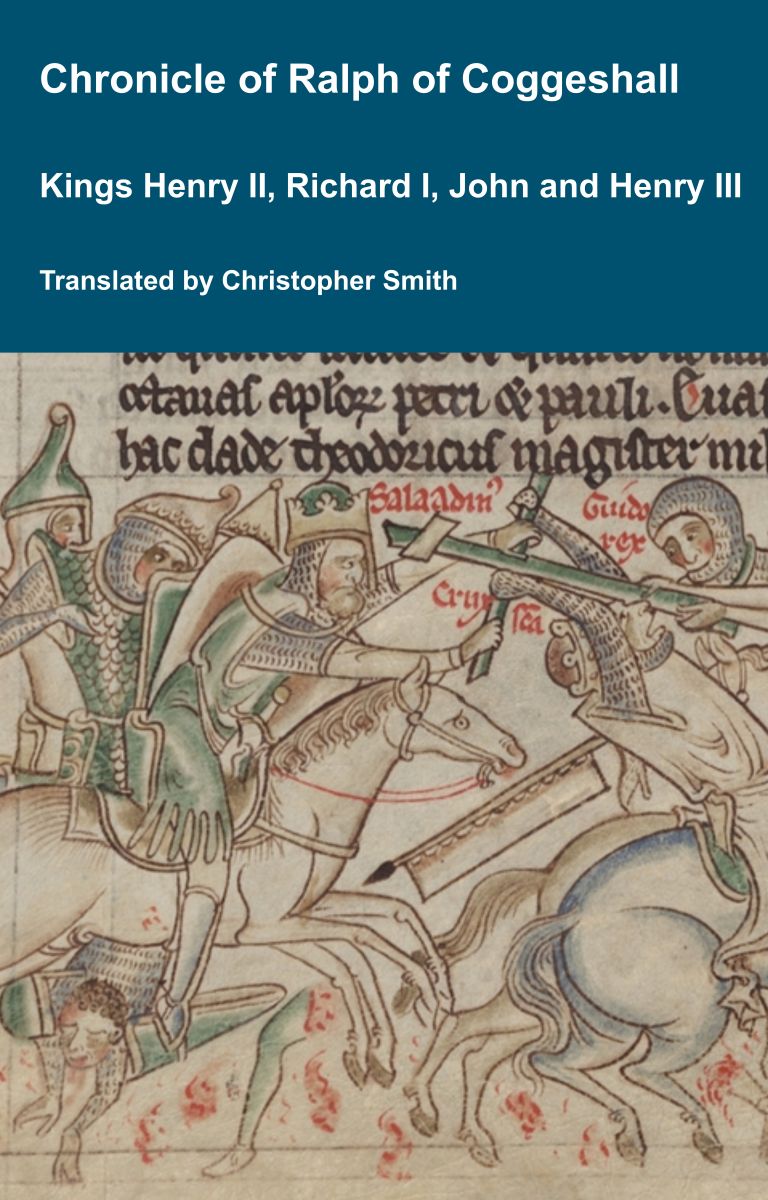
Chronicle of Abbot Ralph of Coggeshall
The Chronicle of Abbot Ralph of Coggeshall (Chronicon Anglicanum) is an indispensable medieval history that brings to life centuries of English and European affairs through the eyes of a learned Cistercian monk. Ralph of Coggeshall, abbot of the Abbey of Coggeshall in Essex in the early 13th century, continued and expanded his community’s chronicle, documenting events from the Norman Conquest of 1066 into the tumultuous reign of King Henry III. Blending eyewitness testimony, careful compilation, and the monastic commitment to record-keeping, this chronicle offers a rare narrative of political intrigue, royal power struggles, and social upheaval in England and beyond. Ralph’s work captures the reigns of pivotal figures such as Richard I and King John, providing invaluable insights into their characters, decisions, and the forces that shaped medieval rule. More than a simple annal, Chronicon Anglicanum conveys the texture of medieval life and governance, making it a rich source for scholars and readers fascinated by English history, monastic authorship, and the shaping of the medieval world.
Available at Amazon in eBook and Paperback format.
In 1705 Thomas Wyndham [aged 19] admitted at King's College, Cambridge University [Map].
In 1705 Francis Godolphin 2nd Earl Godolphin [aged 26] was awarded Master of Arts at King's College, Cambridge University [Map].


In 1709 Thomas Wyndham [aged 23] was awarded Bachelor of Arts at King's College, Cambridge University [Map].
In 1712 Thomas Wyndham [aged 26] was awarded Master of Arts: Cambridge University at King's College, Cambridge University [Map].
In 1771 George Lumley-Saunderson 5th Earl Scarborough [aged 17] was educated at King's College, Cambridge University [Map].

In 1773 Thomas Orde-Powlett 1st Baron Bolton [aged 32] graduated Master of Arts: Cambridge University at King's College, Cambridge University [Map].
In 1773 Philip Dormer Stanhope [aged 21] was expelled from King's College, Cambridge University [Map].
On 16th November 1781 Reverend Francis Hodgson was born to Reverend James Hodgson [aged 32] and Jane Coke [aged 27]. He was educated at Whitgift School, before proceeding to Eton College [Map] as a King's Scholar, and then as a Scholar to King's College, Cambridge University [Map]. He married (1) 1815 Susanna Matilda Tayler (2) 1838 Eliza Denman.
In 1782 John Lumley-Savile 7th Earl Scarborough [aged 21] graduated Master of Arts: Cambridge University at King's College, Cambridge University [Map].
On 17th January 1788 Bishop John Lonsdale was born to John Lonsdale [aged 51] and Elizabeth Steer. He was educated at Eton College [Map] and King's College, Cambridge University [Map]. He married November 1815 Sophia Bolland and had issue.
Jean de Waurin's Chronicle of England Volume 6 Books 3-6: The Wars of the Roses
Jean de Waurin was a French Chronicler, from the Artois region, who was born around 1400, and died around 1474. Waurin’s Chronicle of England, Volume 6, covering the period 1450 to 1471, from which we have selected and translated Chapters relating to the Wars of the Roses, provides a vivid, original, contemporary description of key events some of which he witnessed first-hand, some of which he was told by the key people involved with whom Waurin had a personal relationship.
Available at Amazon in eBook and Paperback format.
In 1806 Reverend Francis Hodgson [aged 24] was appointed Assistant Master at Eton College [Map] which position he resigned after a year to become a resident tutor and Fellow at King's College, Cambridge University [Map]. It was there that he met and formed a lifelong friendship with the poet Lord Byron [aged 17], who was at that time an undergraduate at Trinity College [Map]. Their friendship is recorded in the many letters between them that have been published in biographies of Byron.


In 1816 Reverend Robert Behoe Radcliffe [aged 18] entered King's College, Cambridge University [Map] graduating BA in 1821 and MA in 1826.
Between 1819 and 1829 Reverend Robert Behoe Radcliffe [aged 21] was a Fellow of King's College, Cambridge University [Map].
In 1839 Bishop John Lonsdale [aged 50] was appointed Principal of King's College, Cambridge University [Map].
Foxe's Book of Martyrs. After that Queen Mary, by public proclamation in the first year of her reign, had inhibited the sincere preaching of God's holy word, as is before declared, divers godly ministers of the word, which had the cure and charge of souls committed to them, did, notwithstanding, according to their bounden duty, feed their flock faithfully, not as preachers authorized by public authority, (as the godly order of the realm was in the happy days of blessed King Edward,) but as the private pastors of particular flocks; among whom Laurence Saunders was one, a man of worshipful parentage. His bringing up was in learning from his yonth, in places meet for that purpose, as namely in the school of Eton; from whence (according to the manner there used) he was chosen to go to the King's college in Cambridge [Map], where he continued scholar of the college three whole years, and there profited in knowledge and learning very much for that time. Shortly after that, he did forsake the university, and went to his parents, upon whose advice he minded to become a merchant, for that his mother, who was a gentlewoman of good estimation, being left a widow, and having a good portion for him among his other brethren, she thought to set him up wealthily; and so he, coming up to London, was bound apprentice with a merchant, named Sir William Chester, who afterward chanced to be sheriff of London the same year that Saunders was burned at Coventry. Thus, by the mind of his friends, Laurence should needs have been a merchant; but Almighty God, who hath his secret working in all things, saw better for his servant, as it fell out in the end. For although that Saunders was bound by fast indenture to play the merchant, yet the Lord so wrought inwardly in his heart, that he could find no liking in that vocation; so that when his other fellows were busily occupied about that kind of trade, he would secretly withdraw himself into some privy corner, and there fall into his solitary lamentations; as one not liking that kind and trade of life.
John Evelyn's Diary. 31st August 1654. Thence to Caius, and afterward to King's College [Map], where I found the chapel [Map] altogether answered expectation, especially the roof, all of stone, which for the flatness of its laying and carving may, I conceive, vie with any in Christendom. The contignation of the roof (which I went upon), weight, and artificial joining of the stones is admirable. The lights are also very fair. In one aisle lies the famous Dr. Collins, so celebrated for his fluency in the Latin tongue. From this roof we could descry Ely [Map], and the encampment of Sturbridge fair now beginning to set up their tents and booths; also Royston [Map], Newmarket, Suffolk, etc., houses belonging to the King. The library is too narrow.
Samuel Pepys' Diary. 15th July 1661. Up by three o'clock this morning, and rode to Cambridge, and was there by seven o'clock, where, after I was trimmed, I went to Christ College, and found my brother John [aged 20] at eight o'clock in bed, which vexed me. Then to King's College chappell [Map], where I found the scholars in their surplices at the service with the organs, which is a strange sight to what it used in my time to be here.

Samuel Pepys' Diary. 8th October 1667. And then to the garden, and there eat many grapes, and took some with us and so away thence, exceeding well satisfied, though not to that degree that, by my old esteem of the house, I ought and did expect to have done, the situation of it not pleasing me. Here we parted with Lowther [aged 26] and his friends, and away to Cambridge, it being foul, rainy weather, and there did take up at the Rose [Map], for the sake of Mrs. Dorothy Drawwater, the vintner's daughter, which is mentioned in the play of Sir Martin Marrall. Here we had a good chamber, and bespoke a good supper; and then I took my wife, and W. Hewer [aged 25], and Willet, it holding up a little, and shewed them Trinity College [Map] and St. John's Library [Map], and went to King's College Chapel [Map], to see the outside of it only; and so to our inne, and with much pleasure did this, they walking in their pretty morning gowns, very handsome, and I proud to find myself in condition to do this; and so home to our lodging, and there by and by, to supper, with much good sport, talking with the Drawers concerning matters of the town, and persons whom I remember, and so, after supper, to cards; and then to bed, lying, I in one bed, and my wife and girl in another, in the same room, and very merry talking together, and mightily pleased both of us with the girl. Saunders, the only violin in my time, is, I hear, dead of the plague in the late plague there.