

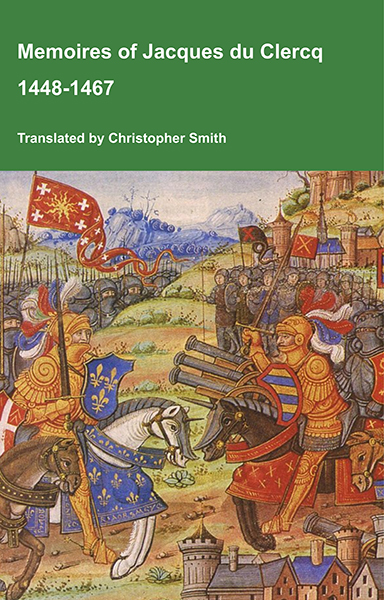
This is a translation of the 'Memoires of Jacques du Clercq', published in 1823 in two volumes, edited by Frederic, Baron de Reissenberg. In his introduction Reissenberg writes: 'Jacques du Clercq tells us that he was born in 1424, and that he was a licentiate in law and a counsellor to Philip the Good, Duke of Burgundy, in the castellany of Douai, Lille, and Orchies. It appears that he established his residence at Arras. In 1446, he married the daughter of Baldwin de la Lacherie, a gentleman who lived in Lille. We read in the fifth book of his Memoirs that his father, also named Jacques du Clercq, had married a lady of the Le Camelin family, from Compiègne. His ancestors, always attached to the counts of Flanders, had constantly served them, whether in their councils or in their armies.' The Memoires cover a period of nineteen years beginning in in 1448, ending in in 1467. It appears that the author had intended to extend the Memoirs beyond that date; no doubt illness or death prevented him from carrying out this plan. As Reissenberg writes the 'merit of this work lies in the simplicity of its narrative, in its tone of good faith, and in a certain air of frankness which naturally wins the reader’s confidence.' Du Clercq ranges from events of national and international importance, including events of the Wars of the Roses in England, to simple, everyday local events such as marriages, robberies, murders, trials and deaths, including that of his own father in Book 5; one of his last entries.
Available at Amazon in eBook and Paperback format.
King England Scotland and Ireland is in King.
1603 Death of Queen Elizabeth I Accession of James I
1626 English Coronation of Charles I
1685 Death and Burial of Charles II
1685 Coronation James II and Mary
1689 Coronation William III and Mary II
On 24th March 1603 Elizabeth I [aged 69] died at Richmond Palace [Map] around three in the morning. Her first cousin twice removed James [aged 36] succeeded I King England Scotland and Ireland.
Immediately following her death Robert Carey 1st Earl Monmouth [aged 43] started on horseback for Edinburgh to inform King James I of England and Ireland and VI of Scotland arriving at Holyrood Palace [Map] late on the 26 Mar 1603. His conduct met with general disapproval and merited censure as contrary to all decency, good manners and respect. George Carew and Thomas Lake [aged 35] were sent by the Council to formally inform James of her death.
On 25th July 1603 King James I of England and Ireland and VI of Scotland [aged 37] was crowned I King England Scotland and Ireland at Westminster Abbey [Map].
Charles Howard 1st Earl Nottingham [aged 67] was appointed Lord High Steward.
On 26th July 1603 Thomas Bennett [aged 60] and Thomas Cambell [aged 67] were knighted.
On 27th July 1603 William Wrey 1st Baronet was knighted at Whitehall Palace [Map].
On 30th July 1603 Richard Preston 1st Earl Desmond was knighted at Whitehall Palace [Map].
Bishop Thomas Bilson [aged 56] gave the sermon. While the wording conceded something to the divine right of kings, it also included a caveat about lawful resistance to a monarch.


On 27th March 1625 King James I of England and Ireland and VI of Scotland [aged 58] died at Theobalds House, Hertfordshire. His son Charles [aged 24] succeeded I King England Scotland and Ireland. Duke York merged with the Crown.


On 2nd February 1626 King Charles I of England, Scotland and Ireland [aged 25] was crowned I King England Scotland and Ireland at Westminster Abbey [Map] by Archbishop George Abbott [aged 63]. His wife Henrietta Maria [aged 16] was not crowned since she being Catholic refused to attend an Anglican service. She watched Charles at a discreet distance.
Robert Radclyffe 5th Earl of Sussex [aged 52] carried the Orb.
Francis Talbot 11th Earl of Shrewsbury [aged 3] bore the Second Sword of State.
Philip Herbert 4th Earl Pembroke 1st Earl Montgomery [aged 41] carried the Spurs.
Francis Manners 6th Earl of Rutland [aged 48] bore the Rod with the Dove.
William Cavendish 3rd Earl Devonshire [aged 8], James Stanley 7th Earl of Derby [aged 19], James Howard 3rd Earl Suffolk [aged 6], Roger Palmer [aged 49] and Mildmay Fane 2nd Earl of Westmoreland [aged 24], John Maynard [aged 34] were appointed Knight of the Bath.
John Rayney 1st Baronet [aged 25] was knighted.
On 29th May 1660, his thirtieth birthday, King Charles II of England Scotland and Ireland [aged 30] was restored II King England Scotland and Ireland.
John Evelyn 1st Baronet [aged 27] was created 1st Baronet Evelyn of Godstone. This is the first Baronetcy Charles II created following his Restoration indicating the high regard in which he held John Evelyn and the Evelyn family including John Evelyn [aged 39].


On 23rd April 1661 King Charles II of England Scotland and Ireland [aged 30] was crowned II King England Scotland and Ireland at Westminster Abbey [Map].
John Bennet 1st Baron Ossulston [aged 44], Francis Fane [aged 23] and Edward Hungerford [aged 28] was appointed Knight of the Bath.
Francis Godolphin [aged 55] was knighted.
Josceline Percy 11th Earl of Northumberland [aged 16] attended.
James Howard 3rd Earl Suffolk [aged 42] was appointed Earl Marshal.


On 6th February 1685 King Charles II of England Scotland and Ireland [aged 54] died around midday the morning at Whitehall Palace [Map] attended by Charles Scarburgh [aged 69]. His brother James [aged 51] succeeded II King England Scotland and Ireland. Duke York merged with the Crown. Mary of Modena Queen Consort England Scotland and Ireland [aged 26] by marriage Queen Consort England Scotland and Ireland. His brother King James II of England Scotland and Ireland, William Chiffinch [aged 83], Richard Mason [aged 52] and Archbishop William Sancroft [aged 68] were present.
The time of his death reported differtently by different contemporary sources: John Evelyn's Diary 'at halfe an houre after eleven in the morning', the Anonymous Letter to Reverend Roper: 'Yesterday noon', Ambassador Barillon's Account: 'and at noon, he died without any struggle or convulsion.' and Charl;es Scarburgh's Manuscript: 'He expired on February the Sixth soon after noon'.
According to Mark Bryant's book "Private Lives: Curious Facts about the Famous and Infamous' King Charles is supposed to have said the much repested phrase: "I am sorry, gentlemen, for being such a time a-dying." This doesn't appear to come from a contemporary source. Macaulay in his 'History of England', writing much later has "He apologised to those who had stood round him all night for the trouble which he had caused. He had been, he said, a most unconscionable time dying; but he hoped that they would excuse it." Perhaps the nearest we can find in a contemporary source is the Anonymous Letter to Reverend Roper: 'and beg the pardon of the standers by, and those that were employed about him, that he gave them so much trouble: that he hoped the work was almost over...'


On 23rd April 1685 King James II of England Scotland and Ireland [aged 51] was crowned II King England Scotland and Ireland by Archbishop William Sancroft [aged 68]. Mary of Modena Queen Consort England Scotland and Ireland [aged 26] crowned Queen Consort England Scotland and Ireland.
Bishop Francis Turner [aged 47] preached the sermon.
John Ashburnham 1st Baron Ashburnham [aged 29] carried the canopy being one of the Barons of the Cinque Ports at Westminster Abbey [Map].
Henry Fitzroy 1st Duke Grafton [aged 21] was appointed Constable of England.


On 23rd December 1688 King James II of England Scotland and Ireland [aged 55] left England for France effectively abdicating as King England Scotland and Ireland. In April 1689 Parliament made William and Mary joint monarchs; His daughter Mary [aged 26] succeeded II Queen England Scotland and Ireland. His nephew William [aged 38] succeeded III King England Scotland and Ireland.


On 11th April 1689 King William III of England, Scotland and Ireland [aged 38] and Mary Stewart II Queen England Scotland and Ireland [aged 26] were crowned II King England Scotland and Ireland at Westminster Abbey [Map].
John Ashburnham 1st Baron Ashburnham [aged 33] carried the canopy being one of the Barons of the Cinque Ports.
George Compton 4th Earl of Northampton [aged 24] bore the King's sceptre and cross at Westminster Abbey [Map].
On 8th March 1702 King William III of England, Scotland and Ireland [aged 51] died of Pneumonia at Kensington Palace. His demise was the direct result of a fall from his horse, named Sorrel, which stumbled on a molehill causing King William to fall and break his collarbone. For many years afterwards, Jacobites would raise their glasses and toast "the little gentleman in the black velvet waistcoat". His first cousin Anne [aged 37] succeeded I Queen England Scotland and Ireland. She, Anne, being the sister of his wife Mary Stewart II Queen England Scotland and Ireland.


On 23rd April 1702 Queen Anne of England Scotland and Ireland [aged 37] was crowned I Queen England Scotland and Ireland at Westminster Abbey [Map] by Archbishop Thomas Tenison [aged 65].