

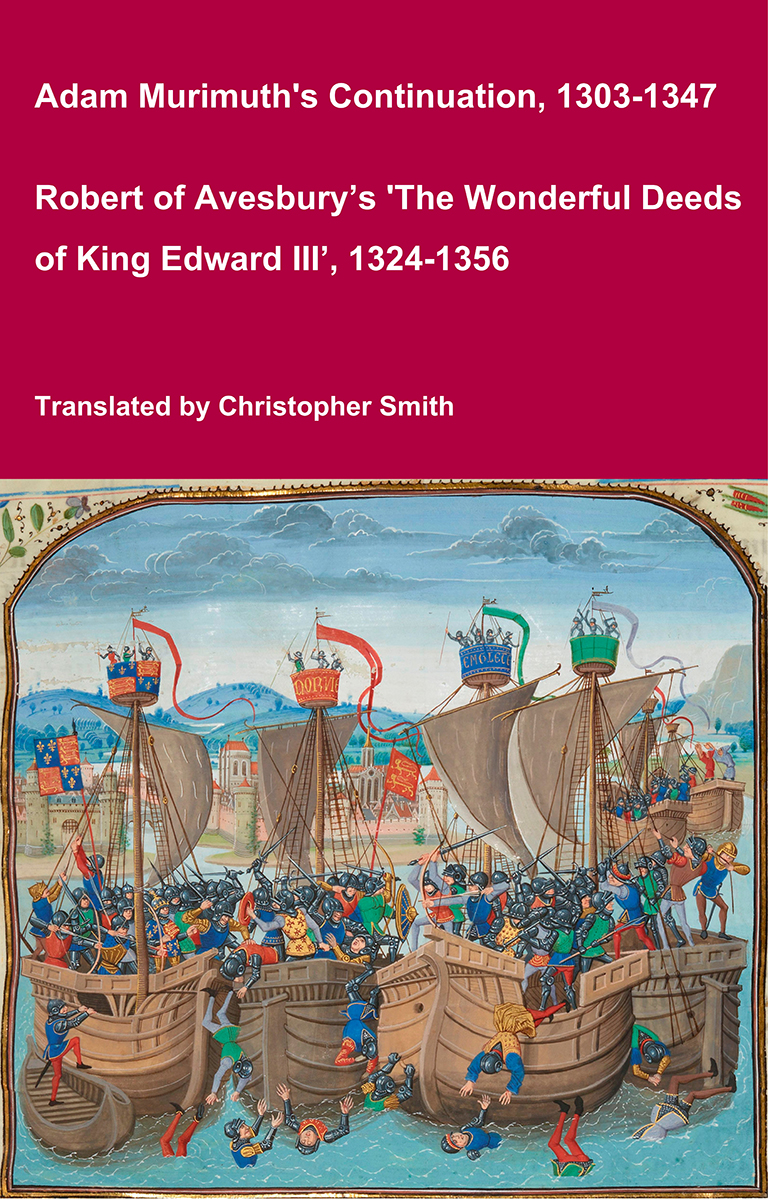
Adam Murimuth's Continuation and Robert of Avesbury’s 'The Wonderful Deeds of King Edward III'
This volume brings together two of the most important contemporary chronicles for the reign of Edward III and the opening phases of the Hundred Years’ War. Written in Latin by English clerical observers, these texts provide a vivid and authoritative window into the political, diplomatic, and military history of fourteenth-century England and its continental ambitions. Adam Murimuth Continuatio's Chronicarum continues an earlier chronicle into the mid-fourteenth century, offering concise but valuable notices on royal policy, foreign relations, and ecclesiastical affairs. Its annalistic structure makes it especially useful for establishing chronology and tracing the development of events year by year. Complementing it, Robert of Avesbury’s De gestis mirabilibus regis Edwardi tertii is a rich documentary chronicle preserving letters, treaties, and official records alongside narrative passages. It is an indispensable source for understanding Edward III’s claim to the French crown, the conduct of war, and the mechanisms of medieval diplomacy. Together, these works offer scholars, students, and enthusiasts a reliable and unembellished account of a transformative period in English and European history. Essential for anyone interested in medieval chronicles, the Hundred Years’ War, or the reign of Edward III.
Available at Amazon in eBook and Paperback format.
1600-1603 Essex Rebellion Elizabeth's Death is in 17th Century Events.
On 16th June 1600 Henry Somerset 1st Marquess Worcester [aged 23] and Anne Russell Countess Worcester [aged 22] were married. He the son of Edward Somerset 4th Earl of Worcester [aged 50] and Elizabeth Hastings Countess of Worcester [aged 54]. They were fifth cousins.
Mary Fitton [aged 21] led a Masque in celebration at the Blackfriars residence of Henry Brooke 11th Baron Cobham [aged 35] with Queen Elizabeth I of England and Ireland [aged 66] and William Herbert 3rd Earl Pembroke [aged 20] attending. She, Mary soon afterwards became the mistress of William Herbert 3rd Earl Pembroke and soon became pregnant.
On 2nd July 1600 the Battle of Nieuwpoort took place at Nieuwpoort in Flanders.
Charles Drury was killed.
On 28th November 1660, considered to be the official foundation date of the Royal Society, a meeting at Gresham College of 12 natural philosophers decided to commence a "Colledge for the Promoting of Physico-Mathematicall Experimentall Learning". Amongst those founders were Christopher Wren, Robert Boyle, John Wilkins, William Brouncker and Robert Moray.
On 5th August 1600. The Gowrie Conspiracy was an attempt by John Ruthven 3rd Earl Gowrie [aged 23] and his brother Alexander Ruthven [aged 20] to kill King James I [aged 34]. He, King James, had had their father William Ruthven 1st Earl Gowrie executed for his part in the Raid of Ruthven eighteen years earlier.
The attempt was botched. John Ruthven 3rd Earl Gowrie and Alexander Ruthven were killed, the former by John Ramsay 1st Earl Holderness [aged 20].
William Ruthven fled to France.
Patrick Ruthven was imprisoned for nineteen years at the Tower of London [Map].


On 23rd December 1600 the future King Charles I was baptised at Holyrood Palace [Map]. He was created Duke Albany.


On 25th December 1600 Alexander Livingston 1st Earl Linlithgow was created 1st Earl Linlithgow on the occasion of the Baptism of Prince Charles.
On 31st December 1600 Queen Elizabeth I of England and Ireland [aged 67] granted a Royal Charter to the Company of Merchants of London trading into the East Indies aka the East India Company led by George Clifford 3rd Earl of Cumberland [aged 42] by which they received a monopoloy on trade with the East Indies. Thomas Smythe [aged 42] was appointed first Governor of the East India Company.


General History of Voyages Volume 8 Chapter 10 Section 1 Preparation. Every thing being in readiness, the fleet departed from Woolwich, in the river Thames, on the 13th of February, 1600, after the English mode of reckoning, or more properly 1601. They were so long delayed in the Thames and the Downs, for want of wind, that it was Easter before they arrived at Dartmouth, where they spent, five or six days, taking in bread.and,other provisions, appointed to be procured there.
On 24th March 1603 Elizabeth I [aged 69] died at Richmond Palace [Map] around three in the morning. Her first cousin twice removed James [aged 36] succeeded I King England Scotland and Ireland.
Immediately following her death Robert Carey 1st Earl Monmouth [aged 43] started on horseback for Edinburgh to inform King James I of England and Ireland and VI of Scotland arriving at Holyrood Palace [Map] late on the 26 Mar 1603. His conduct met with general disapproval and merited censure as contrary to all decency, good manners and respect. George Carew and Thomas Lake [aged 35] were sent by the Council to formally inform James of her death.
Jean de Waurin's Chronicle of England Volume 6 Books 3-6: The Wars of the Roses
Jean de Waurin was a French Chronicler, from the Artois region, who was born around 1400, and died around 1474. Waurin’s Chronicle of England, Volume 6, covering the period 1450 to 1471, from which we have selected and translated Chapters relating to the Wars of the Roses, provides a vivid, original, contemporary description of key events some of which he witnessed first-hand, some of which he was told by the key people involved with whom Waurin had a personal relationship.
Available at Amazon in eBook and Paperback format.
Diary of Anne Clifford. 24th March 1603. The 20th [Note. A mistake for the 24th?] Mr Flocknall, my Aunt Warwick's [aged 55] man, brought us word from his Lady, that the Queen died about 2/3 o'clock in the morning.
This message was delivered to my Mother [aged 42] and me in the same chamber where afterwards I was married.
Note 1. I was at Queen Elizabeth's death thirteen years and two months old, and Mr Richard Sackville was fourteen years old, he being then at Dorset House with his grandfather and that great family.
At the death of this worthy Queen my mother and I lay at Austin Friars in the same chamber where afterwards I was married.

On 28th April 1603 Queen Elizabeth I of England and Ireland [deceased] was buried at Westminster Abbey [Map].
Helena Snakenbourg Marchioness Northampton [aged 54] was Chief Mourner in the procession since Arabella Stewart [aged 28] refused to take part. She was supported by Thomas Cecil 1st Earl Exeter [aged 60] and Charles Howard 1st Earl Nottingham [aged 67].
George Bourchier [aged 68] carried the Standard of the Dragon.
Philip Herbert 4th Earl Pembroke 1st Earl Montgomery [aged 18] carried the Standard of the Greyhound.
Thomas Somerset carried the Standard of the Lyon.
William Segar [aged 49] carried the Sword of State as Norrey King of Arms.
Admiral Richard Leveson [aged 33] was one of the six knights who carried the canopy.
George Bourchier: George Bourchier and Martha Howard were married. The difference in their ages was 20 years. He the son of John Bourchier 2nd Earl Bath and Eleanor Manners Countess Bath. They were fifth cousin once removed. He a great x 5 grandson of King Edward III of England. In 1535 he was born to John Bourchier 2nd Earl Bath and Eleanor Manners Countess Bath. In 1605 George Bourchier died.
Thomas Somerset: he was born to Henry Somerset 1st Marquess Worcester and Anne Russell Countess Worcester. On 30th December 1648 Thomas Somerset died at Dunkirk.