

The History of William Marshal was commissioned by his son shortly after William’s death in 1219 to celebrate the Marshal’s remarkable life; it is an authentic, contemporary voice. The manuscript was discovered in 1861 by French historian Paul Meyer. Meyer published the manuscript in its original Anglo-French in 1891 in two books. This book is a line by line translation of the first of Meyer’s books; lines 1-10152. Book 1 of the History begins in 1139 and ends in 1194. It describes the events of the Anarchy, the role of William’s father John, John’s marriages, William’s childhood, his role as a hostage at the siege of Newbury, his injury and imprisonment in Poitou where he met Eleanor of Aquitaine and his life as a knight errant. It continues with the accusation against him of an improper relationship with Margaret, wife of Henry the Young King, his exile, and return, the death of Henry the Young King, the rebellion of Richard, the future King Richard I, war with France, the death of King Henry II, and the capture of King Richard, and the rebellion of John, the future King John. It ends with the release of King Richard and the death of John Marshal.
Available at Amazon in eBook and Paperback format.
Garter Robes is in Garter Knights.
After 20th June 1560. Hasting's Chapel, St Helen's Church, Ashby-de-la-Zouch [Map]. Monument to Francis Hastings 2nd Earl Huntingdon [deceased] and Catherine Pole Countess Huntingdon [aged 49] by Richard Parker of Burton on Trent. Chest tomb with five sons on one side, five daughters on the other side, and eldest son on the end. Elizabethan Period. Leg Garter. Garter Robes. Widow's Barbe. Lancastrian Esses and Inter-twined Knots Collar. Feet resting on the Manticore badge of the Hasting's family.
Inscription: "Here lyeth ye corps of Francys late Erle of Hutyngdun, Lord Hastyngs, Hungerford, Botreaux, Molyns, and Moyles, Knight of ye honorable order of ye Garter, which deceased ye XXth daye of June ao Dni 1561: and ye ladie Katheryn, Countisse of Hutyngdon his wife, which deceased ye XXIIId daye of Sepbr anno dni 1576". Moved at least twice. Some restoration.


In 1611 Robert "The Elder" Peake [aged 60]. Portrait of King Charles I of England, Scotland and Ireland [aged 10] in his Garter Robes and Leg Garter.

Around 1615 Unknown Painter. Posthumous portrait of Philip Herbert 4th Earl Pembroke 1st Earl Montgomery [aged 30] wearing his Garter Robes and Garter Collar.

In 1616 William Larkin [aged 34]. Portrait of George Villiers 1st Duke of Buckingham [aged 23] wearing his Garter Robes and Leg Garter.

Before 1619 Robert "The Elder" Peake [aged 67]. Portrait of Henry Frederick Stewart Prince of Wales in his Garter Robes and Leg Garter.

Around 1639 Anthony Van Dyck [aged 39]. Portrait of Henry Danvers 1st Earl Danby [aged 65] in his Garter Robes.

Samuel Pepys' Diary. 9th October 1660. This morning Sir W. Batten [aged 59] with Colonel Birch [aged 45] to Deptford, to pay off two ships. Sir W. Pen [aged 39] and I staid to do business, and afterwards together to White Hall, where I went to my Lord, and found him in bed not well, and saw in his chamber his picture1, very well done; and am with child2 till I get it copied out, which I hope to do when he is gone to sea.
Note 1. Peter Lely [aged 42]. Portrait of Edward Montagu 1st Earl Sandwich [aged 35] in his Garter Robes and Garter Collar.
Note 2. A figurative expression for an eager longing desire, used by Udall and by Spenser. The latest authority given by Dr. Murray in the "New English Dictionary", is Bailey in 1725.

Around 1661 Peter Lely [aged 42]. Portrait of Charles Stewart 6th Duke Lennox in his Garter Robes and Garter Collar.

Around 1665 John Greenhill [aged 21]. Portrait of King Charles II of England Scotland and Ireland [aged 34] in his Garter Robes.
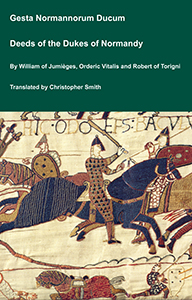
The Deeds of the Dukes of Normandy
The Gesta Normannorum Ducum [The Deeds of the Dukes of Normandy] is a landmark medieval chronicle tracing the rise and fall of the Norman dynasty from its early roots through the pivotal events surrounding the Norman Conquest of England. Originally penned in Latin by the monk William of Jumièges shortly before 1060 and later expanded at the behest of William the Conqueror, the work chronicles the deeds, politics, battles, and leadership of the Norman dukes, especially William’s own claim to the English throne. The narrative combines earlier historical sources with firsthand information and oral testimony to present an authoritative account of Normandy’s transformation from a Viking settlement into one of medieval Europe’s most powerful realms. William’s history emphasizes the legitimacy, military prowess, and governance of the Norman line, framing their expansion, including the conquest of England, as both divinely sanctioned and noble in purpose. Later chroniclers such as Orderic Vitalis and Robert of Torigni continued the history, extending the coverage into the 12th century, providing broader context on ducal rule and its impact. Today this classic work remains a foundational source for understanding Norman identity, medieval statesmanship, and the historical forces that reshaped England and Western Europe between 800AD and 1100AD.
Available at Amazon in eBook and Paperback format.

Before 3rd January 1670 Peter Lely [aged 51]. Portrait of George Monck 1st Duke Albemarle [aged 61] in his Garter Robes.

Around 1673 Peter Lely [aged 54]. Portrait of Charles II King Scotland in his Garter Robes and Garter Collar.

Before 4th January 1674 Peter Lely [aged 55]. Portrait of King James II of England Scotland and Ireland [aged 40] wearing his Garter Robes.

Around 1676 Peter Lely [aged 57]. Portrait of Henry Bennet 1st Earl Arlington [aged 58] wearing his Garter Robes.

Around 1678 Peter Lely [aged 59]. Portrait of Charles II King Scotland in his Garter Robes and Garter Collar and Leg Garter.

Around 1678 Peter Lely [aged 59]. Portrait of James Butler 1st Duke Ormonde [aged 67] in his Garter Robes.

Before 7th December 1680 Peter Lely [aged 62]. Portrait of John Maitland 1st Duke Lauderdale [aged 64] wearing his Garter Robes.

Around 1686 Willem Wissing [aged 30]. Portrait of Lawrence Hyde 1st Earl Rochester [aged 43] wearing his Garter Robes including the Garter Collar and holding his white Lord Treasurer Staff of Office.

Around 1720 Charles Jervas [aged 45]. Portrait of Thomas Pelham Holles 1st Duke Newcastle-under-Lyne [aged 26] in his Garter Robes.

In 1721 Charles Jervas [aged 46]. Portrait of John Manners 2nd Duke Rutland [aged 44] in his Garter Robes.

In 1730 John Vanderbank [aged 35]. Portrait of Philip Stanhope 4th Earl Chesterfield [aged 35] in his Garter Robes
William of Worcester's Chronicle of England
William of Worcester, born around 1415, and died around 1482 was secretary to John Fastolf, the renowned soldier of the Hundred Years War, during which time he collected documents, letters, and wrote a record of events. Following their return to England in 1440 William was witness to major events. Twice in his chronicle he uses the first person: 1. when writing about the murder of Thomas, 7th Baron Scales, in 1460, he writes '… and I saw him lying naked in the cemetery near the porch of the church of St. Mary Overie in Southwark …' and 2. describing King Edward IV's entry into London in 1461 he writes '… proclaimed that all the people themselves were to recognize and acknowledge Edward as king. I was present and heard this, and immediately went down with them into the city'. William’s Chronicle is rich in detail. It is the source of much information about the Wars of the Roses, including the term 'Diabolical Marriage' to describe the marriage of Queen Elizabeth Woodville’s brother John’s marriage to Katherine, Dowager Duchess of Norfolk, he aged twenty, she sixty-five or more, and the story about a paper crown being placed in mockery on the severed head of Richard, 3rd Duke of York.
Available at Amazon in eBook and Paperback format.

In 1756 Joshua Reynolds [aged 32]. Portrait of Henry Fitzroy 1st Duke Grafton in his Garter Robes.

Before 25th October 1760 George Knapton [aged 62]. Portrait.of King George II of Great Britain and Ireland [aged 76] wearing his Garter Robes.

In 1773 Joshua Reynolds [aged 49]. Portrait of Richard Coote 1st Earl Bellomont in his Garter Robes.

In 1773 Joshua Reynolds [aged 49]. Portrait of John Stuart 3rd Earl Bute [aged 59] in his Garter Robes.

In 1807 John Hoppner [aged 48]. Portrait of King George IV of Great Britain and Ireland [aged 44] in his Garter Robes and Leg Garter.
After 18th November 1834. St Andrew's Church, Wimpole [Map]. Monument to Philip Yorke 3rd Earl of Hardwicke [deceased].
Altar tomb with shaped ends and recumbent effigy in Garter robes with Leg Garter, all in white marble; the ends of the tomb chest are carved with arms and heraldic emblems; signed 'R. WESTMACOTT, JUNR, A.R.A. [aged 35] 1844'.


