

Death of King Richard II is in 1400-1414 Epiphany Rising and Rebellions Against Henry IV.
On 14th February 1400 (exact date not known) King Richard II [aged 33] died at Pontefract Castle [Map] where he had been imprisoned three months before; possibly murdered, possibly starved to death. His death was a consequence of the Epiphany Rising; he was still considered a threat.
Edmund Mortimer 5th Earl March 7th Earl of Ulster [aged 8] de jure Heir to the Throne of England since he was descended from Philippa Plantagenet Countess March 2nd Countess Ulster the daughter of Lionel of Antwerp 1st Duke of Clarence. The new King Henry IV [aged 32] ignored his claim. Edmund Mortimer 5th Earl March 7th Earl of Ulster and his brother Roger Mortimer [aged 6] were imprisoned in Windsor and Berkhamstead castles respectively; they were treated well.
On 17th February 1400 Richard's corpse was displayed at St Paul's Cathedral [Map].
On 6th March 1400 Richard's remains were buried at King's Langley Priory, Hertfordshire [Map].

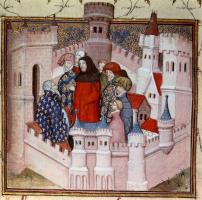


The Annals Yorkshire by John Mayall. 1399. The unfortunate Richard II, was confined some time in Leeds castle, till his removal to Pontefract, where he was murdered in cold blood, or starved to death, within the fatal walls of the fortress there, which was so often the scene of the foulest deeds of cruelty. In Hardynge's chronicle, the circumstance is thus noticed:
"The kyng then sent kyng Richard to Ledis
There to be kept surely in privitee;
Fro thens after to Pyckering went he needis,
And to Knaresbro' after led was he;
But to Pomfret last where he did dee.
The fate of Richard II. has been described as follows: "One Sir Piers, of Exton, departing from court, came to Pomfret, commanding that the esquire who was used to serve Richard should let him eat well know, as not long would he eat. King Richard sat down to dinner, and was. served without curtesie or assay, when he, marvelling at the sudden change, demanded of the esquire, why he did not do his duty? Sir, said he, I am otherwise commanded by Sir Piers of Exton, who is newly come from King Henry; when he heard that word he took the carving-knife in his hand, and struck the esquire on his head, saying, "The devil take thee, and Henry of Lancaster together," and with that word, Sir Piers entered into the chamber, well armed, with eight tall men in harness; every man having a bill in his hand. King Richard, perceiving them armed, knew well that they came to his confusion, and, putting the table from him, valiantly took the bill out of the first man's hand, and manfully defended himself, slaying four of them in a short space of time. Sir Piers, dismayed, leaped into Richard's chair, the other four assailing and chasing him about the chamber, till he came by the knight, who, with a stroke of his pole-axe felled him to the ground, after which he was shortly rid out of the world, without either confession or receipt of sacrament."
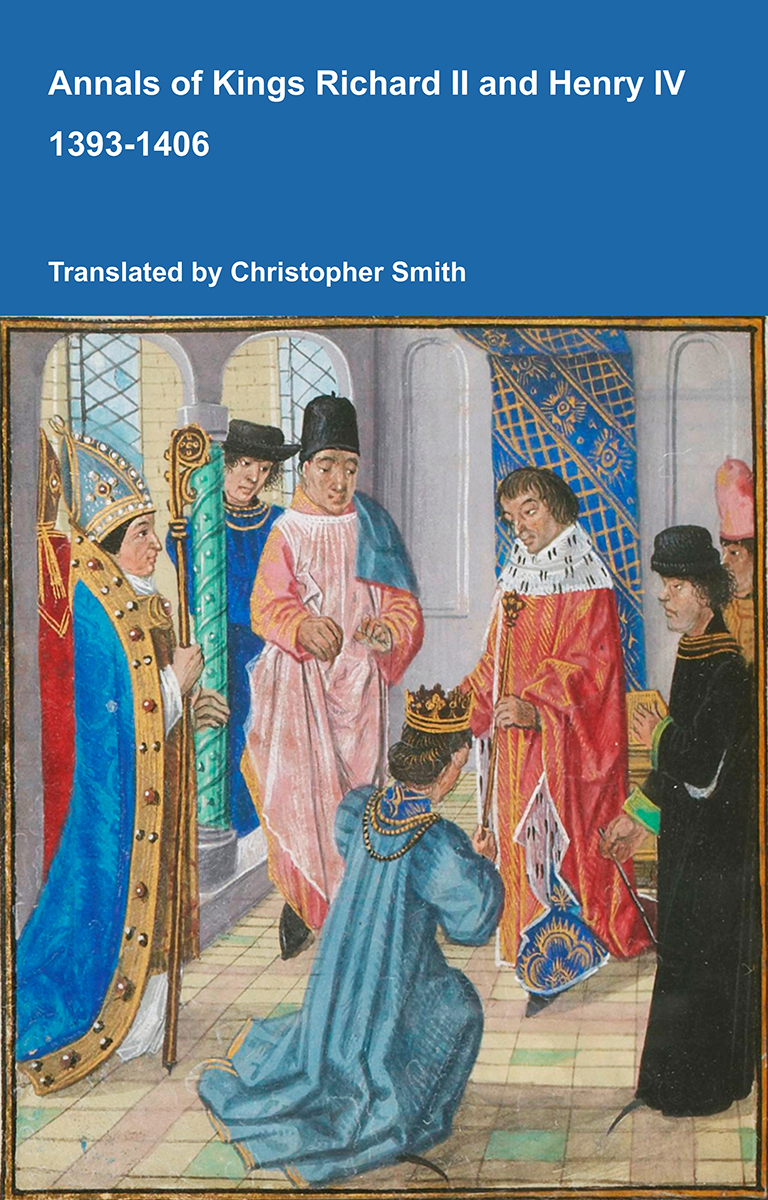 Annals of Kings Richard II and Henry IV. Richard [aged 33], formerly King of England, being held in custody in Pontefract Castle [Map], when he heard of the misfortune that had happened to his brother, John Holland, and to the others, is said to have been plunged into such grief that he wished to kill himself by starvation. He is said to have abstained to such an extent that, when the opening of his stomach had closed, and afterwards, by the counsel of friends, he wished to satisfy nature by eating, his appetite being entirely shut off, he was unable to eat. And so it came about that, his nature weakened, he failed, and on Saint Valentine’s Day [14th February 1400] he ended his last day at the aforesaid castle. His body was carried and displayed through the most celebrated places lying between the said castle and London, namely in those places where it spent the night. At least that part of the body by which it could be recognised was shown, namely from the lower part of the forehead down to the throat. At last, when it had come to St Albans and had spent the night there, the solemn Office of the Dead was performed for his soul by the convent. In the morning, after Mass had been celebrated by the abbot, it was carried to London, to the church of St Paul, where the king was present at the funeral rites on the first day, and on the following day with certain nobles of the realm and citizens of London. And soon, when Mass had been completed, the body was brought back to Langley to be buried among the friars, and it reached the aforesaid place in the dark of night. Immediately messengers were sent on the king’s behalf to the Abbot of St Albans, to warn the abbot, on the king’s behalf, that on the following day, very early in the morning, he should hasten to the place, where, together with the Bishop of Chester and the Abbot of Waltham, he was to be present at the final royal funeral rites. And so it was done. Thus, without pomp, without anything more, the royal body was committed to burial.
Ricardus, quondam Rex Angliæ, constitutus sub custodia in Castro de Ponte Fracto, cum audisset infortunium quod contigerat fratri suo, Johanni Holand, et cæteris, in tantam, ut fertur, demersus est tristitiam, quod semetipsum inedia voluit peremisse. In tantum dicitur abstinuisse, quod, clauso orificio stomachi, cum expost, consilio amicorum, voluisset naturæ satisfecisse comedendo, præcluso omnino appetitu, comedere non valeret; ut factum est, ut, debilitata natura, deficeret, et die Sancti Valentini diem supremum clauderet, apud castrum præfatum. Cujus corpus per loca celeberrima quæ interjacent, a dicto castellà usque Londonias, deportatum fuit, et ostensum; in hiis, videlicet, locis ubi pernoctavit; ea pars saltem corporis per quod cognosci poterat, scilicet, ab ima parte frontis usque ad guttur. Tandem, cum ventum fuisset ad Sanctäüm Albanum, et, [dum] ibi pernoctasset, factum fuisset Officium solemne Mortuorum pro ejus anima a Conventu, mane celebrata Missa per Abbatem, deportatum est Londonias, ad ecclesiam Sancti Pauli, ubi Rex affuit exequiis primo die; et in crastino, cum quibusdam regni nobilibus et civibus Londoniarum. Et mox expleta Missa, corpus reducitur ad Langleye, inter Fratres tumulandum; pervenitque cæca nocte ad præfatum locum. Et mox missi sunt nuncii de parte Regis ad Abbatem Sancti Albani, qui monerent Abbatem, ex parte Regis, ut in crastimo, summo mane, maturaret ad locum, ubi, cum Episcopo Cestrensi et Abbate Waltham, supremis regiis funeralibus interesset. Et factum est ita; sicque sine pompa, sine pluri, traditum fuit corpus regium sepulturæ.
Pakington's Chronicle [-1390]. [March 1400] Richard late Kinge first prisonid in the Tour of London, after yn the Castel of Leedes, and lafte yn Pontfractle.
Pakington's Chronicle [-1390]. [March 1400] King Richard died for Hungre in Pontfract Caftel [Map], after brought to S. Paules in London, and buried at Langeley.
Chronicle of John Benet. March 1400. In the beginning of March, King Richard died, having reigned for twenty-two years. He was buried at Langley, but later, his remains were transferred to Westminster by King Henry V.
... et in principio mensis Marcii defunctus est rex Ricardus cum regnasset XXII annis et sepultus apud Langeley et postea translata fuerunt ossa eius in Westimonasterium per Henricum regem quintum a conquestu.