Pontefract Castle, South Yorkshire, England, British Isles [Map]

Pontefract Castle is in Pontefract [Map], Castles in South Yorkshire.

In 1068 Ilbert Lacy 1st Baron Pontefract [aged 23] was created 1st Baron Pontefract. Both he and the creation of the Barony are obscure. He commissioned the building of Pontefract Castle [Map] which became his caput.

On 22nd March 1322 Thomas Plantagenet 2nd Earl of Leicester, 2nd Earl Lancaster, Earl of Salisbury and Lincoln [aged 44] was beheaded at Pontefract Castle [Map] following his capture six days before at the Battle of Boroughbridge. He was buried at Pontefract Priory [Map]. Earl of Leicester, Earl Lancaster forfeit.

Chronicle of Adam of Usk [~1352-1430]. 15th June 1381. In this rising of the commons were many great men of the land in many places beheaded. The Savoy [Map], the palace of the duke of Lancaster [aged 41] and the fairest in the kingdom, standing near London on the bank of Thames, was, from the commons' hatred of the duke, utterly destroyed by them with fire; and the duke himself, for fear of them, fled into Scotland1. To appease them and to quiet their fury, the king [aged 14] granted that the state of villeinage, as well in their persons as in their labour, should be henceforth done away, freedom fully given, and all prisoners set at large. And this he commanded and made to be openly proclaimed throughout the counties of the kingdom. And then what a throe of grief passed through the desolated land! For they boasted that they would slay all those of higher birth, would raise up king and lords from among themselves, would stablish new laws, and, in a word, would make new, or rather - disfigure, the face and estate of the whole island. Then every man struck off the head of his enemy, and despoiled his richer neighbour. But, by the mercy of God, when their leader, being in Smithfield near London, doffed not his hood before the king nor in anything did reverence to the king's majesty, his head was deftly struck off, in the very midst of his flock of kites, by sir William Walworth, knight and citizen of London; and straightway, being raised on the point of a sword, it was shown before them. Then the commons in sore dread sought flight by stealth, and there and then casting away their rebellious weapons, as though unguilty of such riot and wickedness, like foxes into their holes, they pitifully crept home. But the king and the lords pursued them, and some they made to be dragged behind horses, some they slew with the sword, some they hanged on the gallows, some they quartered; and they destroyed thousands2.

Note 1. John of Gaunt was at this time in the north, negotiating a truce with Scotland. Knighton (ij. 143-7) tells us that so unpopular was his name that his duchess was refused admission into his own castle at Pontefract [Map], and that he himself was denied hospitality by the earl of Northumberland; and that it was reported that a large force of the insurgents was sent north in pursuit of him. He retired to Edinburgh on a safe-conduct from the Scots, by whom he was well entertained.

Note 2. The severity of the punishments inflicted after the suppression of the outbreak is fully set forth in the pages of Walsingham's History. Richard, however, interfered to prevent indiscriminate slaughter of the insurgents when first beaten in the field.— Wals. Hist. Angl. (Rolls series), i. 466.

Before June 1396 John Savile of Shelley and Golcar [aged 71] was appointed Constable of Pontefract Castle.

In 1399 Robert Waterton [aged 39] was appointed Constable of Pontefract Castle. In January 1400 he was given custody of King Richard II of England [aged 31] who died shortly thereafter.

Chronicle of John Benet. 19th August 1399. Afterward, he advanced to Flint Castle, where he captured King Richard and led him first to Chester, then to Coventry, Northampton, and finally to London, where he imprisoned him in the Tower. The Duke Henry then held a parliament in London and was crowned King Henry on the feast of Saint Edward, King and Confessor. Before Christmas, King Richard was placed in Pontefract Castle [Map].

... et postea transivit ad castellum de Flynt et in eo cepit regem Ricardum et duxit illum in Cestriam et ad Coventriam et Norhamptonam et sic Londonias et posuit illum in Turri, et tenuit Dux Henricus parliamentum apud Lundon' et coronatus fuit Henricus in regem in die sancti Edwardi regis et confessoris, et ante Natale positus est rex Ricardus in castro de Pontefracto;

On 14th February 1400 (exact date not known) King Richard II [aged 33] died at Pontefract Castle [Map] where he had been imprisoned three months before; possibly murdered, possibly starved to death. His death was a consequence of the Epiphany Rising; he was still considered a threat.

Edmund Mortimer 5th Earl March 7th Earl of Ulster [aged 8] de jure Heir to the Throne of England since he was descended from Philippa Plantagenet Countess March 2nd Countess Ulster the daughter of Lionel of Antwerp 1st Duke of Clarence. The new King Henry IV [aged 32] ignored his claim. Edmund Mortimer 5th Earl March 7th Earl of Ulster and his brother Roger Mortimer [aged 6] were imprisoned in Windsor and Berkhamstead castles respectively; they were treated well.

On 17th February 1400 Richard's corpse was displayed at St Paul's Cathedral [Map].

On 6th March 1400 Richard's remains were buried at King's Langley Priory, Hertfordshire [Map].

Annals of Kings Richard II and Henry IV. Richard [aged 33], formerly King of England, being held in custody in Pontefract Castle [Map], when he heard of the misfortune that had happened to his brother, John Holland, and to the others, is said to have been plunged into such grief that he wished to kill himself by starvation. He is said to have abstained to such an extent that, when the opening of his stomach had closed, and afterwards, by the counsel of friends, he wished to satisfy nature by eating, his appetite being entirely shut off, he was unable to eat. And so it came about that, his nature weakened, he failed, and on Saint Valentine’s Day [14th February 1400] he ended his last day at the aforesaid castle. His body was carried and displayed through the most celebrated places lying between the said castle and London, namely in those places where it spent the night. At least that part of the body by which it could be recognised was shown, namely from the lower part of the forehead down to the throat. At last, when it had come to St Albans and had spent the night there, the solemn Office of the Dead was performed for his soul by the convent. In the morning, after Mass had been celebrated by the abbot, it was carried to London, to the church of St Paul, where the king was present at the funeral rites on the first day, and on the following day with certain nobles of the realm and citizens of London. And soon, when Mass had been completed, the body was brought back to Langley to be buried among the friars, and it reached the aforesaid place in the dark of night. Immediately messengers were sent on the king’s behalf to the Abbot of St Albans, to warn the abbot, on the king’s behalf, that on the following day, very early in the morning, he should hasten to the place, where, together with the Bishop of Chester and the Abbot of Waltham, he was to be present at the final royal funeral rites. And so it was done. Thus, without pomp, without anything more, the royal body was committed to burial.

Ricardus, quondam Rex Angliæ, constitutus sub custodia in Castro de Ponte Fracto, cum audisset infortunium quod contigerat fratri suo, Johanni Holand, et cæteris, in tantam, ut fertur, demersus est tristitiam, quod semetipsum inedia voluit peremisse. In tantum dicitur abstinuisse, quod, clauso orificio stomachi, cum expost, consilio amicorum, voluisset naturæ satisfecisse comedendo, præcluso omnino appetitu, comedere non valeret; ut factum est, ut, debilitata natura, deficeret, et die Sancti Valentini diem supremum clauderet, apud castrum præfatum. Cujus corpus per loca celeberrima quæ interjacent, a dicto castellà usque Londonias, deportatum fuit, et ostensum; in hiis, videlicet, locis ubi pernoctavit; ea pars saltem corporis per quod cognosci poterat, scilicet, ab ima parte frontis usque ad guttur. Tandem, cum ventum fuisset ad Sanctäüm Albanum, et, [dum] ibi pernoctasset, factum fuisset Officium solemne Mortuorum pro ejus anima a Conventu, mane celebrata Missa per Abbatem, deportatum est Londonias, ad ecclesiam Sancti Pauli, ubi Rex affuit exequiis primo die; et in crastino, cum quibusdam regni nobilibus et civibus Londoniarum. Et mox expleta Missa, corpus reducitur ad Langleye, inter Fratres tumulandum; pervenitque cæca nocte ad præfatum locum. Et mox missi sunt nuncii de parte Regis ad Abbatem Sancti Albani, qui monerent Abbatem, ex parte Regis, ut in crastimo, summo mane, maturaret ad locum, ubi, cum Episcopo Cestrensi et Abbate Waltham, supremis regiis funeralibus interesset. Et factum est ita; sicque sine pompa, sine pluri, traditum fuit corpus regium sepulturæ.

Pakington's Chronicle [-1390]. [March 1400] King Richard died for Hungre in Pontfract Caftel [Map], after brought to S. Paules in London, and buried at Langeley.

On 29th May 1405 Archbishop Richard Scrope [aged 55] and Thomas Mowbray 4th Earl Norfolk 2nd Earl Nottingham [aged 19] were arrested and taken to Pontefract Castle [Map].

After 25th October 1415 Charles Valois Duke Orléans [aged 20] was imprisoned at Sterborough Castle [Map] then Pontefract Castle [Map].

In 1427 Malise Graham 3rd Earl Strathearn 1st Earl Menteith [aged 20] was imprisoned at Pontefract Castle [Map] as a hostage for King James I of Scotland [aged 32]. He wasn't released until 1453.

Chronicle of Gregory. Around July 1464. Alle so the same somer my Lord of Warwycke [aged 35] and his brether the Lord Mountegewe [aged 33], that was made Erle of Northehumberlond by the King, they ij layde a sege unto the castelle of Anwyke [Map] a gate it by a-poyntement. And in the same wyse and forme they gate the castelle of Dunsterborowe [Map] by the same mene. And thenne they layd sege to the castelle of Bamborowe [Map], and layde grete ordynans and gonnys [Note. guns] there too. And manly they gate it by fors, and toke there yn that fals traytur Syr Raffe Gray [aged 32], and brought him unto the King to the castelle of Pomfrete [Map]. And fro thens he was ladde to Dankester [Map], and there his hedde was smete of and sent to London, and it was sette a-pon Londyn Bryge [Map].

On 25th June 1483 supporters of the Woodvilles were executed at Pontefract Castle [Map]..

Anthony Woodville 2nd Earl Rivers [aged 43] was beheaded. His brother Richard [aged 30] succeeded 3rd Earl Rivers, 3rd Baron Rivers.

Richard Grey [aged 26] and Thomas Vaughan [aged 73] were beheaded.

Pontefract Castle [Map]. 1648.

Chronicle of a Bourgeois of Valenciennes

Récits d’un bourgeois de Valenciennes aka The Chronicle of a Bourgeois of Valenciennes is a vivid 14th-century vernacular chronicle written by an anonymous urban chronicler from Valenciennes in the County of Hainaut. It survives in a manuscript that describes local and regional history from about 1253 to 1366, blending chronology, narrative episodes, and eyewitness-style accounts of political, military, and social events in medieval France, Flanders, and the Low Countries. The work begins with a chronological framework of events affecting Valenciennes and its region under rulers such as King Philip VI of France and the shifting allegiances of local nobility. It includes accounts of conflicts, sieges, diplomatic manoeuvres, and the impact of broader struggles like the Hundred Years’ War on urban life in Hainaut. Written from the perspective of a burgher (bourgeois) rather than a monastery or royal court, the chronicle offers a rare lay viewpoint on high politics and warfare, reflecting how merchants, townspeople, and civic institutions experienced the turbulence of the 13th and 14th centuries. Its narrative style combines straightforward reporting of events with moral and civic observations, making it a valuable source for readers interested in medieval urban society, regional politics, and the lived experience of war and governance in pre-modern Europe.

Available at Amazon in eBook and Paperback format.

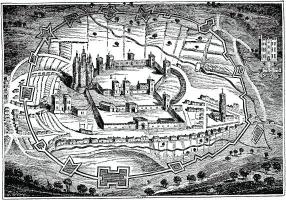
Vesta Monumenta. 1734. Plate 1.42. Pontefract Castle [Map]. Engraving by George [aged 50] Vertue after a drawing originally produced for a survey of the properties of the Duchy of Lancaster conducted by the Chancellor of the Duchy, Ambrose Cave, in 1561.